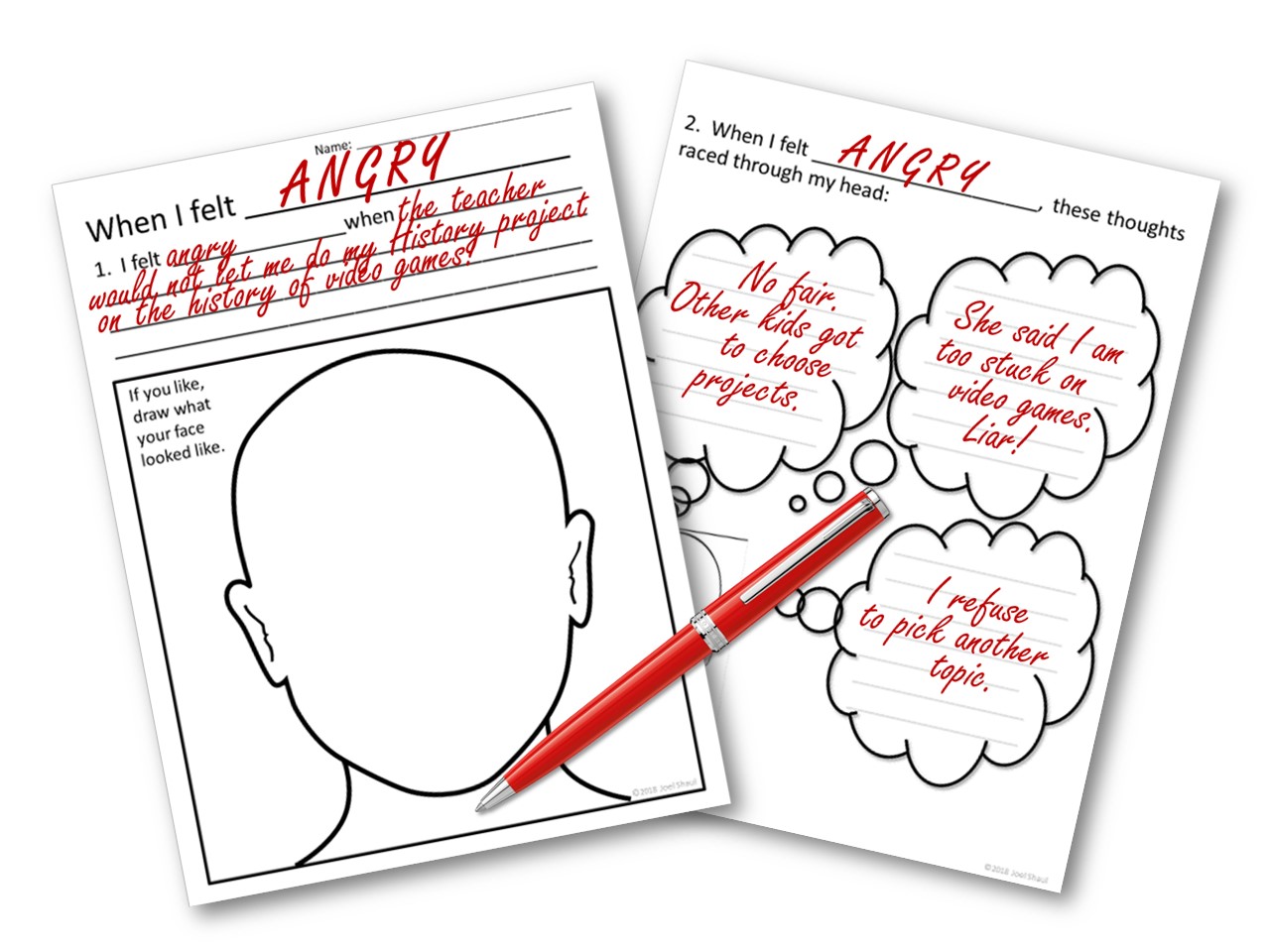
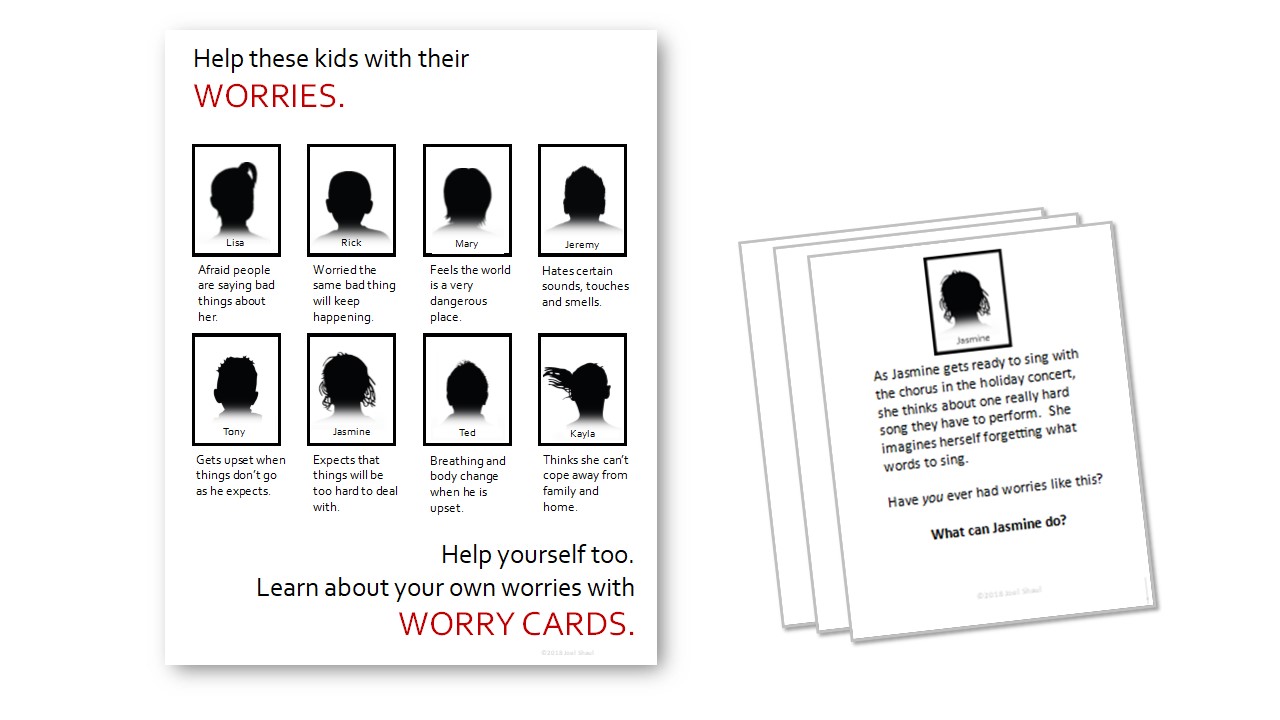
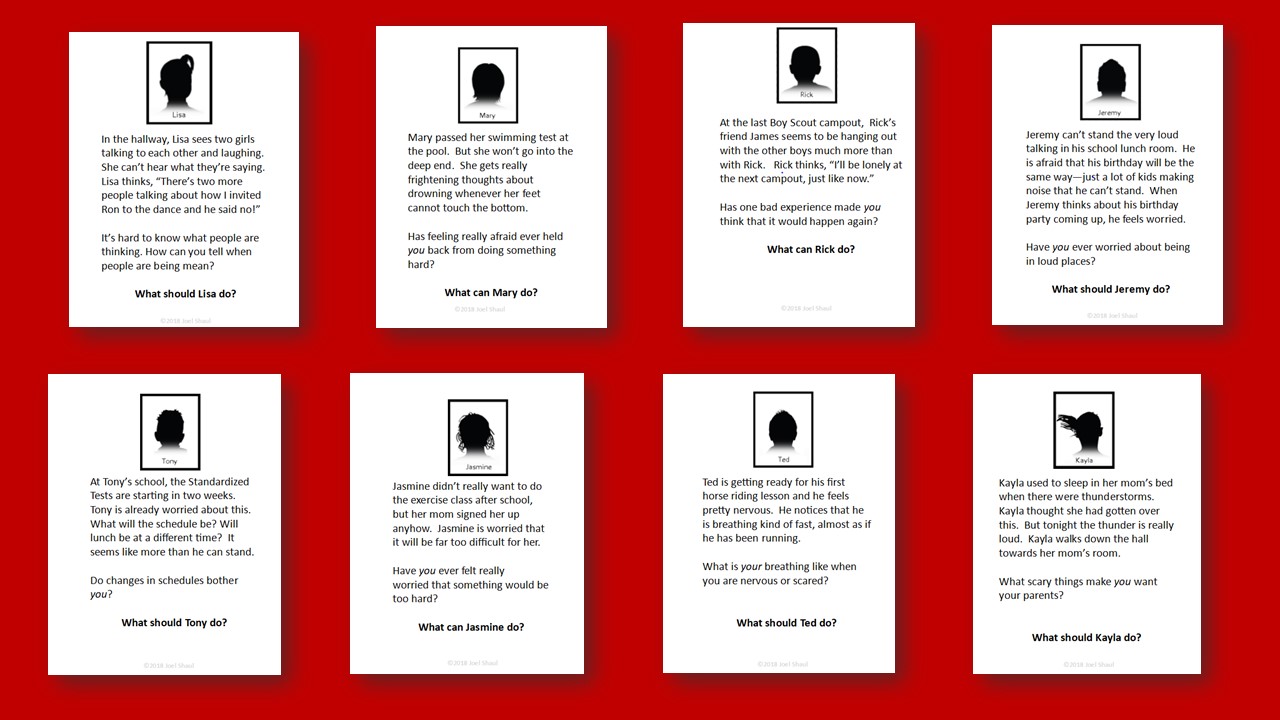
Cognitive Behavioral Therapy for anger and other upsetting emotions.
Click HERE to access these CBT worksheets.


Social Skills Activities for Children with Autism
AutismTeachingStrategies.com
Ideas, tips, lessons, strategies for teaching emotional awareness and emotional regulation skills to children and youth with Asperger’s or other autism spectrum disorders.
Your comments on these resources are most welcome, and often helpful. Click HERE to send an email.

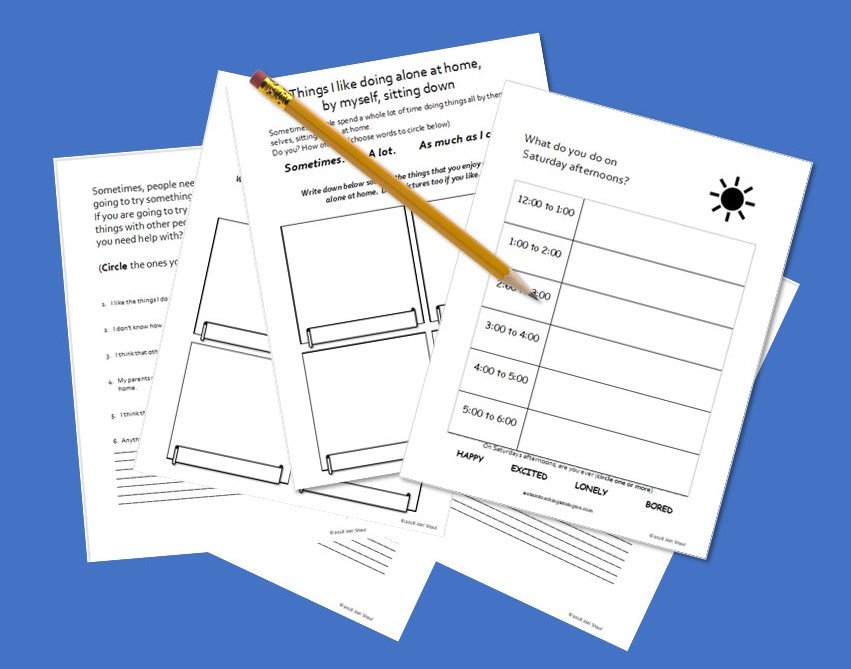
In an earlier post, I provide an isolation card activity for you to download and use in your social skills teaching activities with children on the autism spectrum. Here are some additional materials for you to use, simple worksheets.There are many reasons that children with Asperger’s and other autism spectrum disorders often struggle with social isolation. They may be motivated to socialize, but their efforts may not be fruitful. They might be enthralled with solitary activities based on their preferred interests. Kids with ASD can find their days at school exhausting, and they sometimes over-compensate with down time to recover. Typical children can reject or bully children with ASD.The worksheets are to support your social skills teaching efforts on this topic. The most important worksheets are the daily schedule records, which you can use separately if you like if you don’t wish to use the other four worksheets.If you do not download the card activity from the earlier blog post, I do suggest you check out the content of the cards anyhow. I believe it will help you cover more dimensions of this social skills activity.
My best wishes to you, and the children you are helping, as you work on this issue.
Follow the directions below to download the PDF files for the worksheets.

*I have a special card “game” activity to further explore social isolation. To learn about this free resource, click here.
*Social isolation is often closely related to over-attachment to screen devices. I have a good, free workbook to explore screen addiction. To learn about The Screen Lover’s Help Book, click here.
Your comments on these resources are most welcome, and often helpful. Click HERE to send an email.
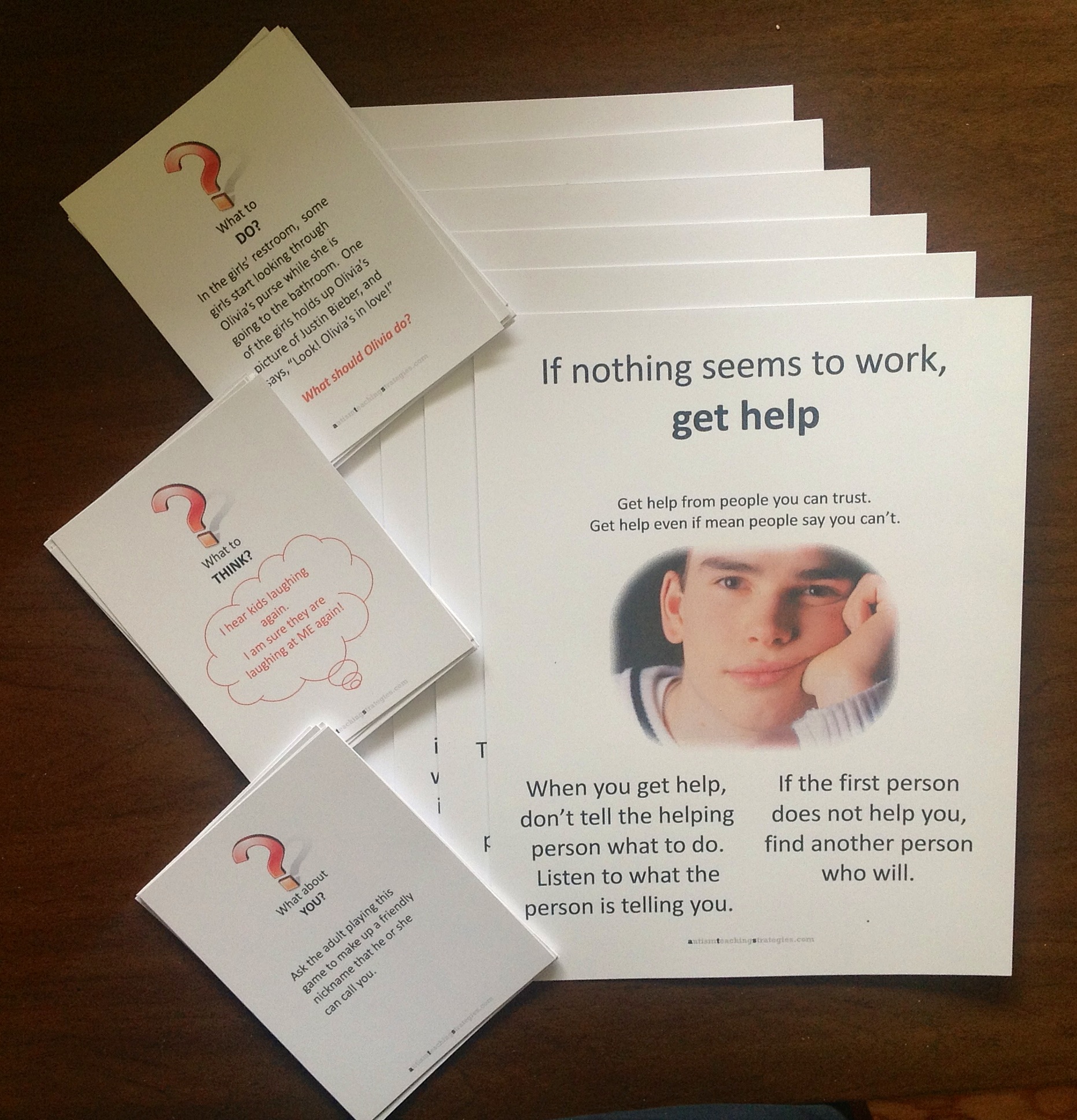
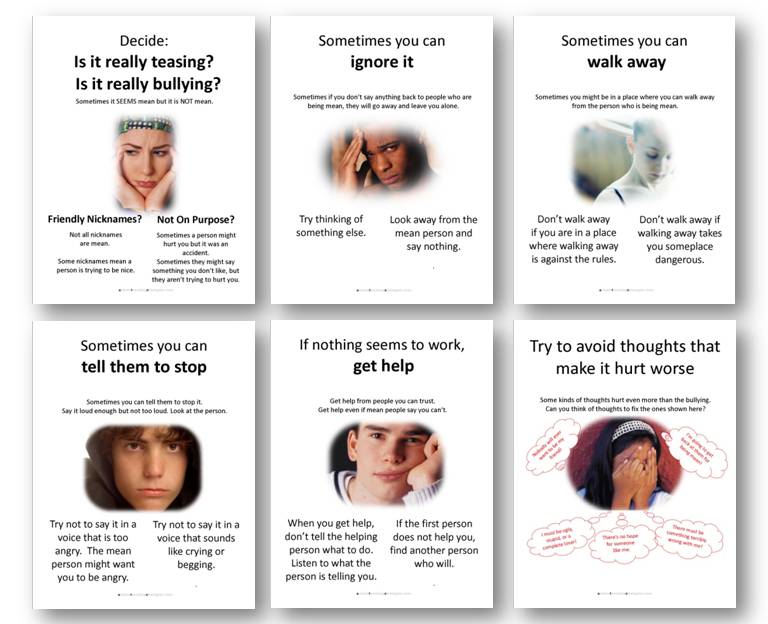
This kit is also available in Polish
If you don’t want to print and cut out all these materials, download the Teasing and Bullying Kit, PowerPoint Version
Your comments on these resources are most welcome, and often helpful. Click HERE to send an email.
To download the pdf of this kit, click on the red link here:
This resource is available in Polish
This activity is also available in a PowerPoint version in case you want to “show it” rather than cut it out:
Social isolation is common in children with autism spectrum disorders. The reasons are obvious. They can become enthralled with preferred activities that they carry out in solitude. The social world can be tiring and frustrating and children with autism can over-compensate with down time to recover. Modern technology provides engaging self- stimulation without face-to-face social contact. Children with ASD can become bewildered and discouraged when they go about trying to socialize. The peers of children with ASD can be unaccommodating and rejecting.
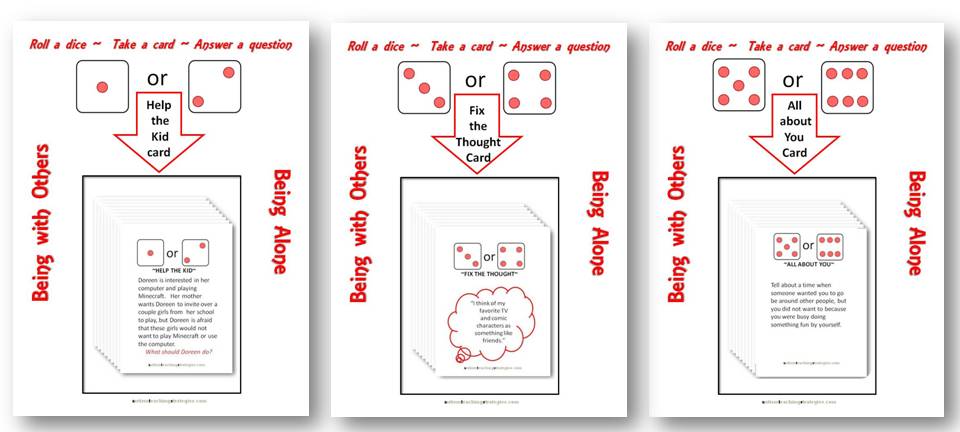
I have provided for you here a social skills teaching activity to help children with ASD’s to explore social isolation. It can be played in a small group or one-on-one between an adult and a child. To play it, you need a single die. When you roll it, it directs the participant to draw a card out of one of three piles of 12 cards.
Roll 1 or 2: “Help the Kid” card. Each card describes a different child experiencing a unique isolation problem. You have to figure out some way to “Help the Kid” with their problem. There is more than one possible solution to each.
Roll 3 or 4: “Fix the Thought” card. Each card shows a different thought or belief which can either contribute to social isolation or make loneliness hurt more. You have to think of one or more thoughts or beliefs to counter the negative thought.
Roll 5 or 6: “All about You.” These questions explore the child’s own social isolation.
Hot to make the cards and card holders: Click on the PDF download link at the top of this post.
I hope you find this social skills game activity useful.
Here is a free download of worksheets on the topic of social isolation for children on the autism spectrum.
Social isolation is often strongly associated with overuse of screen devices. I have a good, free workbook to explore this problem. To learn more about The Screen Lover’s Help Book, click here.
Your comments on these resources are most welcome, and often helpful. Click HERE to send an email.
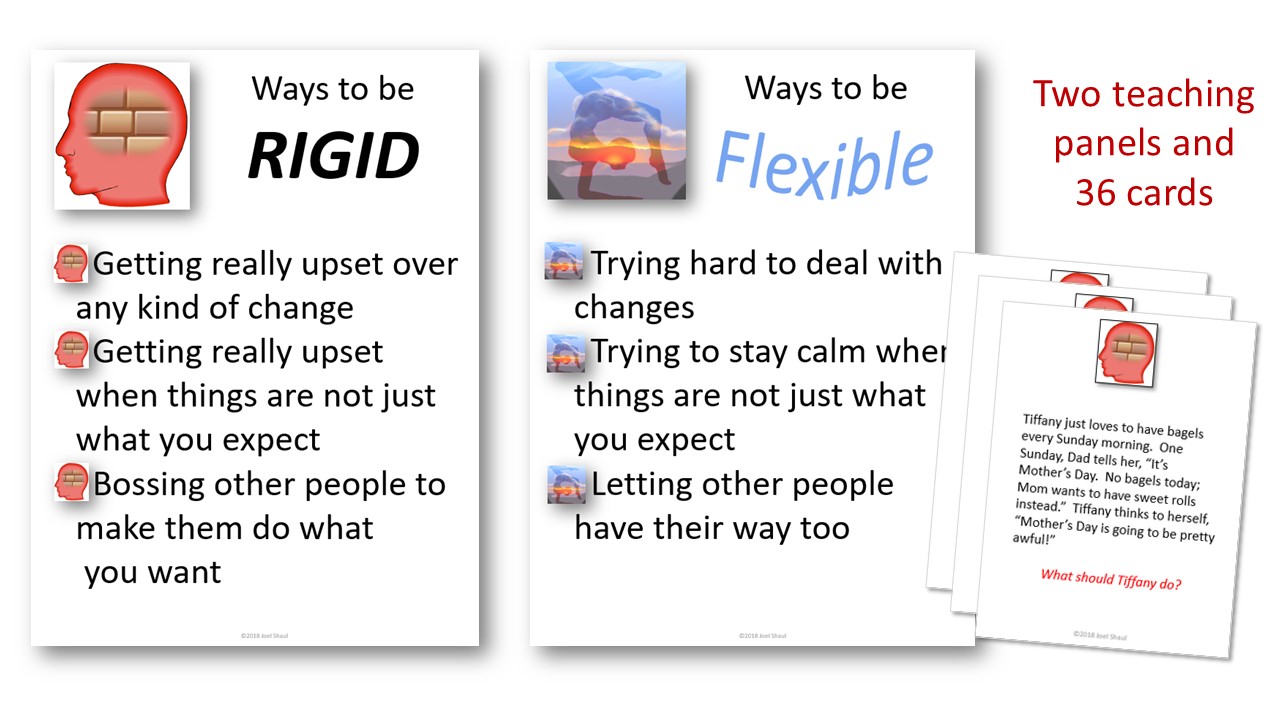
Also available in POLISH language version
Free social skills games & activities, communication / conversation skills for kids with ASD
Free social skills games & activities, social interaction skills for kids with ASD
Free social skills games & activities, emotional regulation skills for kids with ASD
Your comments on these resources are most welcome, and often helpful. Click HERE to send an email.
Many children with autism spectrum disorders can get bogged down with our spoken teaching. In this blog post, I offer some guidance on how to establish a visual oriented social skills training style for those children on the autism spectrum who appear to favor this modality.If you work a lot with children who have autism spectrum disorders, you have seen the following: A child listens to your words for a short time, and then their brain hits a kind of inner mute button, and your session or lesson is effectively finished.
There can be a number of reasons for this. We might be using boring words, speaking too fast, using language that is too complex, or neglecting to reference the child’s preferred interests. But a common reason for “losing your audience” in social skills training with kids on the autism spectrum is that many kids with ASD seem to learn better in a visual modality. Temple Grandin is a well-known example of a person with autism who learns visually. She articulates this beautifully in this quote: “When I think about abstract concepts such as relationships with people, I use visual images such as a sliding glass door. Relationships should be approached gently because barging forward too quickly might shatter the door.” (From Teaching Children with Autism, by Kathleen Ann Quail )

There are certainly many children with autism who do not learn in a visual manner like Temple Grandin. But for the ones who do, I believe is important to keep on hand a variety of engaging and meaningful props for your social skills learning activities. Here are a few examples.
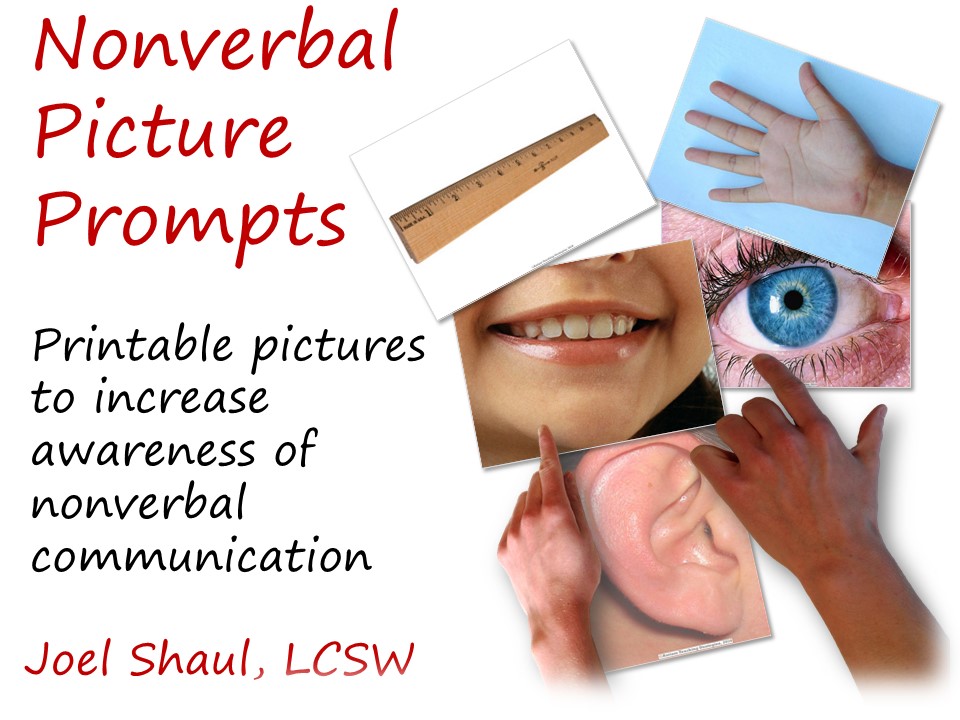
For many kids with ASD, our frequent verbal prompts regarding nonverbal factors just become part of the unwanted noise they tune out. But when you keep on hand pictures of eyes, hands, a face and a ruler, and use these as visual prompts during social skills activities, you can get much better attention and retention.
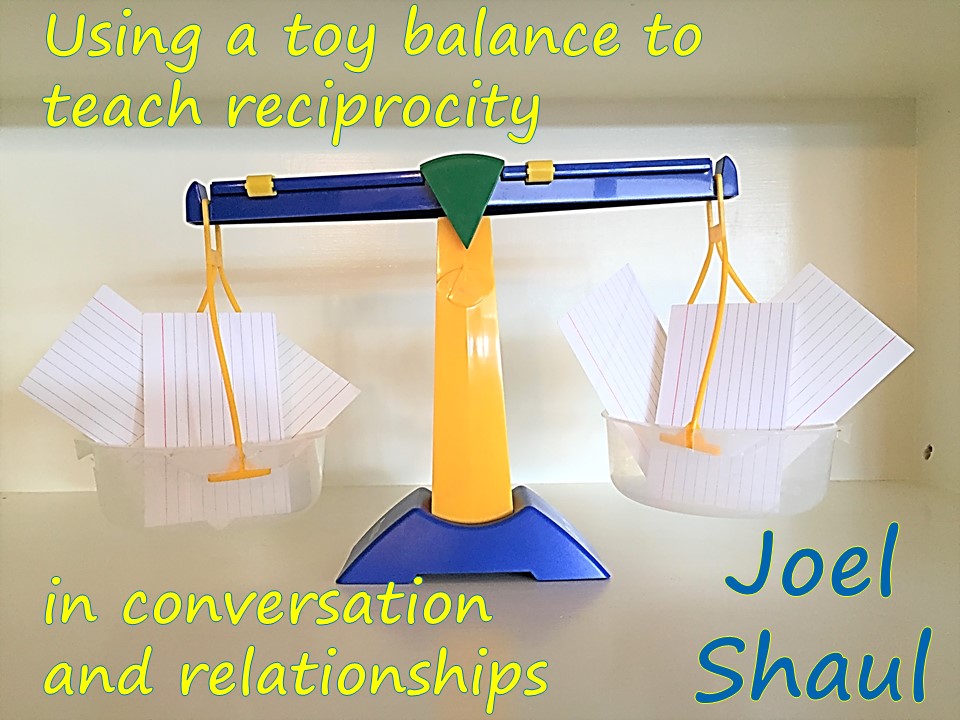
Children with ASD can tune out our words after years and years of verbally prompting to talk less, talk more, stop talking about that, and so forth. For individuals who might be withering under all this scrutiny and badgering, try a social skills teaching approach. This toy balance, available for about 15 dollars online, is terrific for social skills activities to teach reciprocity in conversation and relationships. Learn more about this here.
I invite you to explore dozens of other visual-based, engaging autism social skills training methods on this website.
Here is a one minute video that explains much of this.
Joel Shaul
Your comments on these resources are most welcome, and often helpful. Click HERE to send an email.
This resource is also available in Polish.
CBT Thought Bubbles Teletherapy / On-Screen Version; no printing needed
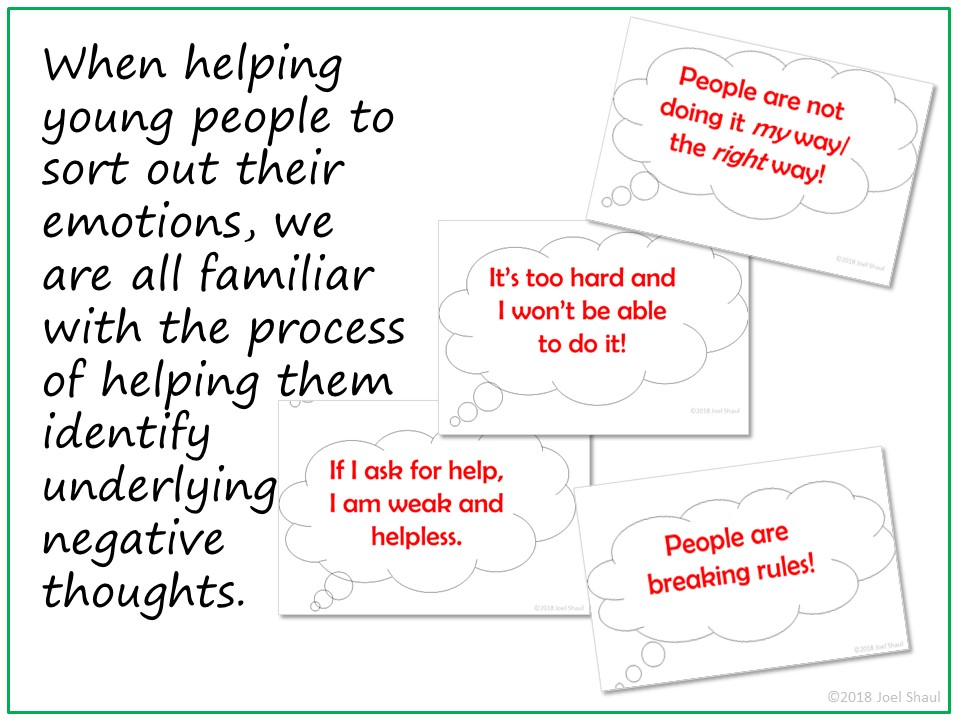
When helping young people to sort out their emotions, we are all familiar with the process of helping them identify underlying negative thoughts.
Here is a hands-on activity to help.
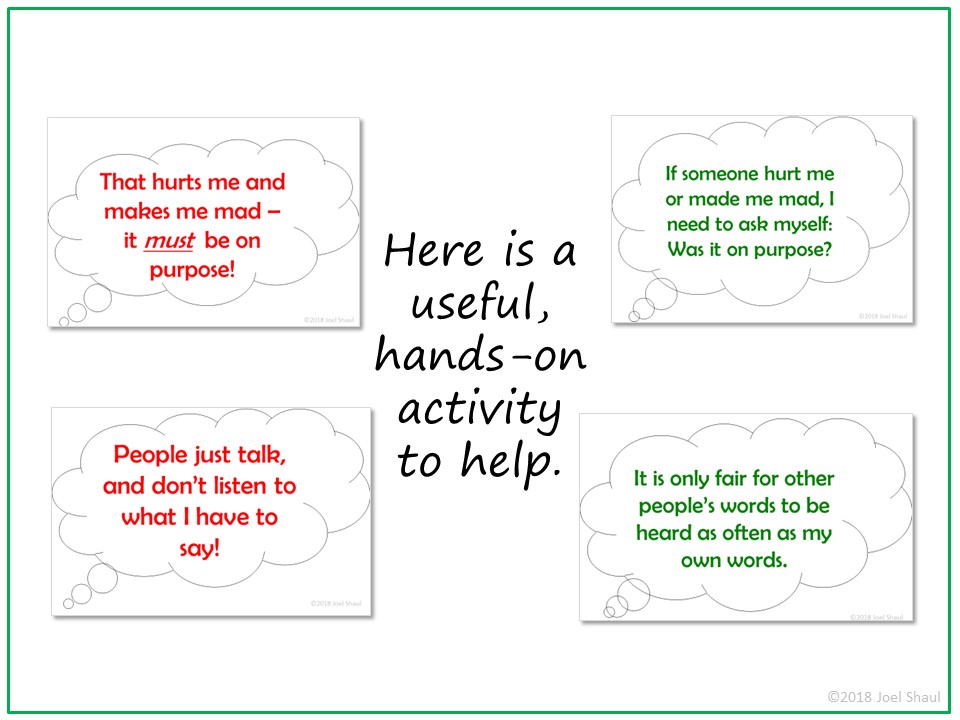
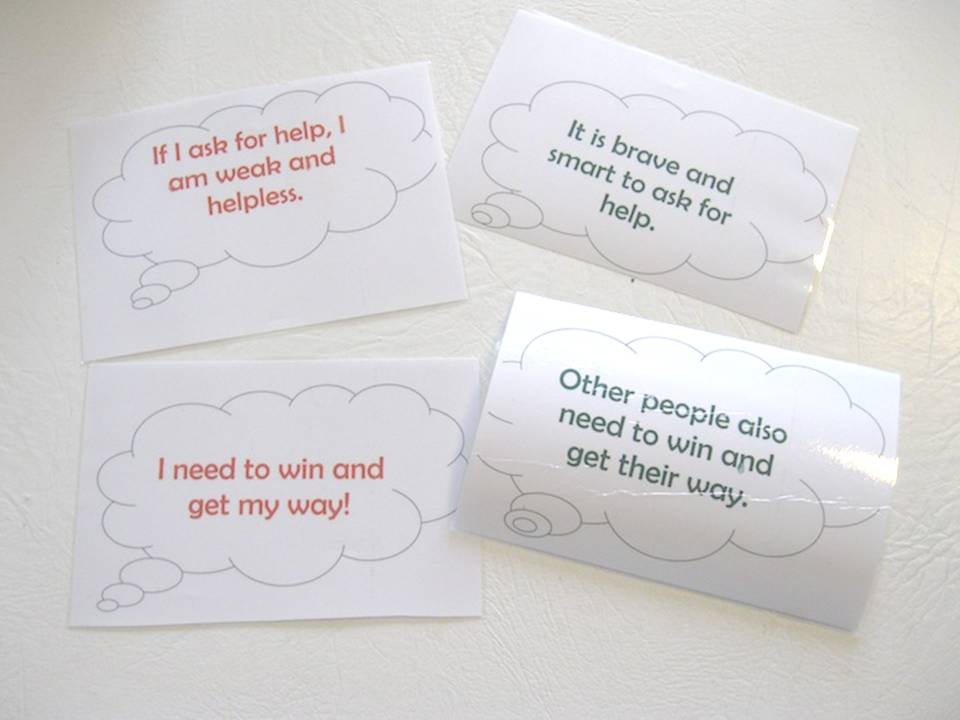
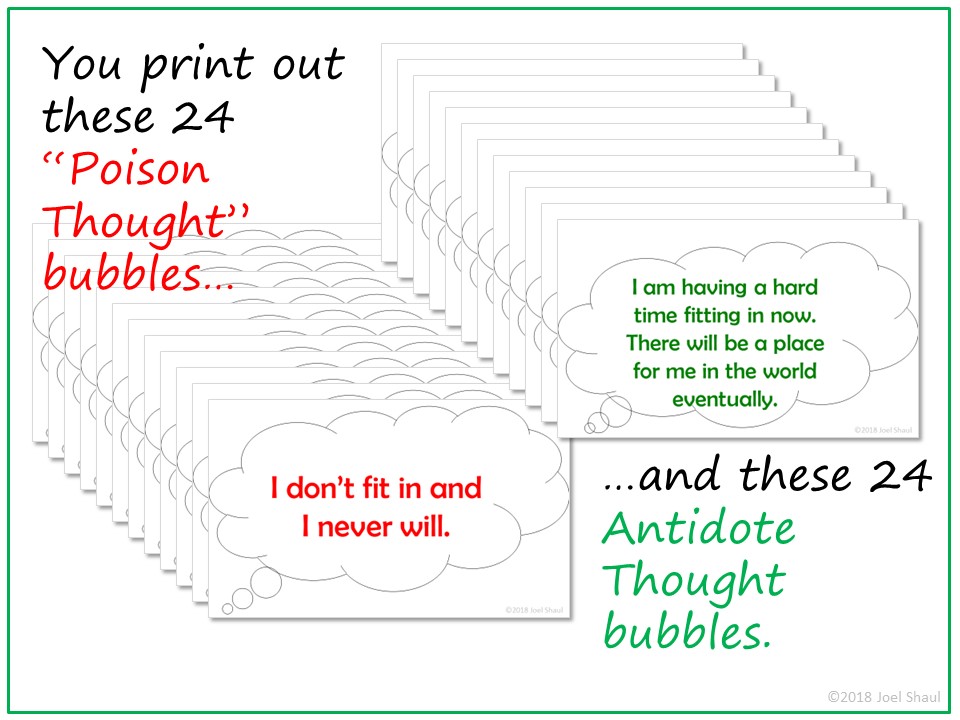
You print out the 24 “Poison Thought” thought bubbles, and the corresponding 24 “Antidote Thought” thought bubbles.
This sets up a number of emotional regulation activities, from simple to advanced. This resource can help convert a stiff, verbal exchange into something a little more playful and collaborative.
Here are some other free Cognitive Behavior Therapy resources for children with autism:
8 Simple CBT YouTube Videos for Kids
Simplified CBT Worksheets for Kids
Mint New Thoughts CBT Activity
Your comments on these resources are most welcome, and often helpful. Click HERE to send an email.
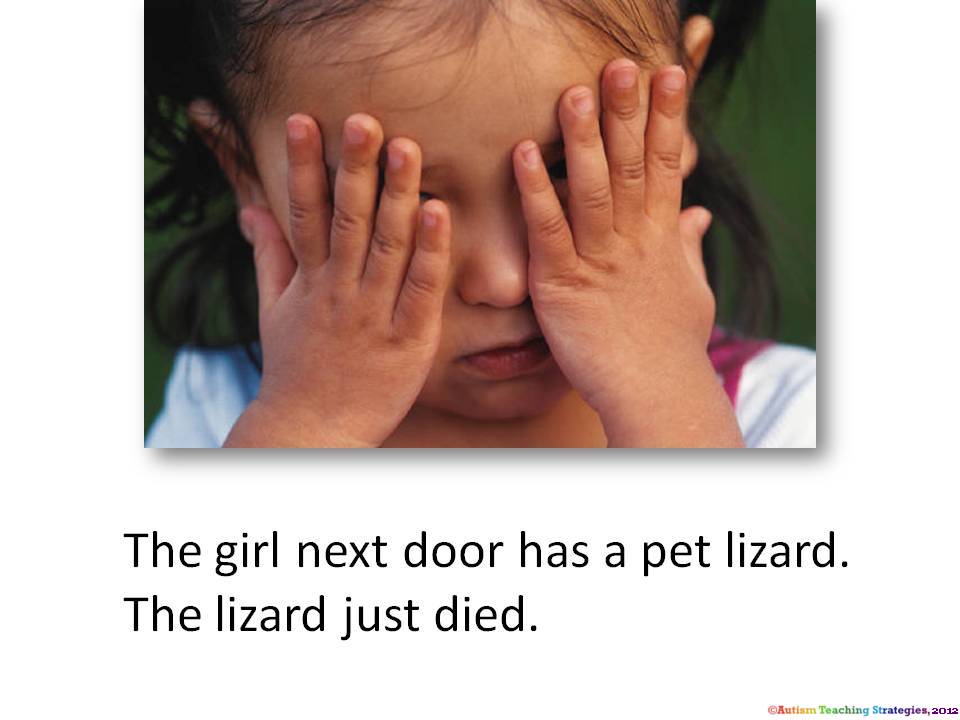
In this download, there are 22 photographs of people in distress, accompanied by very simple word descriptions. These are to help set up role plays for practicing empathy / showing concern skills with children on the autism spectrum. It is very useful to use the Showing Concern Picture Cards in combination with the Showing Concern Wall Display.
To download the Showing Concern Wall Display, please click on the link below:
To download 22 picture cards to practice showing concern, click on this next link below:
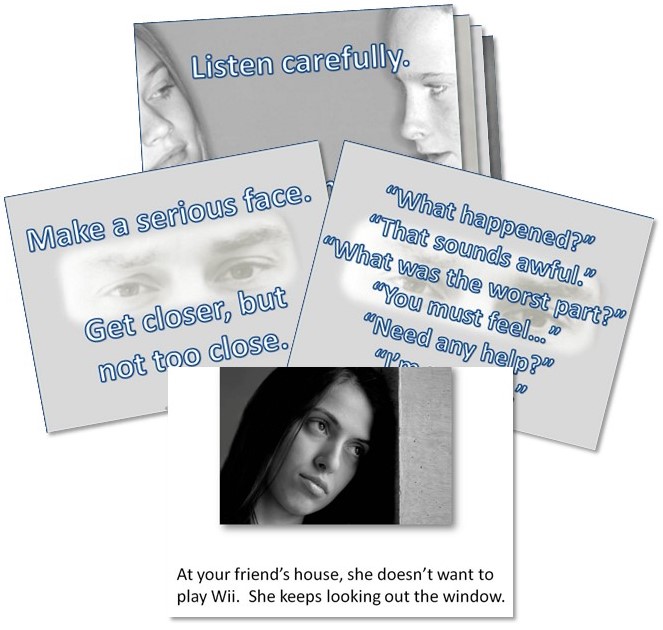
Use the panels in the Wall Display, especially the one showing specific things to say, as word prompts.
Role play where you, the adult, play the person in distress
Role play where pairs of children play roles of distressed person and helper
Role play where you play the role of the person showing concern, but you make mistakes when you do it–with eye contact, tone of voice, what you say, etc. The kids watch and point out your mistakes. Have the kids point out your mistakes.
Your comments on these resources are most welcome, and often helpful. Click HERE to send an email.
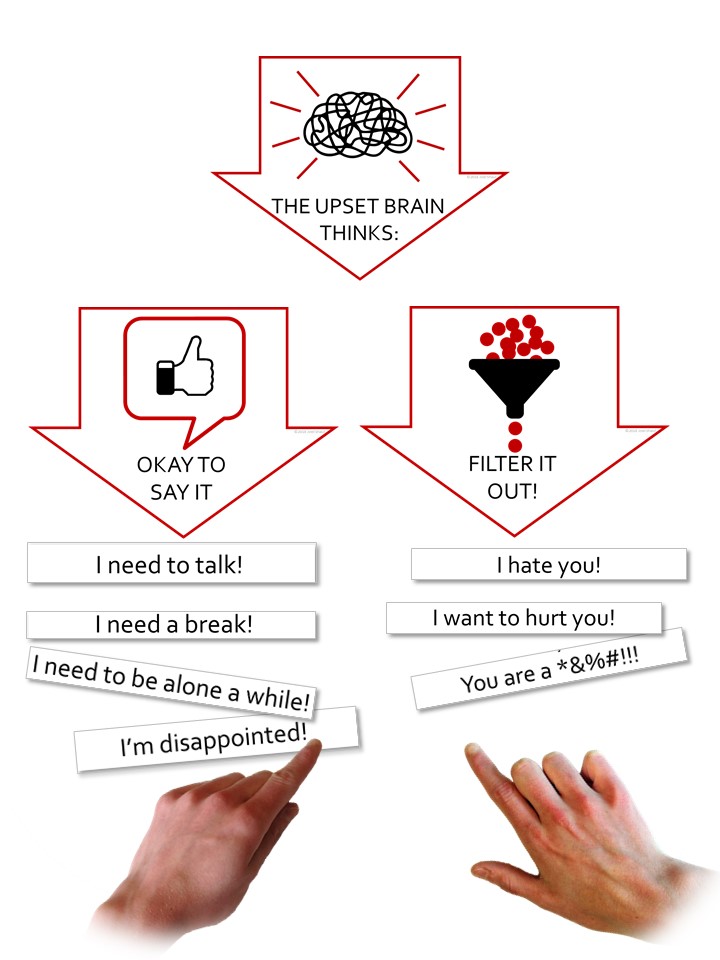
In social skills training in schools and psychotherapy settings, young people on the autism spectrum often struggle with controlling angry verbal outbursts. This is a cut-out paper kit that creates a hands-on activity to teach and practice filtering upsetting thoughts and avoiding blurting out things that are frightening or confusing to others.The Filter the Anger Activity is designed to:
* Raise awareness of okay vs. not-okay things to say when you are mad
*Introduce and reinforce the idea that thoughts can be “filtered” before they are turned into words.
Sample introduction to this activity:
“When we are upset, we can have many, many upsetting thoughts going through their mind, very quickly. The thoughts can be so many, and so powerful, that they can “escape” out of your mouth if you are not careful. Your mind has a filter in it, to help us to say the right things, instead of every one of our thoughts to rush out of our mouths.”
(Now describe a filter; depends on knowledge level of participants. Show them the filter visual)
“There are different kinds of filters.” (have them name some: coffee filter, water filter, oil filter, etc. If you have a prop to demonstrate a filter now, that is good—try a colander, a coffee filter, etc)
“You can’t see the filter in your brain, but the way it works is kind of the same. It is especially important to use your brain’s filter when you are upset or angry, so that you say things that are good, and get you help, and so you avoid saying things that frighten, confuse or anger other people.”
How to use the upset thought strips: On a big table or on the floor, have the participant(s) sort the statements into things that are okay to say, sometimes okay to say, and almost never okay to say. Use the “Filter These Out” and “You can say these” visuals to help them with the sorting.
Usually, the child will spontaneously start talking about times they made unfiltered angry statements. This provides opportunities for learning and adds a visual dimension that is very helpful.
Variations: You, the adult, can try acting out the role of an upset person who is not succeeding in filtering his words. Ask the young participants to help you to filter what you say. Ask them to offer you alternative ways to express your upset feelings.
This is a good teaching/therapy activity for social skills training and anger management for kids with autism spectrum disorders. I hope you find it helpful.
The Filter the Anger activity is much more effective when it is combined with other learning activities.
Here are some related free activities for increasing awareness of social filters, anger management and cause and effect in relationships:
What I should Have Done Different Worksheet
Customizable Meters for Awareness of Negative Behaviors
Words Hurt/Words Help Worksheets
Pencil / Pen Memories Worksheets
Your comments on these resources are most welcome, and often helpful. Click HERE to send an email.