
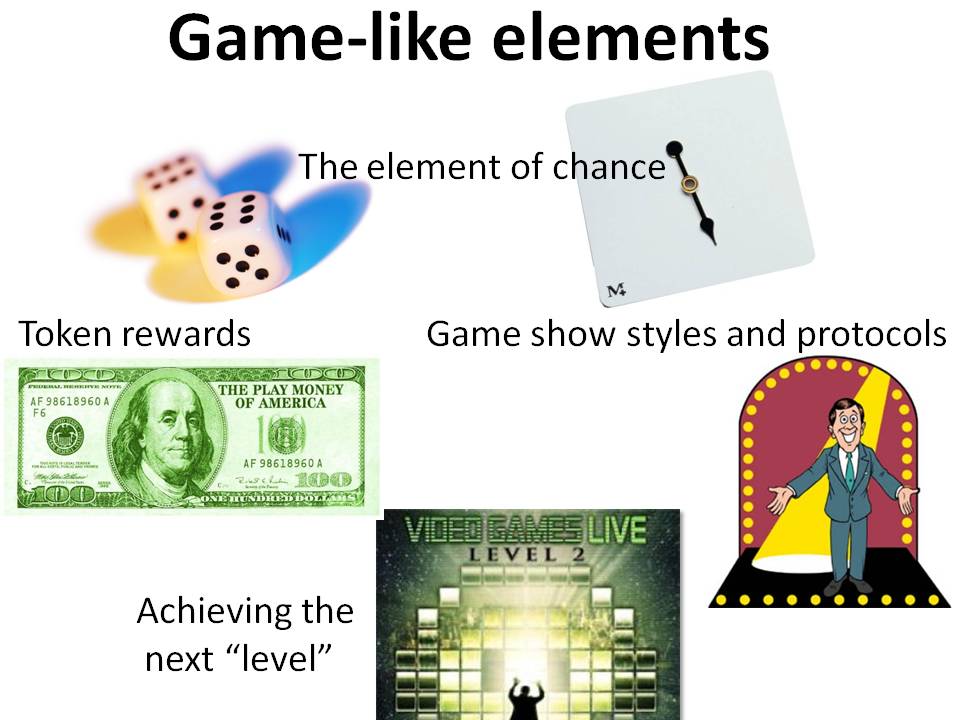
Game-like elements for teaching social skills to children with Asperger’s and other autism spectrum disorders, Part 1

Teaching social skills to children with autism spectrum disorders can be much more effective when it is engaging and fun.  By the time children with autism ends up in our classrooms  or psychotherapy offices, they are often feeling pretty weary and discouraged with their problems.  If we don’t introduce some elements of levity, we may lose their attention altogether.

Here are some tips for making your social skills training engaging and “game-like.” Much of this is summarized in this Youtube video, check it out: http://bit.ly/x9TvvO
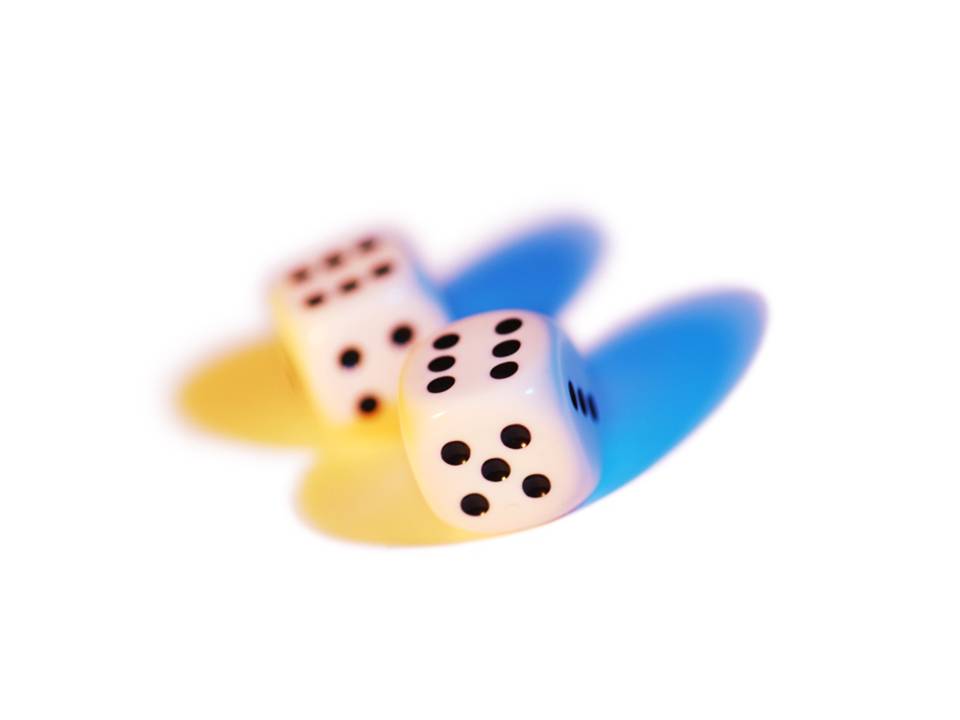
Use the element of chance to make your social skills teaching seem like a social skills game
  1. Introduce the element of chance. A simple way to do this is to use some dice, or a blank spinner (available from teacher supply stores).

Here is an example:  “Kids, we are going to play the compliment game today.  A compliment is when you say something nice to someone about  how they look, or about what they do, or about how they are.  When it is your turn, if you roll a one or two with the dice, you have to give someone a compliment here about how they look.  If you roll a three or a four, give a compliment to someone about what they are doing.  If you roll a five or a six, give a compliment to someone about how they are (nice, funny, smart, fast, clever, etc.)”
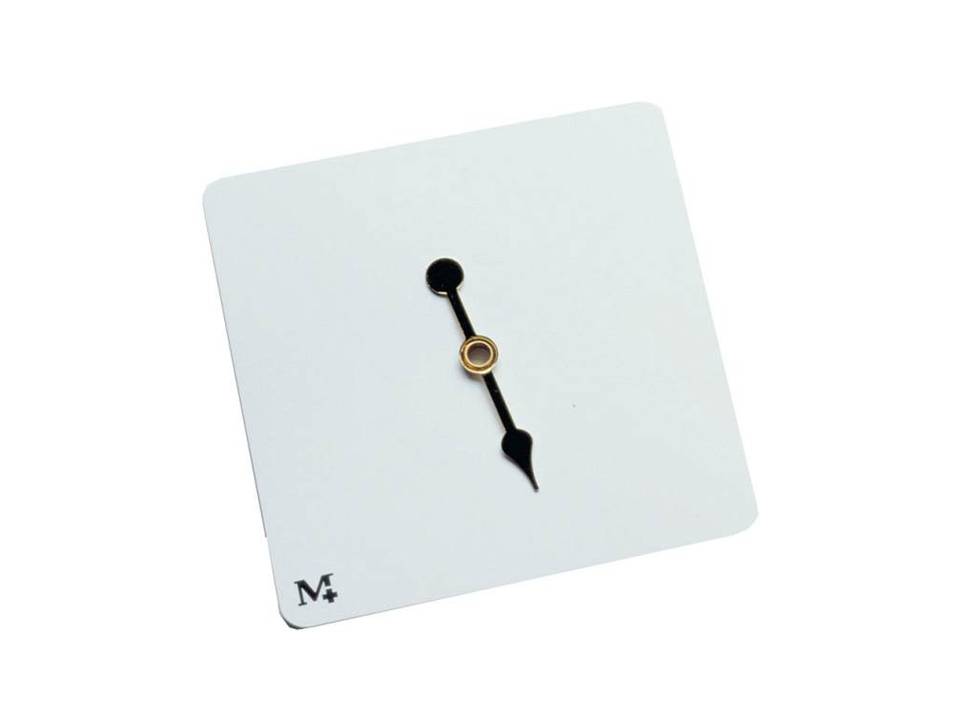
Customize a blank spinner to create social skills games for students/clients on the autism spectrum

social skills learning autism

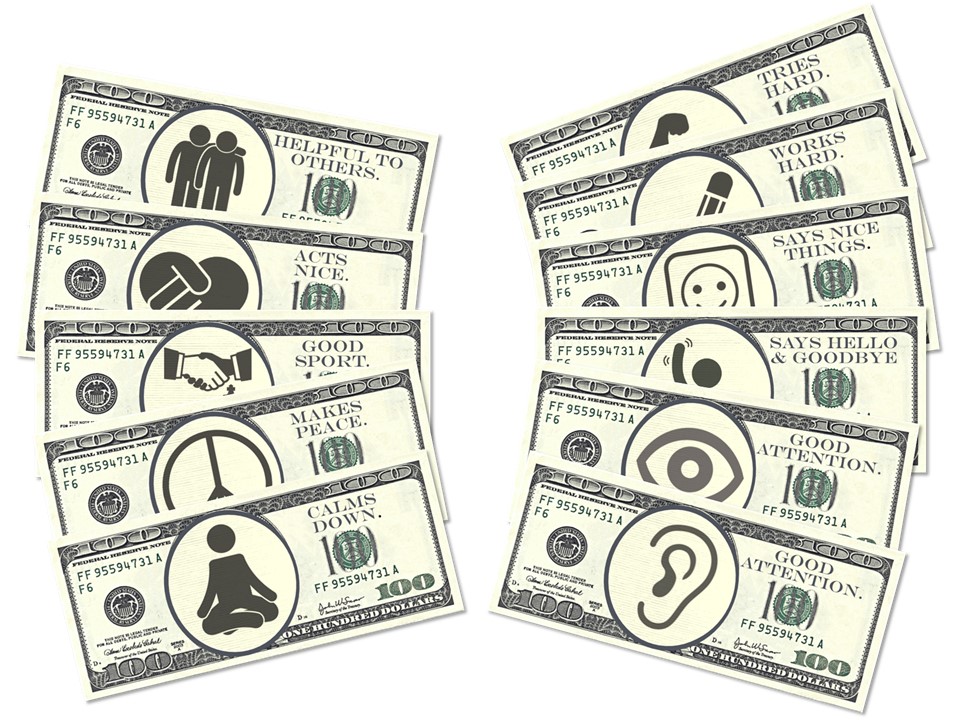
You can download this cool play money that I made! Click here.

2.  Use tokens or scoring systems. These fall into two categories.  The first kind of scoring system is to give out token objects (play money, marbles, etc.).  These you have the kids keep in cups so they are not overly distracted by them.  The second scoring system is to create a score board.  Simply write the names of the children on a dry erase board, and add a hatch mark next to their names each time they score. (This is the preferred system if your kids on the autism spectrum get distracted by wanting to touch and handle the token items.)

Use “levels” to add interest to social skills lessons and social skills training

3.  Use achievement levels. Most kids on the autism spectrum play a lot of video games.  Video games are usually all about “levels” and getting from one level to the next.  Here is an example of how to incorporate this into an activity teaching compliments: “Kids, there are three levels of giving compliments.  We are going to play a compliment game.  Who will get to level three?  Level one is easy.  You say something nice about how someone looks.  Level two is harder.  You have to say something nice about the thing the person is doing.  Level three is the top level.  You have to know the person well enough to know their special inside qualities, like “Generous,” “Smart,” or “Helpful.”
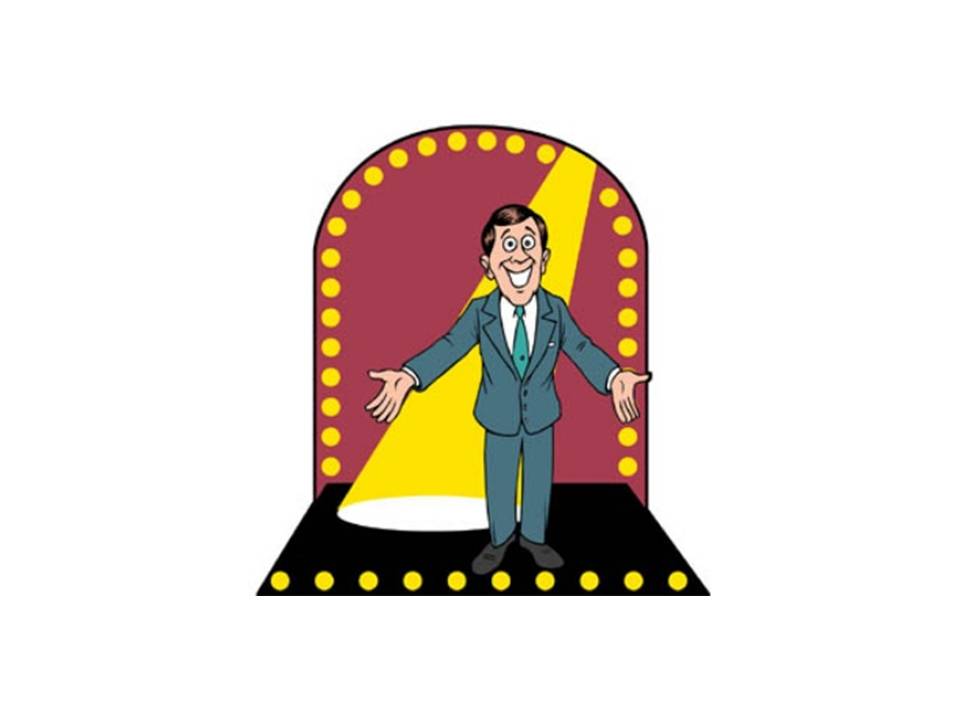
Create a “game show” to turn the social skills lesson into a social skills game

4. Build in Game-show elements. Children with autism spectrum disorders seem to appreciate it when their counselor or teacher is willing to pretend to be a game show host.  Copy and print out the picture of the game show guy shown in the picture above, and stick it on the wall.  If you want to get fancy,  play game show music. Here is a link to Jeopardy music sound clip: http://www.youtube.com/watch?v=vXGhvoekY44 Then,  abandon your professional decorum , and say something like this: “Kids, welcome to the Elmhurst School Game Show.  I am your host, Ms. Apple.  Today, we are going to test people’s ability to give compliments.  Please welcome our first contestant, Tiffany.  Tiffany, come on down!”

I wish you good luck with introducing levity and game-like qualities to your social skills training for kids on the autism spectrum.

Joel Shaul, LCSW

Your comments on these resources are most welcome, and often helpful. Click HERE to send an email.
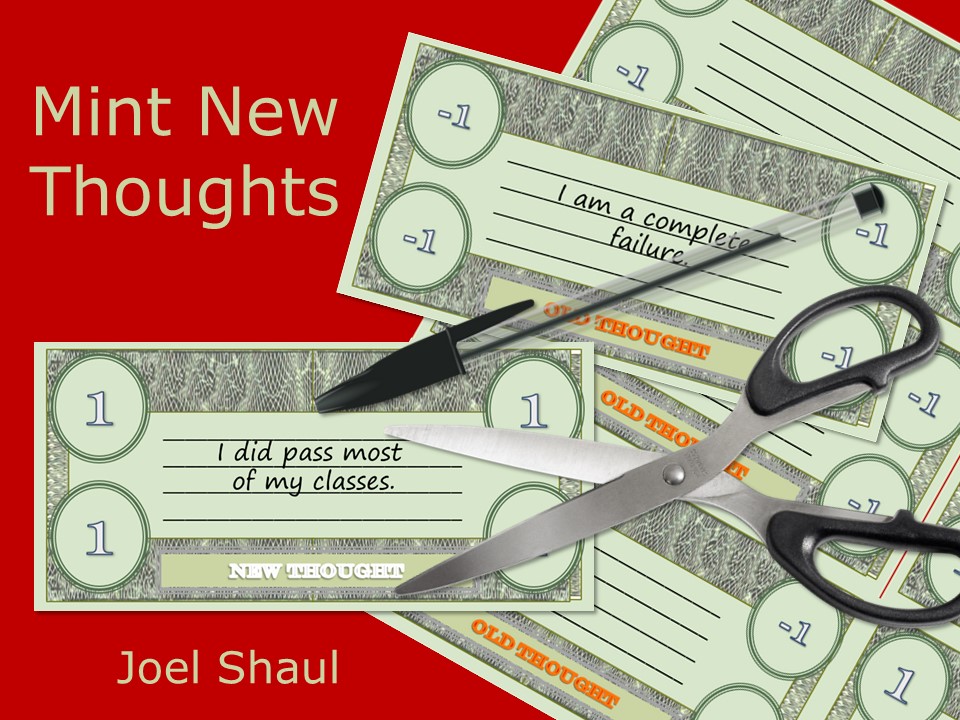
Minting New Thoughts: Engaging CBT Activity for kids with ASD and others

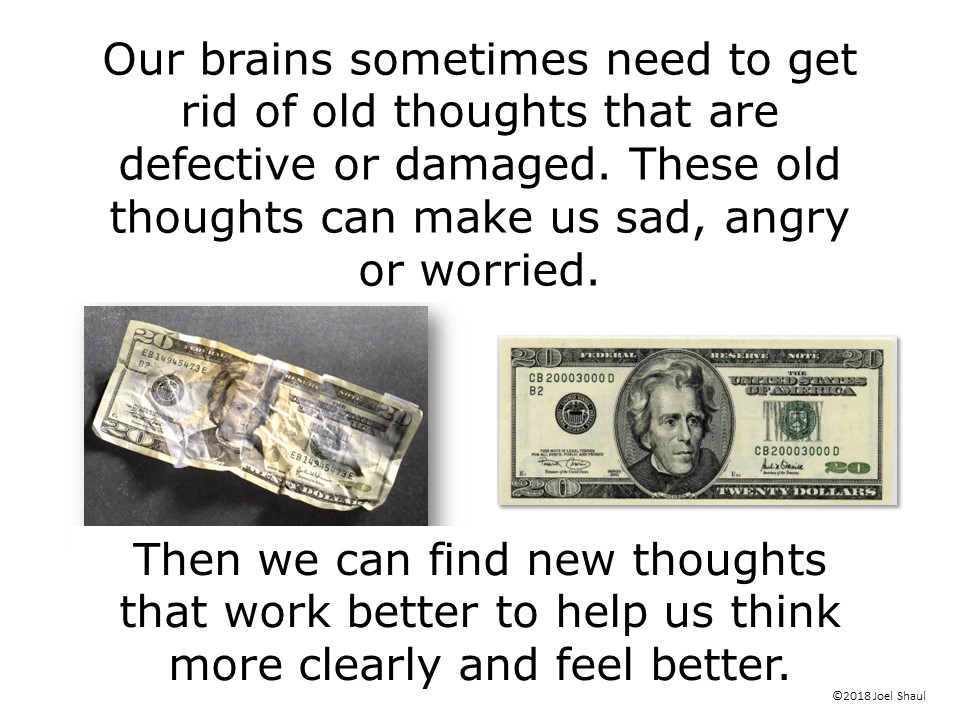
Here is a great activity for individuals or groups of kids to introduce or expand on how to cope with upsetting feelings.  It uses the metaphor of paper money that is first minted, and then shredded if it is defective or worn out. To do the Mint New Thoughts activity you need to print out lots of the special play money (the link for the download play money is found below) and a paper shredder (or you can just tear up the old money).

Print out the OLD THOUGHT money and NEW THOUGHT money in quantities large enough for each participant to have about six to use. To download and print the money, click here:

This kit is available in Polish

Spanish: Acuñar nuevos pensamientos

For free access to an excellent Boom Card version of this resource, click HERE.

To introduce this activity:

Try using language like this:  “Did you ever wonder where money comes from, and what happens to it when it is no good anymore?  Money comes from a huge printing factory called a “mint.”  All of our money comes from these places called mints.

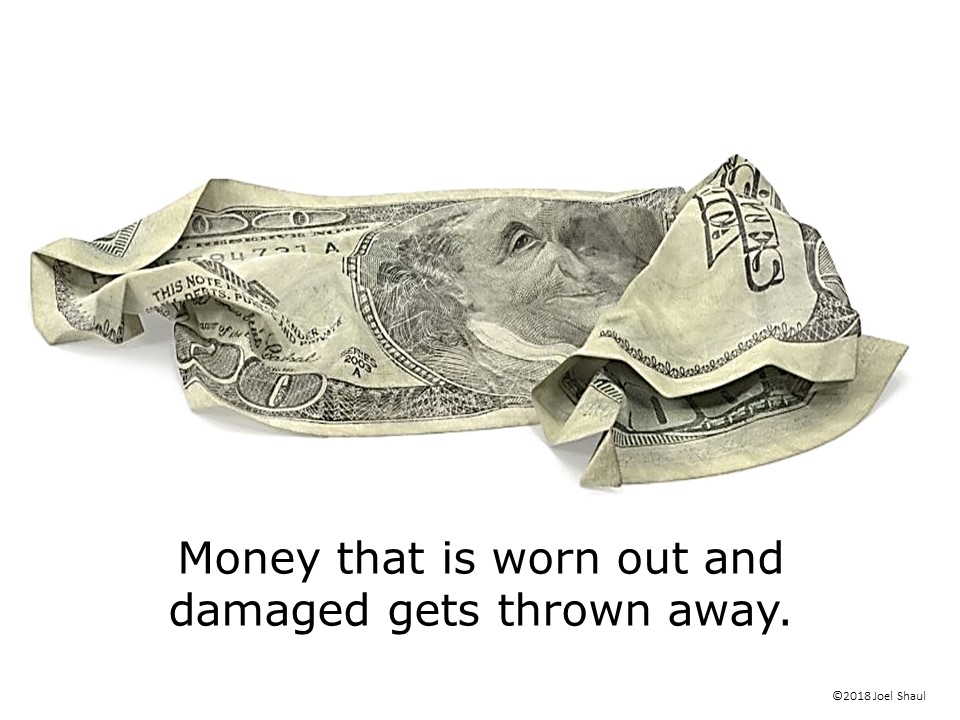
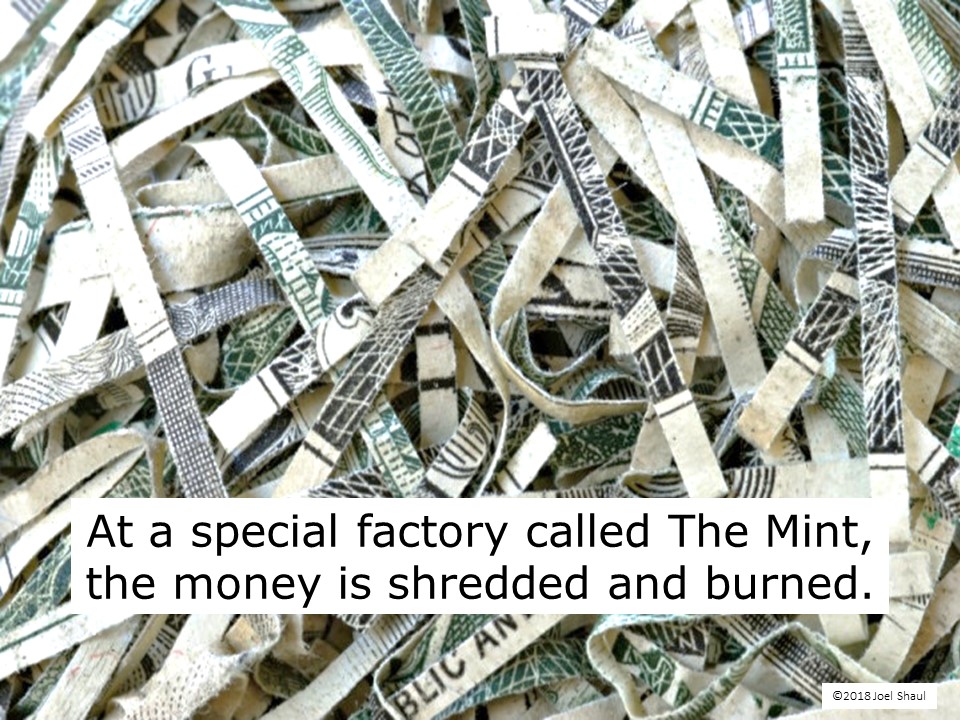
“Often, when the money is not printed right, they have to destroy it.  They use something like the paper shredders you see in an office.  Also, other money gets worn out, and they have to shred that money too.

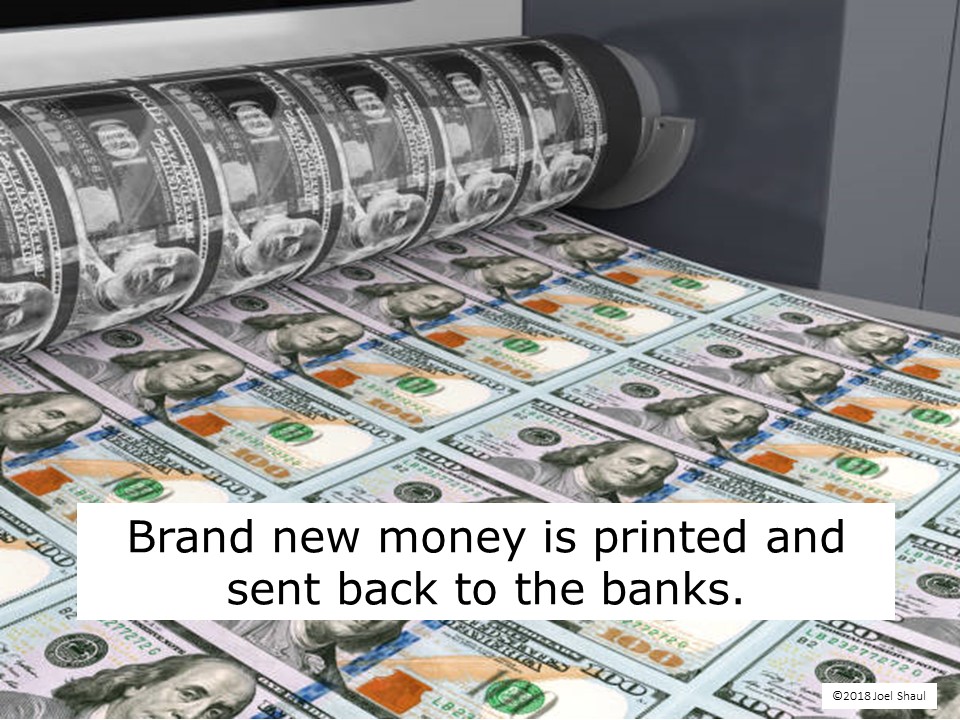
“To replace the destroyed money, the mint prints brand new money.

Your mind is something like a mint that makes money, except your mind makes thoughts instead of dollars.  Hundreds of thoughts, thousands of thoughts, every day.  Most of the thoughts are good and helpful to you.  But some kinds of thoughts aren’t good because they just make you upset too much.  When you get these thoughts, they are like bad or worn-out money that needs to be destroyed.  Then, you need new and better thoughts to make you feel good and calm instead of upset.”

  1. Now, show the kids how to fill out the OLD THOUGHT money.  If you have not already introduced the kids to “poison” and “antidote” thoughts, you will want to do this slowly and carefully.  There are lots of other CBT resources available on the website.
  2. Have the kids fill out the NEW THOUGHT money now.  Provide plenty of extra blank money for them to practice.  Tell them that they can use more than one NEW THOUGHT to replace the OLD THOUGHT.
  3. Have the kids run the old money through a paper shredder.  If you have the opportunity to work outside and actually burn them, like on a charcoal grill, this really gets kids’ attention.
  4. If you like, you can laminate the new money now, and with the kids’ permission, display it.


To access a summary of all the CBT materials on this website, click HERE.

Derived from a method described in Cognitive Therapy with Children and Adolescents, ed. By Reinecke, Dattilio and Freeman, 2006, Guilford Press.

Joel Shaul, LCSW

Your comments on these resources are most welcome, and often helpful. Click HERE to send an email.
ASD Feel Better Promo square directing to JKP

The Conversation Train Book

Green Zone Book Cover Click to Learn More


Help The Upset Person: A cognitive-behavioral group game

Download this resource:

Help the upset person activity

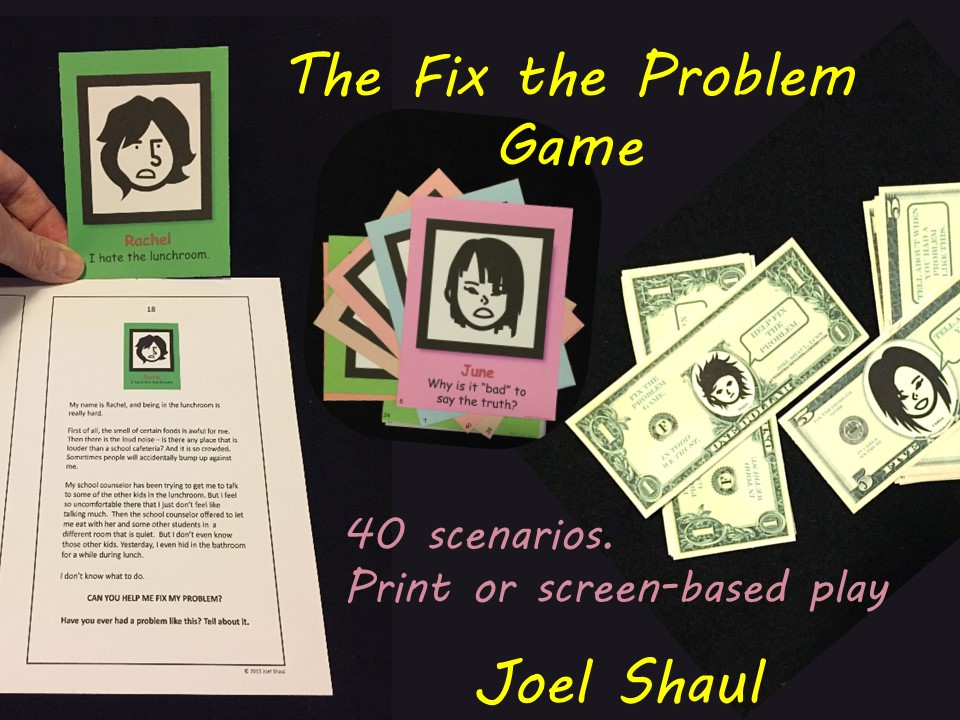
Years after I designed the Help the Upset Person Activity, I designed this similar – but much better game . You should probably check out The Fix The Problem Game instead. Click on the picture below to see it.

This image has an empty alt attribute; its file name is Slide1.jpg

This is an engaging and entertaining cognitive-behavioral teaching strategy  on the topic of emotional regulation.
Here is how to do it:


Here is how to present the activity to your client/student, small group, or class:

“When people are worried, or sad, or disappointed, or mad, they can help themselves to feel better.  They do this by thinking certain things, doing certain things, and saying certain things.  Here is a game where you get to be the one to help an upset person to calm down.

I am going to pretend to be different upset kids.  Your job is to tell me what to THINK, what to DO, and what to SAY to help solve my problem.

If you give me good, helpful advice on what to think, do and say, then I will hold the picture of the upset person lower and lower.  If you give me advice that makes my problem worse, or doesn’t help at all, I will raise the picture higher and higher.

If the picture ends up this high [way above your head], then you have lost the game.

If the picture gets all the way down by my knees, then you have done a great job and you have won the game.”
Here are situations you can use for your enactments of the upset person role plays:

  • Young person who is upset because children on the playground suddenly decide to change the kickball rules to  allow five bases instead of three
  • Young person who is upset because a substitute teacher is not following the normal routine and is not listening to the young person’s advice
  • Young person is upset because the bakery delivered a defective cake to his birthday party—a Pikachu cake that is blue instead of yellow.  (Or, pick a local sports team’s colors and the bakery messes up the colors )
  • Young person is sad and hopeless because, although he is doing his best to fit in and socialize with peers, he has been unsuccessful
  • Young person who is on the bus on the way to the first day of a summer day camp, feeling apprehensive about new activities and the prospect of social failure

Joel Shaul, LCSW

The Conversation Train Book

 Green Zone Book Cover Click to Learn More

Words hurt, words help

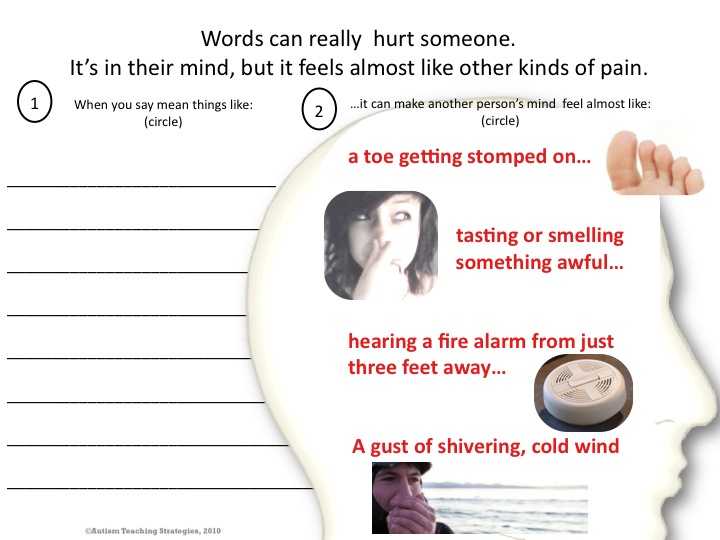
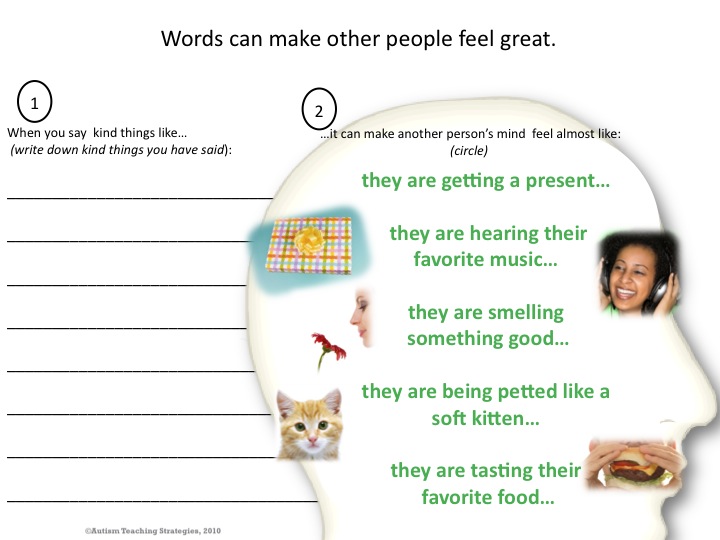
To download the two worksheets shown below, click on the links below:

Words Hurt, Words Help Worksheets Download

[In German: Worte-tun-weh-Worte-helfen]

[In Polish]

[In Hebrew]

When I work with children with ASD on social skills, I often ask them: “How long will another person remember what you do or what you say?” A typical answer I get is: “About five minutes.”  These answers are enlightening.   Frequently, young people with ASD have the impression that other people just don’t remember too many details about what other people say and do.  A young man who sometimes neglected to button his shirt insisted that no one ever noticed.  “And even if they did see my shirt unbuttoned, they would just forget in a second.”

Young people on the autism spectrum may experience difficulty understanding the social consequences of their words and actions.  This lack of awareness can affect them in several ways. First, the child with ASD may be  less likely to say something encouraging or complimentary to another person. Second,  the child may fail to discern the harmful effects of hurtful words, and  blurt out “unfiltered” statements with harsh, judgmental or violent content.  The combination of these distorted beliefs lowers their motivation to make good impressions and also lowers their conviction that altering their own words and behavior really makes any difference anyhow.

When we try to help children with autism increase their ability to use kind words and refrain from hurtful ones, it seems very helpful to use clear visuals. It also helps to equate the other person’s emotional pain and pleasure to physical pain and pleasure.  My clients seem to “get” that other people feel physical pain and pleasure much better than they understand other people’s emotional pain and pleasure.

I developed these illustrated social story worksheets  to help children to realize that their words have the power to hurt and to help, and that their words and actions matter.

Joel Shaul, LCSW

.


.[Years after creating these worksheets, I wrote an illustrated book for children with ASD about social cause and effect. It is called Our Brains are Like Computers. To learn more about it, click HERE.

Here is another set of free social skills worksheets on the topic of social cause and effect and what others remember: Pencil Memories and Pen Memories

Pencil Memories / Pen Memories Social Cause and Effect Worksheets

Your comments on these resources are most welcome, and often helpful. Click HERE to send an email.
The Conversation Train Book

Green Zone Book Cover Click to Learn More

Welcome to Autism Teaching Strategies

I’m glad you found this website and blog.

I love learning about social skills training for young people with autism, and sharing ideas with other professionals who do similar work.  In this blog, I will be passing on some of what I have learned.

In this blog, I share lots of ideas on how to help young people on the autism spectrum with communication, relationship skills and regulation of emotion.  I offer dozens of resources for that you can download for free.  Some are are also available here in German, Spanish and French and most are available in Polish.

Come back often.  Let’s interact. Take away a few ideas, and leave a few of your own if you like.

Joel Shaul, LCSW

_________________________________

The Conversation Train Book

 Green Zone Book Cover Click to Learn More