
Role play practice in social skills work for children with ASD. How to do them. Free printables to help.

Role playing is an essential social skills training method when we are working with young people on the autism spectrum. Most of us probably employ them often in our work. But years ago when I was learning how to use role plays, I muddled through it on my own, and if there was anything out there that instructed professionals how to do role plays, I was unaware of it.

Here is a summary of using role plays for social skills training, with links to free download resources which support the use of role plays.
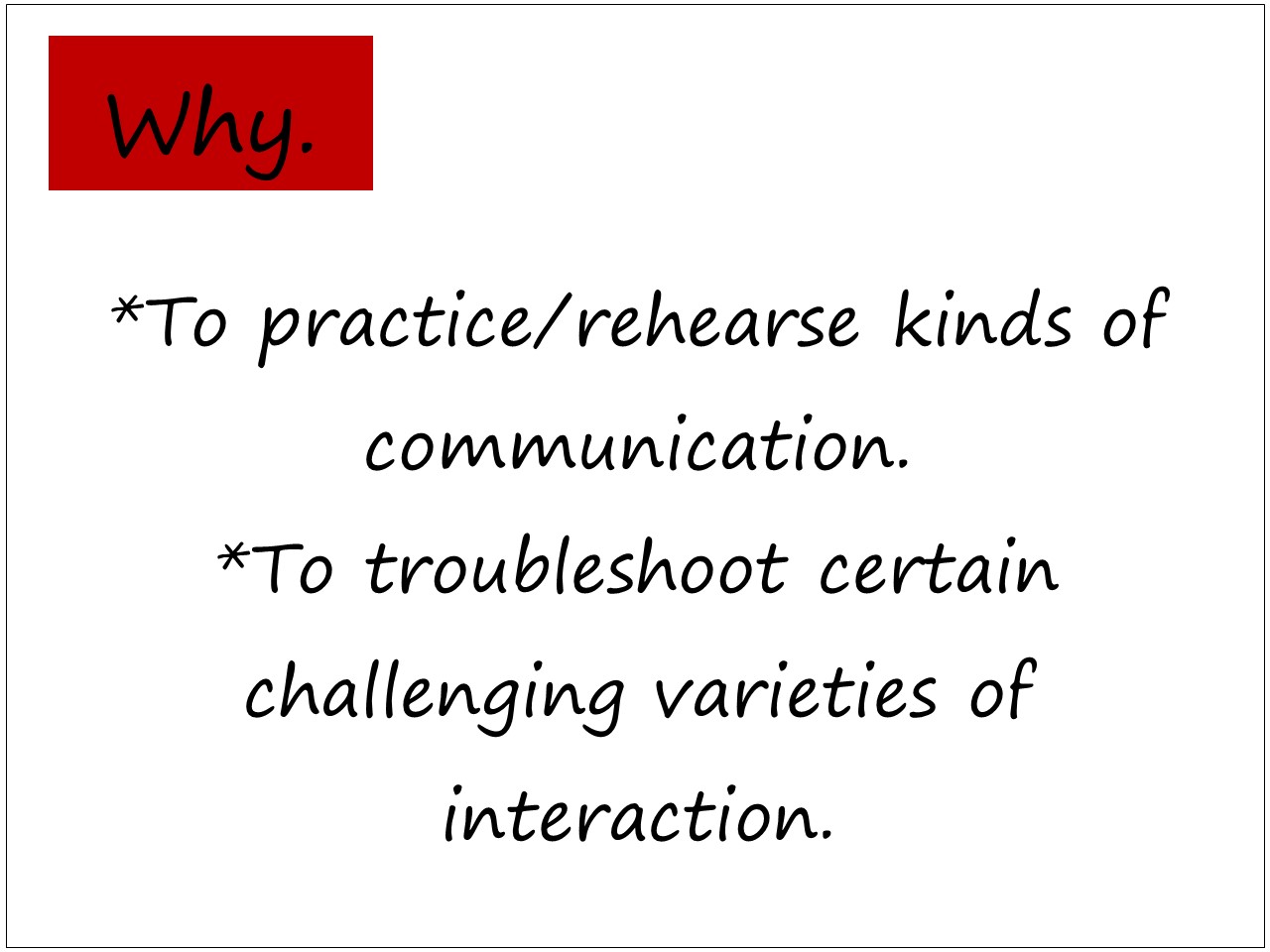
When we are teaching young people with autism what to say and do in social situations, we should never just expect them to implement this learning on their own. They need to practice it in a safe setting where they can be coached, guided and encouraged.
We should be doing role playing often enough in our work that our clients expect it. I have a few clients who actually ask for it.
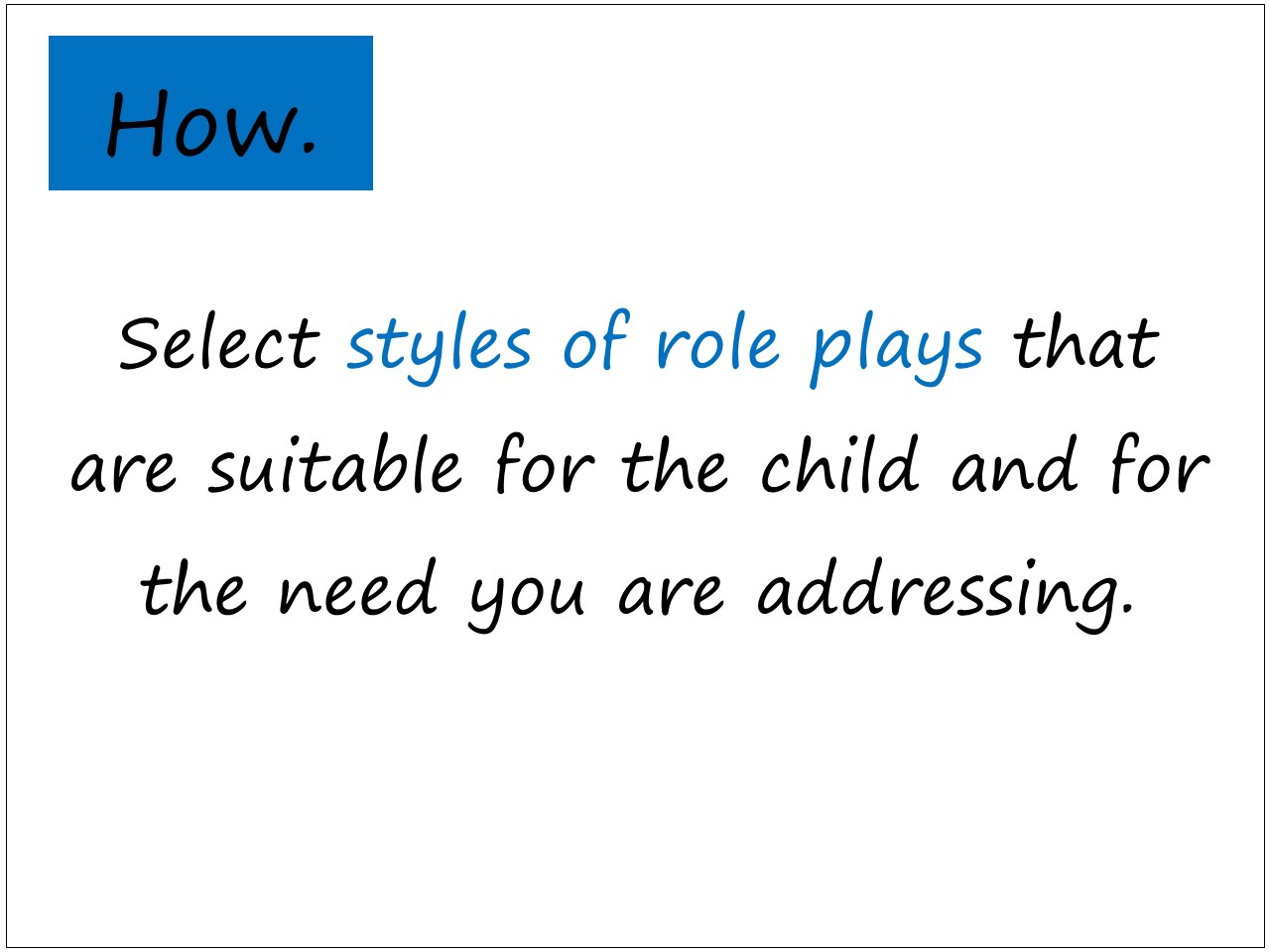
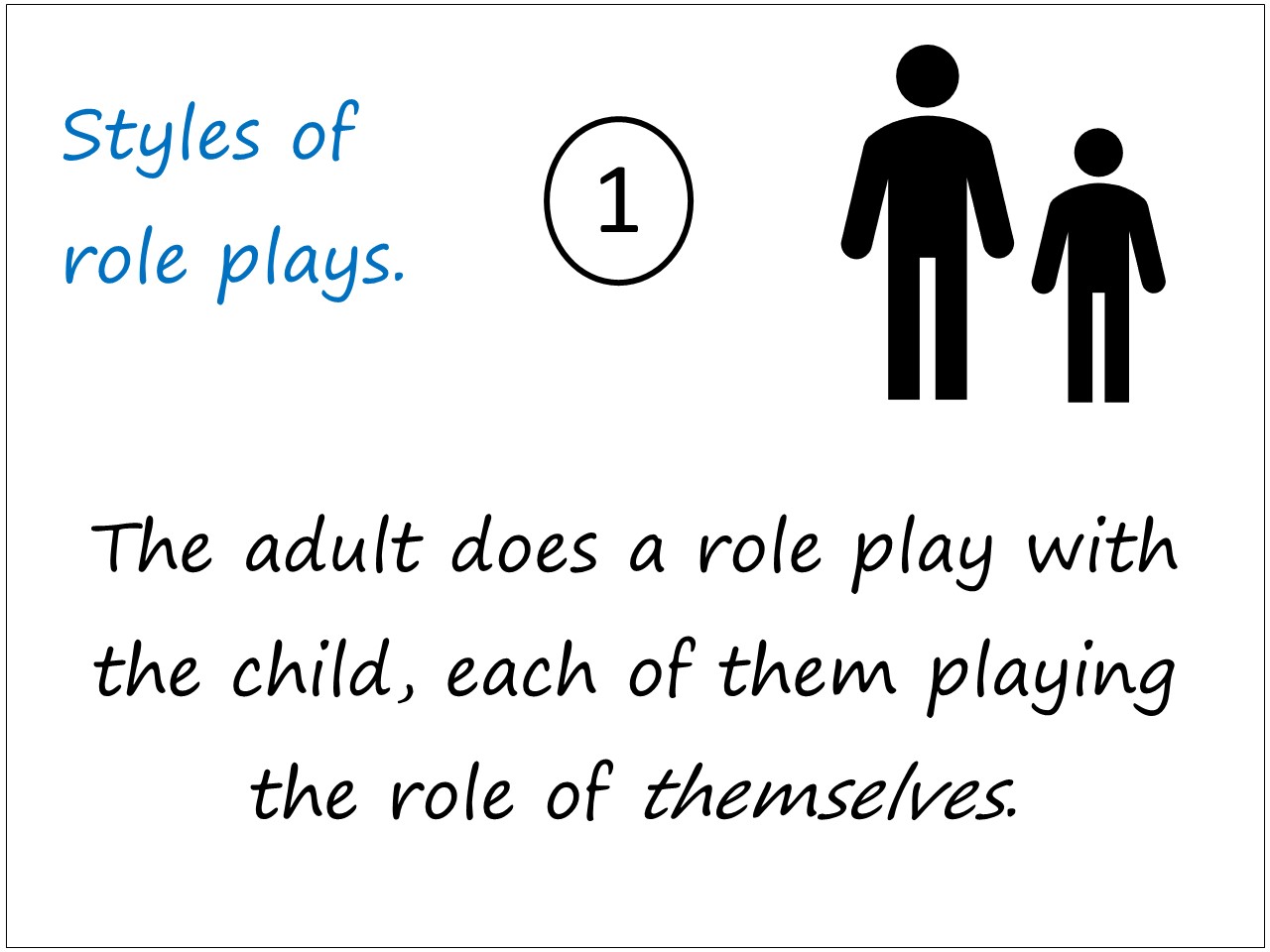
A simple role play set-up can be carried out by printing these How Was Your Day? script sheets and then following the prompts, with both you and the child being yourselves.

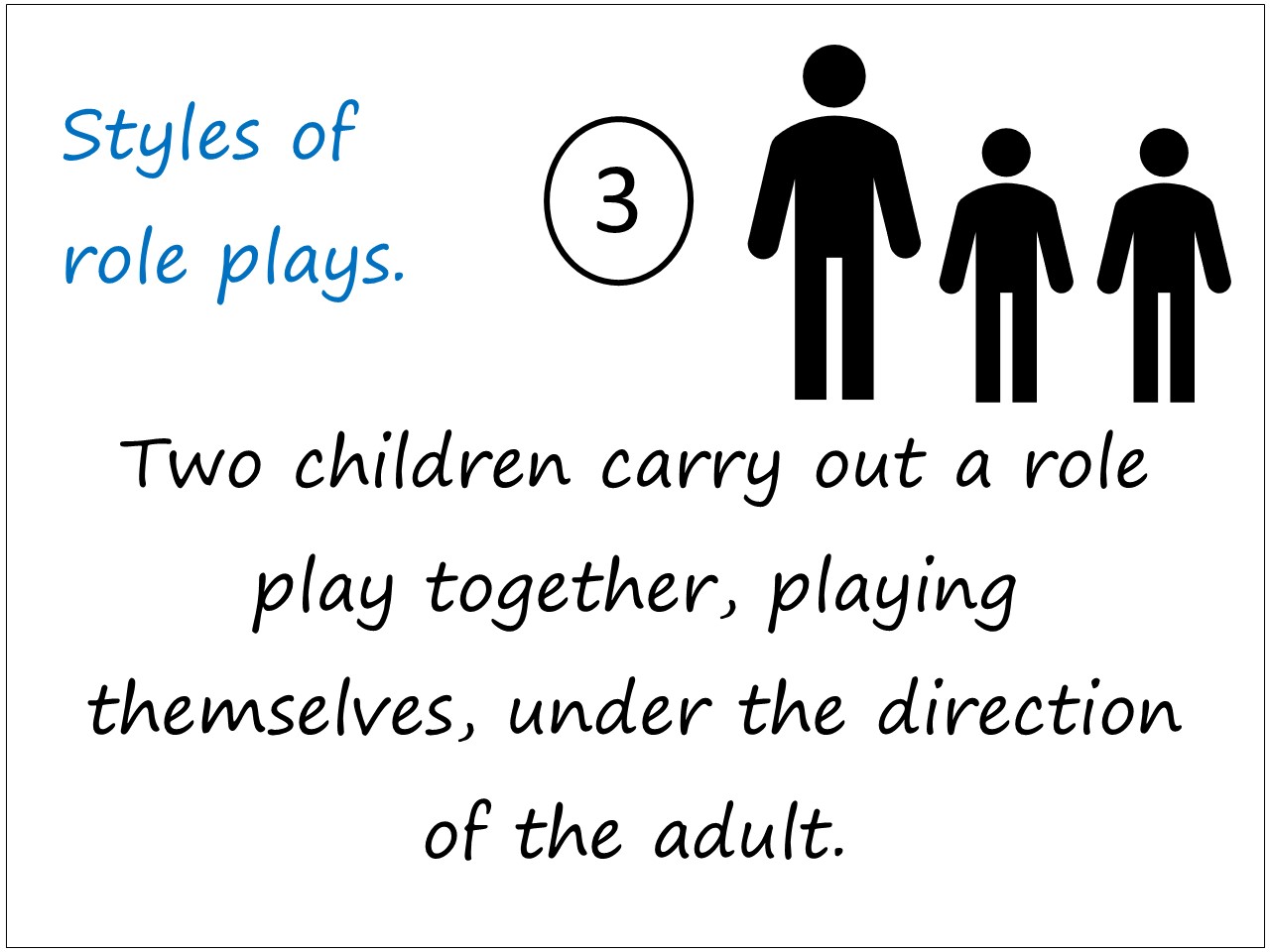
In my own work, my clients are accustomed to me saying things like, “Okay, I am going to play the role of Maria, a girl in your lunchroom.” You might assume that children with autism are too concrete to allow this, but actually that is seldom the case.
When you are setting up role plays like this, make your own role as executive director clear. A fun accessory is this free download to create a “Director” lanyard for you to wear when you are running the role plays.
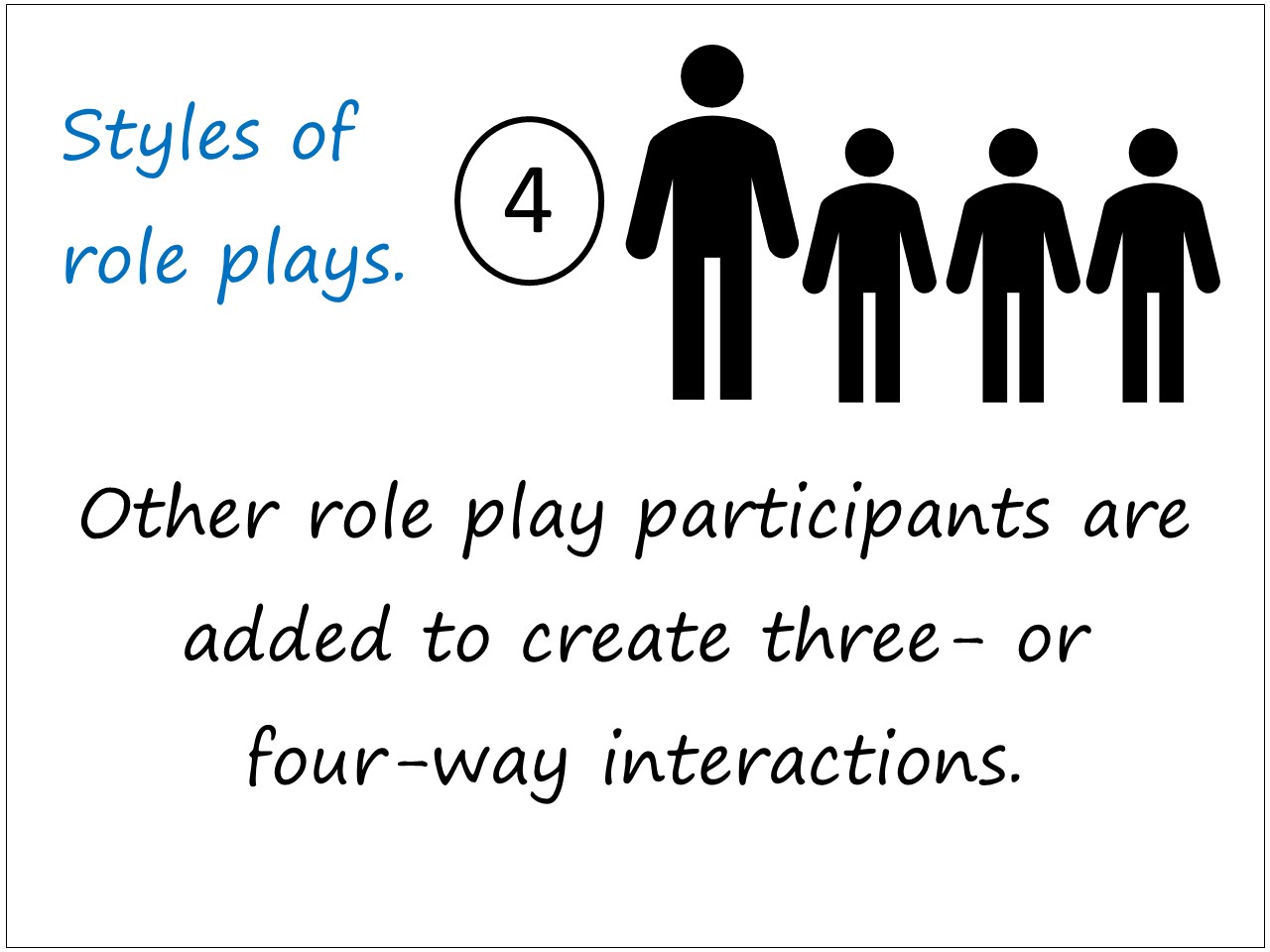
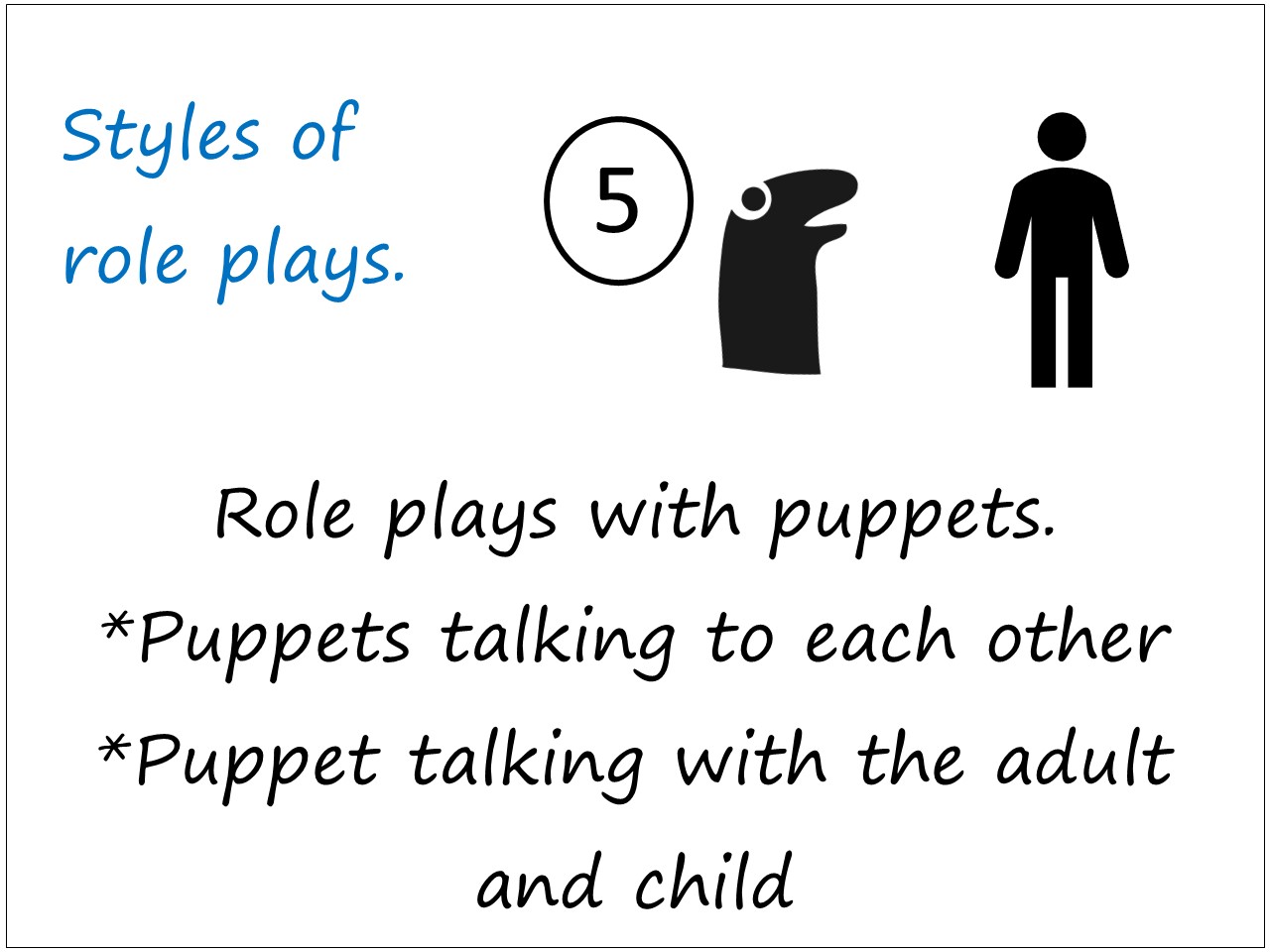
Here is a guide to using puppets in teletherapy – something you really should try if you do teletherapy.
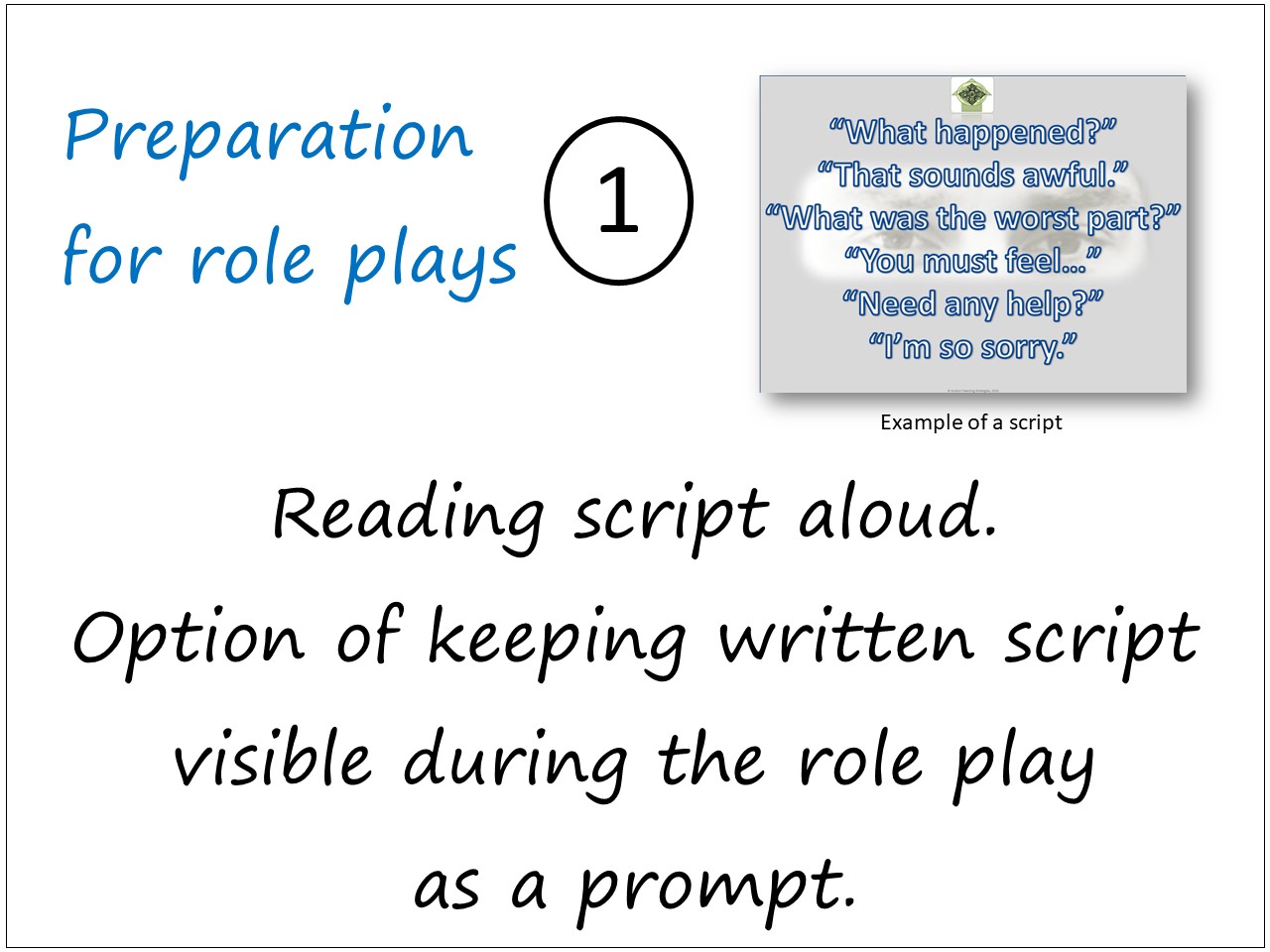
On my website, I have a great many written scripts to help guide role plays. Shown above is part of a free download on empathy / showing concern skills. A related empathy kit sets up role plays with pictures and brief scenario descriptions.
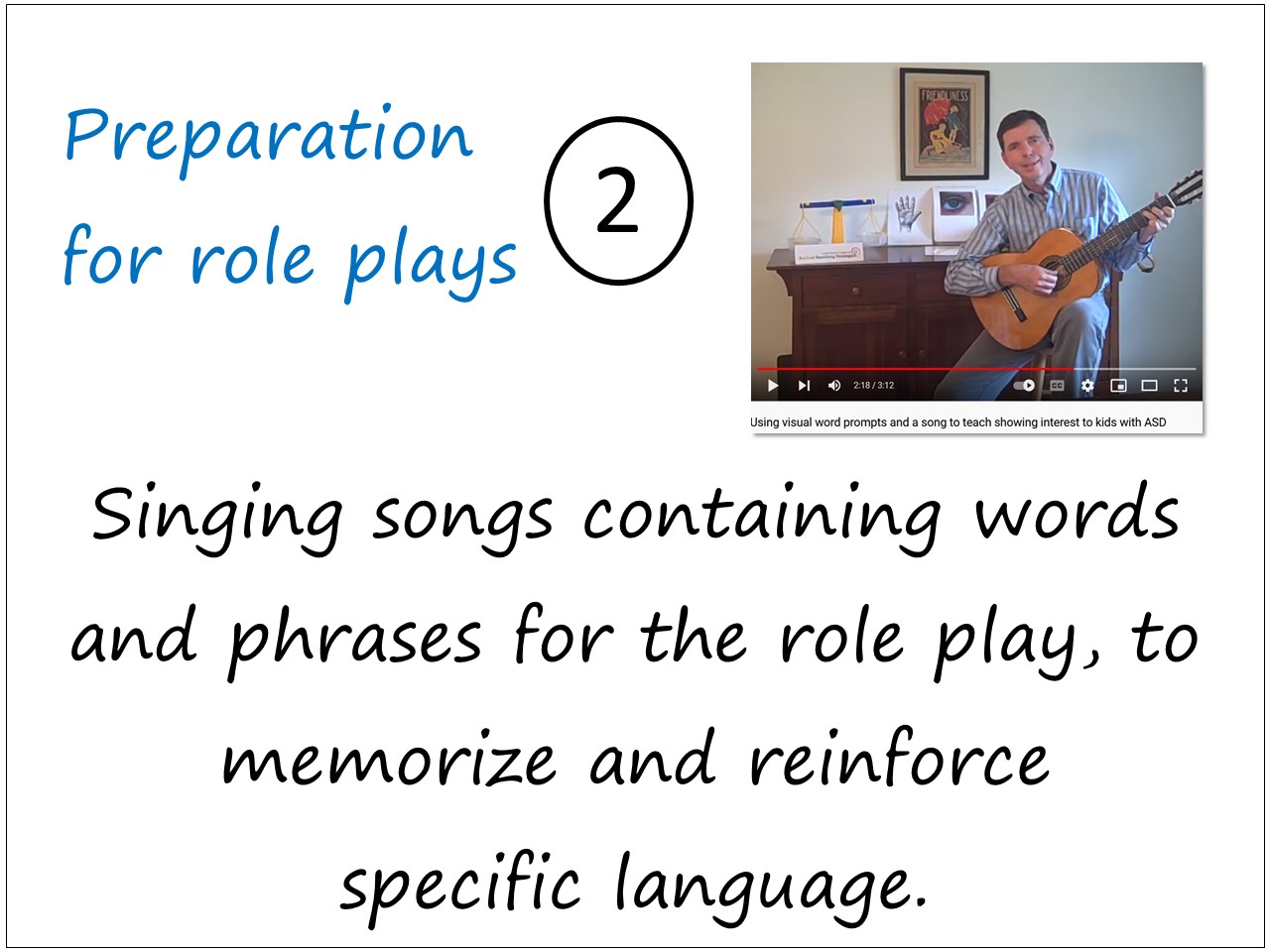
Don’t worry if you are kind of a bad singer (like me). Here is a short YouTube video in which I demonstrate a simple demo of useful language to “script” for showing concern for another person.
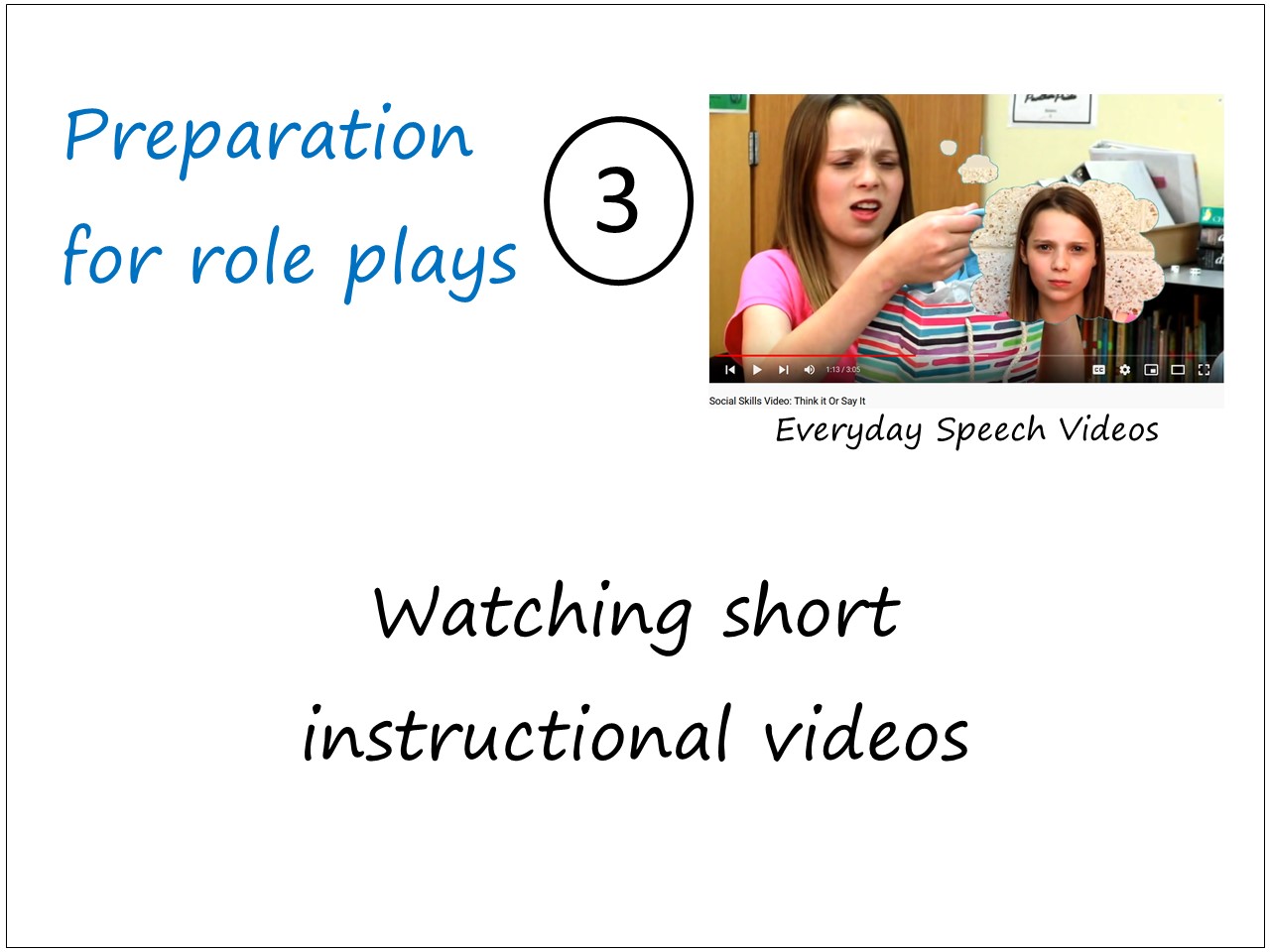
Everyday Speech Videos are invaluable for setting up role plays. You get them via subscription – they are well worth the cost. Here is a free sample on YouTube.
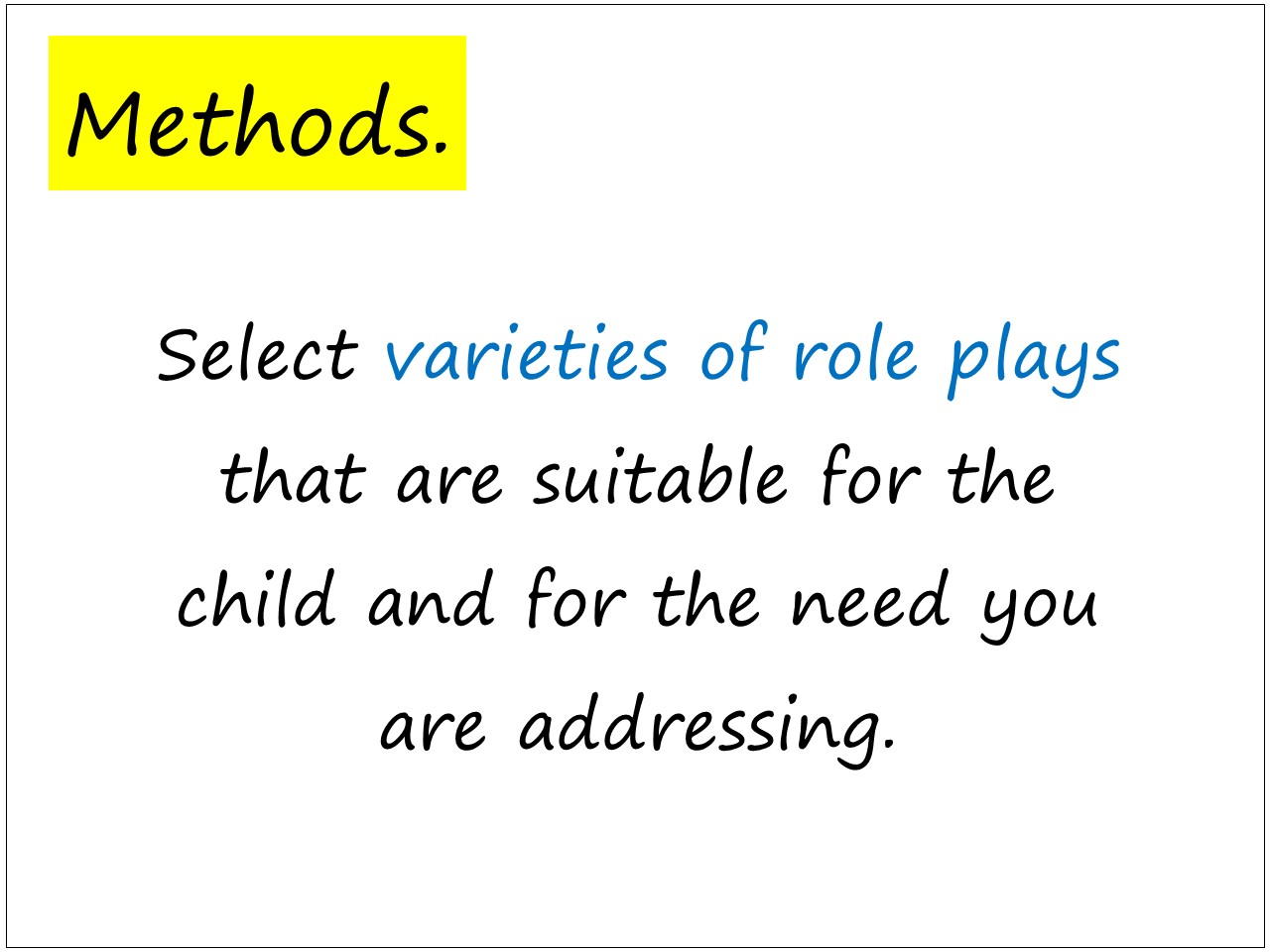
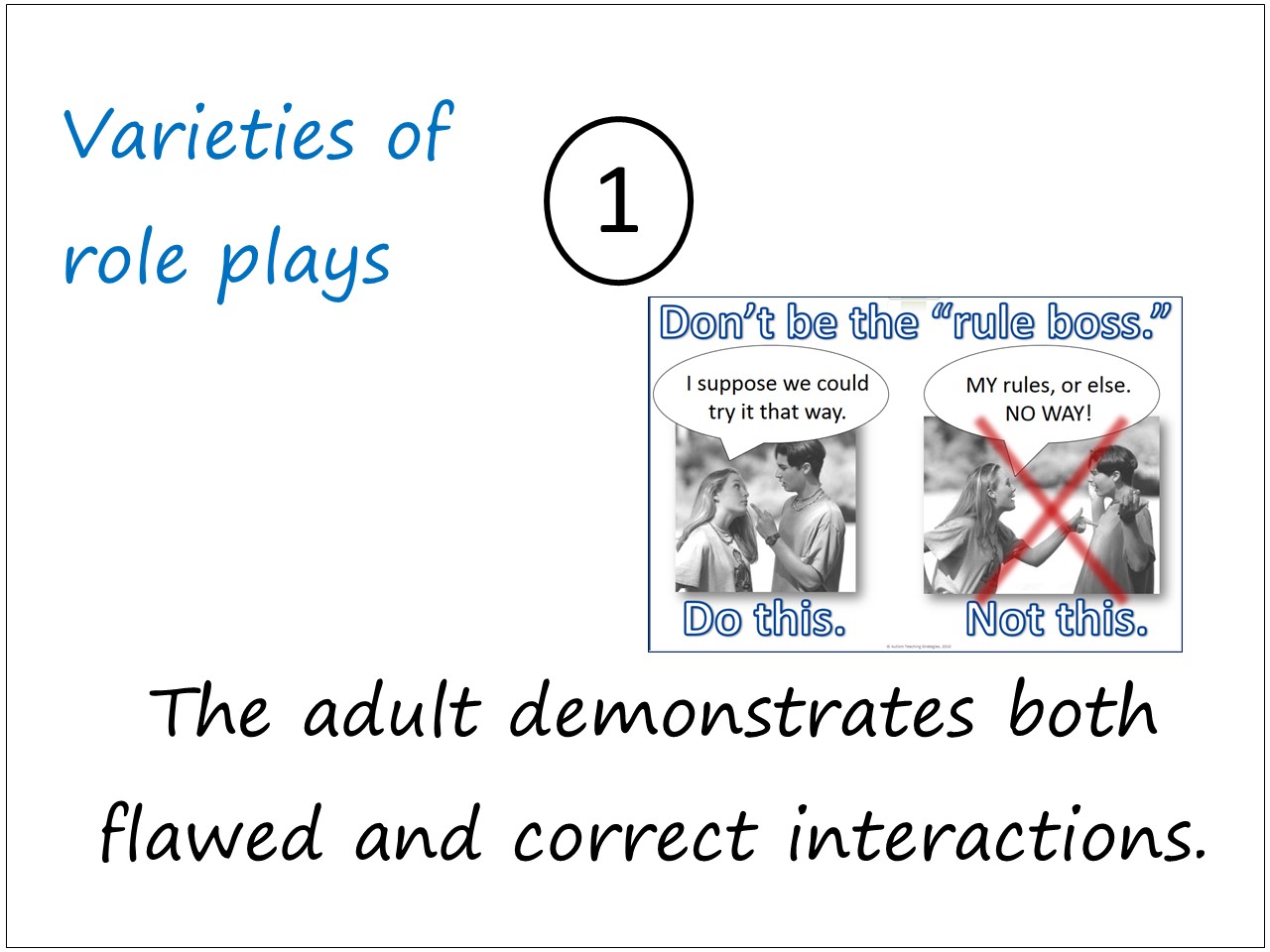
It is very useful for the adult to show what the incorrect social response looks and sounds like. Don’t have the child do it – just you, for instructional purposes. The image above is from a set of illustrated social skills print-outs on dealing with losing and disappointment.
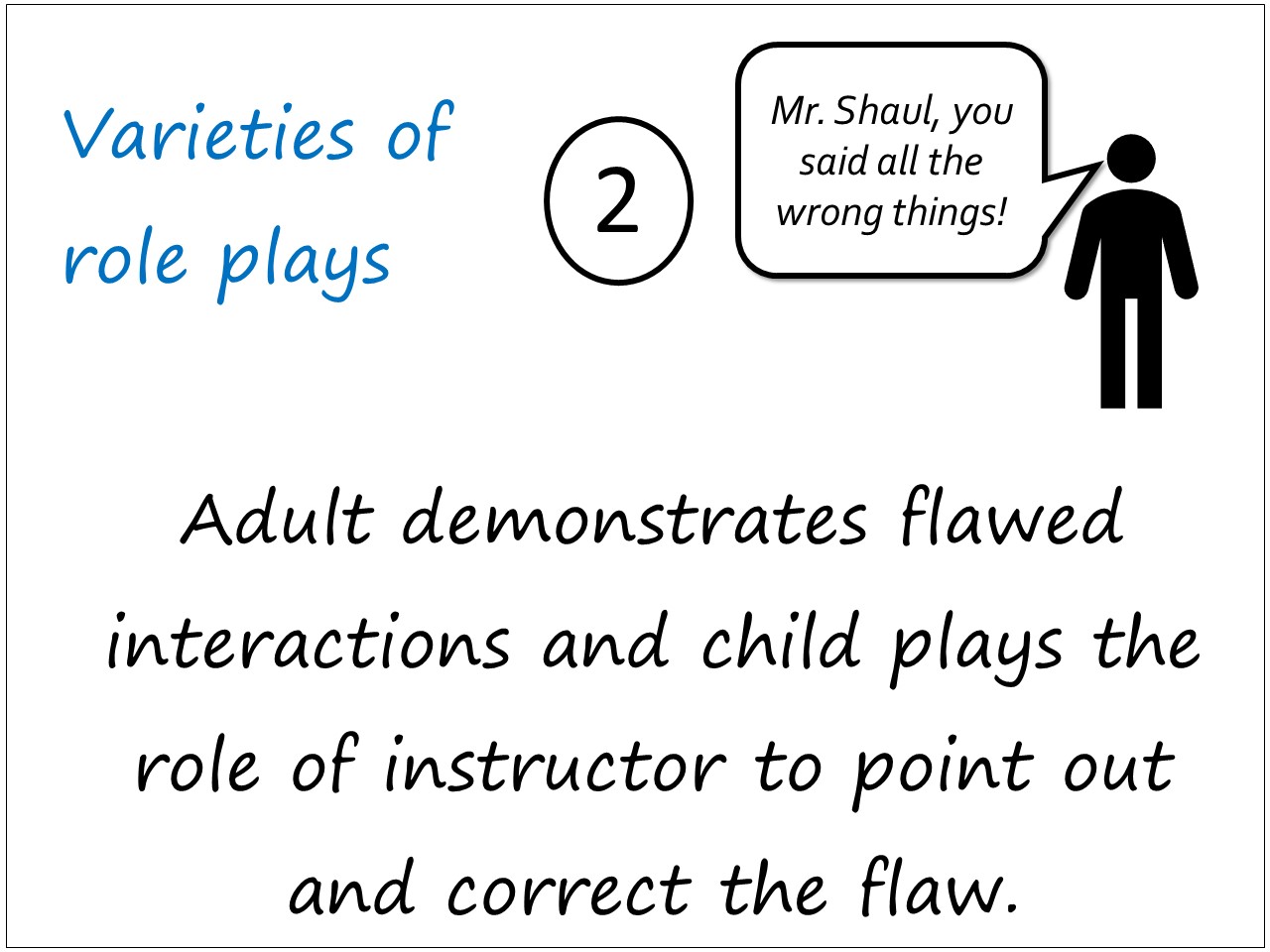
Children receiving social skills training get sick of being scrutinized, criticized and corrected by adults all the time. They always appreciate the opportunity to be the “expert” and point out flaws in somebody else. There are no downsides to using this technique – I do it all the time in my own work.
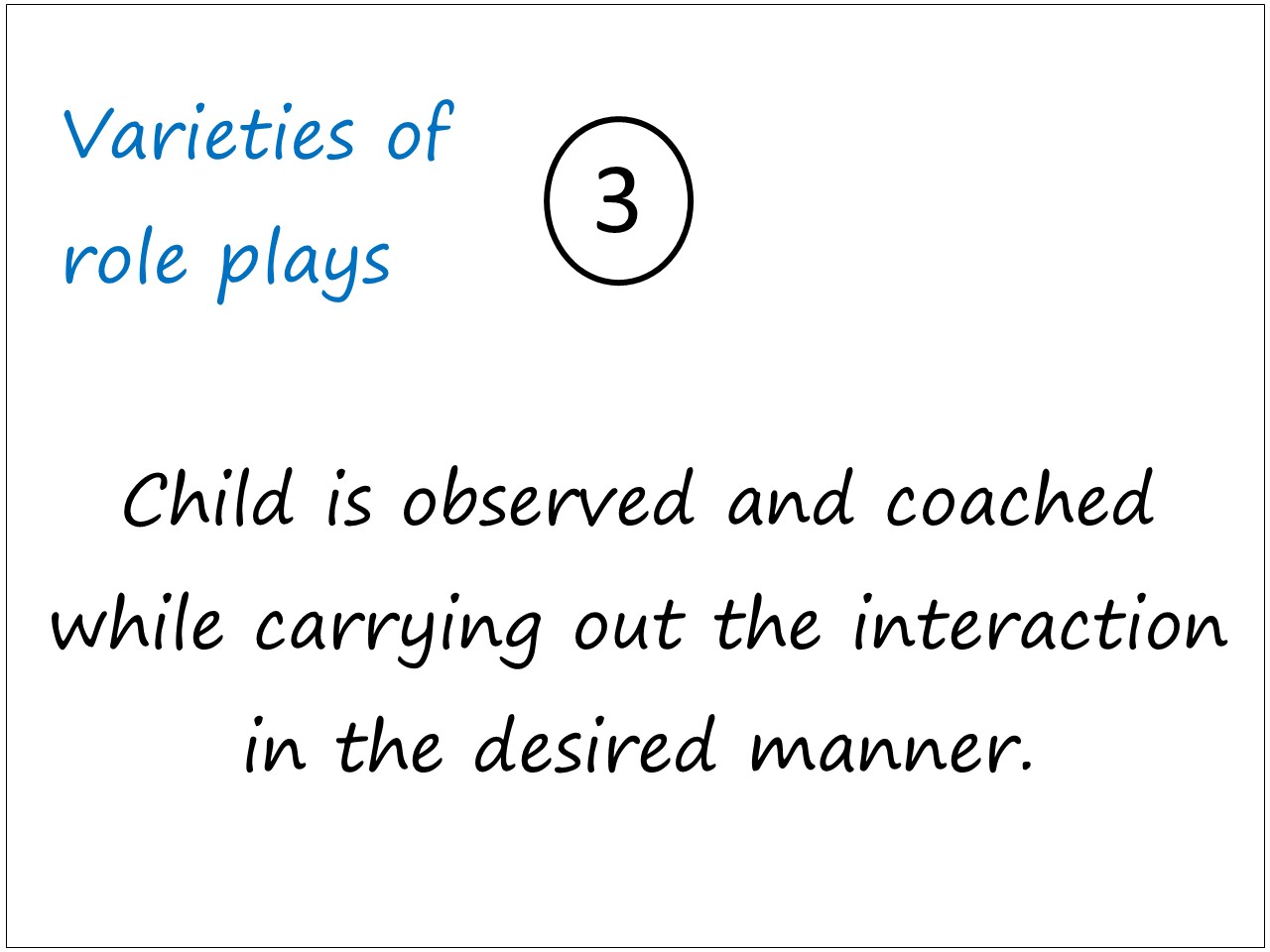
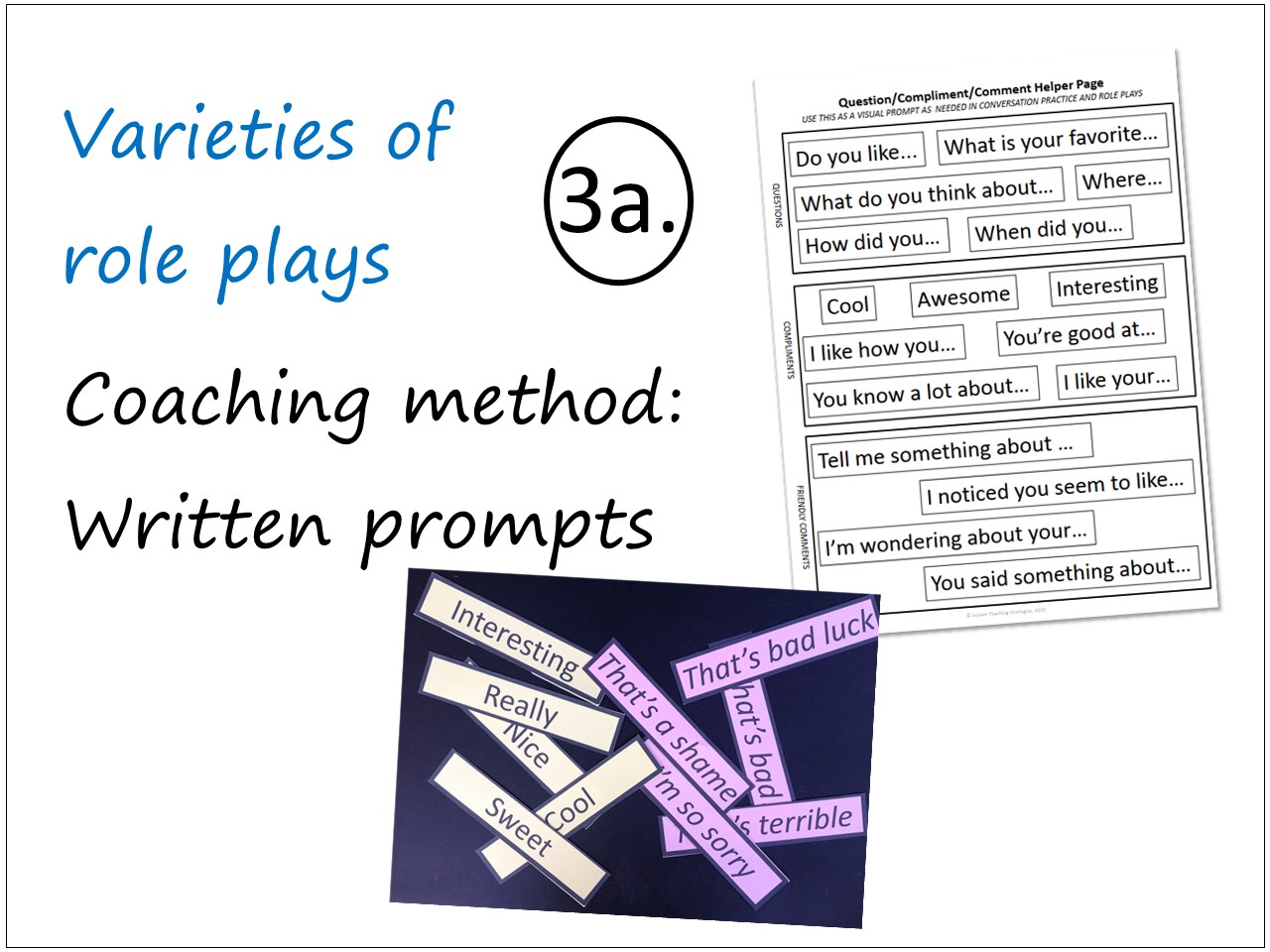
The scripts shown above are Validation Word Prompts and Question, Compliment and Friendly Comment prompts (go to page 8 of download).
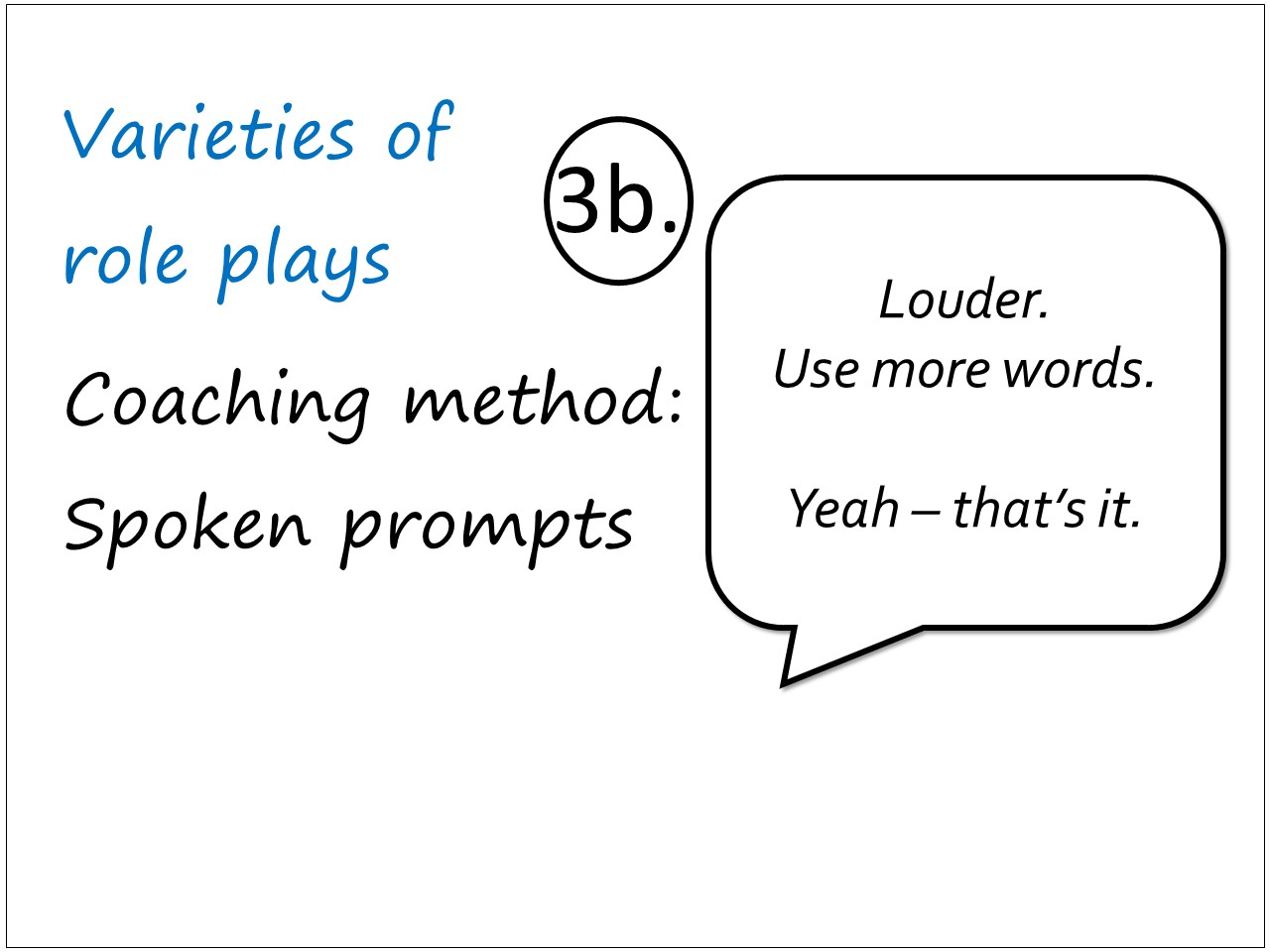
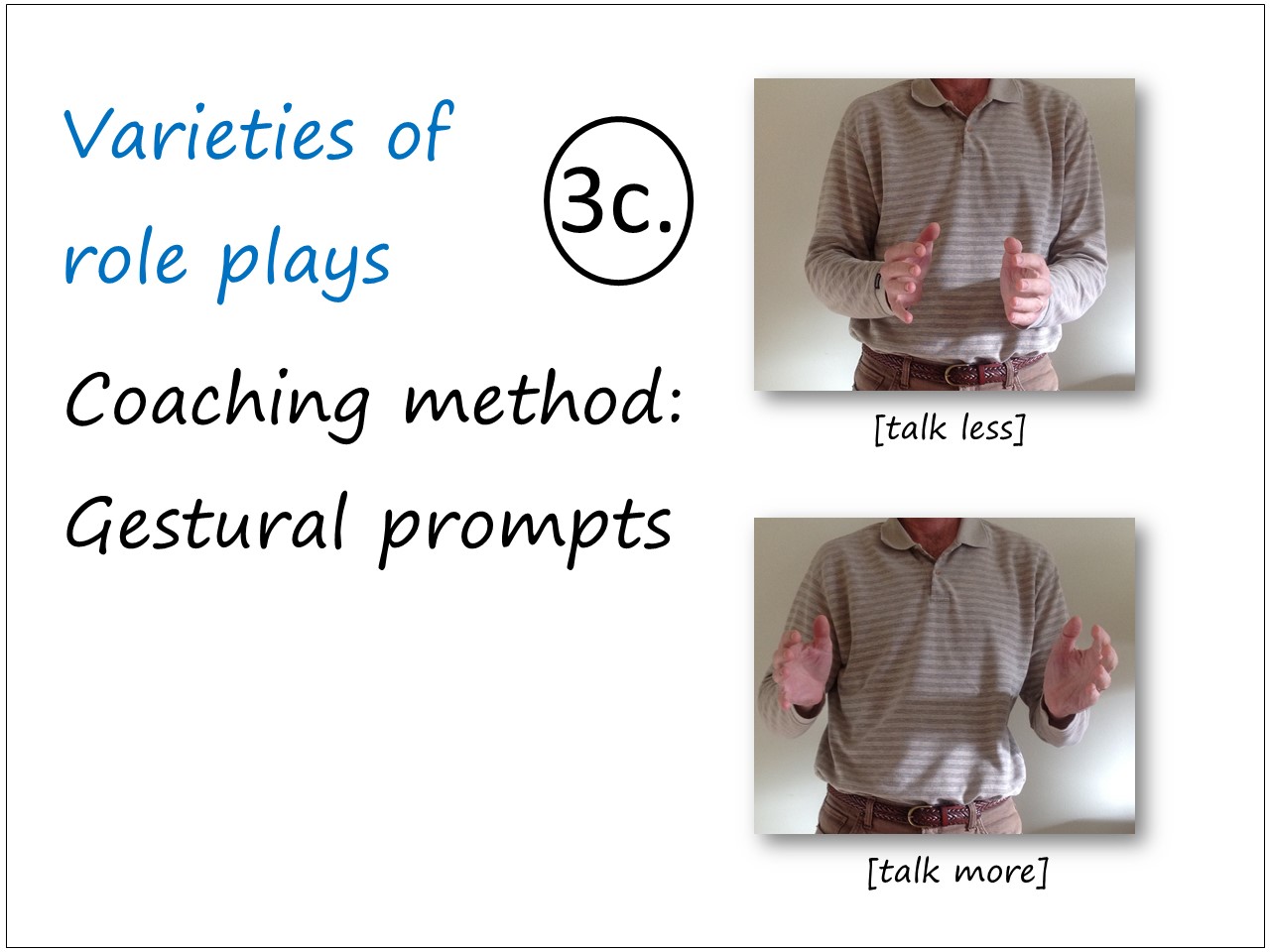
Other common gestural prompts include the one for “Cut!” and the one-handed gesture signalling “That’s enough…wrap up what you’re saying.”
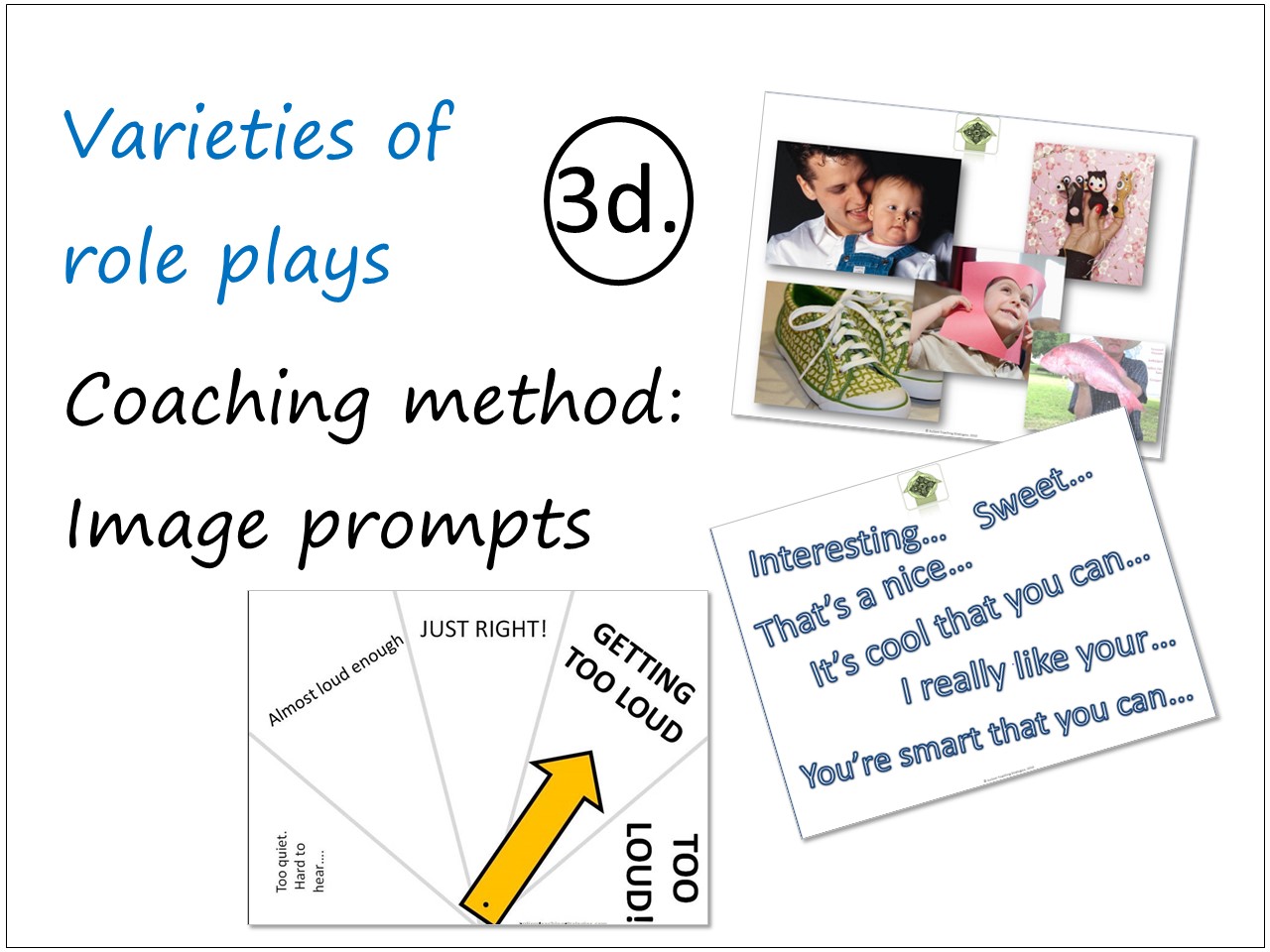
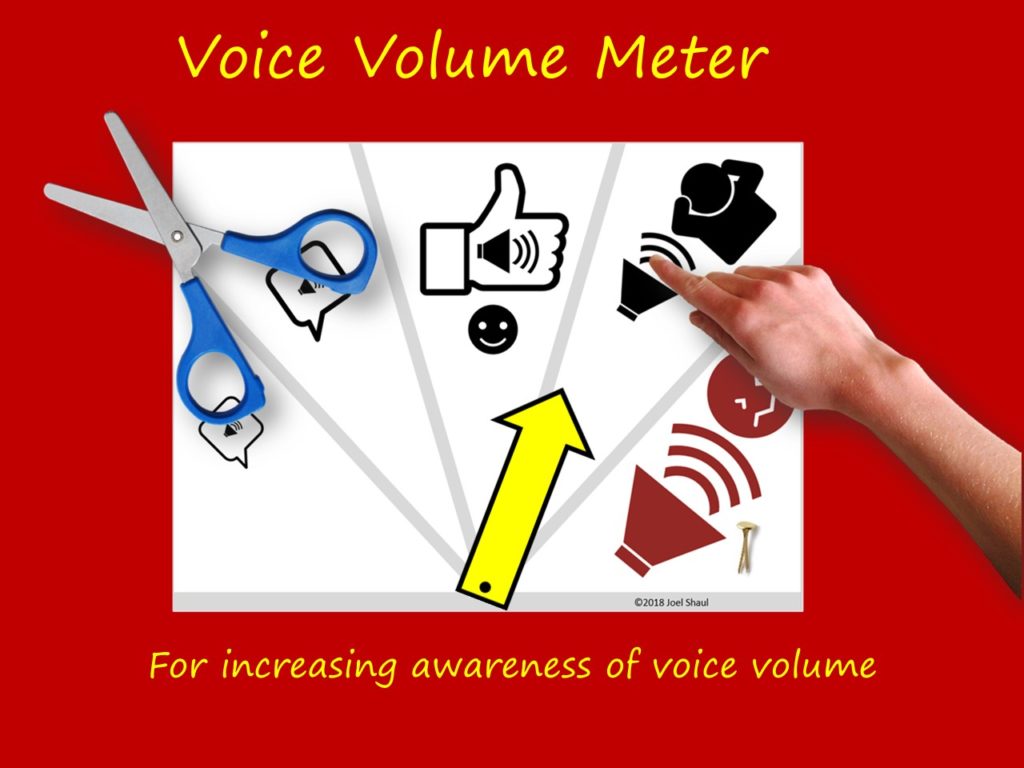
The resources shown above are Volume Meters and Compliment Picture Word Prompts.
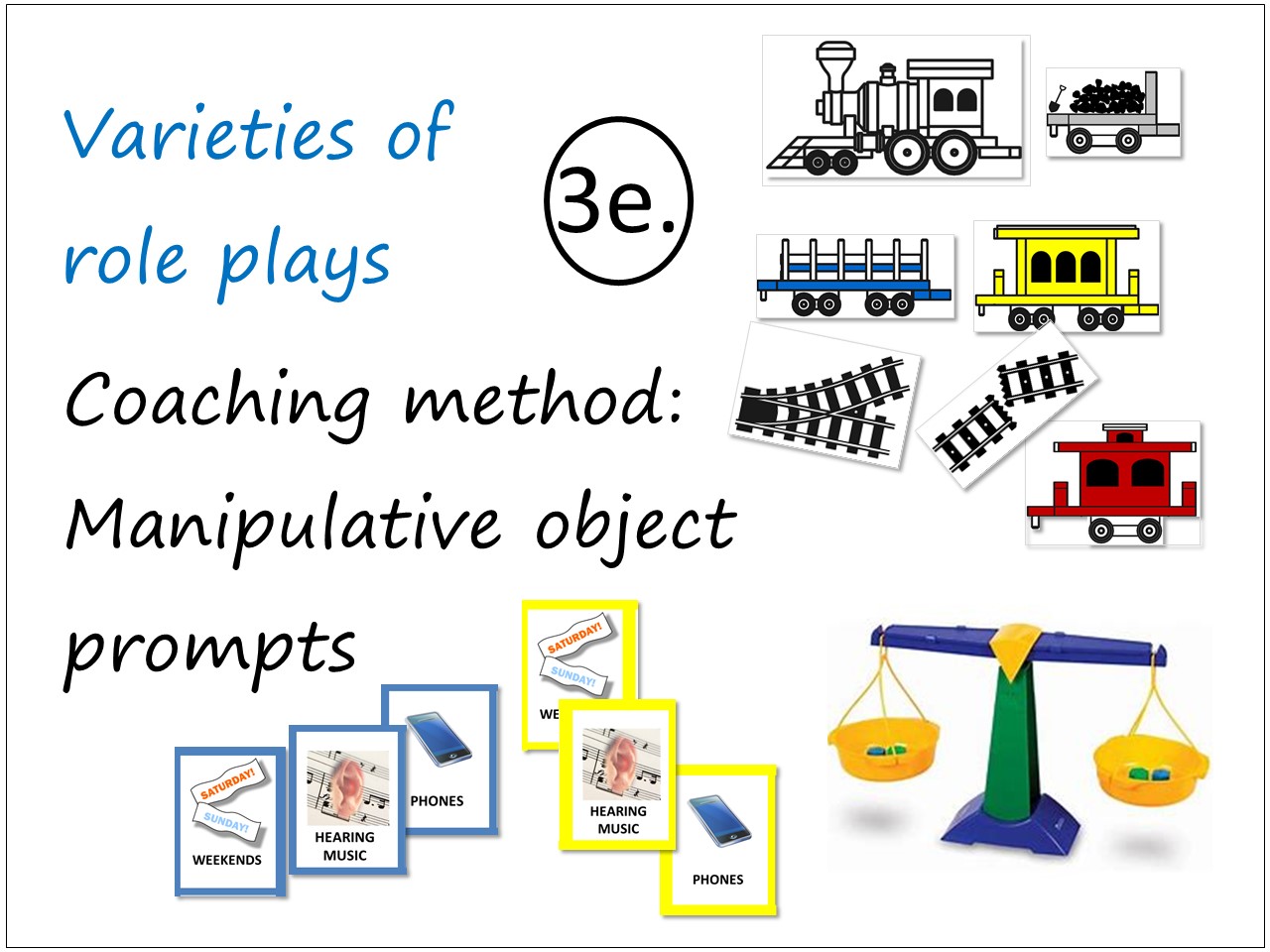
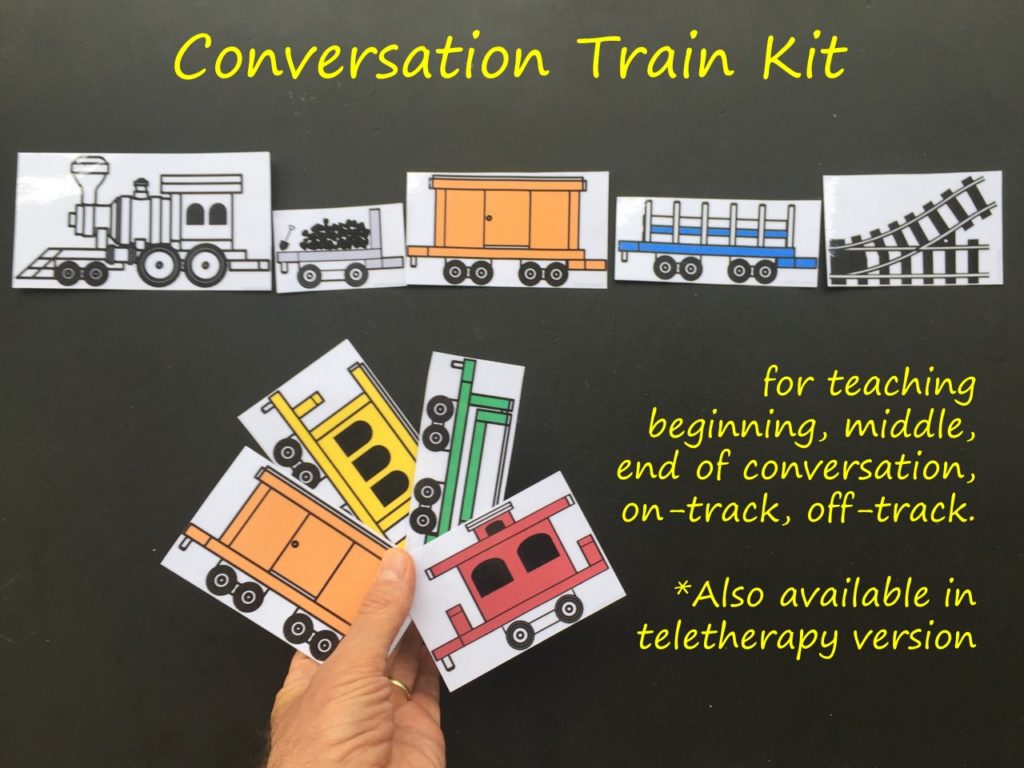
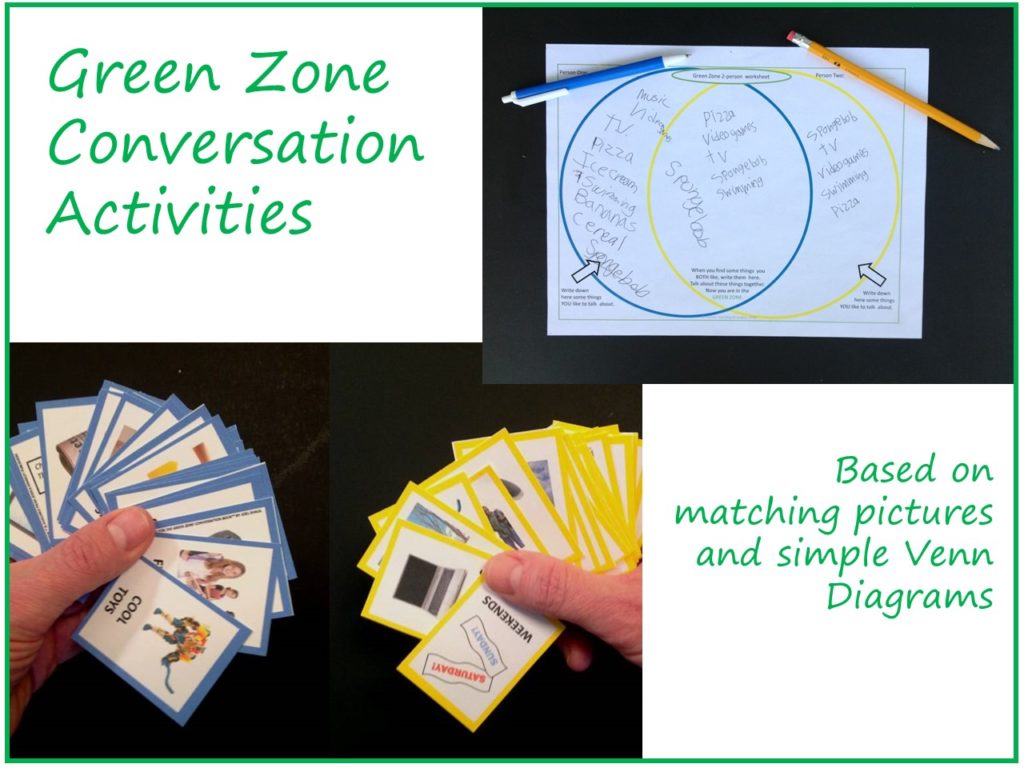
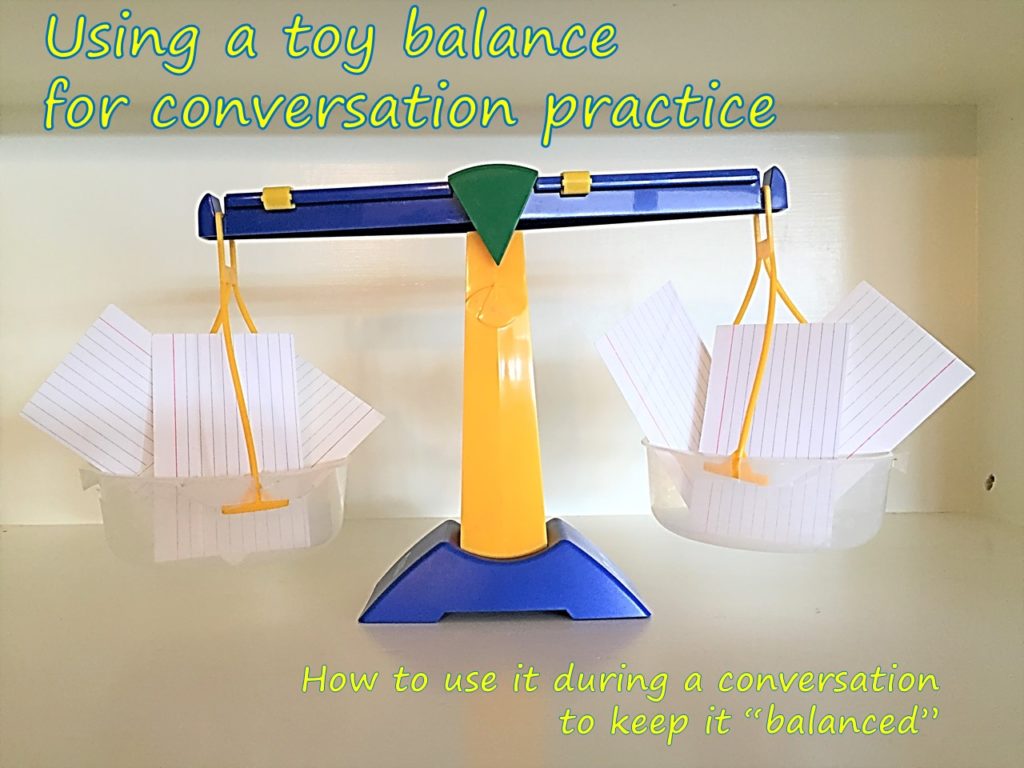
It might sound strange if you have never tried it, but it can be very engaging and effective to conduct role pays at the same time you manipulating objects between the role play participants, or having them move the objects themselves. The balance is an extremely useful, moveable prompt for reciprocal role plays. I explain how to use it here. The Train Conversation Printable Kit is used to map out a conversation in real time while it is happening, with beginning, ending, changing topics and “off track.” The picture cards shown are two pairs of matching 23-card decks which two conversation participants use to compare interests and find common ground (Green Zone Picture Card Activity).
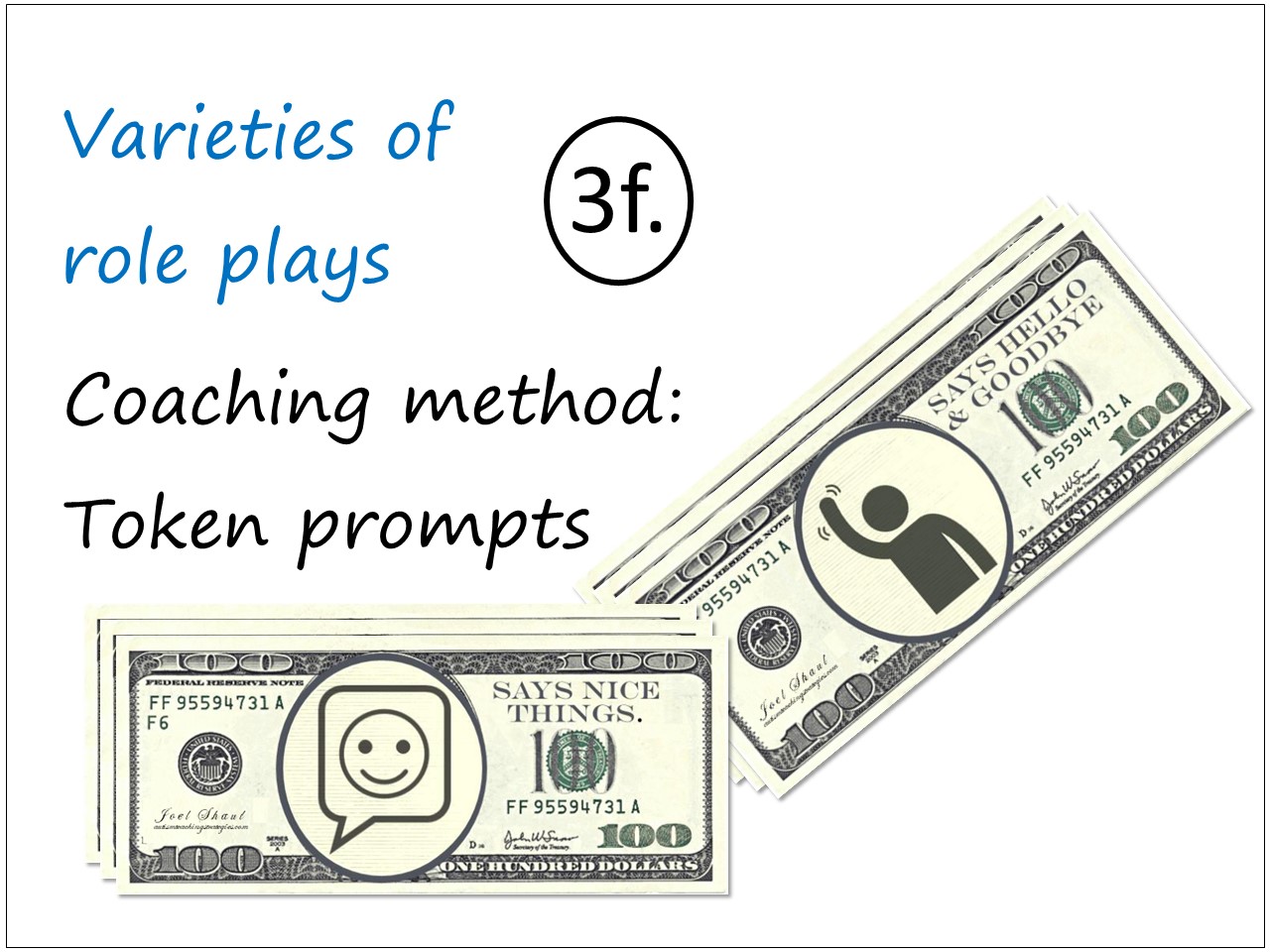
You can use token prompts in a variety of ways in role plays. For example, if you are trying to get a child to practice hellos and goodbyes, or give compliments, you could hand out these free downloadable money tokens.

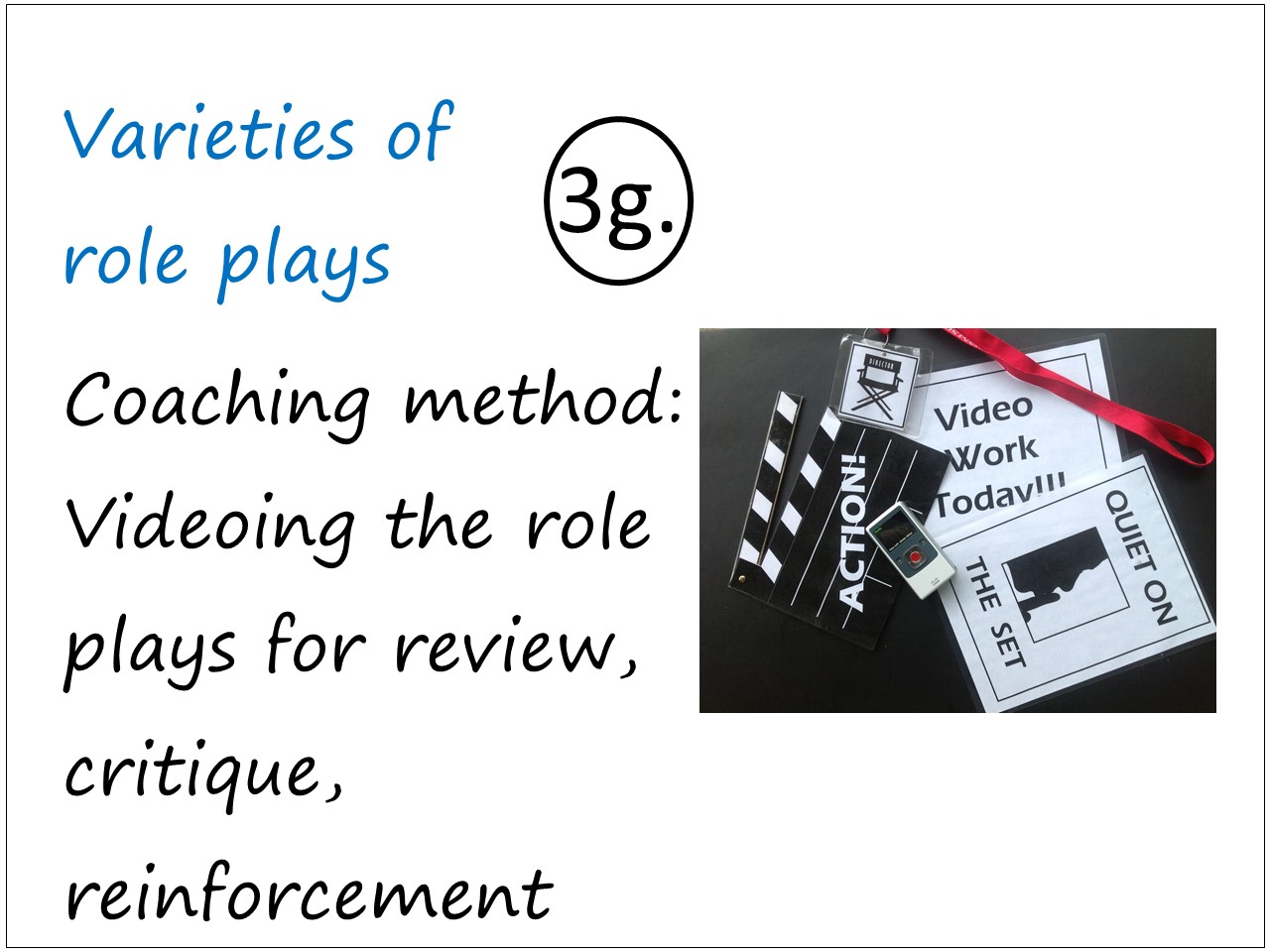
I shoot video and replay video all the time in my sessions. It almost always makes role play work better. Most young people like it a lot. I honestly cannot figure out why other clinicians don’t use video cameras very much these days, except to avoid having to fill out permission forms and so forth.

I have a very good tutorial on using video cameras, and some nice download accessories, on this website.

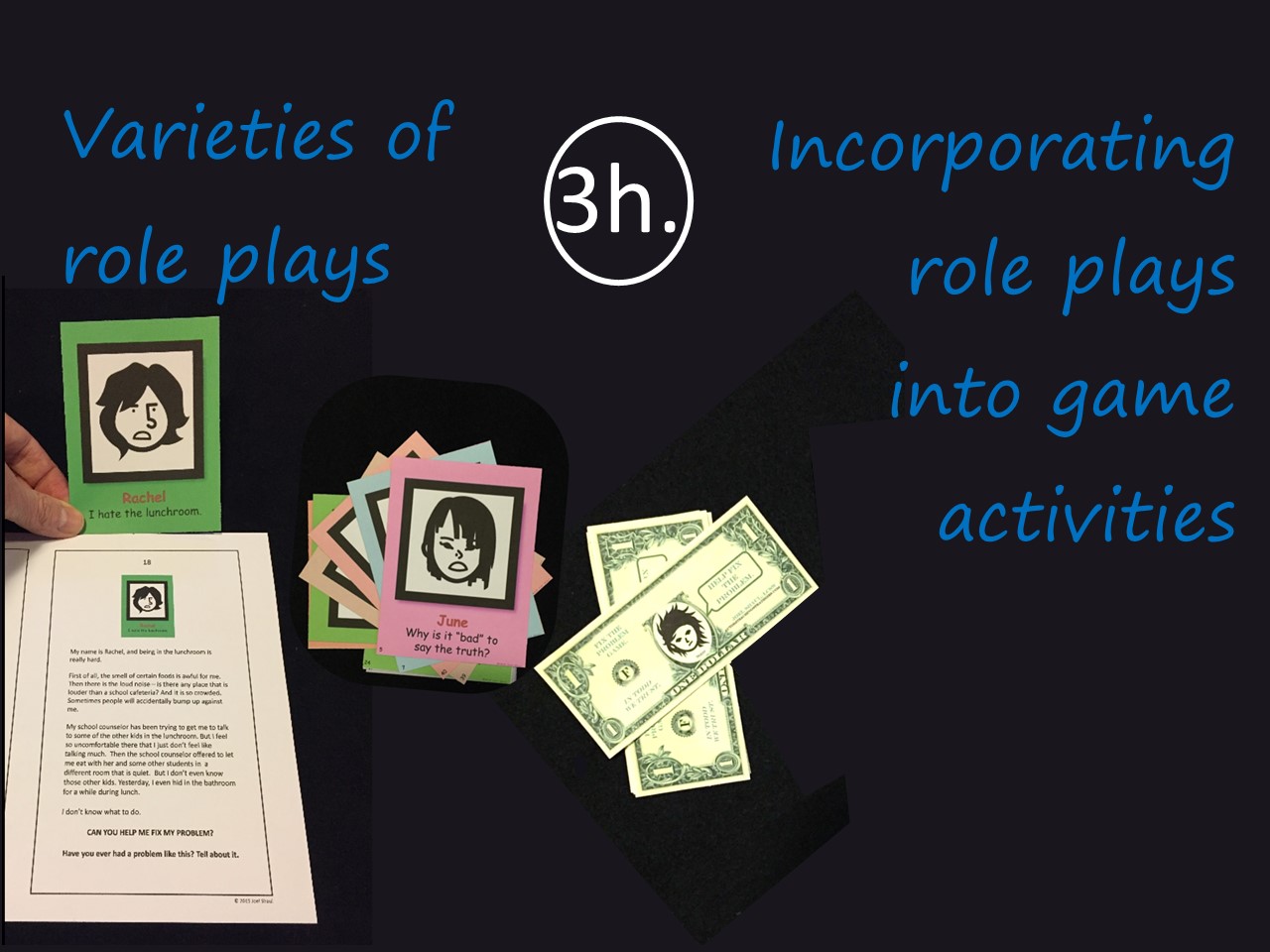
Many of the card game activities on my website have role plays built into the game. One of them, Fix the Problem Game, is shown above.


I hope this information, and these resources, helps to make your role play work engaging and productive.

Joel Shaul, LCSW
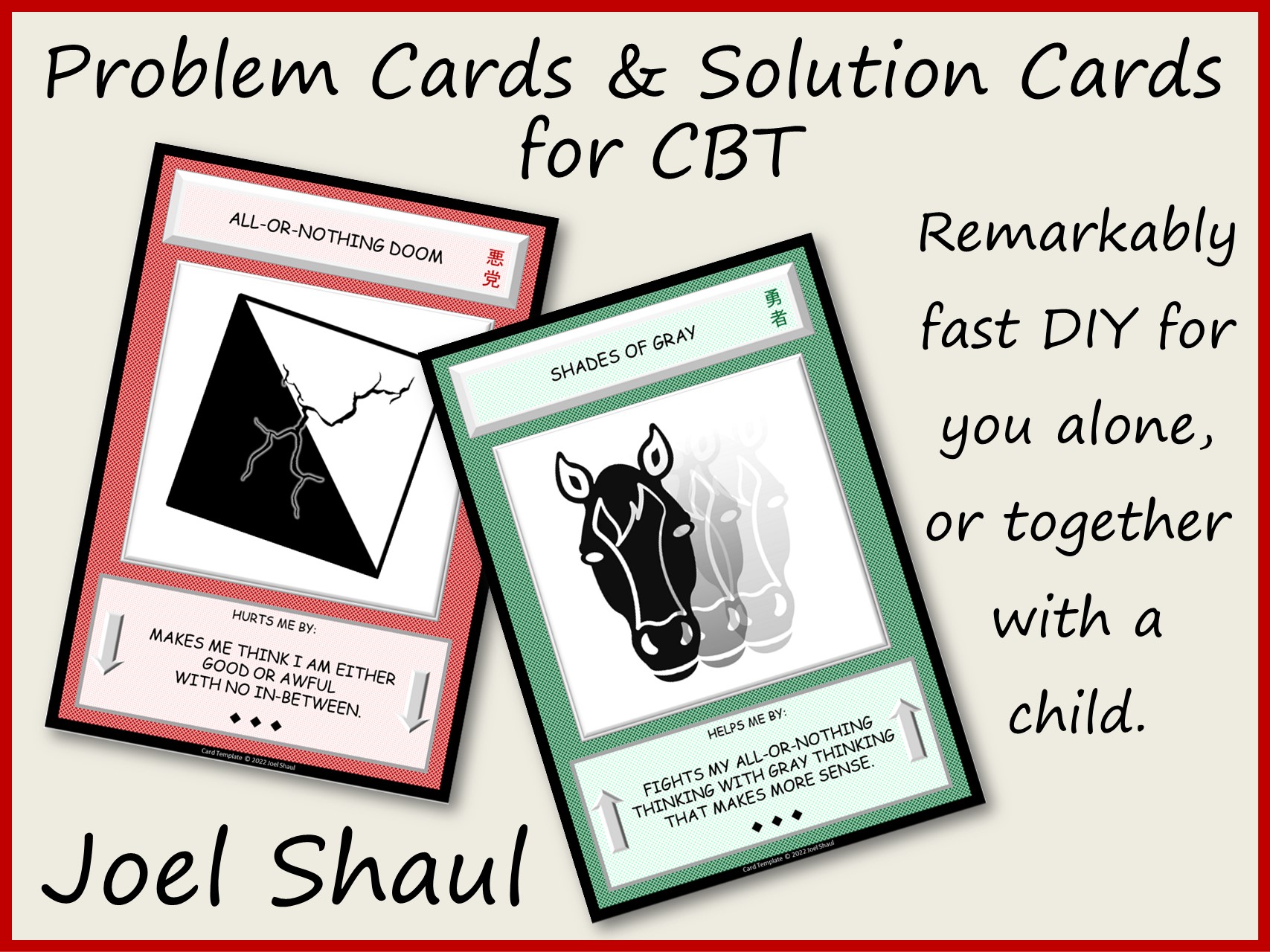
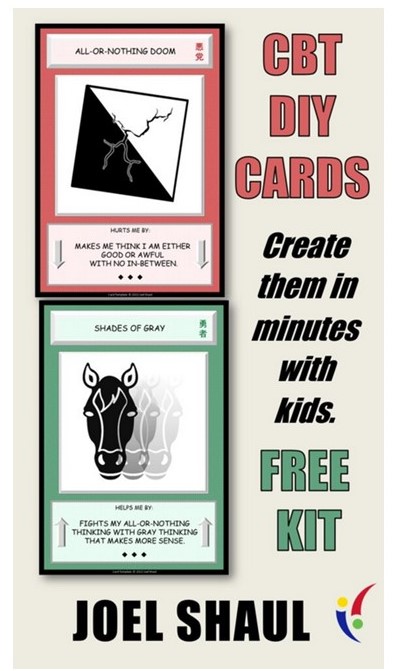
Problem & Solution Cards II: CBT variation. Easy & helpful mental health PowerPoint-based activity

Cognitive behavioral therapy picture cards for children and teens to focus attention on cognitive distortions

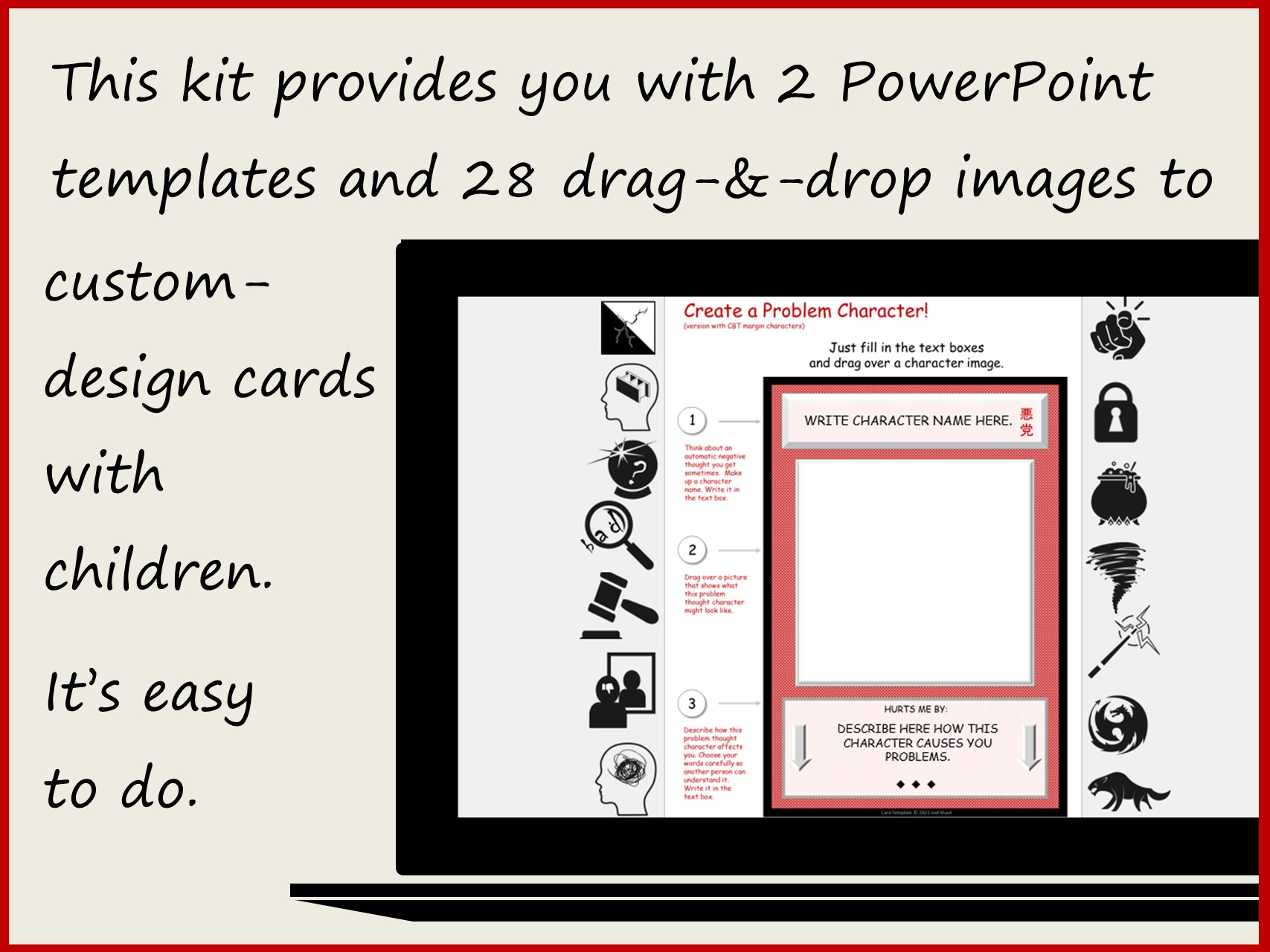
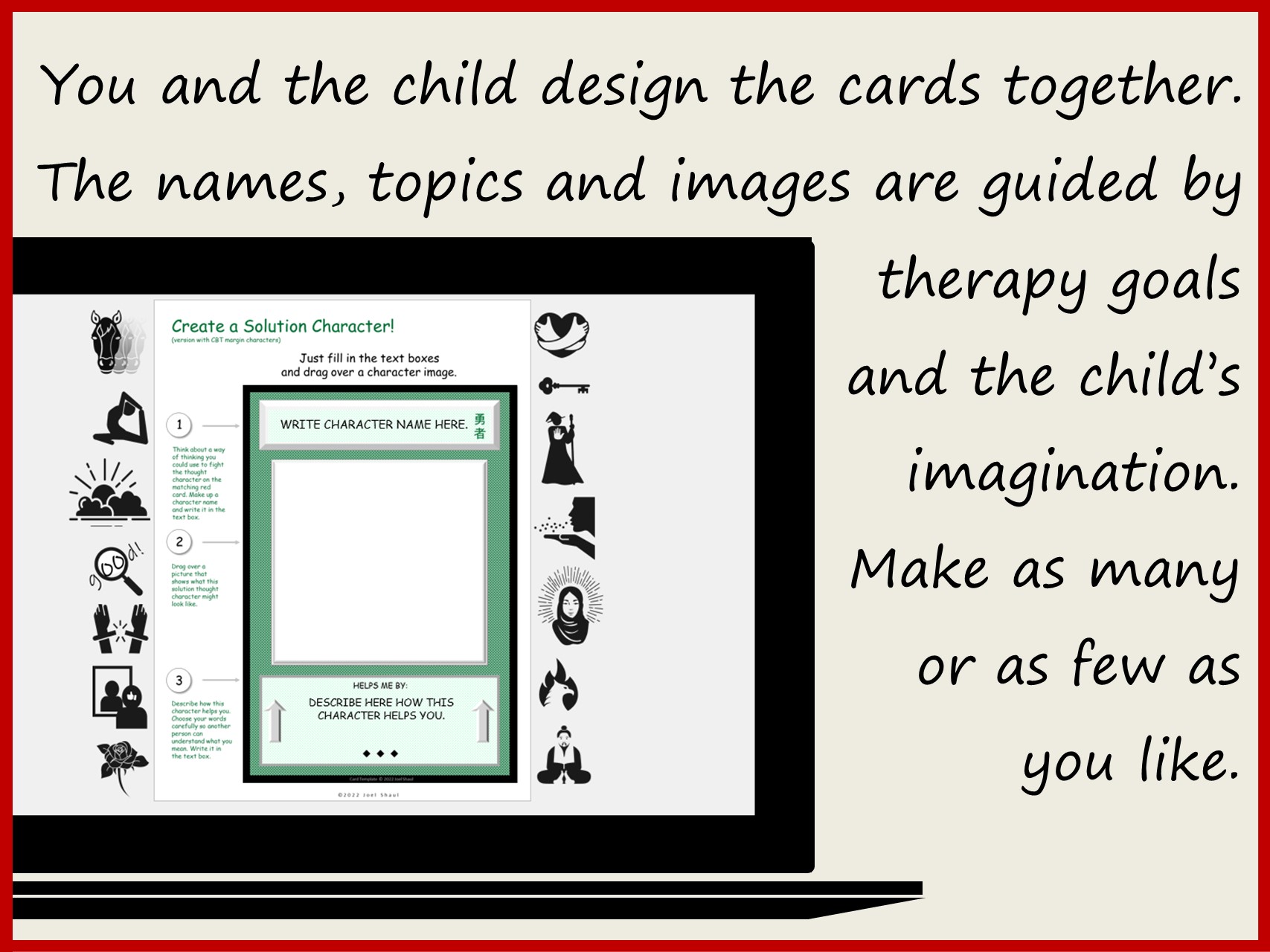
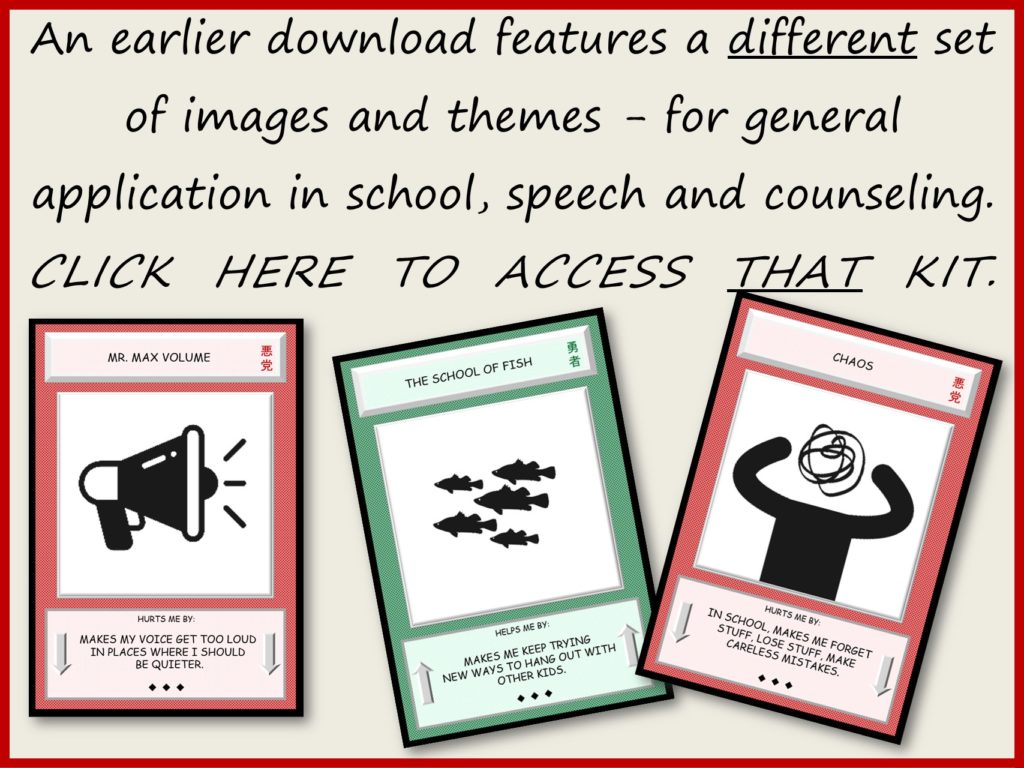
A previous post introduced the first version of this activity featuring a different selection of drag-and-drop images for a variety of social and emotional concerns. Here I provide a second version, featuring images tailored for CBT work.

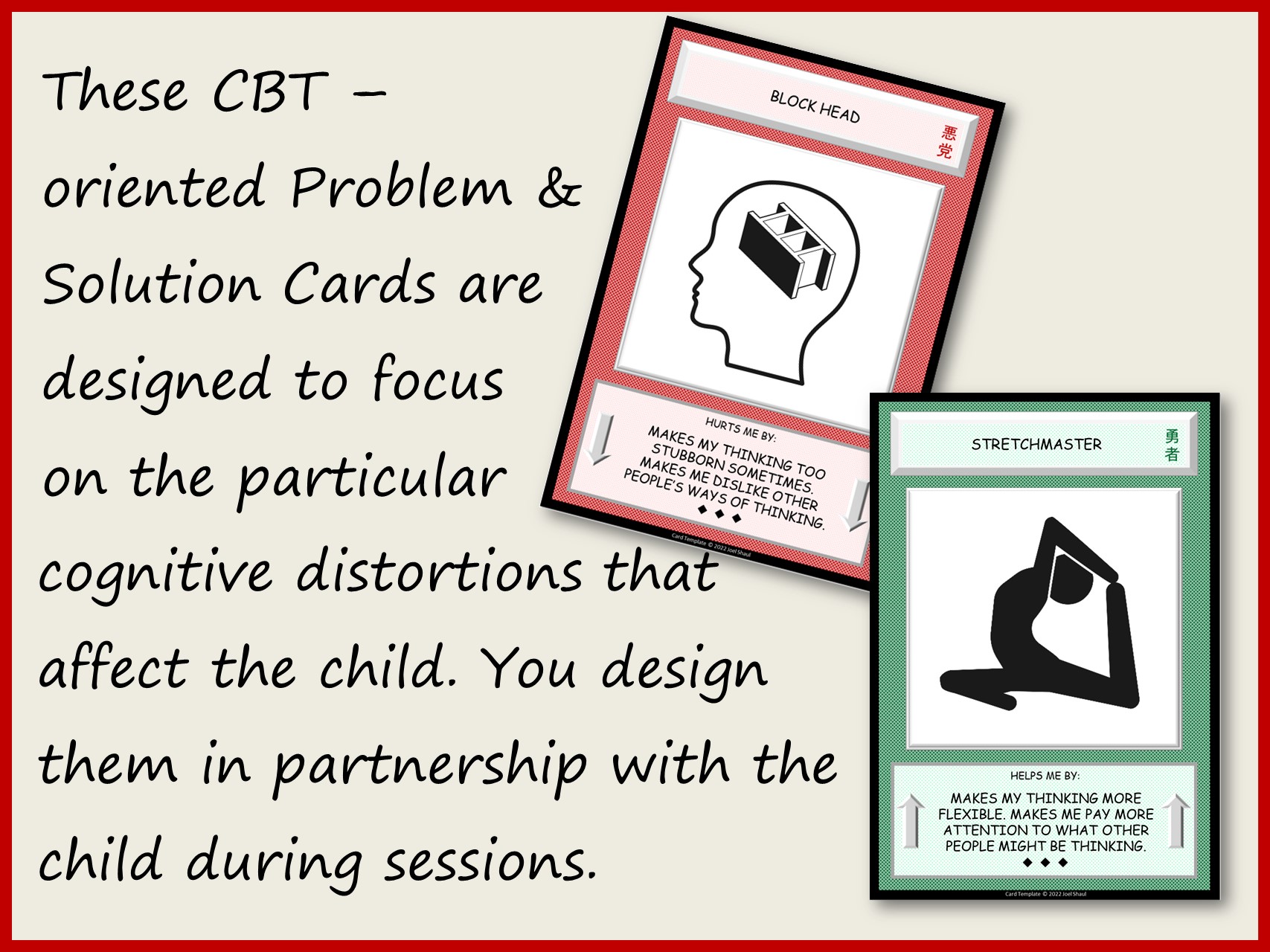
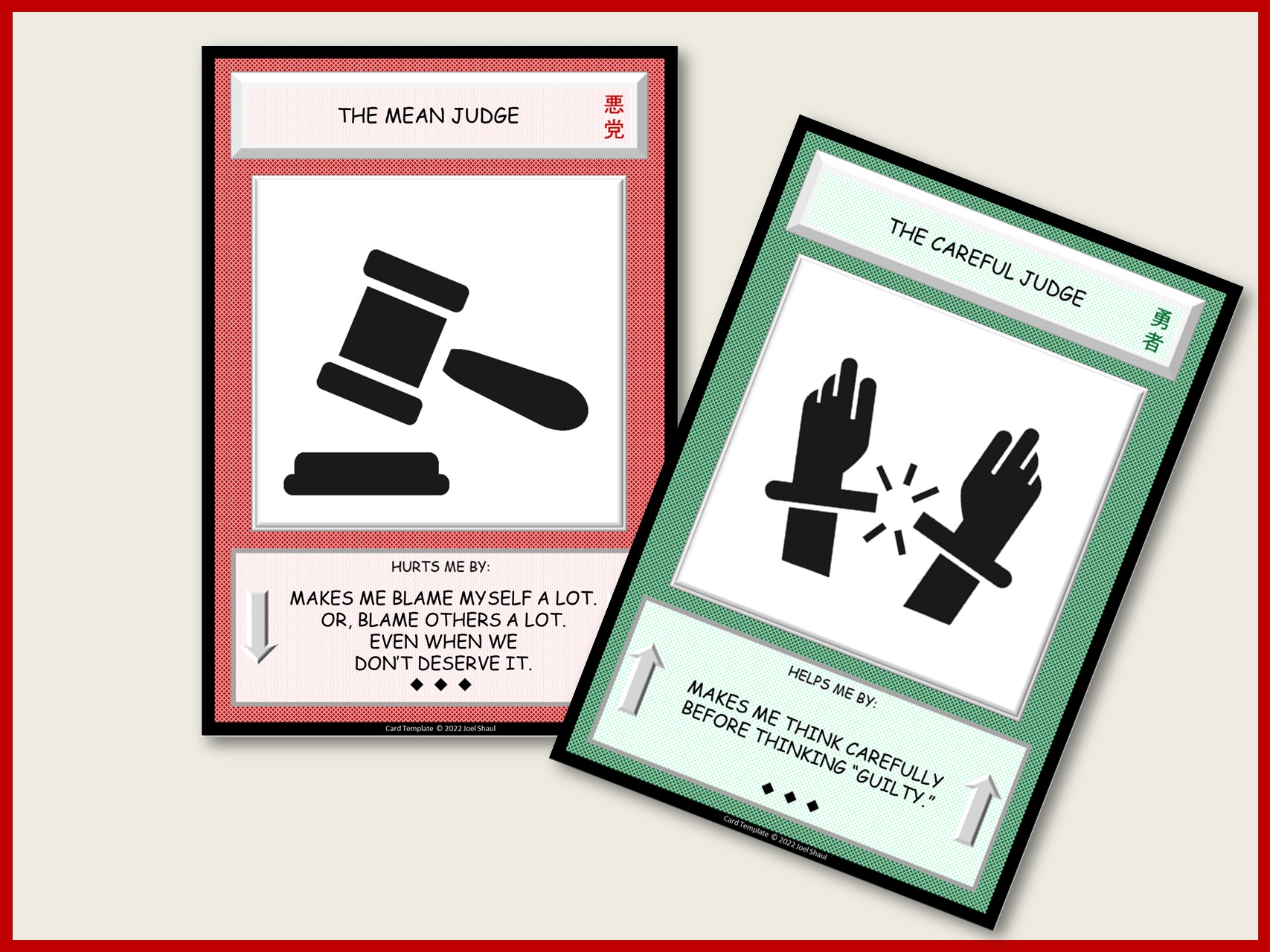
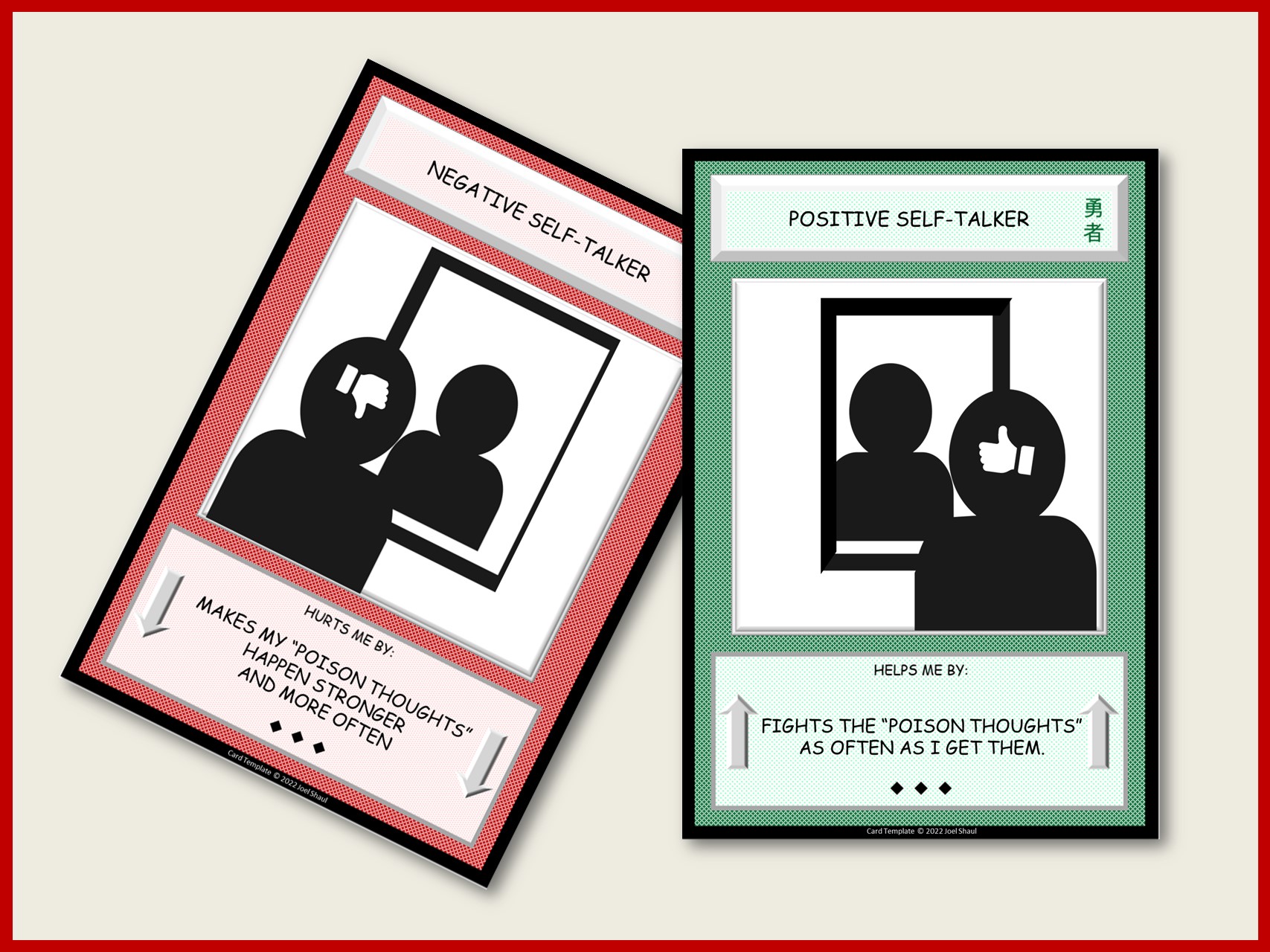
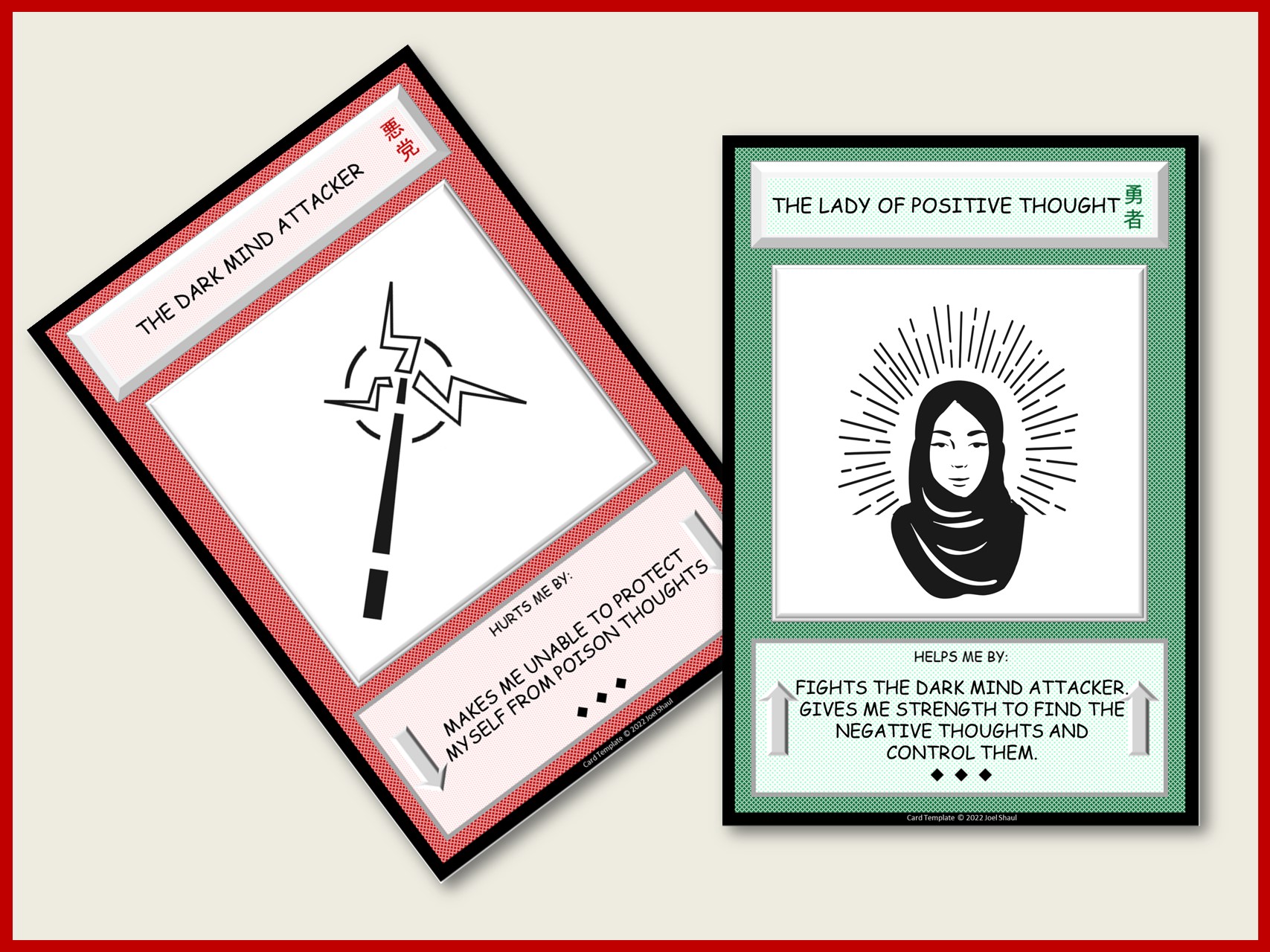
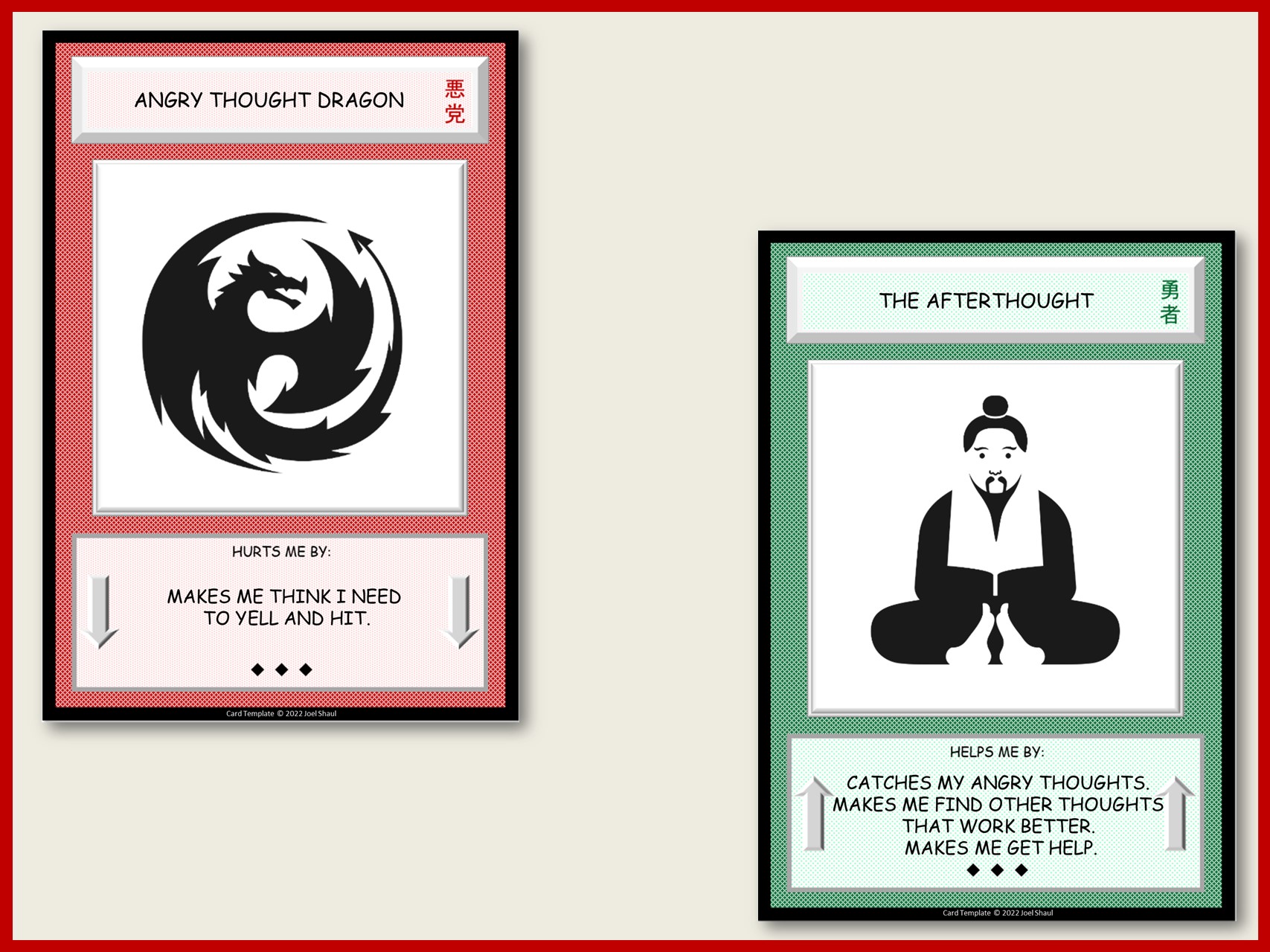
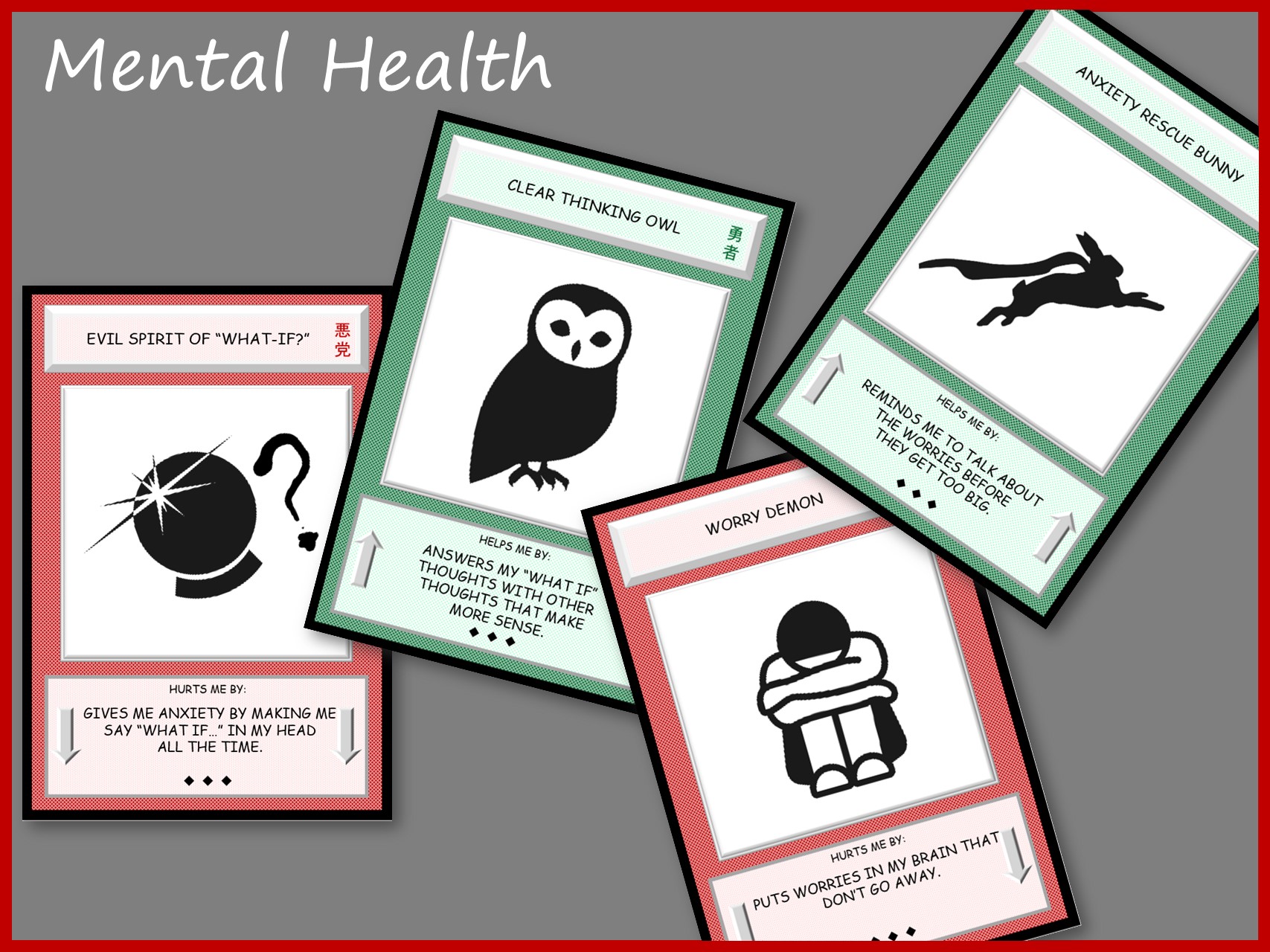
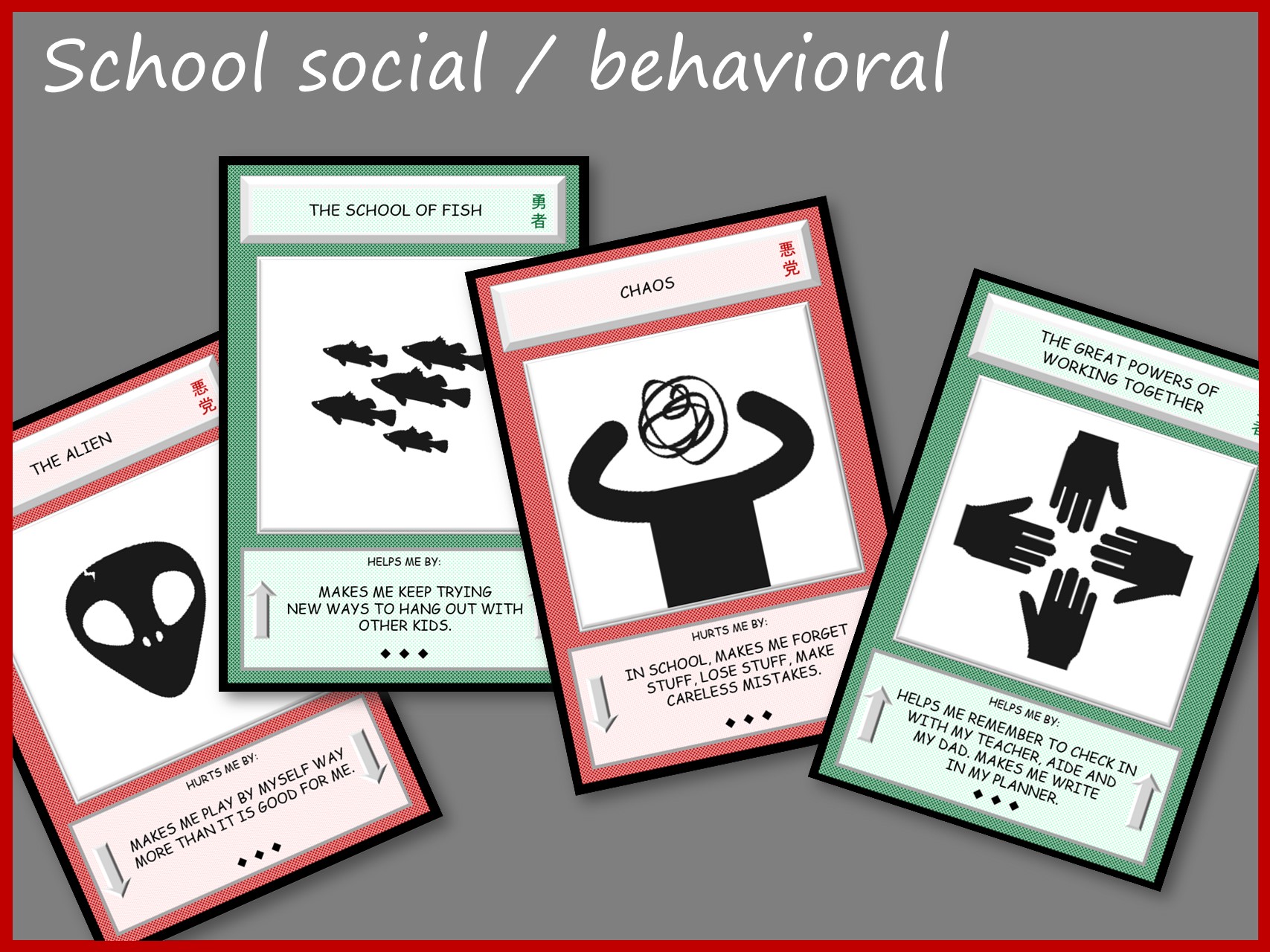
To capitalize on youth culture themes of “good guys” and “bad guys” from movies, stories, video games, and in trading card sets such as Pokémon and Yu-gi-oh, I designed this free, easy card-making project. In my own work, I find it really useful for focusing children’s attention on their problematic patterns of thinking.

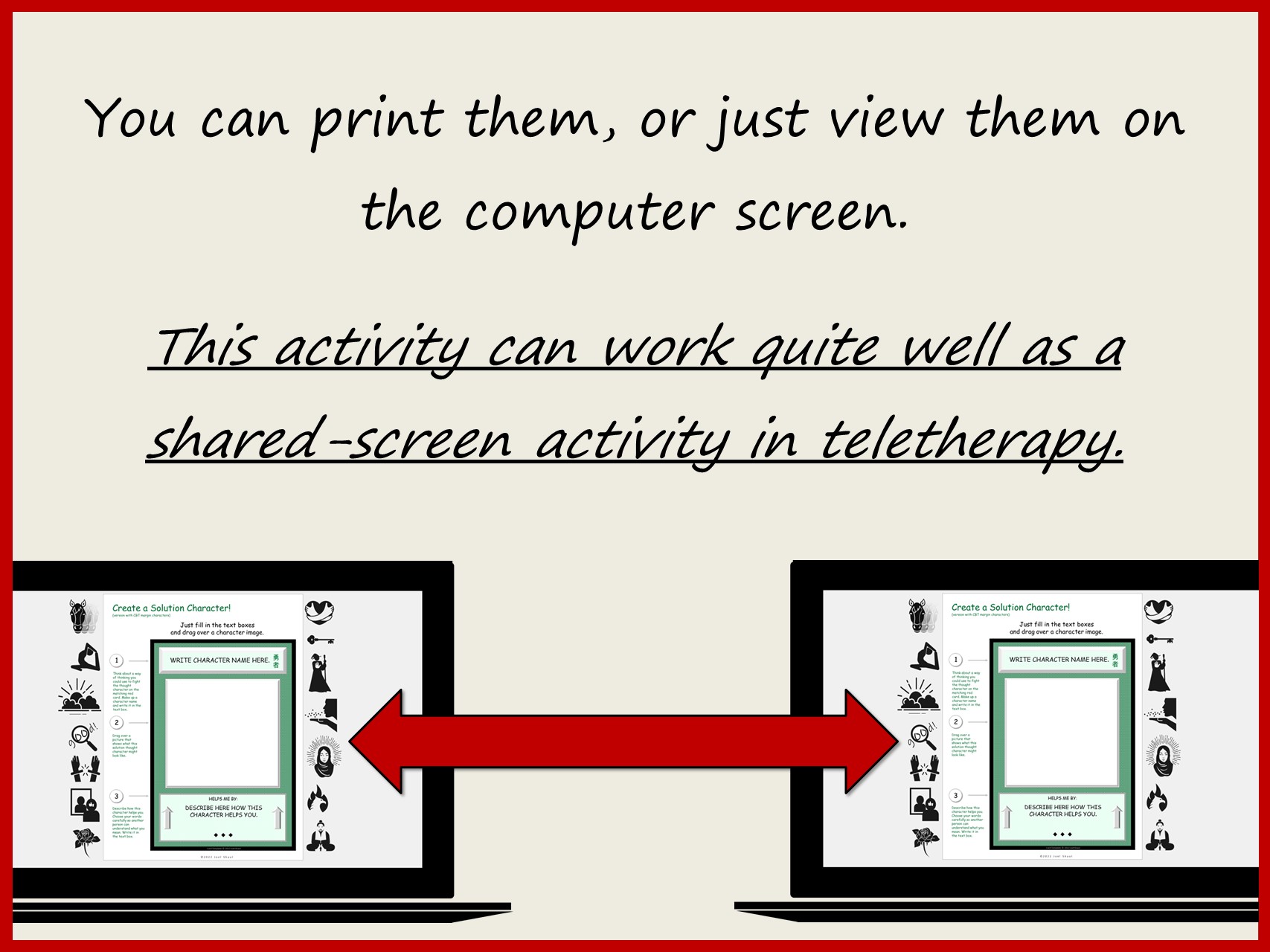
Although this is designed for in-person work, it is also ideally suited for teletherapy, since the collaborative work takes place on a shared computer screen and you can mail or email the finished product to your client.

Here is a one-minute demo on YouTube of how it works.

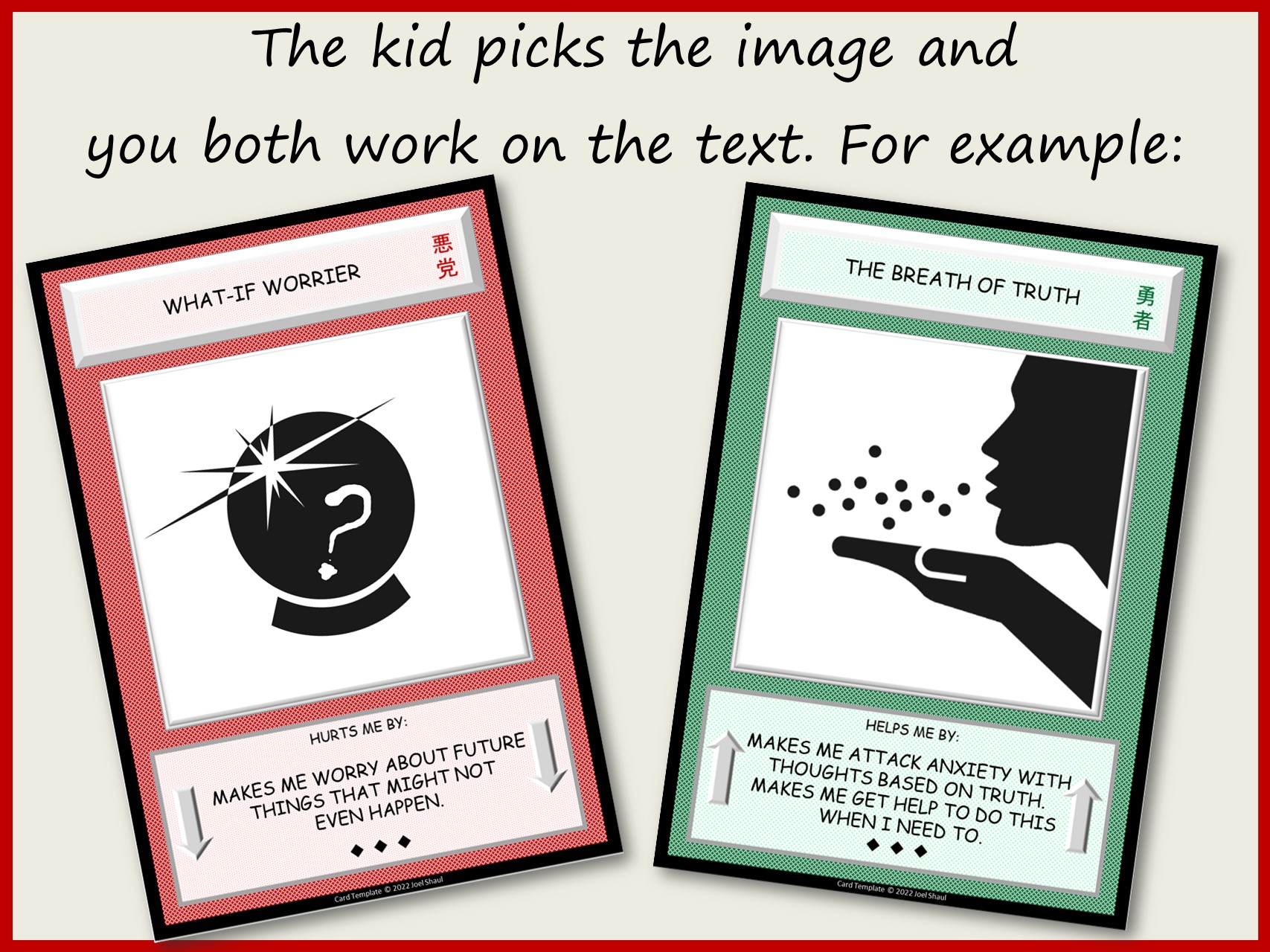
I would like to emphasize that these things are quick and easy to create. In my own work with children and teens on the autism spectrum, I typically can co-create as many as five pairs of cards in a 45 to 50 minute session. Children appreciate being able have input into naming the characters and selecting among the various drag-and-drop images.

There is great potential to add more cards, or modify existing cards, in subsequent sessions.

I have lots of other CBT activities on the website to use with this activity, regular and teletherapy. Check them out.

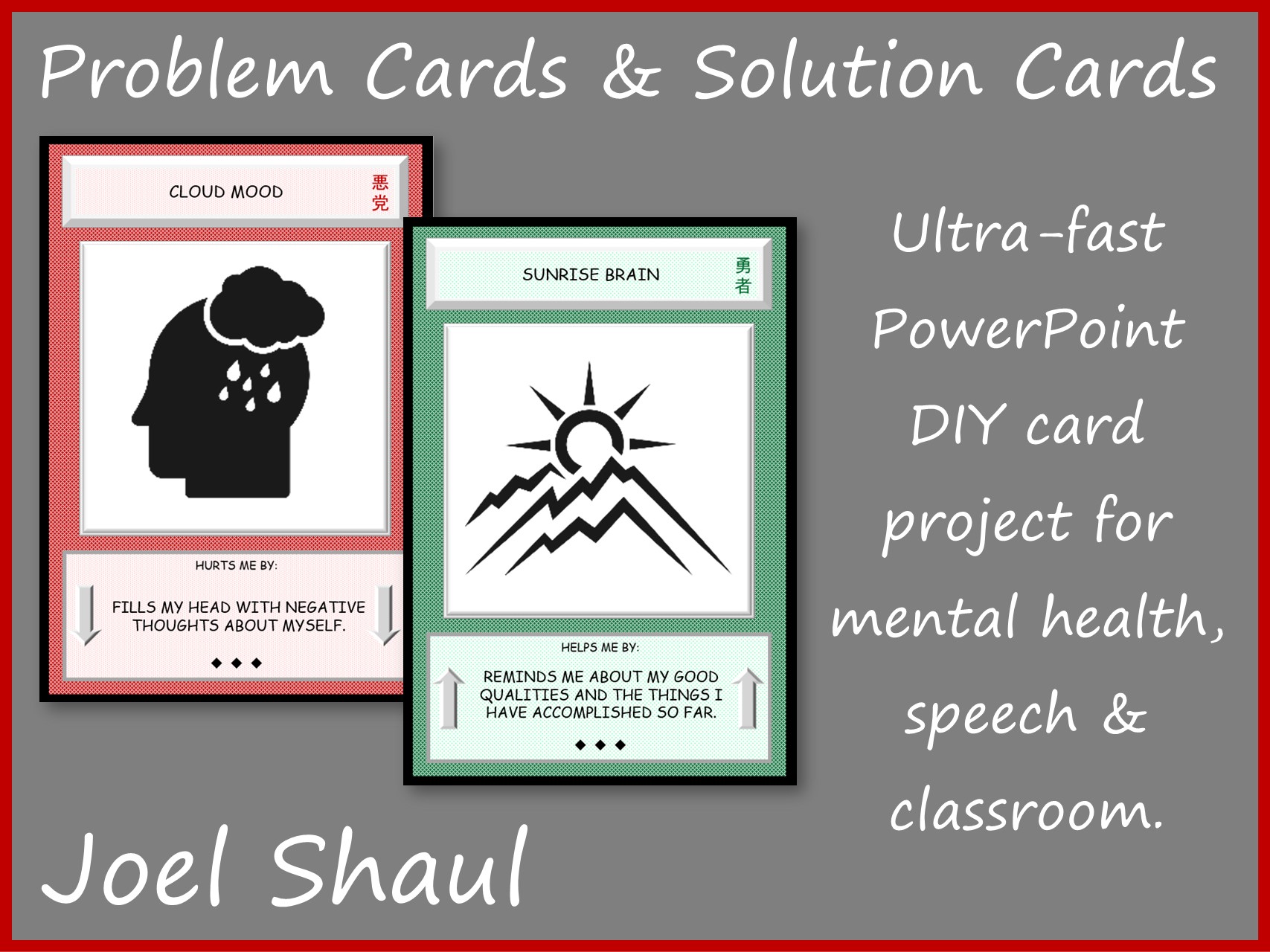
Problem and Solution Cards ~ Fast and fascinating self-awareness project easily completed with child during sessions

Do-it-yourself social skills cards designed to look like Pokémon and Yu-gi-oh

In mental health, special education and speech therapy, children experiencing multiple challenges can feel demoralized by being the “problem child” all the time. It can be useful sometimes to help our young clients externalize their problems onto fantasy characters which we can help them to fight against.

Many young people relate strongly to youth culture themes of “good guys” and “bad guys” through movies, stories, video games, and in trading card sets such as Pokémon and Yu-gi-oh.  To capitalize on this, I designed this free, easy card-making project to help children focus on therapy issues and coping strategies.

Although this is designed for in-person work, it is also ideally suited for teletherapy, since the collaborative work takes place on a shared computer screen and you can mail or email the finished product to your client.

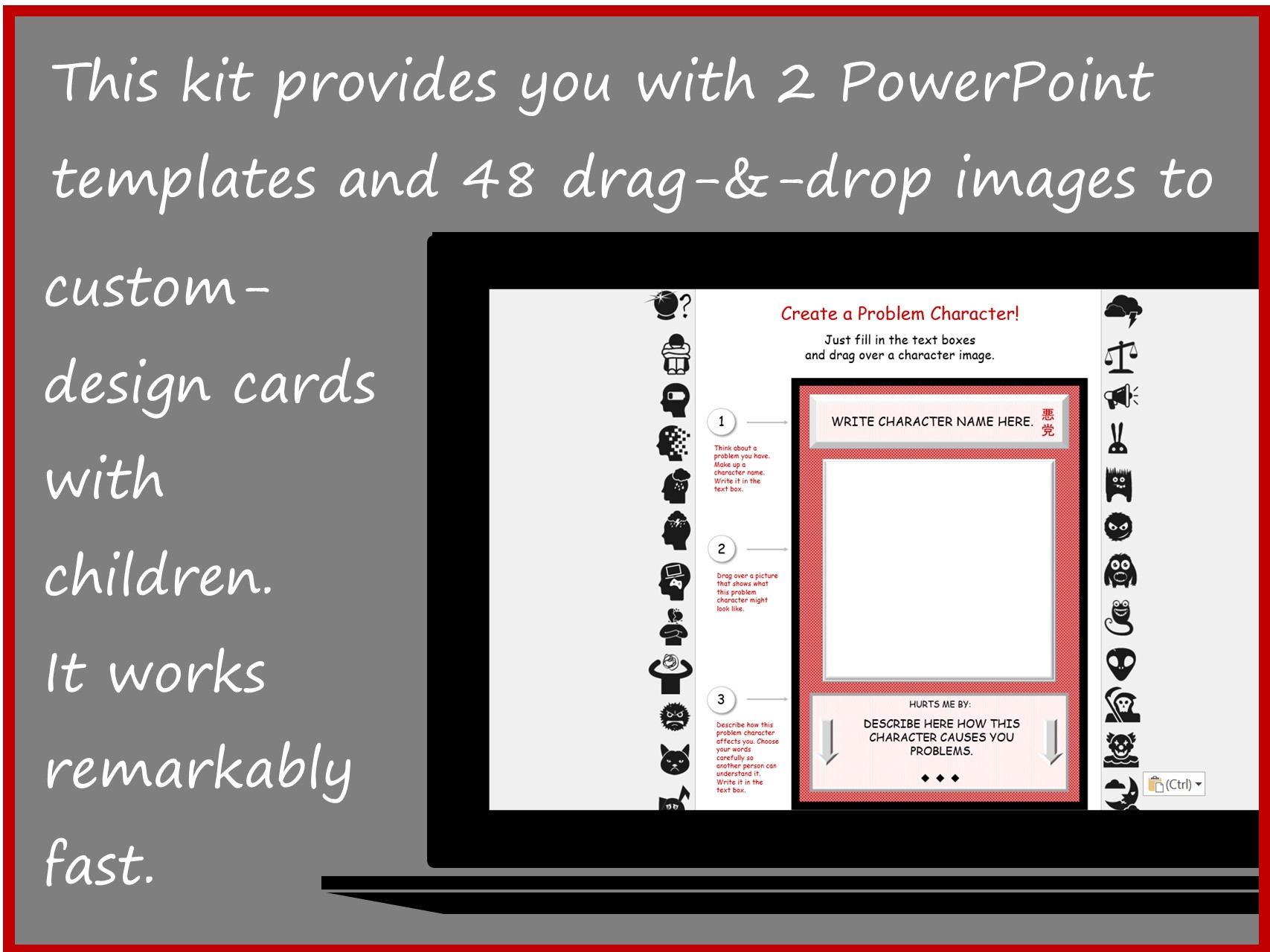
In my own work with children and teens on the autism spectrum, I typically can co-create as many as five pairs of cards in a 45 to 50 minute session. Children appreciate being able have input into naming the characters and selecting among the 48 drag-and-drop images.

There is great potential to add more cards, or modify existing cards, in subsequent sessions.

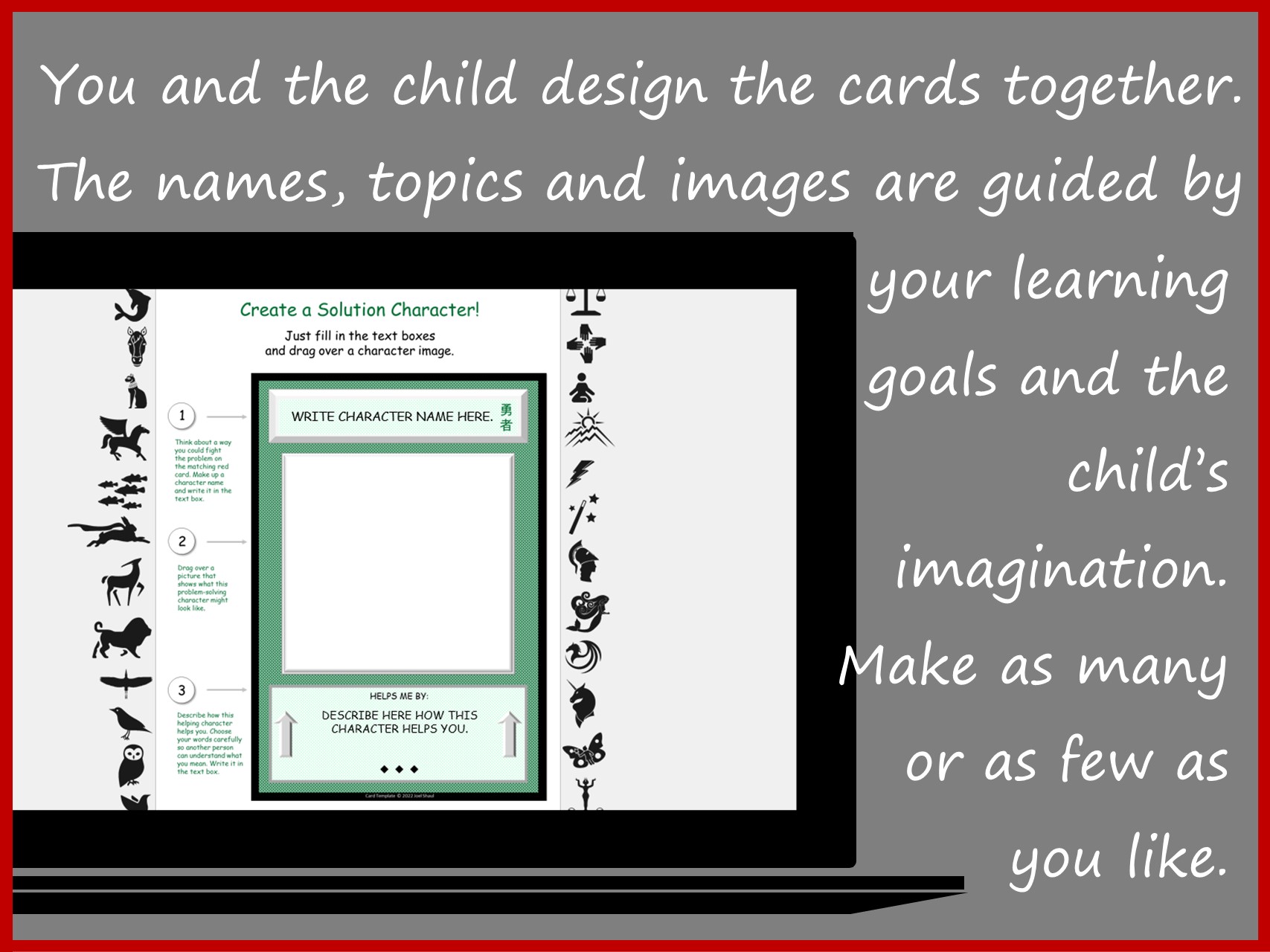
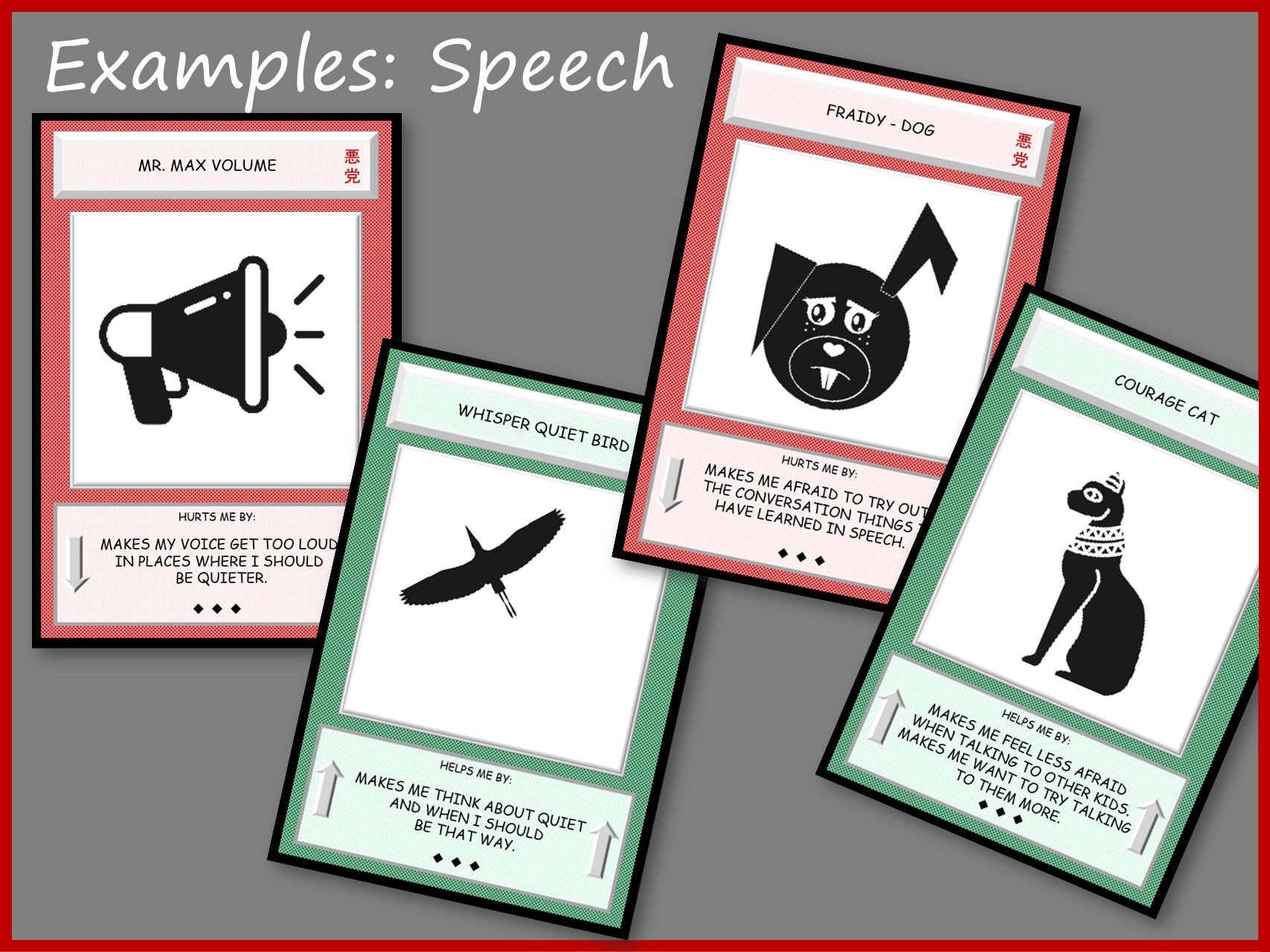
Although I am a mental health professional, in my own work with young people who have ASD, I do a great deal of work on social communication. In my experience, most of the children I work with can quickly make up clever character names. Most can come up with a coherent narrative under “helps me by…” [Obviously, the sample cards shown were not created by clients 🙂 ]

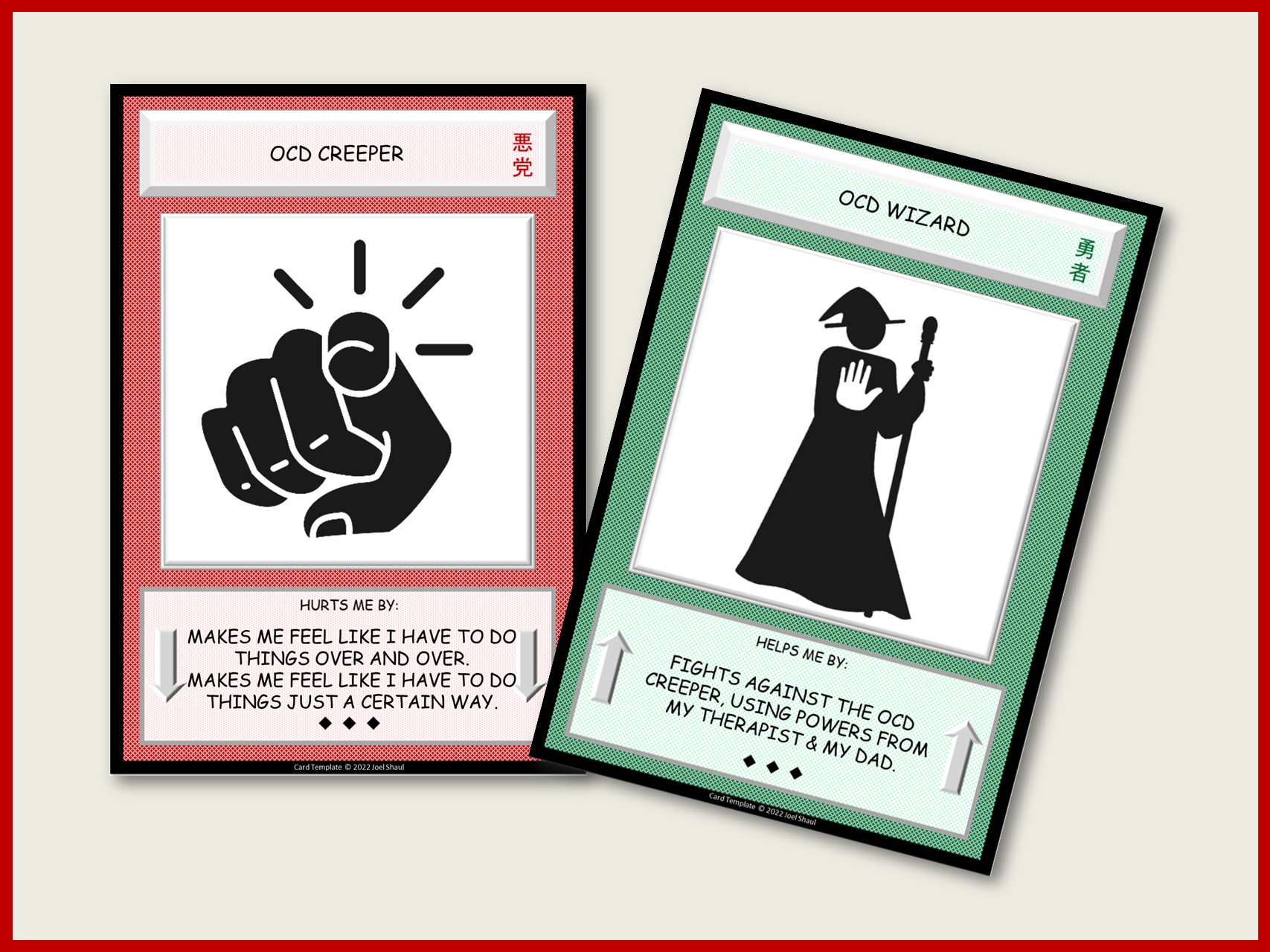
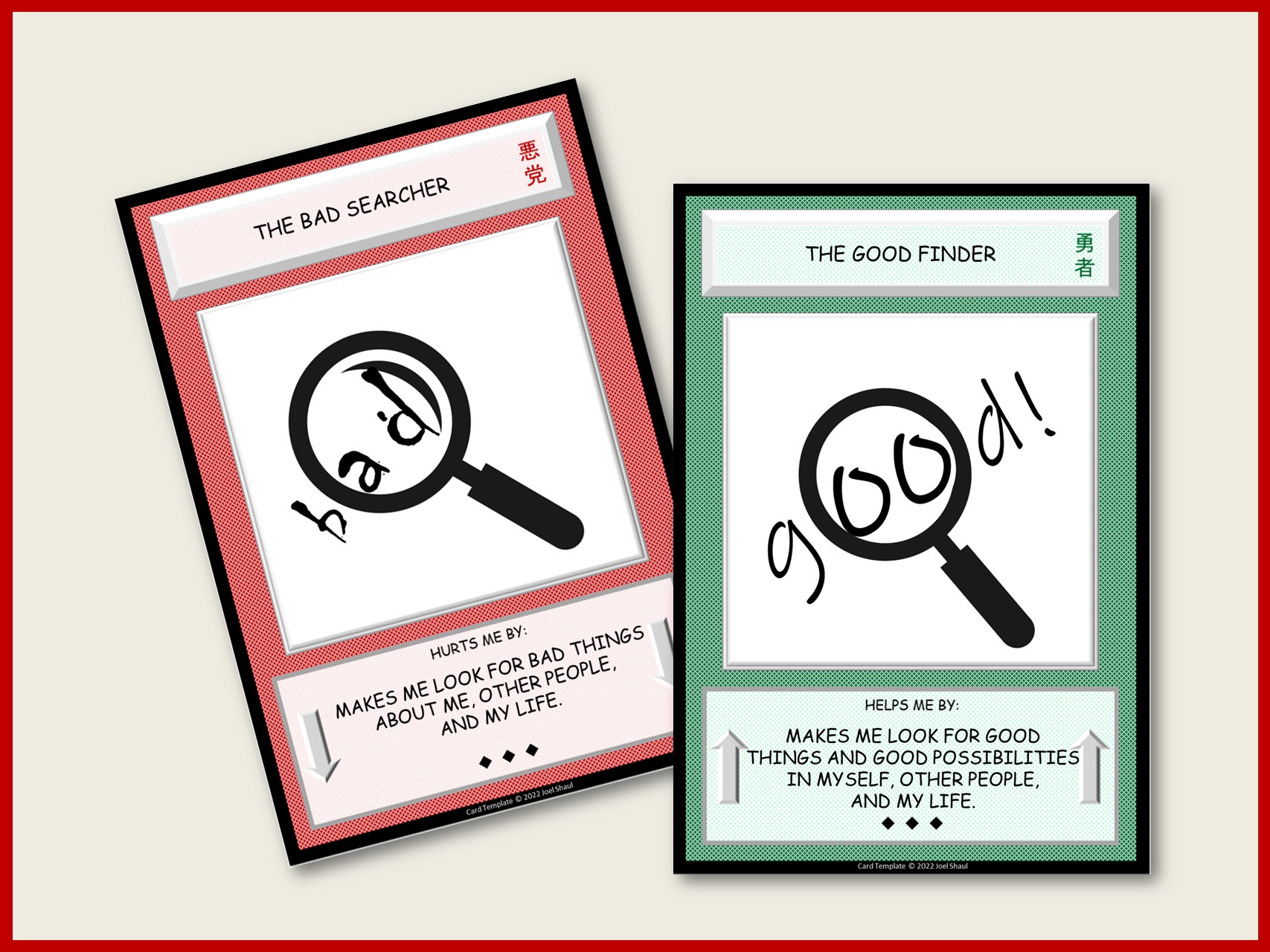
For my fellow mental health professionals: These DIY cards are ideally suited for CBT.

Please note that I have a completely separate CBT-based Problem Solutions Cards kit available with drag-and-drop images specifically selected for mental health therapy.

I am not currently working in schools, but the fact that this project is carried out on-screen in PowerPoint would seem to make it well-adapted for groups and small classroom work for children with emotional and behavioral concerns.

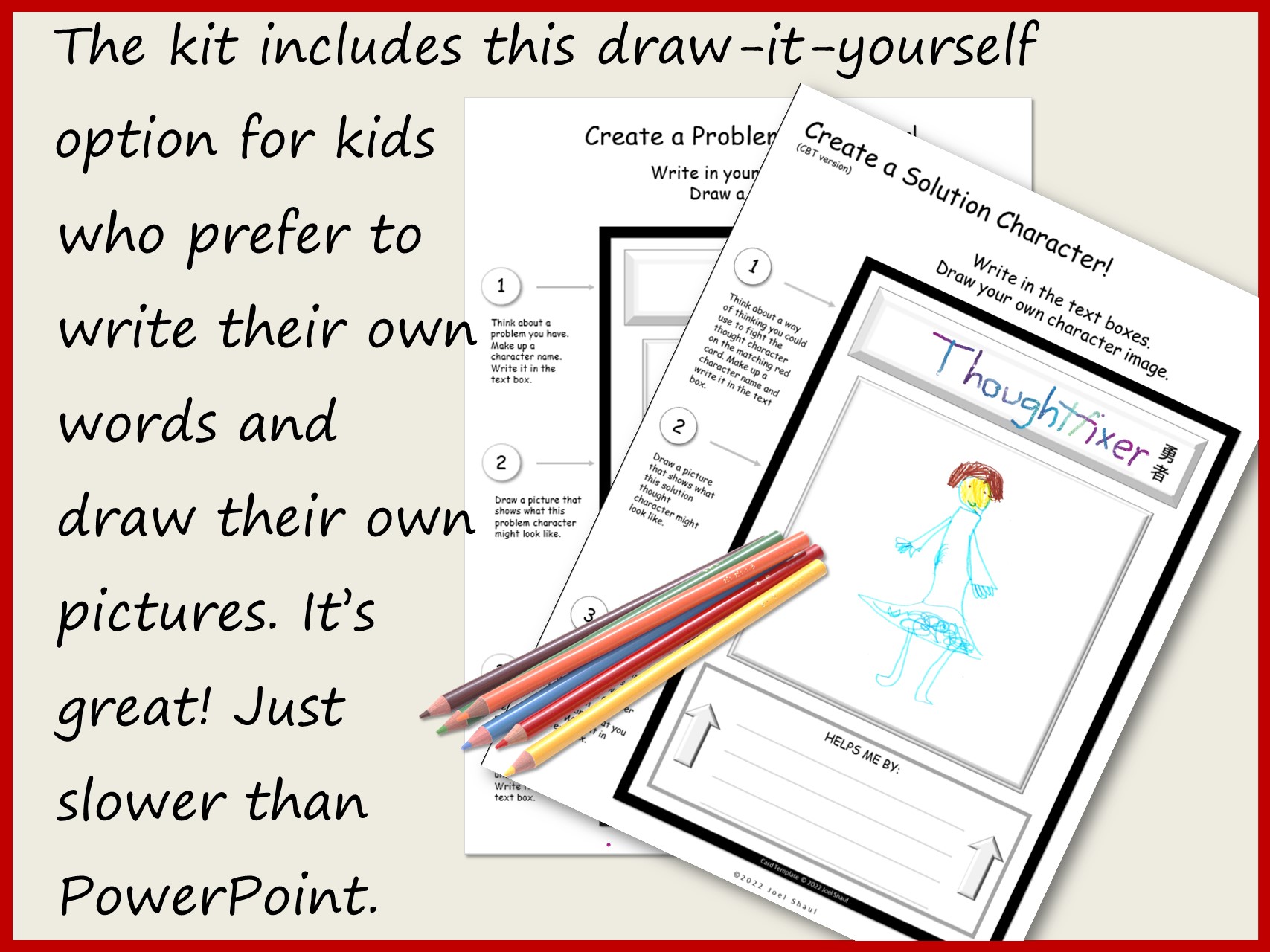
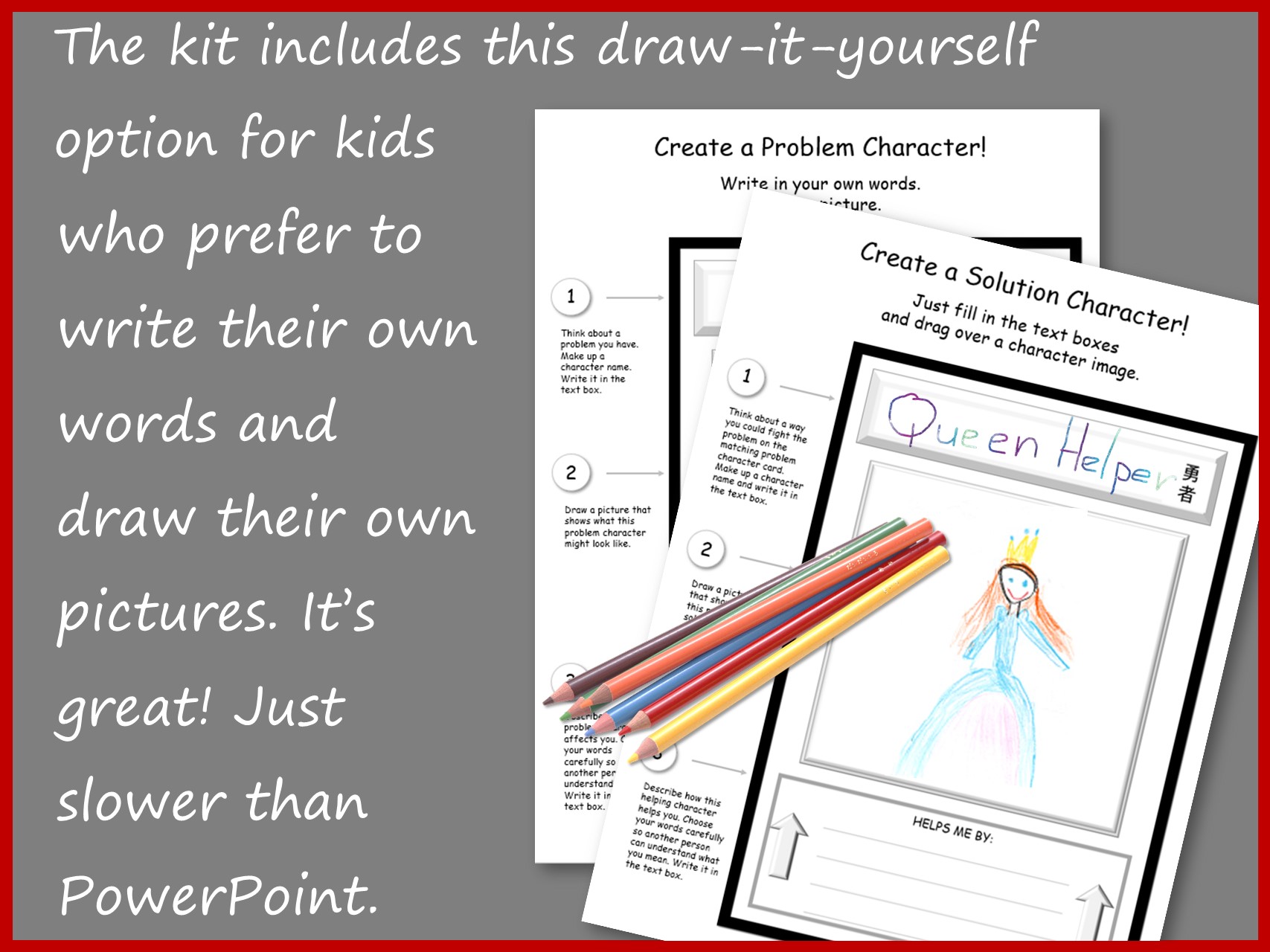
The draw-your-own version of this is similar to a popular download I posted years ago, Dark Force / Light Force Worksheets. In my own work, I like to get children to draw as much as possible in structured therapy projects. Having done this project many times both ways, both through drawing and via drag-and-drop image selecting, I would say that both versions have advantages. One important consideration is that many young people just don’t want to draw. Another consideration is that many of them draw slowly.

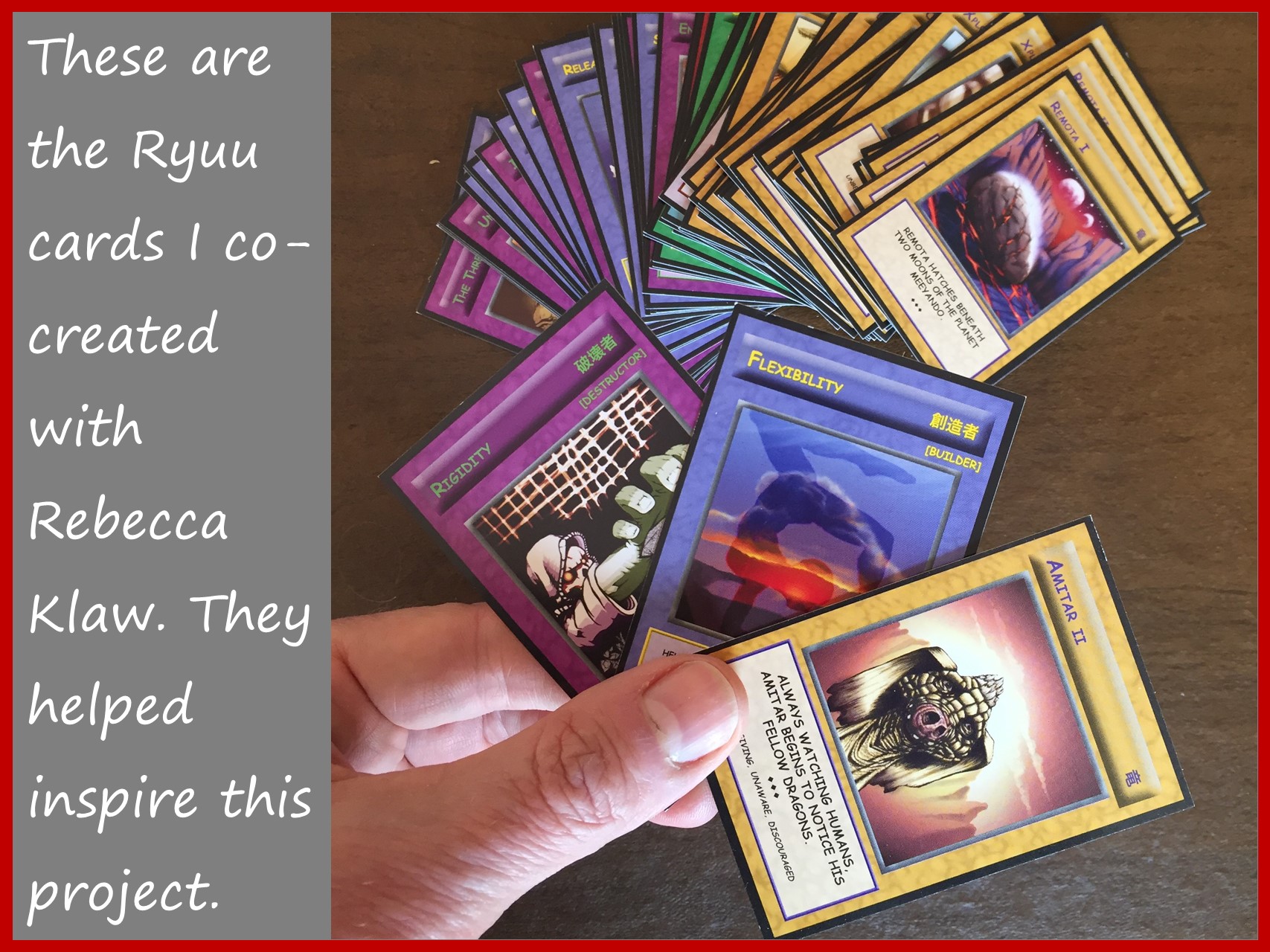
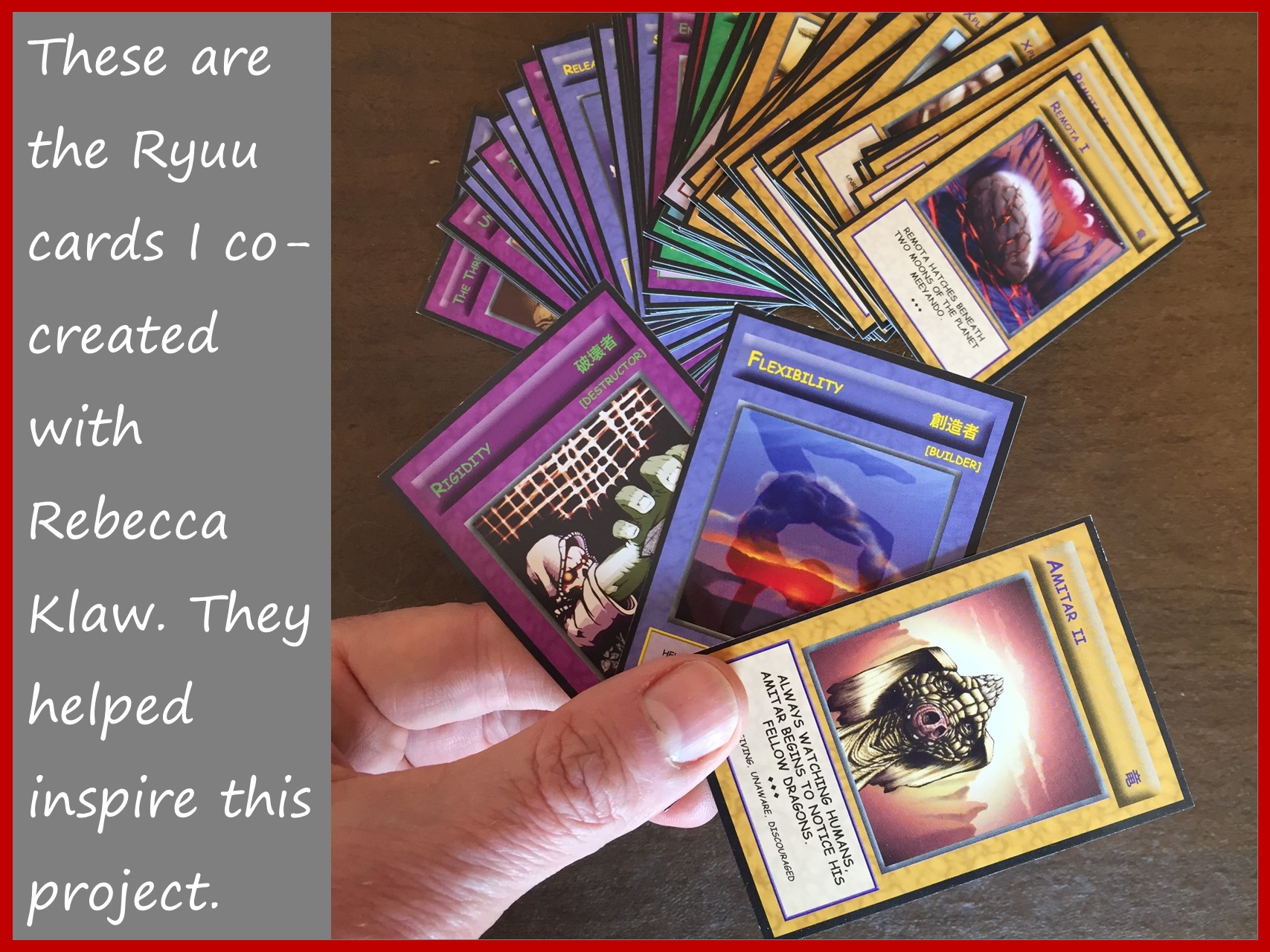
For many years, until 2019, Rebecca Klaw and I sold these cards that we invented, along with related therapy materials.

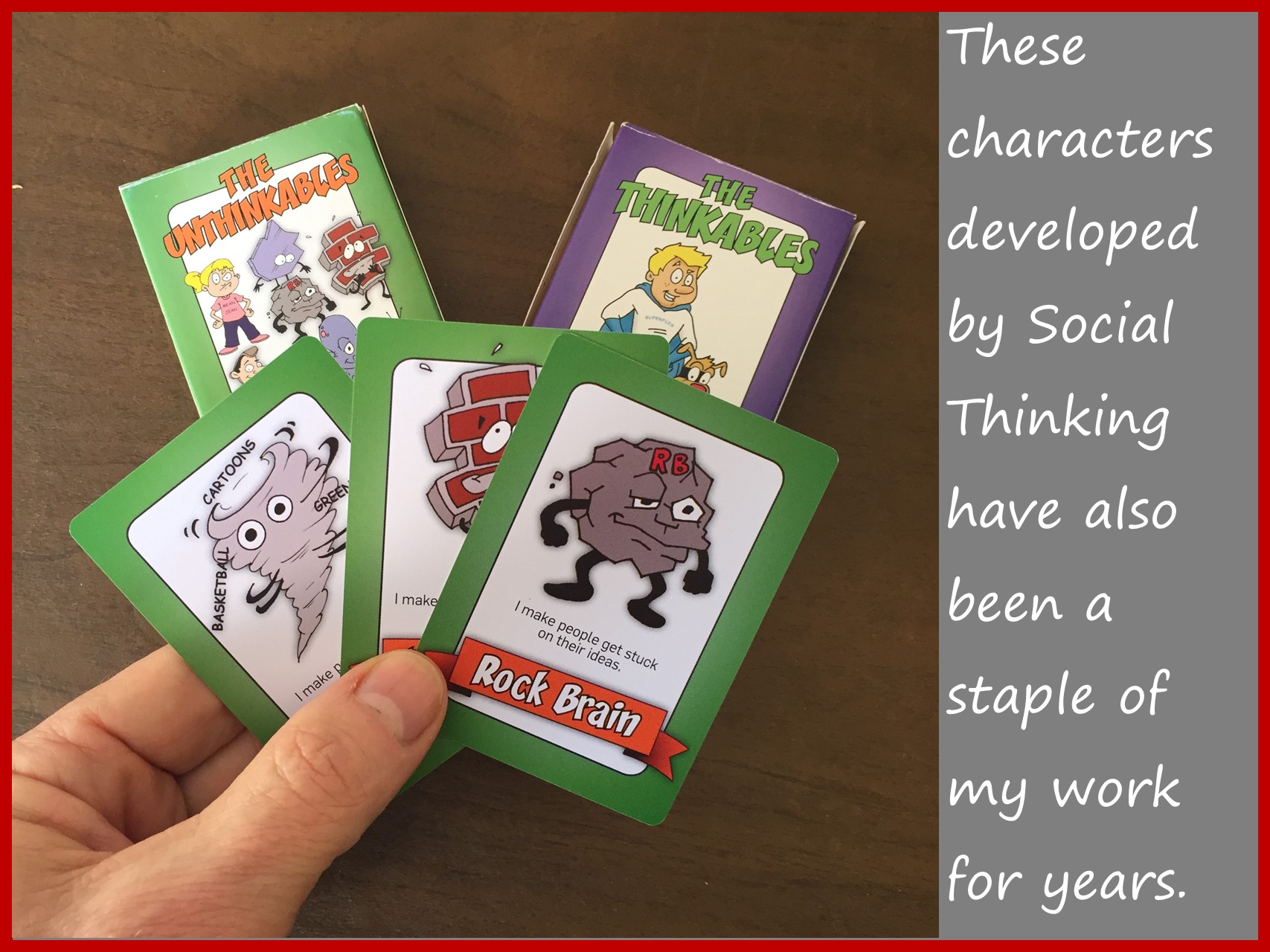
You are probably familiar with these Social Thinking materials based on Unthinkables and Thinkables characters. If not, you should check them out.

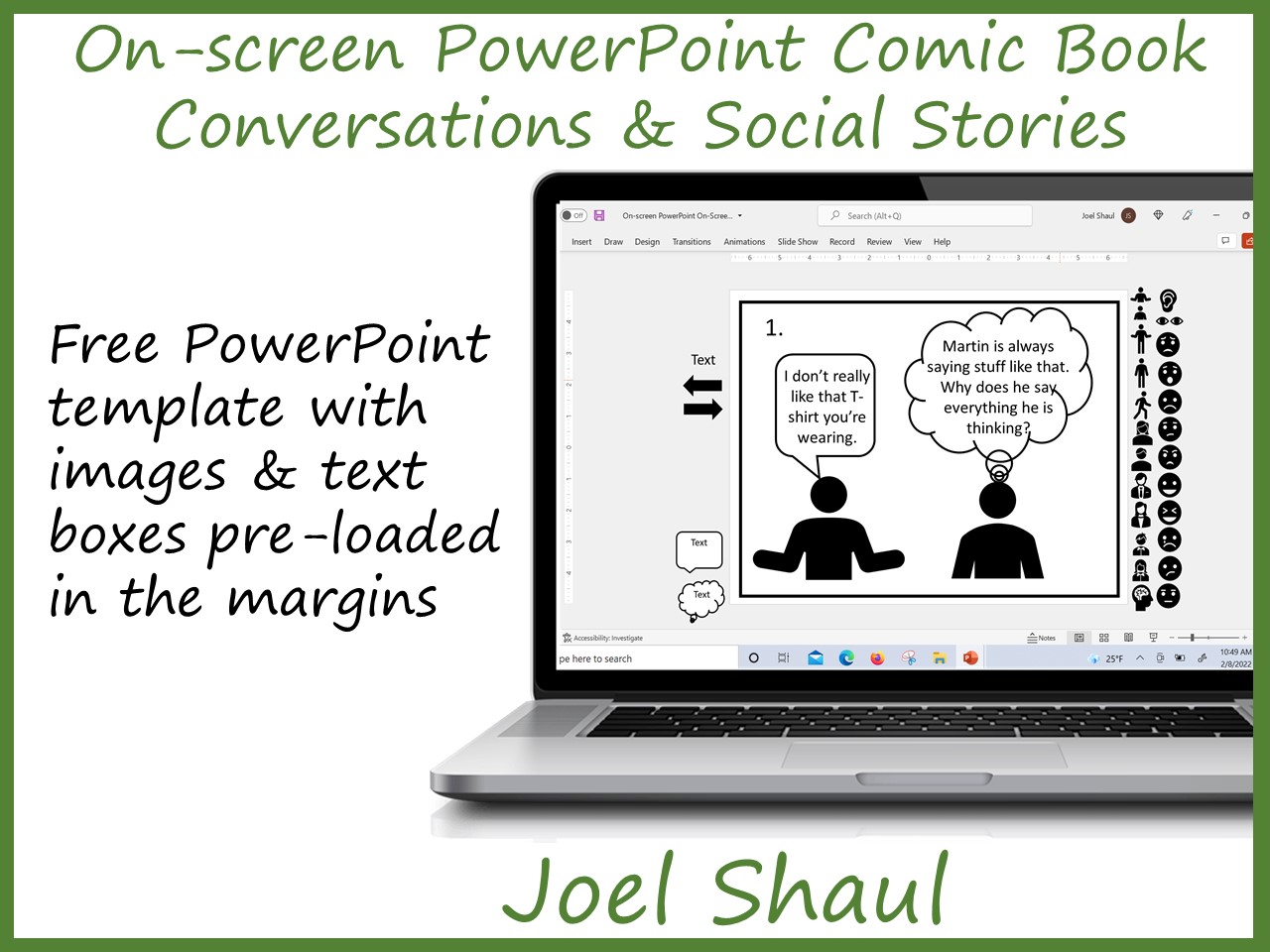
On-screen PowerPoint Comic Book Conversations & Social Stories. Free template download.

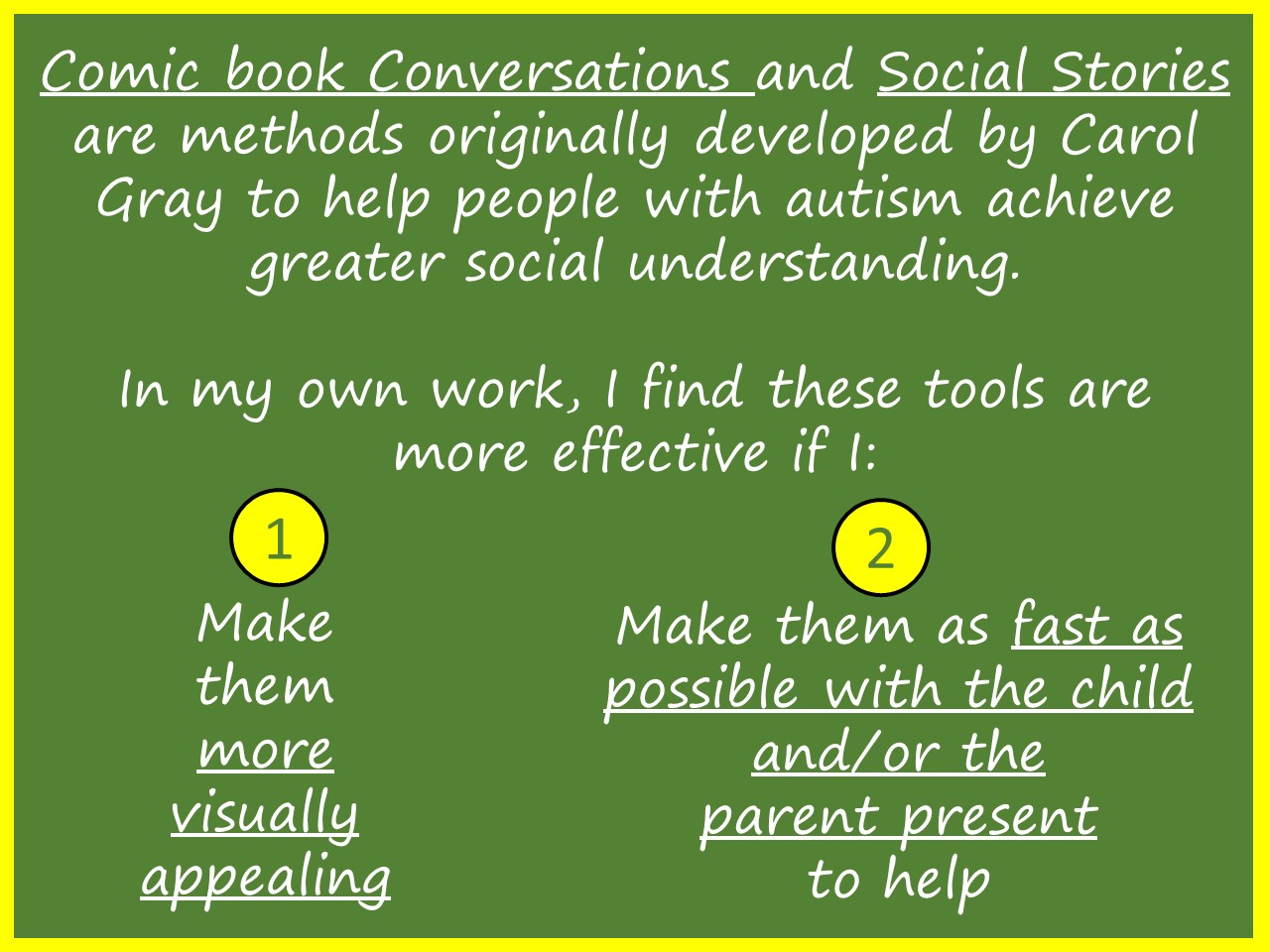
Comic book conversations, social stories and social skills therapy

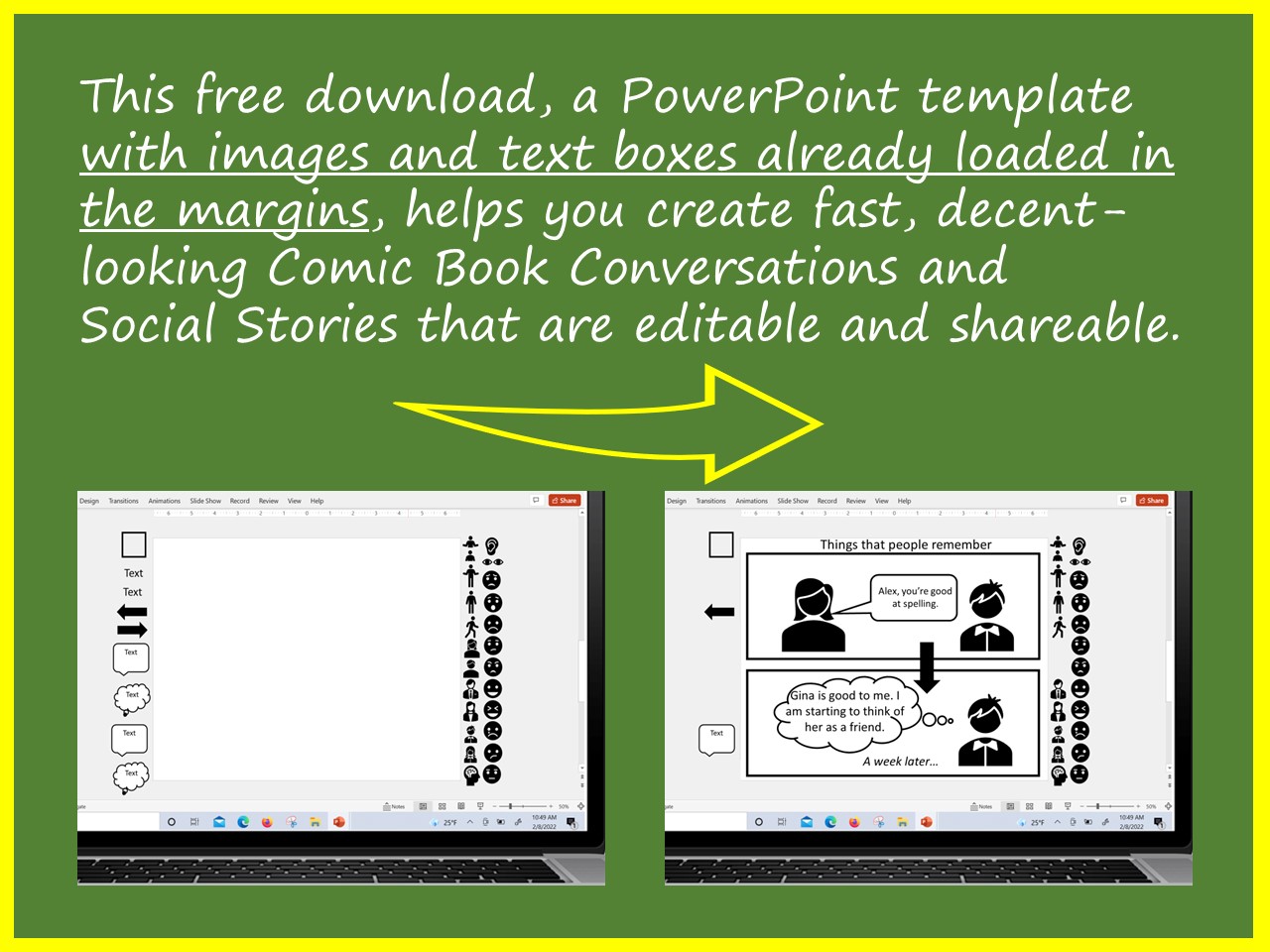
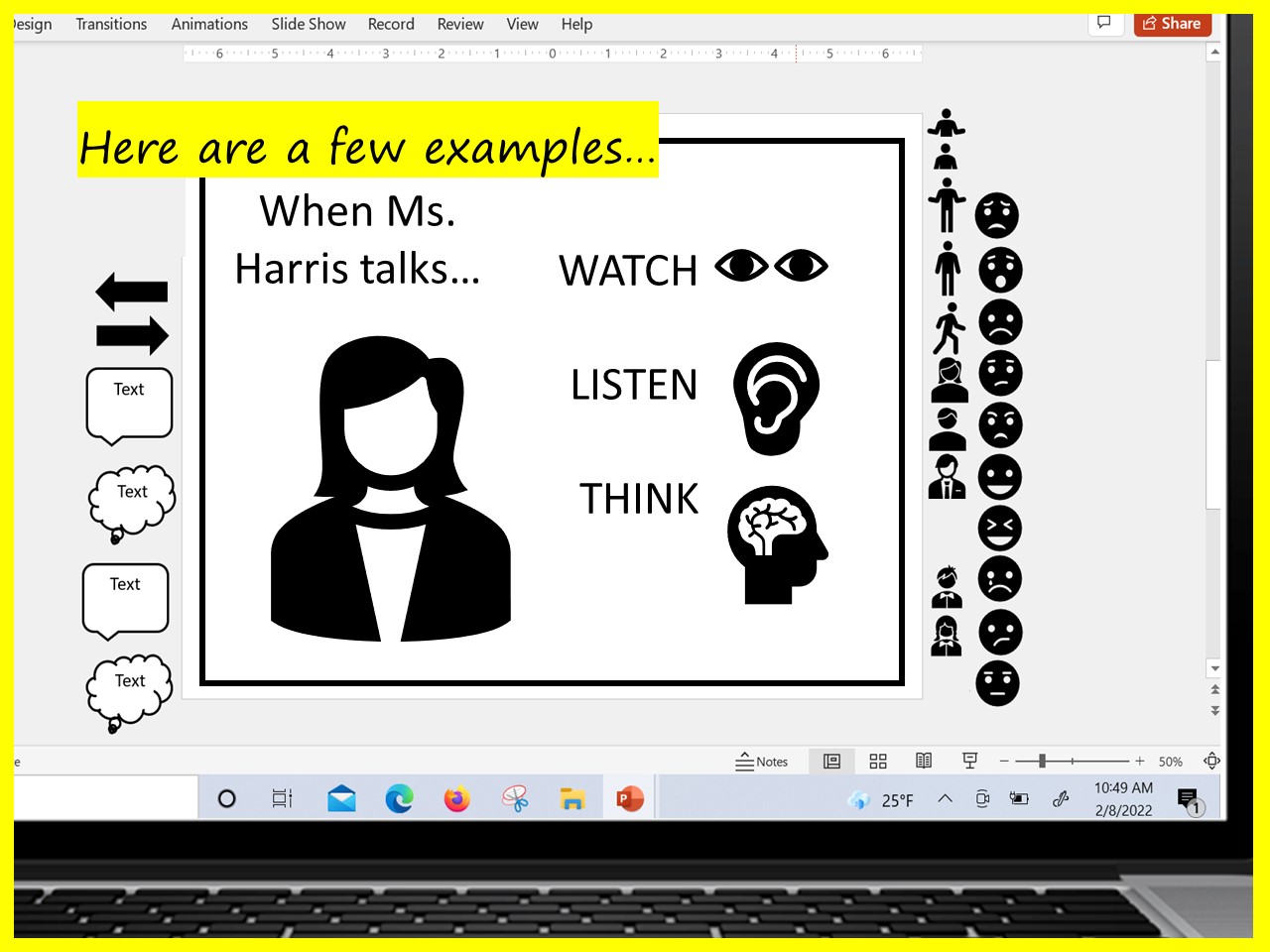
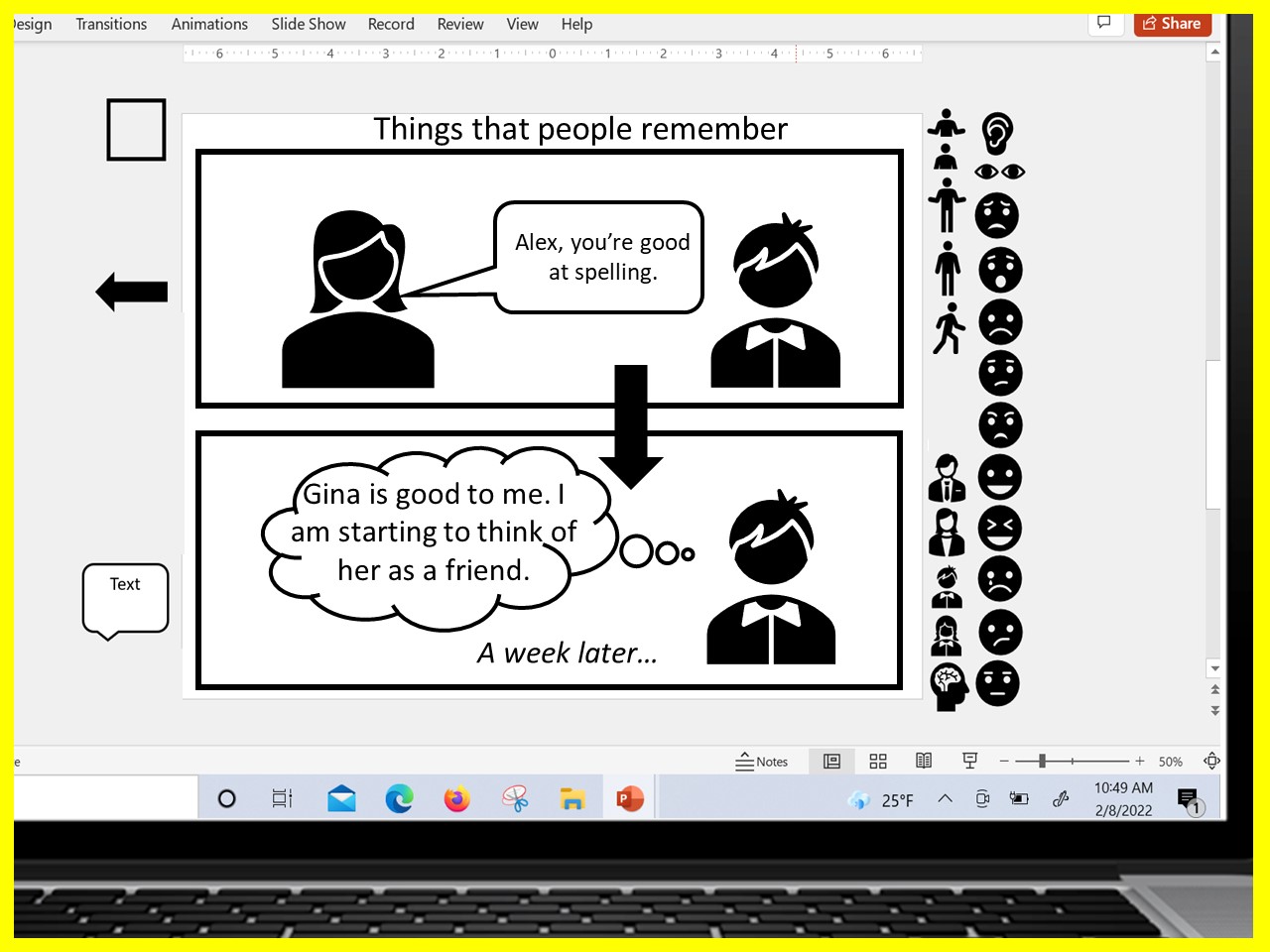
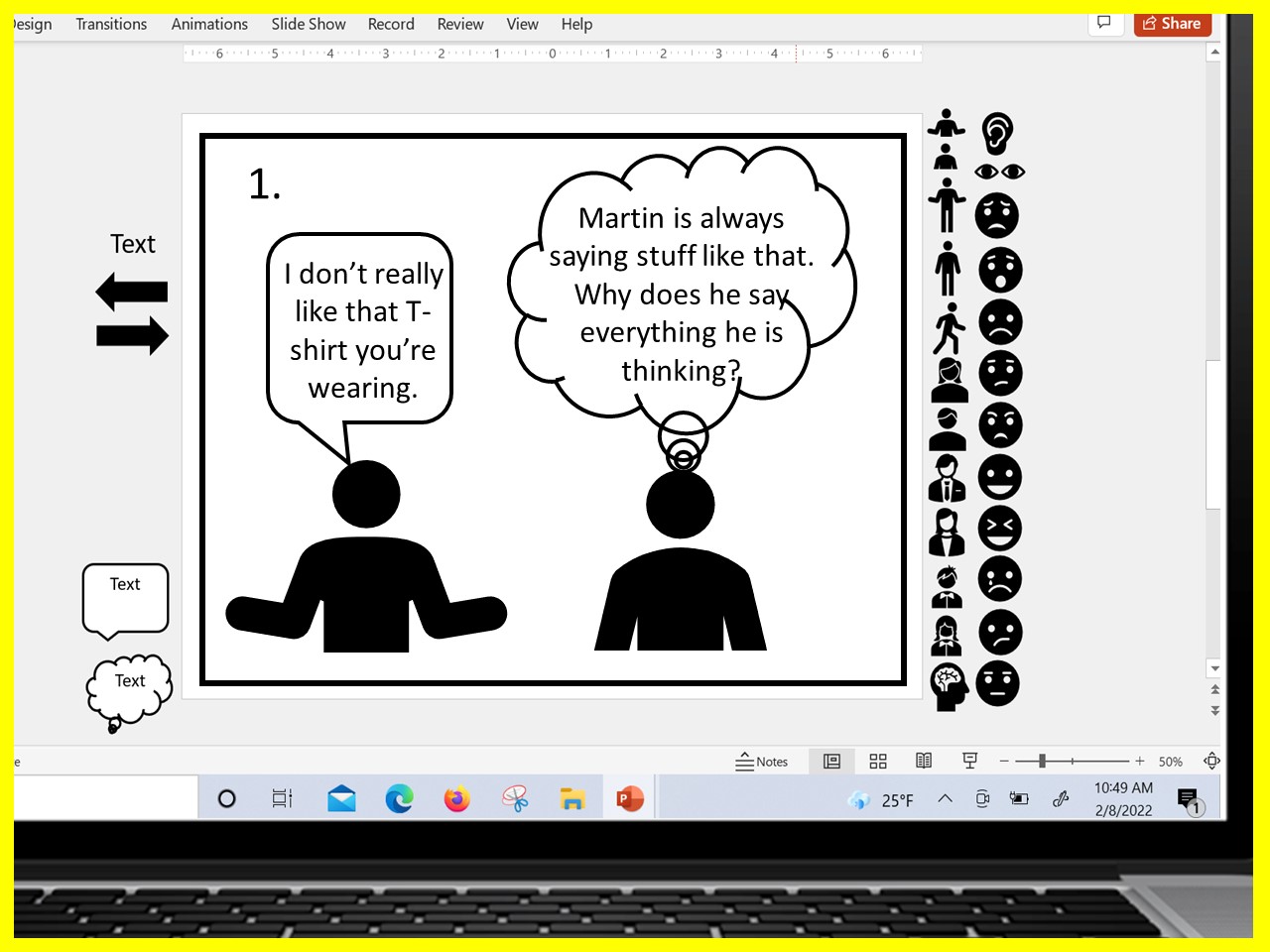
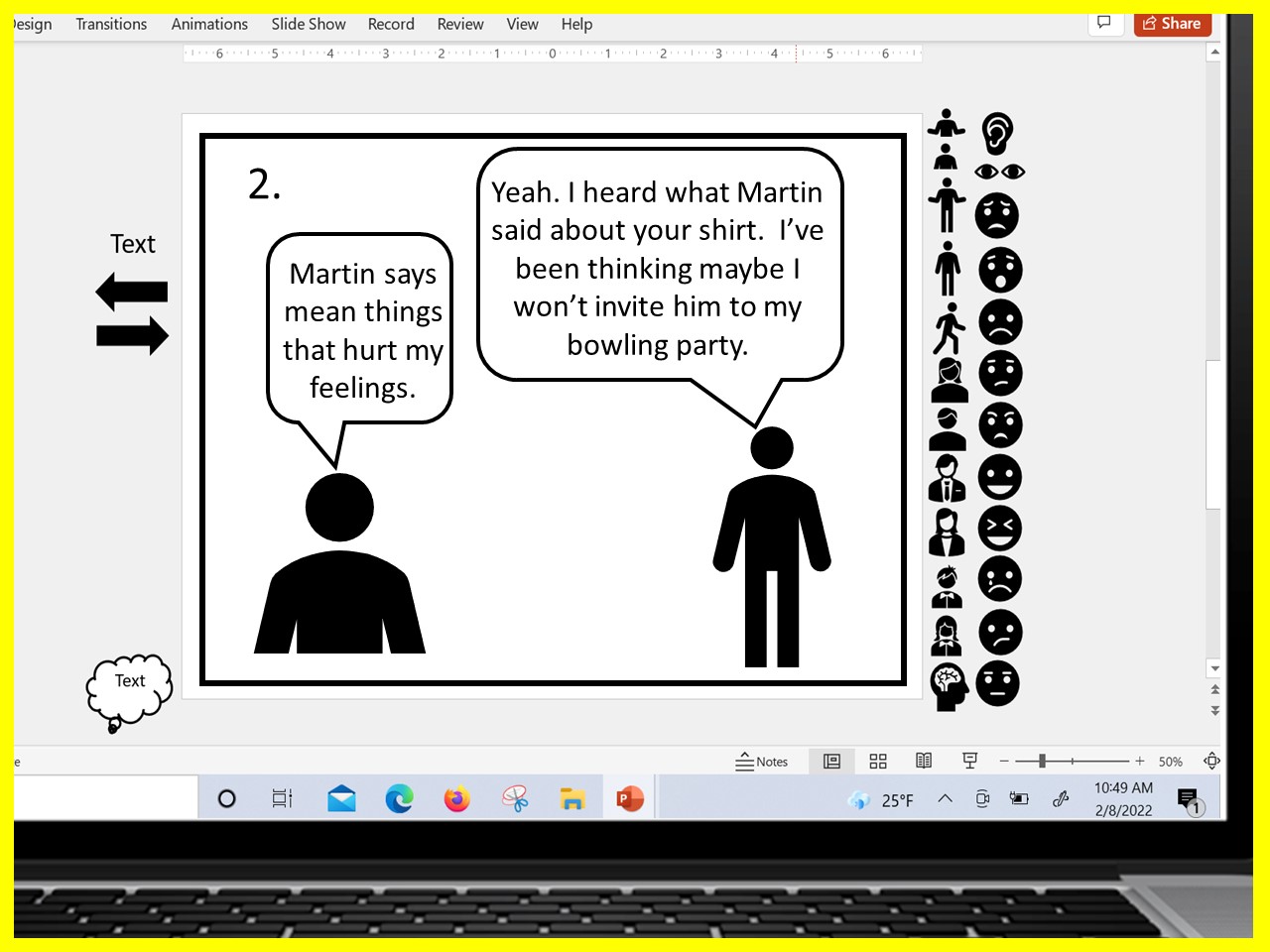
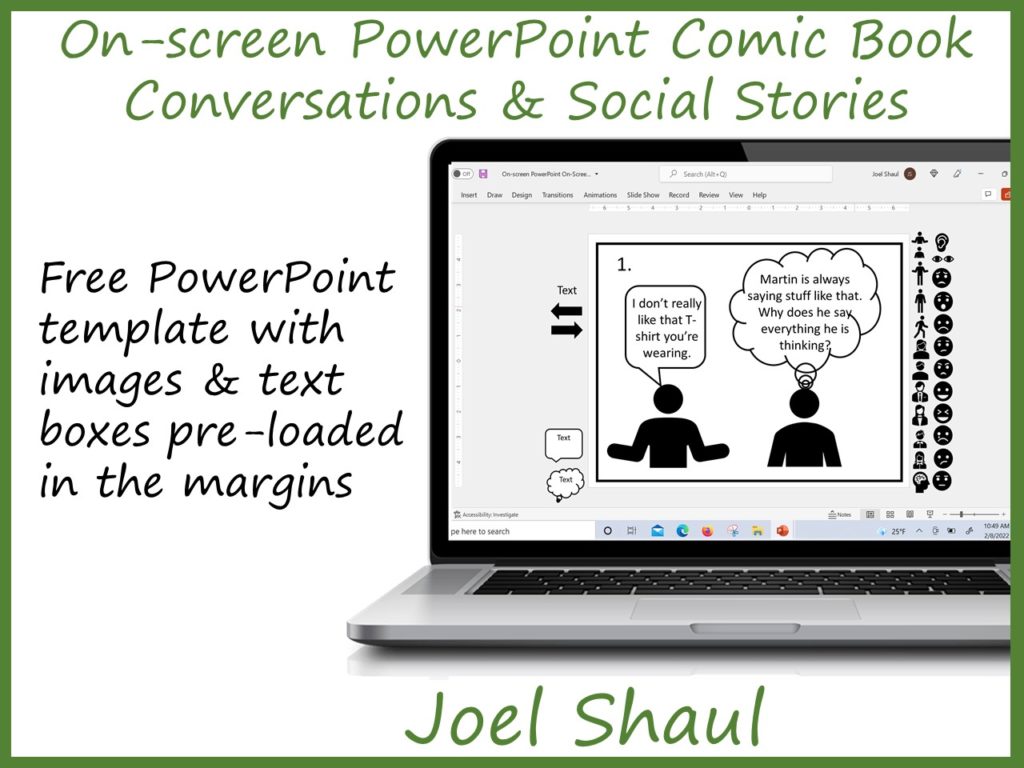
My own paper and pen, stick-figure social skills materials never looked very good. So, over time, in my individual and group work with young people on the autism spectrum, I learned how to use PowerPoint rapidly, during sessions, to be able to put together text, word/thought bubbles and images to make much better Comic Book Conversations and Social Stories. Children liked them better. And since they were in my computer, I could quickly share my work with families and other professionals.

Some months ago, to prepare for my own therapy sessions, I started prepping blank PowerPoint slides with lots of the basic images and shapes I would need to help kids with their particular social and emotional issues. I eventually came up with a template, featuring “pre-loaded” images and text boxes in the margins. It was really helpful. I found I could more often sustain the attention of impatient children who wanted results fast.

I have loaded the margins with the graphic and text elements I use most often. You can easily customize your own template with additional images.

Your comments on these resources are most welcome, and often helpful. Click HERE to send an email.

14 free social skills resources for kids with ASD who don’t speak English

Social skills resources for children who are not English-speakers

I have many free resources translated into Spanish, German, Polish, French and Hebrew. I also have have many other resources, for parents or professionals providing social / emotional skills teaching to children who do not speak English. These include:

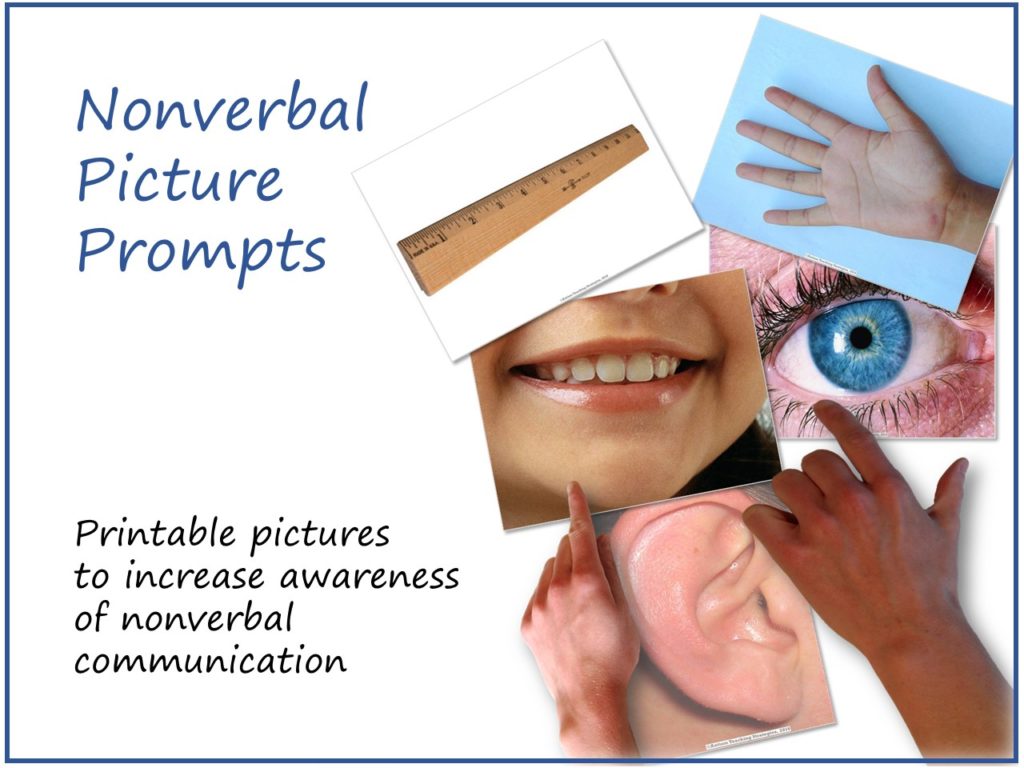
*Resources that are based mainly on images instead of words

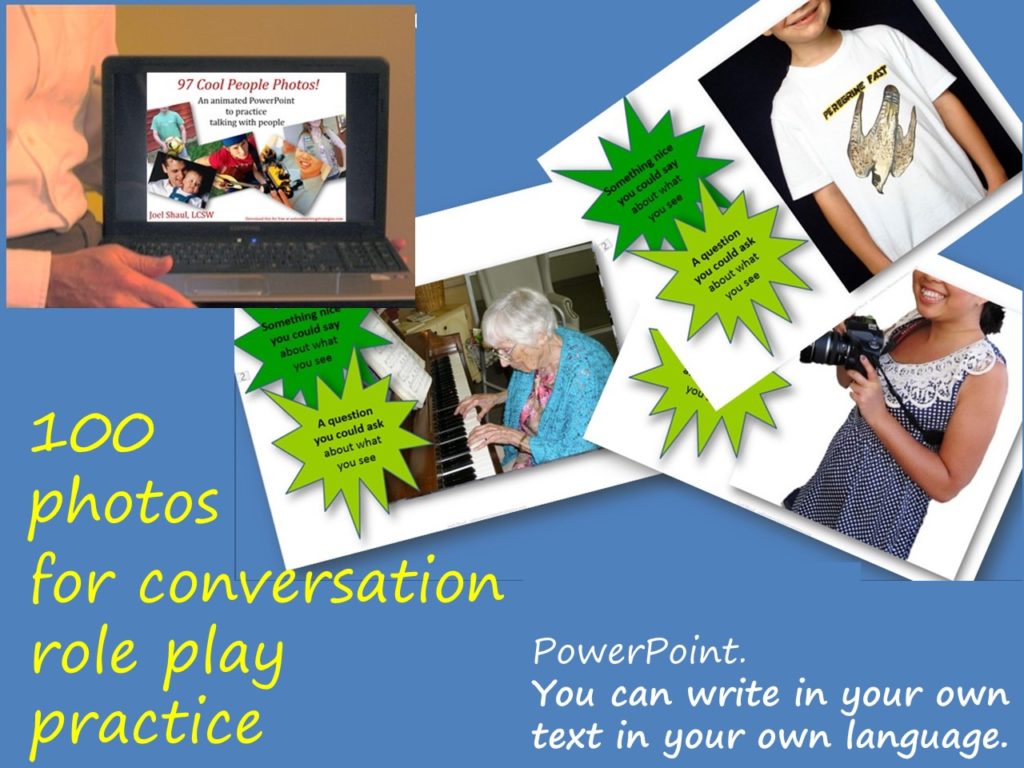
*Resources that are editable, so you can easily add text in your own language

(Elsewhere on this website, I have a number of resources translated into Polish, German, French, Spanish, Hebrew and Albanian.)

This is one of my best hands-on resources for helping children practice conversation basics including greetings, “how are you’s,” staying “on track,” switching topics, and ending the conversation. There is also a screen-based version that works really well. The principles are derived from my book, The Conversation Train.

The simple Venn diagram worksheet can easily be modified for non-English speakers. (It is currently translated into Spanish and Polish). Most of the picture cards work fine without being able to read the English text. These resources are derived from my book, The Green Zone Conversation Book.

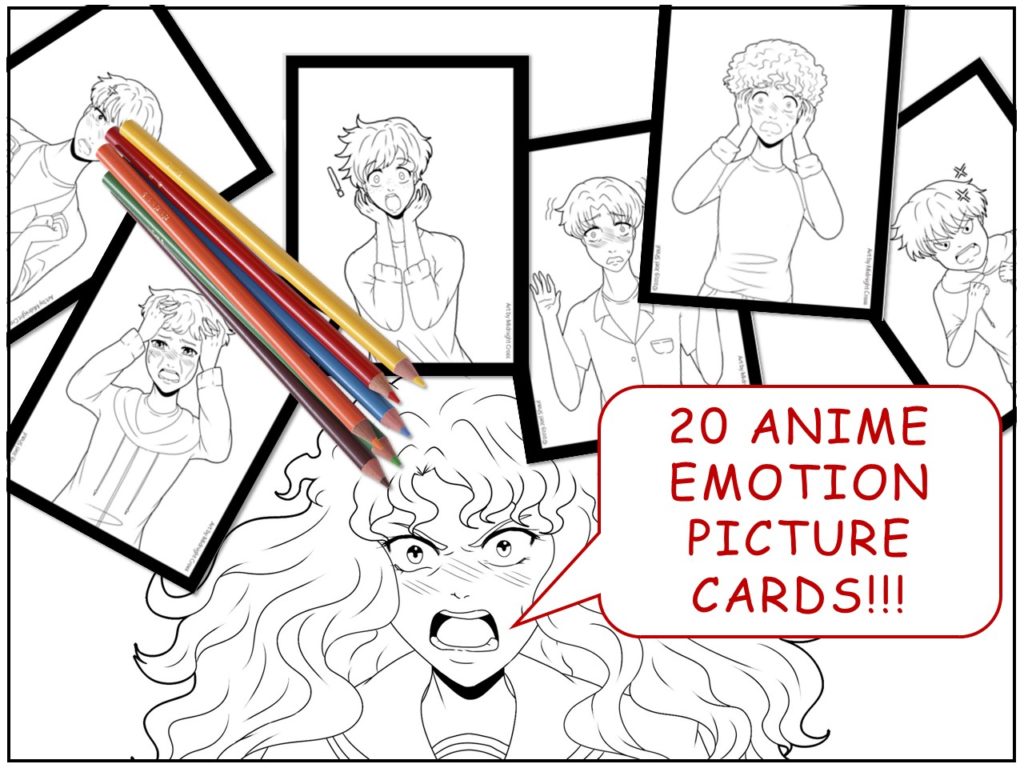
I collaborated with an Australian to produce this popular set of resources. The emotions appear to be universal. You don’t have to color them, but children enjoy doing it. (It is currently translated into Spanish, German, French and Hebrew.)

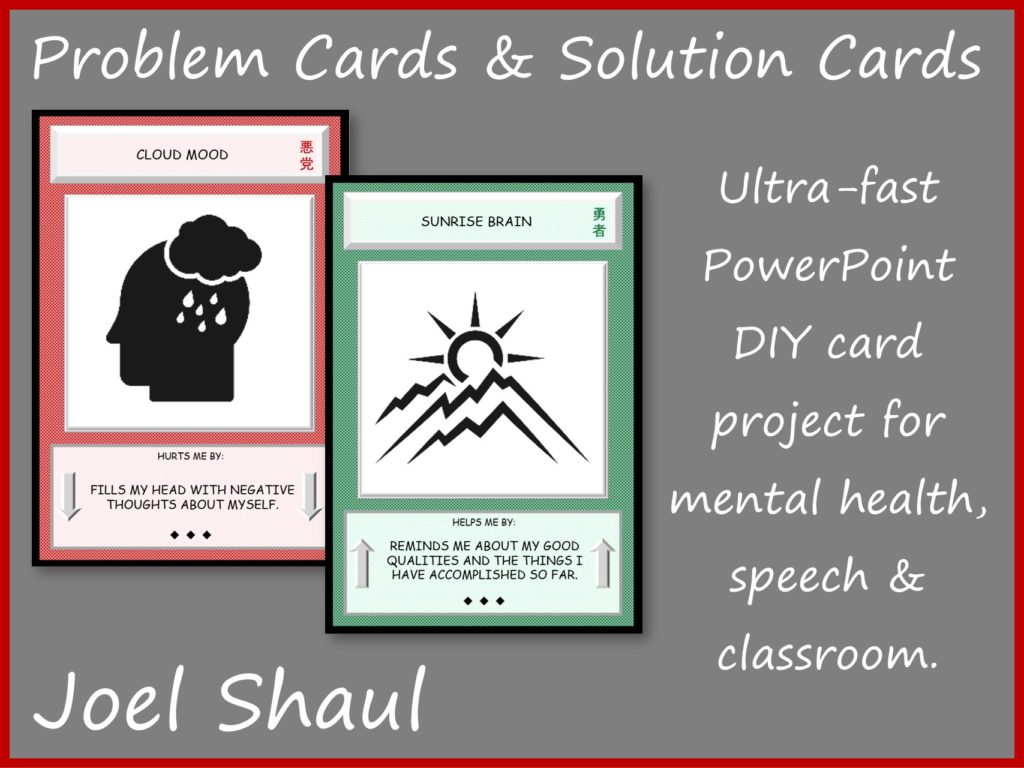
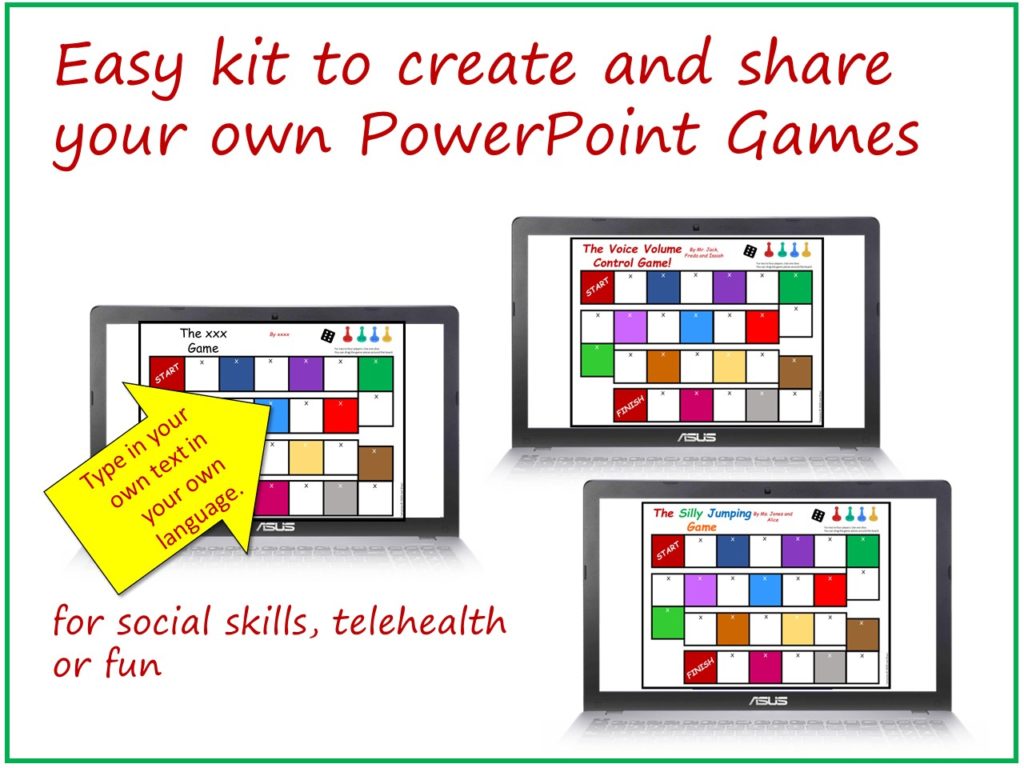
This will work in any language. The card templates are in PowerPoint and you add your own text – in any language.

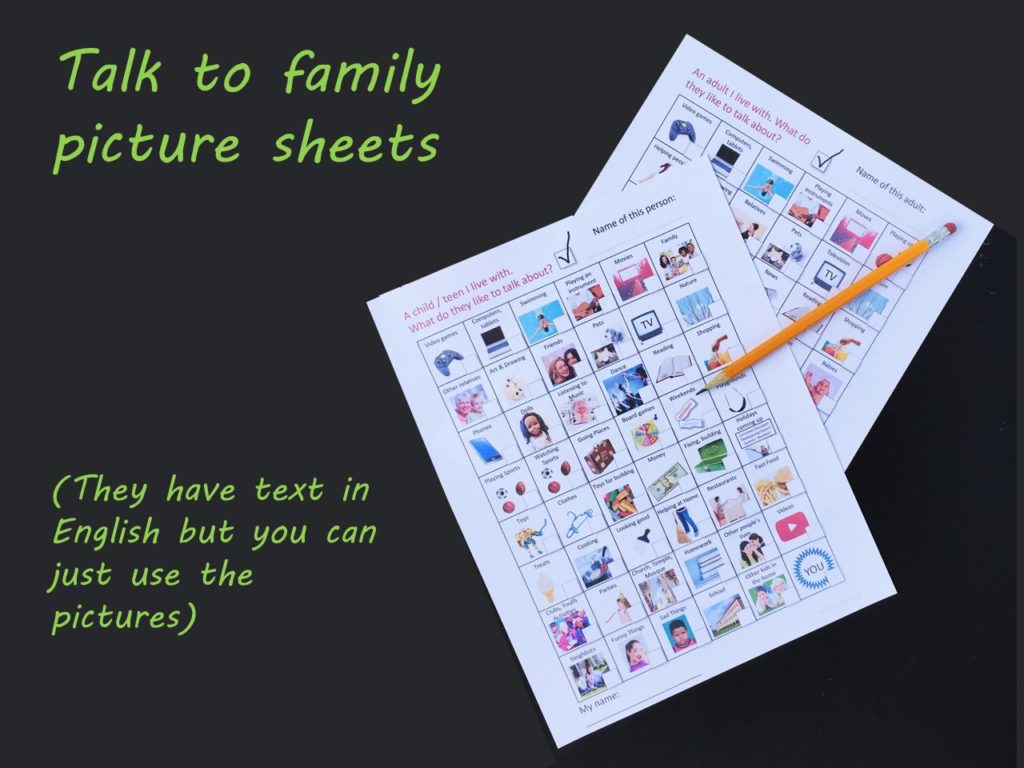
Talk to Family sheets are currently translated into French and Spanish.

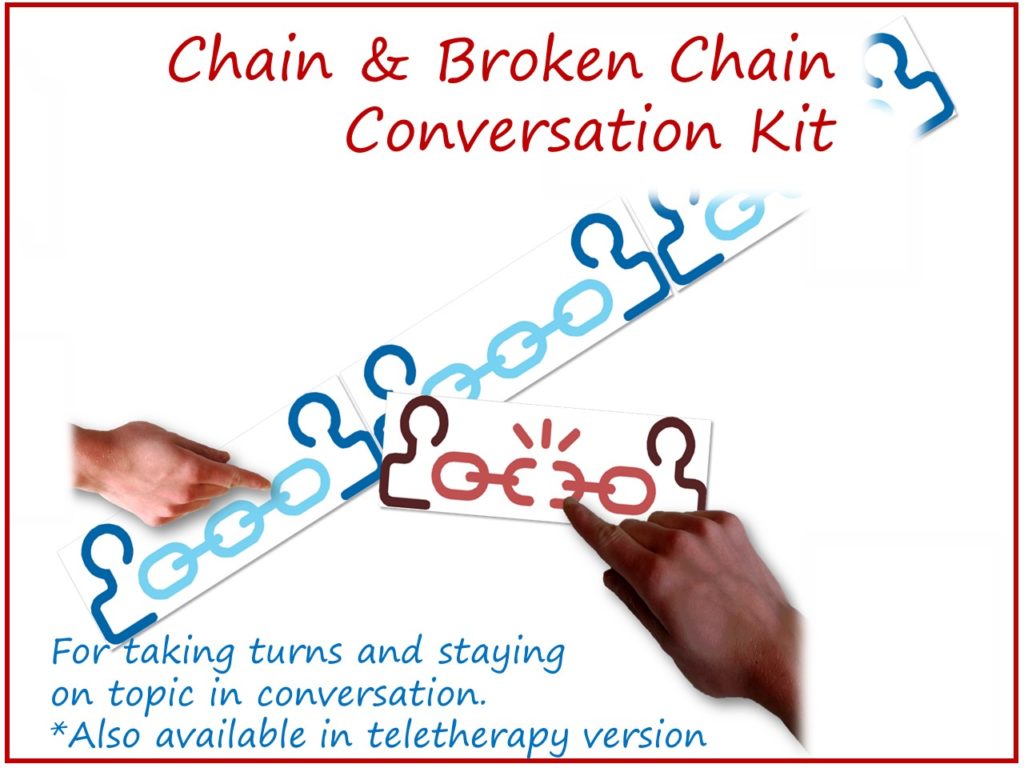
This resource is used in a similar manner to The Conversation Train printables, except the broken chain image is used instead of the broken train track to represent “off topic” statements. (This resource is currently transferred into German and Polish).

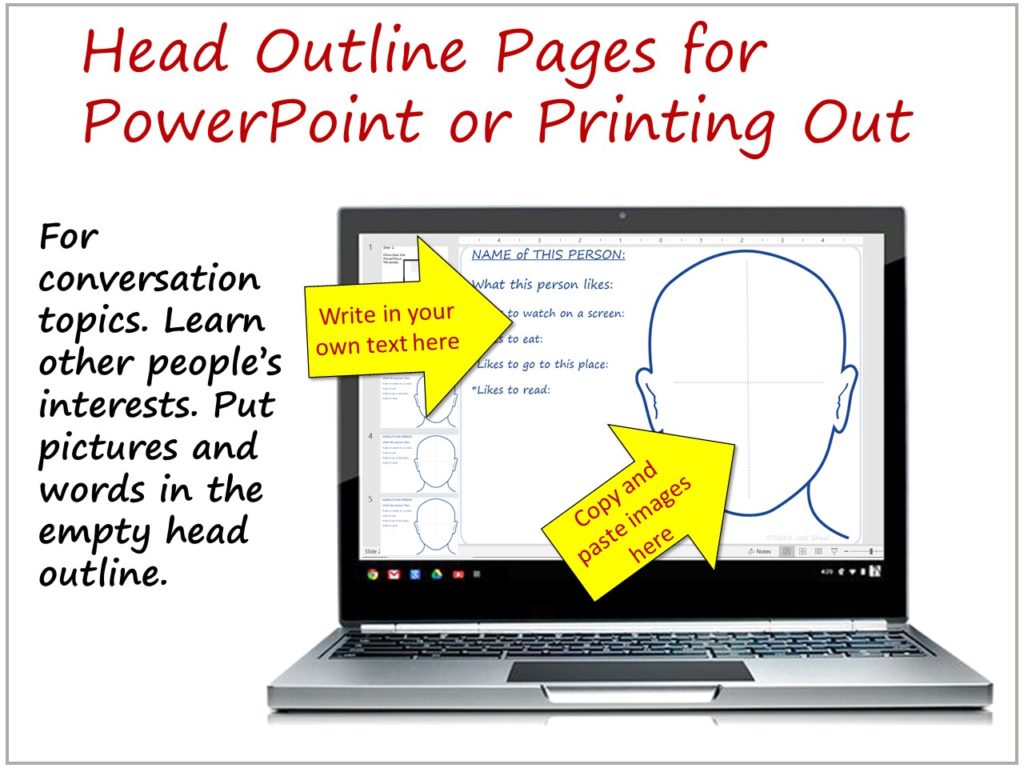
Head Outline Pages is available in a Spanish translation.

Voice Volume Meter is available in a Spanish translation.

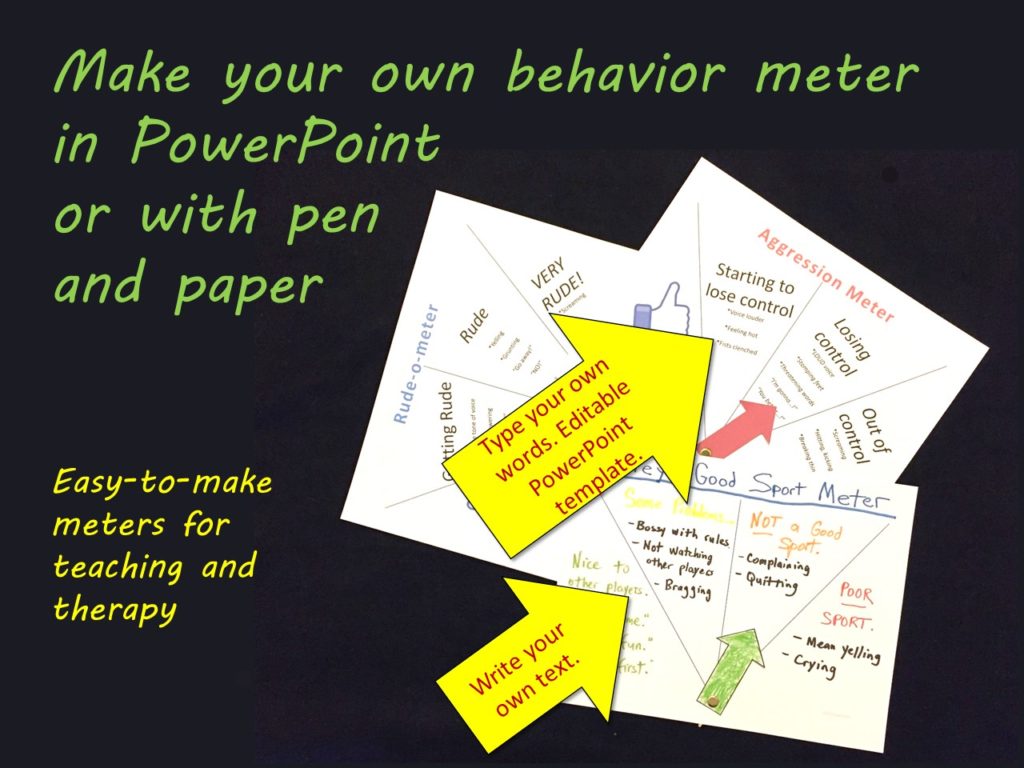
This is a very useful resource. In my own work, I use it several times a week. Children enjoy taking part in the creation of the meters, and it provides helpful continuity between one therapy session and the next.

Add you own text – in any language.

A toy balance is an invaluable social skills resource for your office, speech room or classroom.

I designed this resource carefully so that it is easy to use. You can create a game ahead of time for the children, but in my own work I prefer to create the game with the children, during our time together, so that the children are actual co-creators of the game.

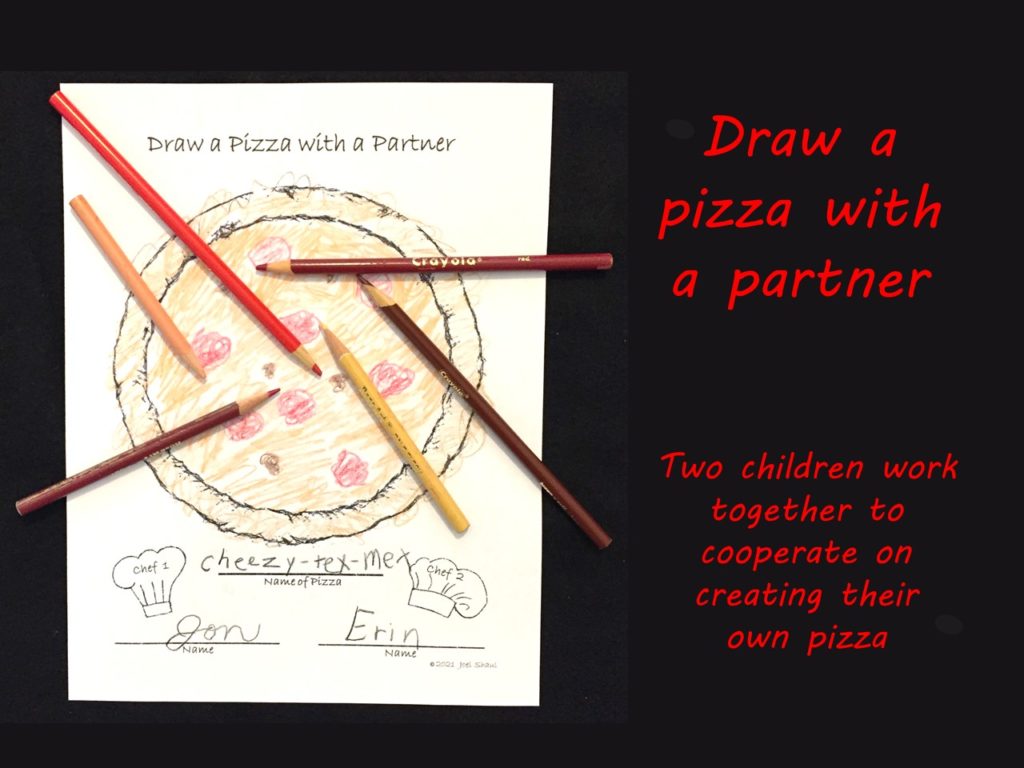
Draw a Pizza sheets are available in Spanish.

Your comments on these resources are most welcome, and often helpful. Click HERE to send an email.

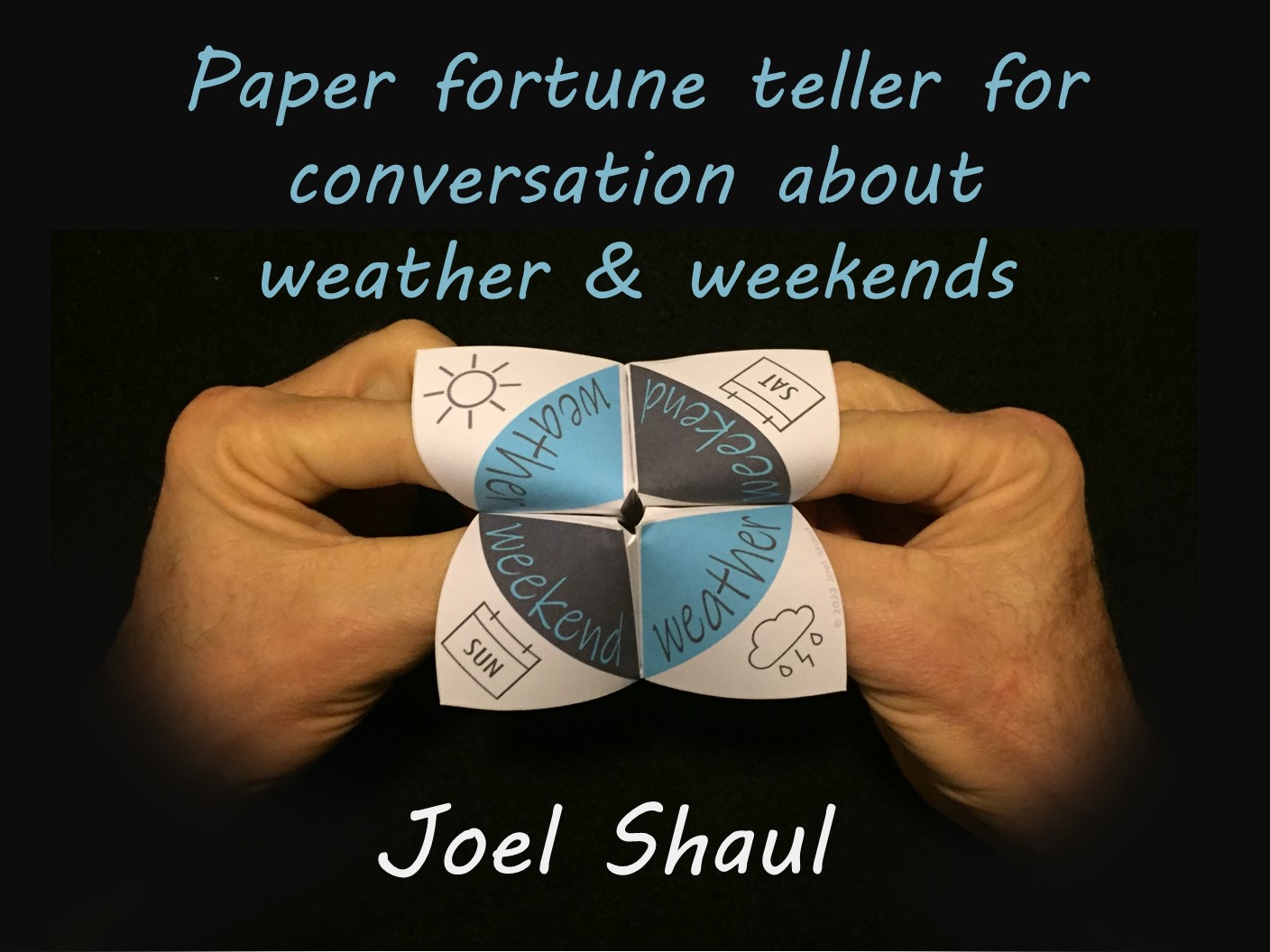
Paper fortune teller for conversation practice of small-talk topics – Weather & Weekends

Social skills conversation game to help children with autism practice small talk

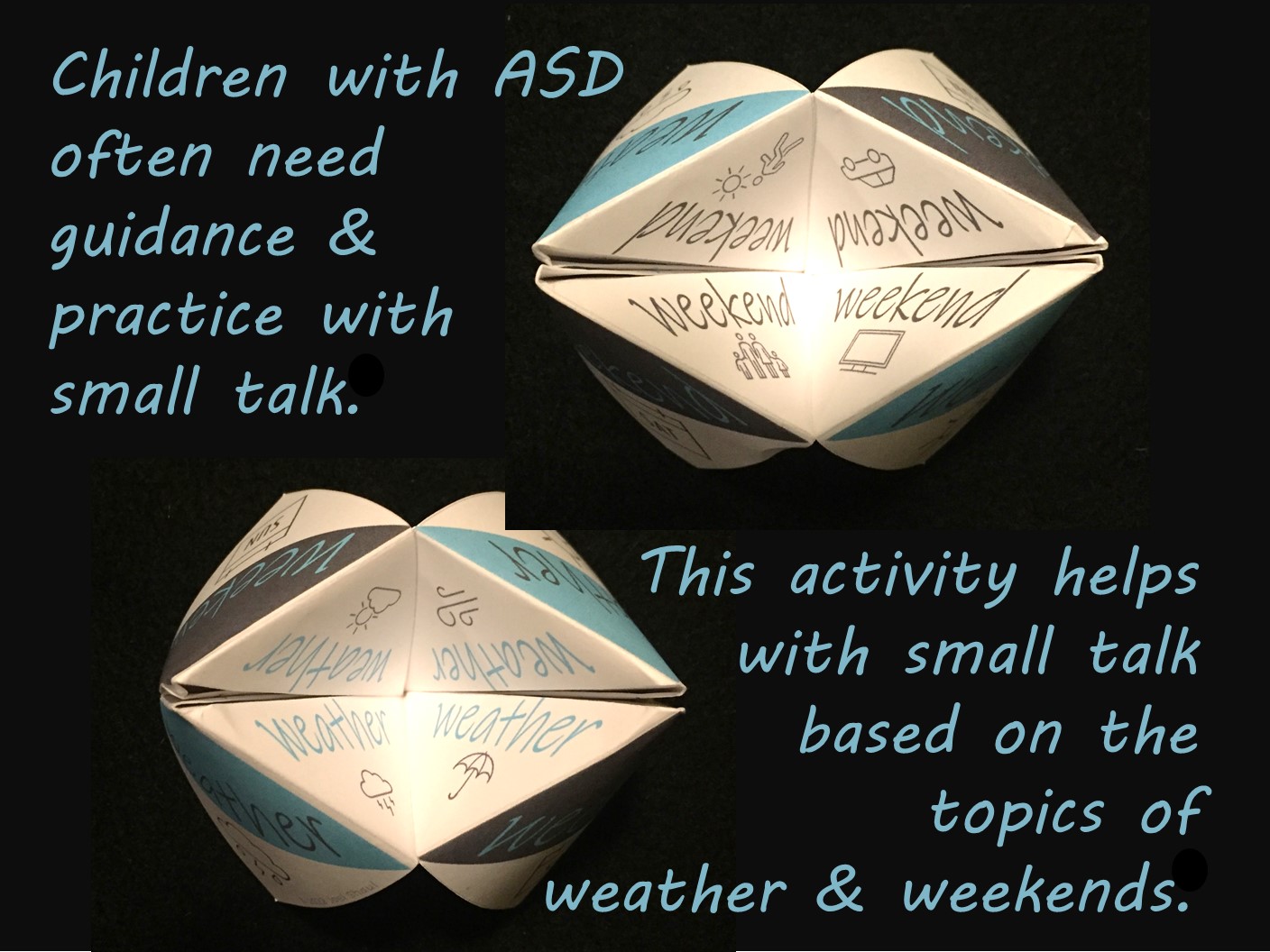
For many young people on the autism spectrum, doing small talk does not come naturally, and in fact it can be really difficult. Many benefit from mastering certain typical, common ground topics. Since learning these skills is very hard work, we need to keep it as enjoyable as possible.

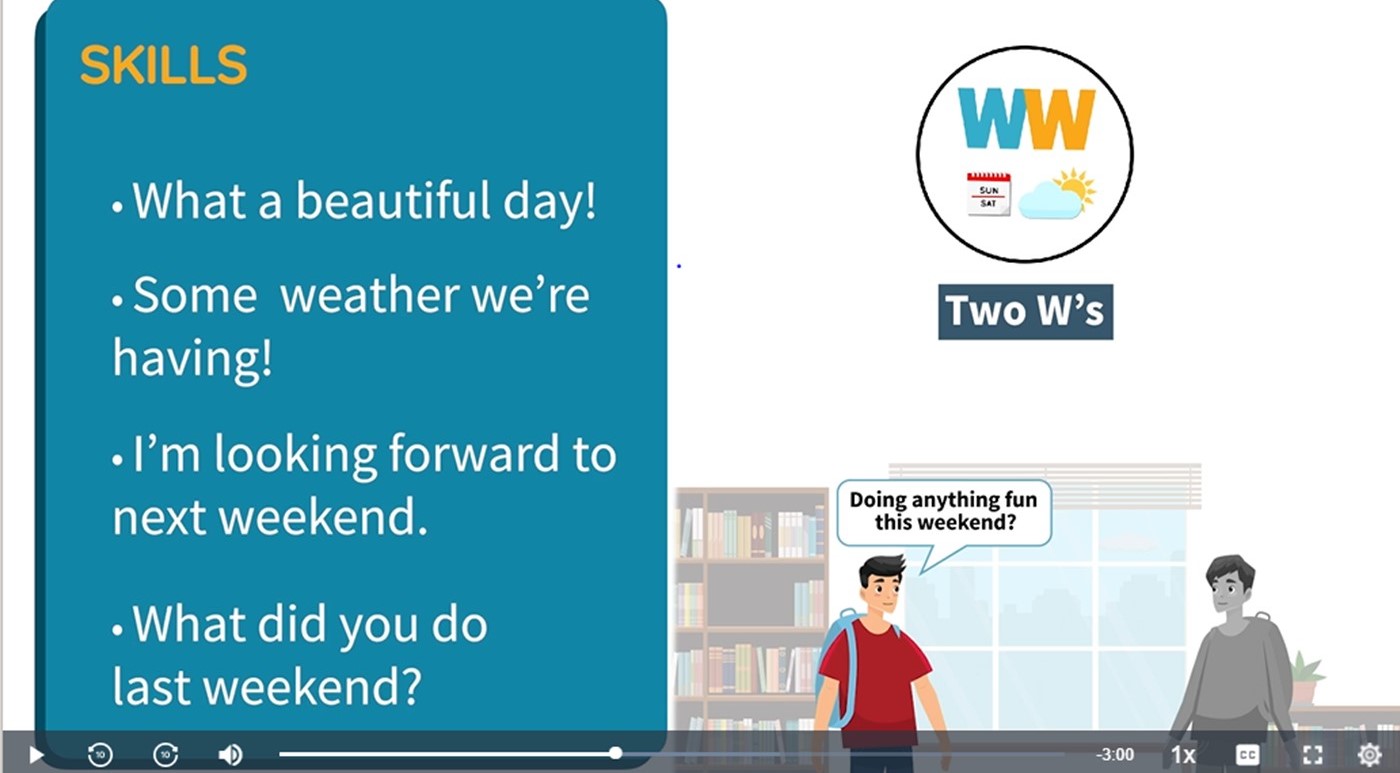
For some time, in my own work, I have been helping children practice conversation by introducing typical topics of weekends and weather, among others. In March 2021, Everyday Speech Videos featured a training video for children on the spectrum on this topic.

Screen shot from Everyday Speech Video on this topic. This company’s videos are pretty terrific.

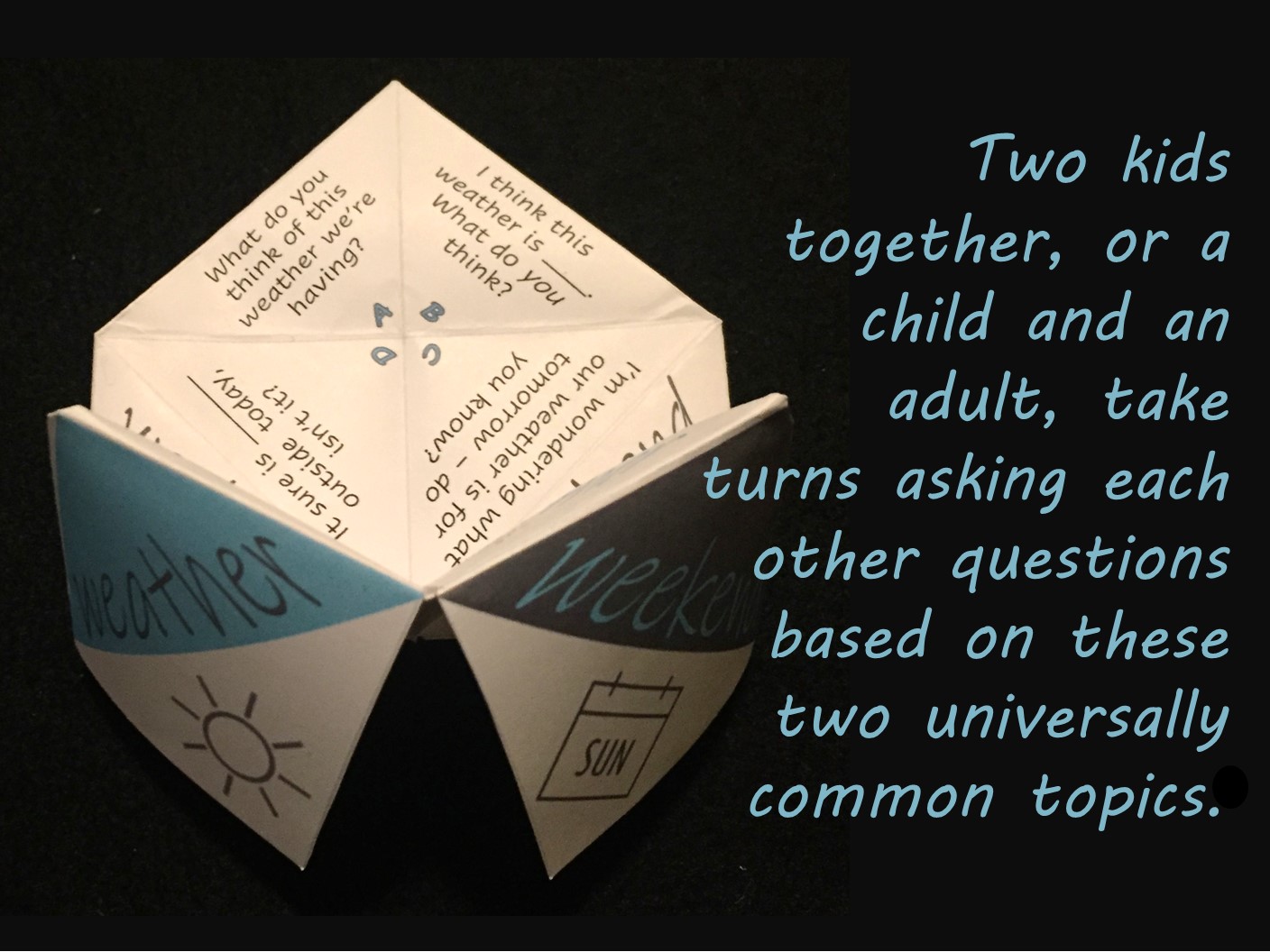
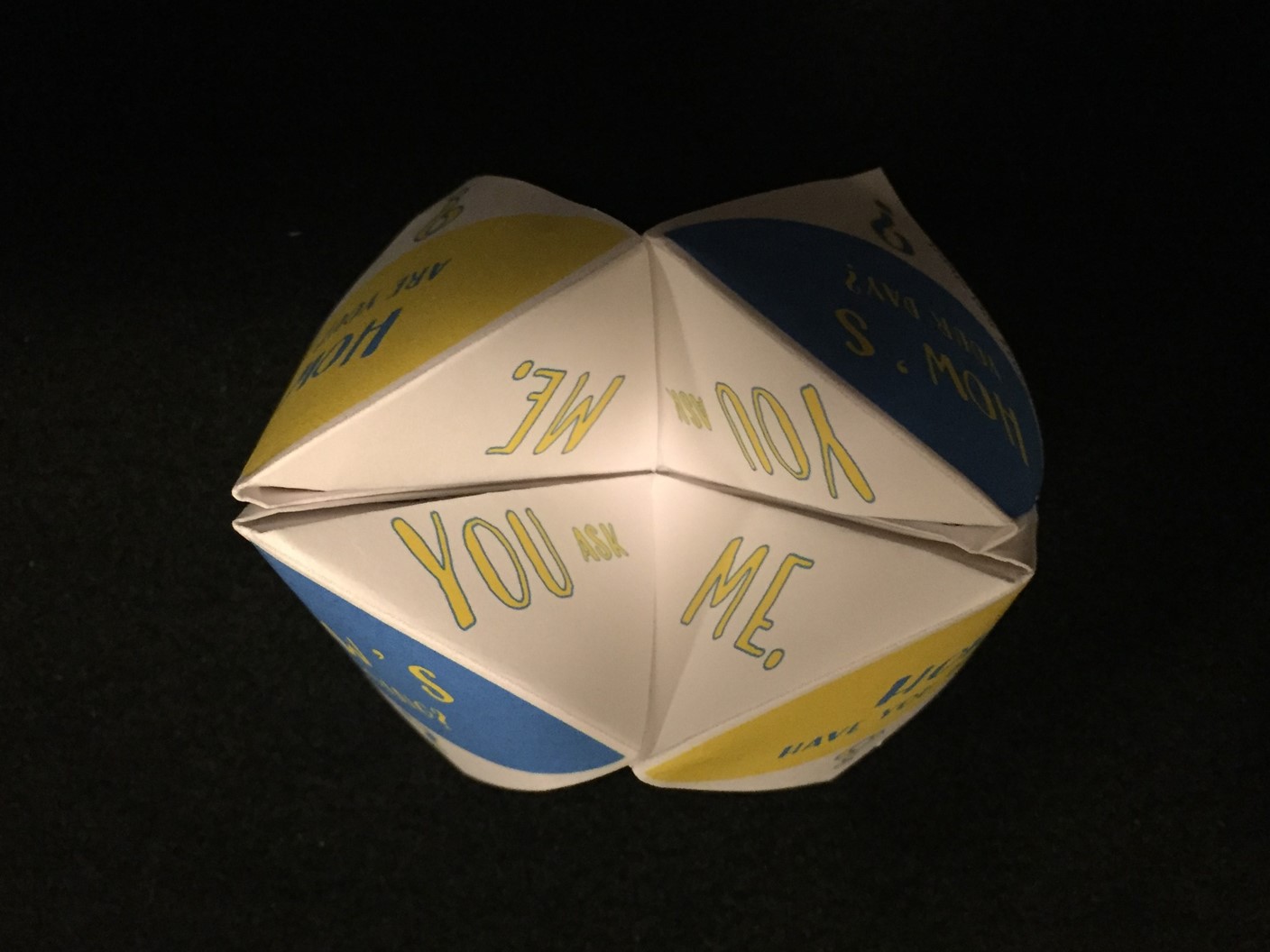
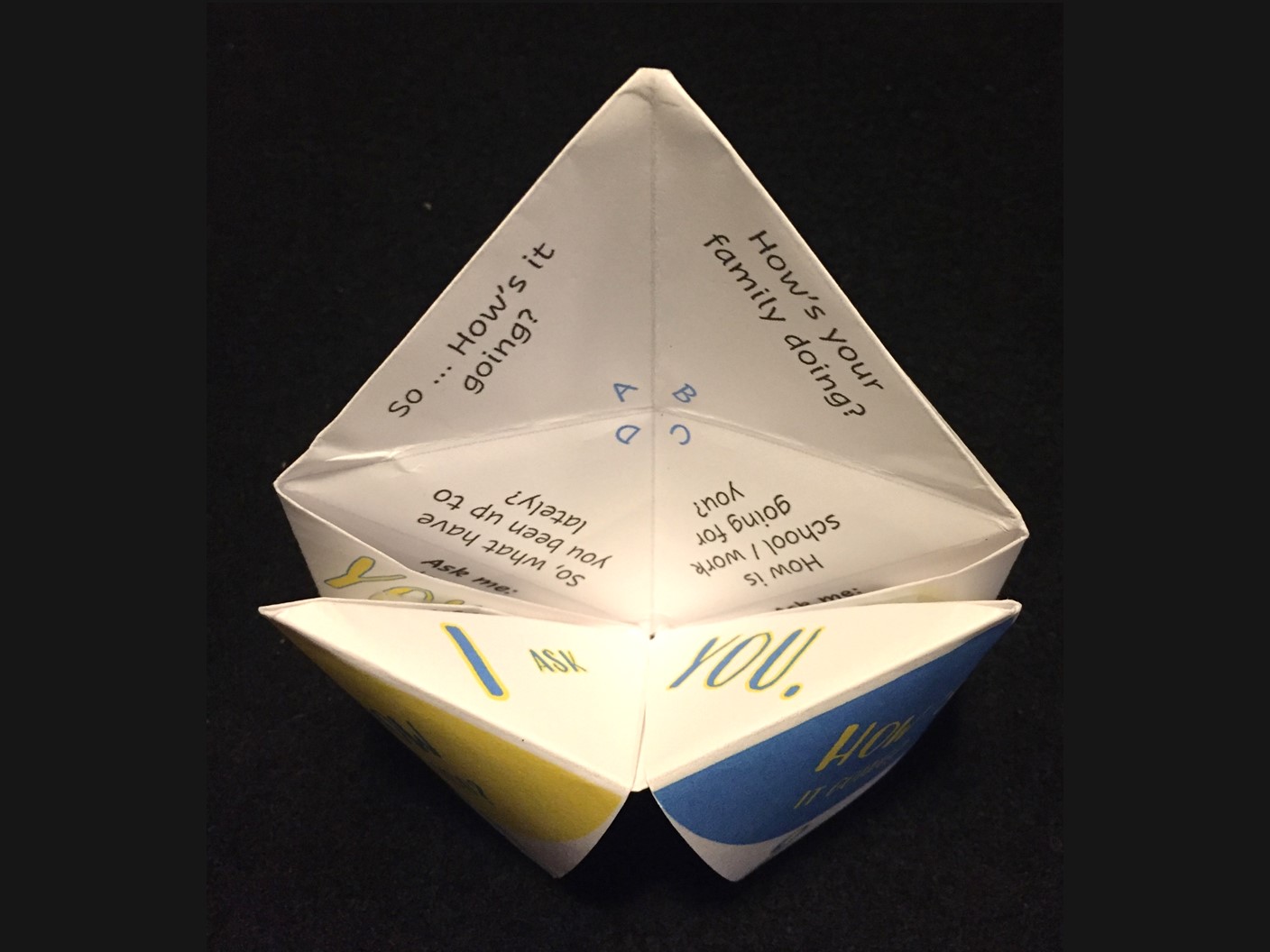
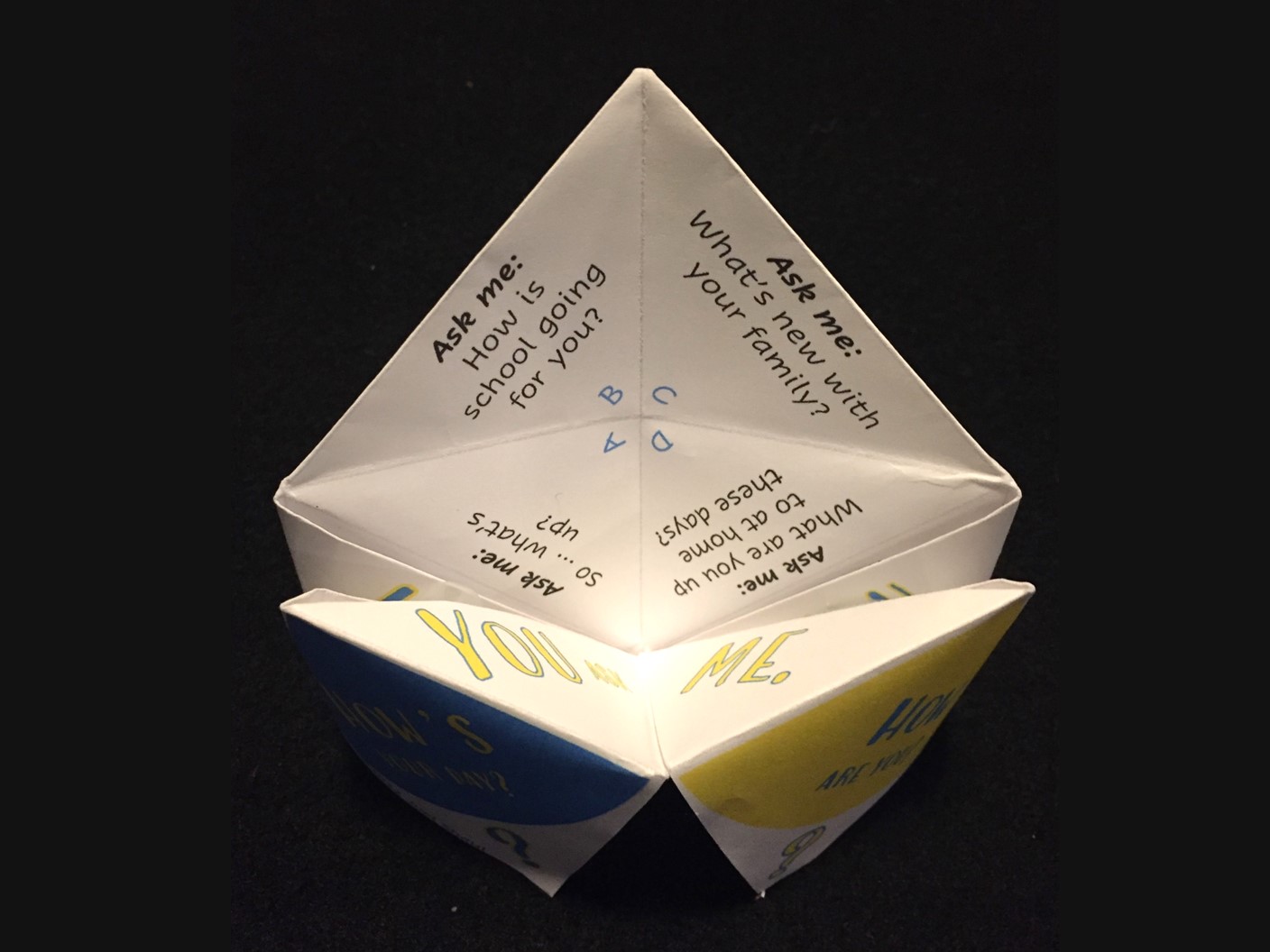
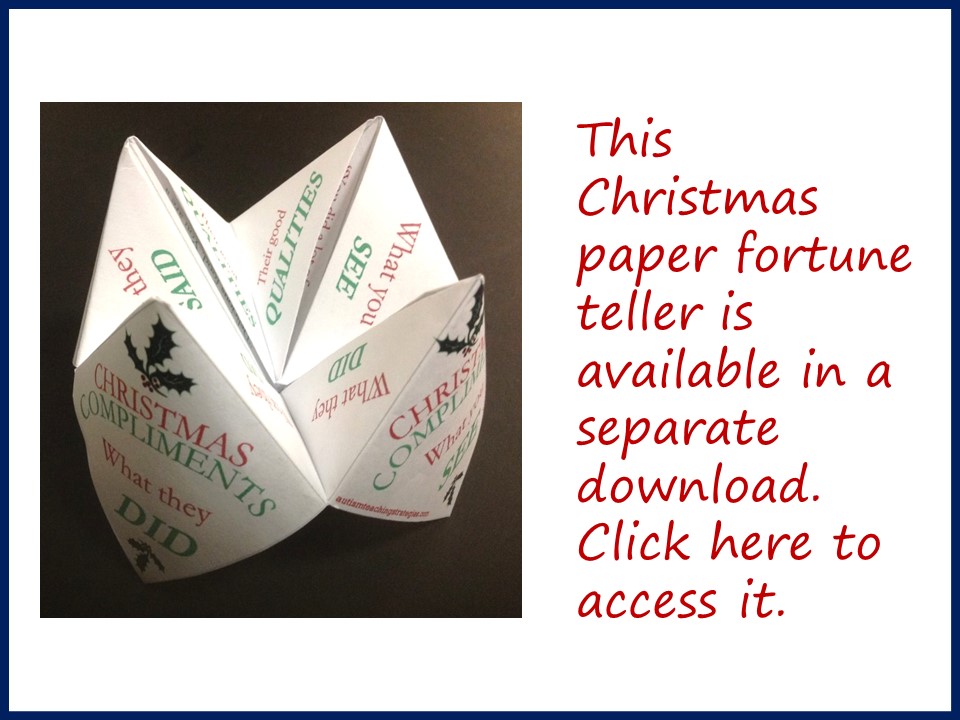
I felt inspired to create a paper fortune teller on this theme.

Your comments on these resources are most welcome, and often helpful. Click HERE to send an email.

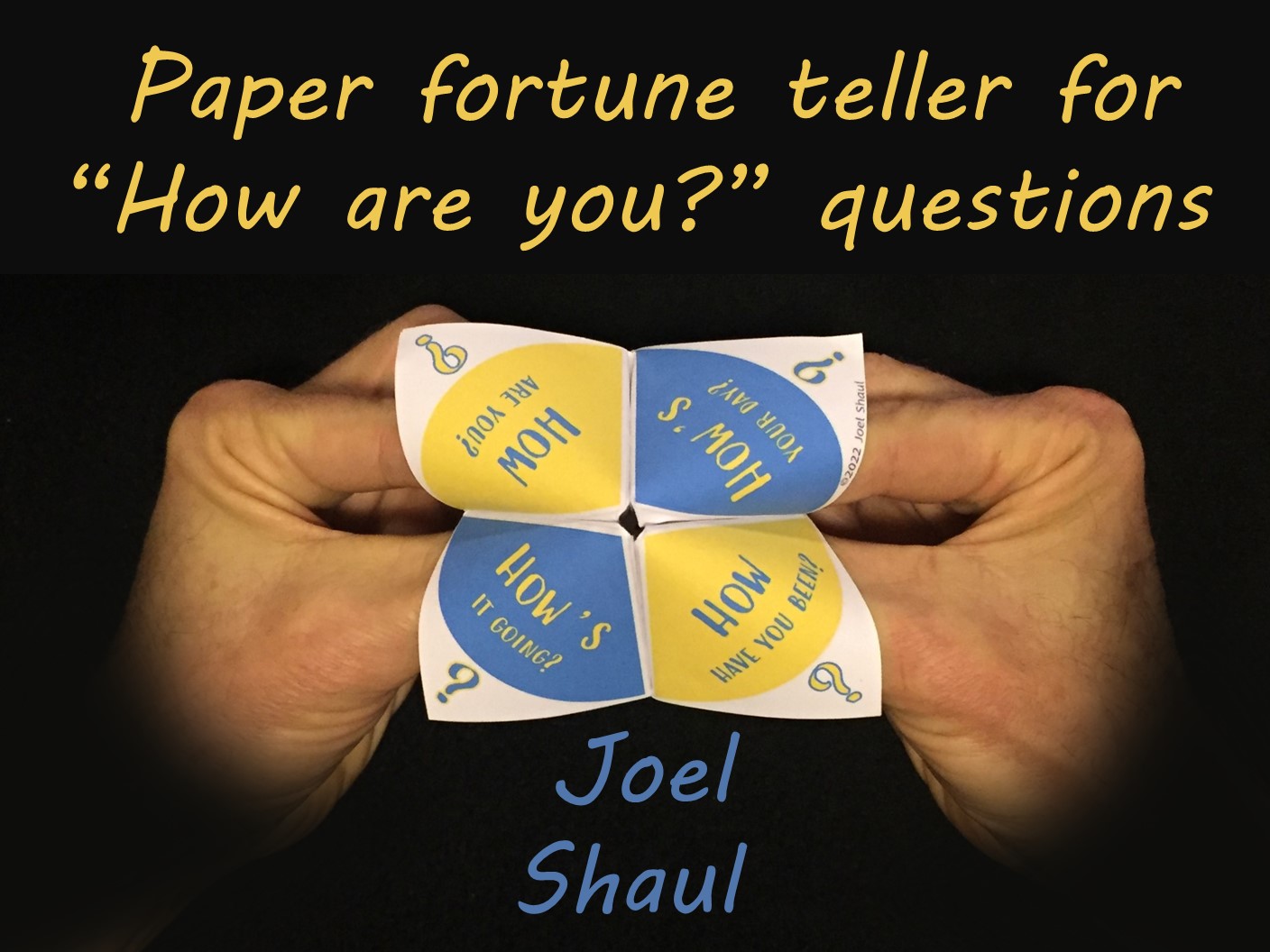
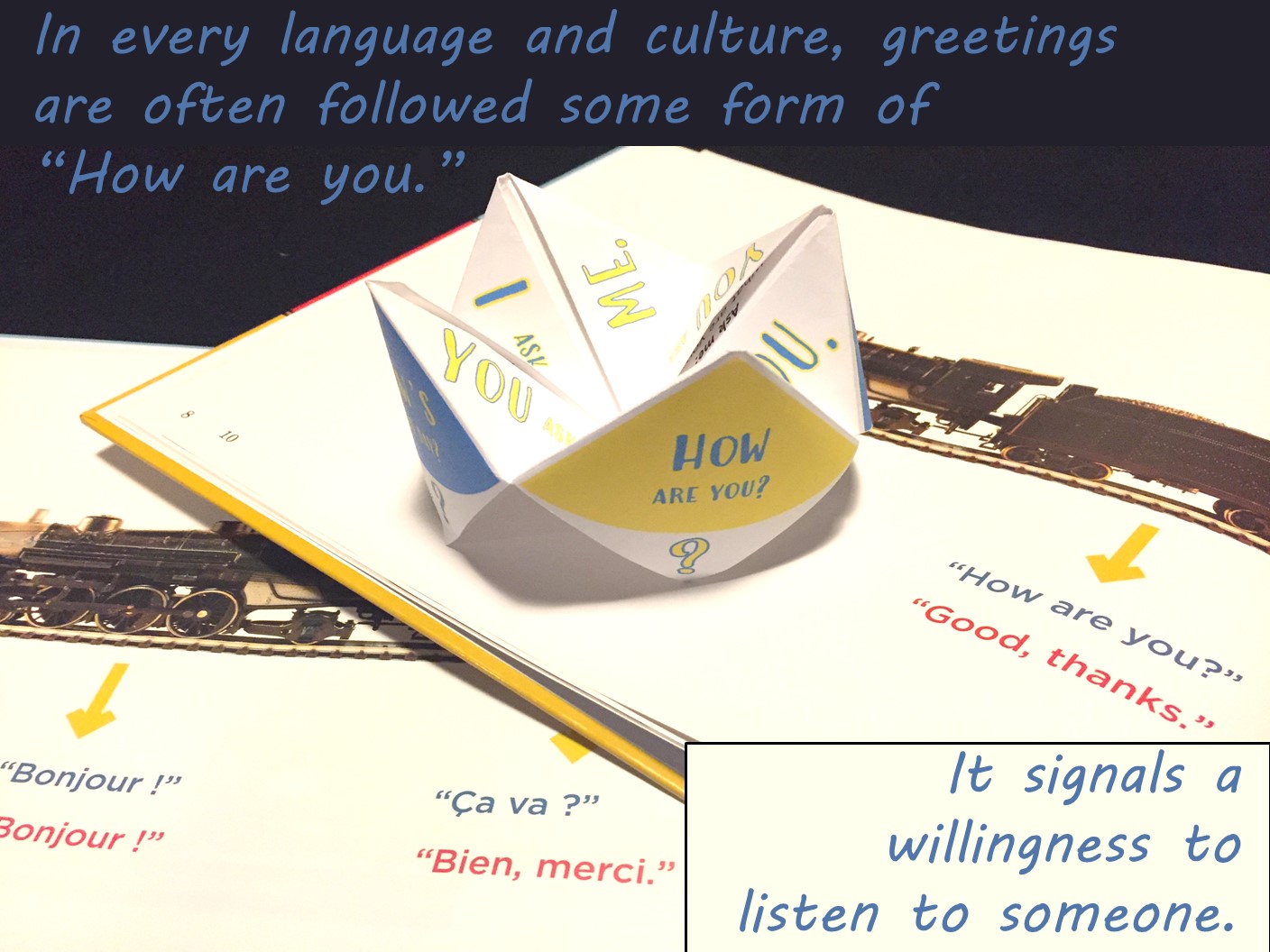
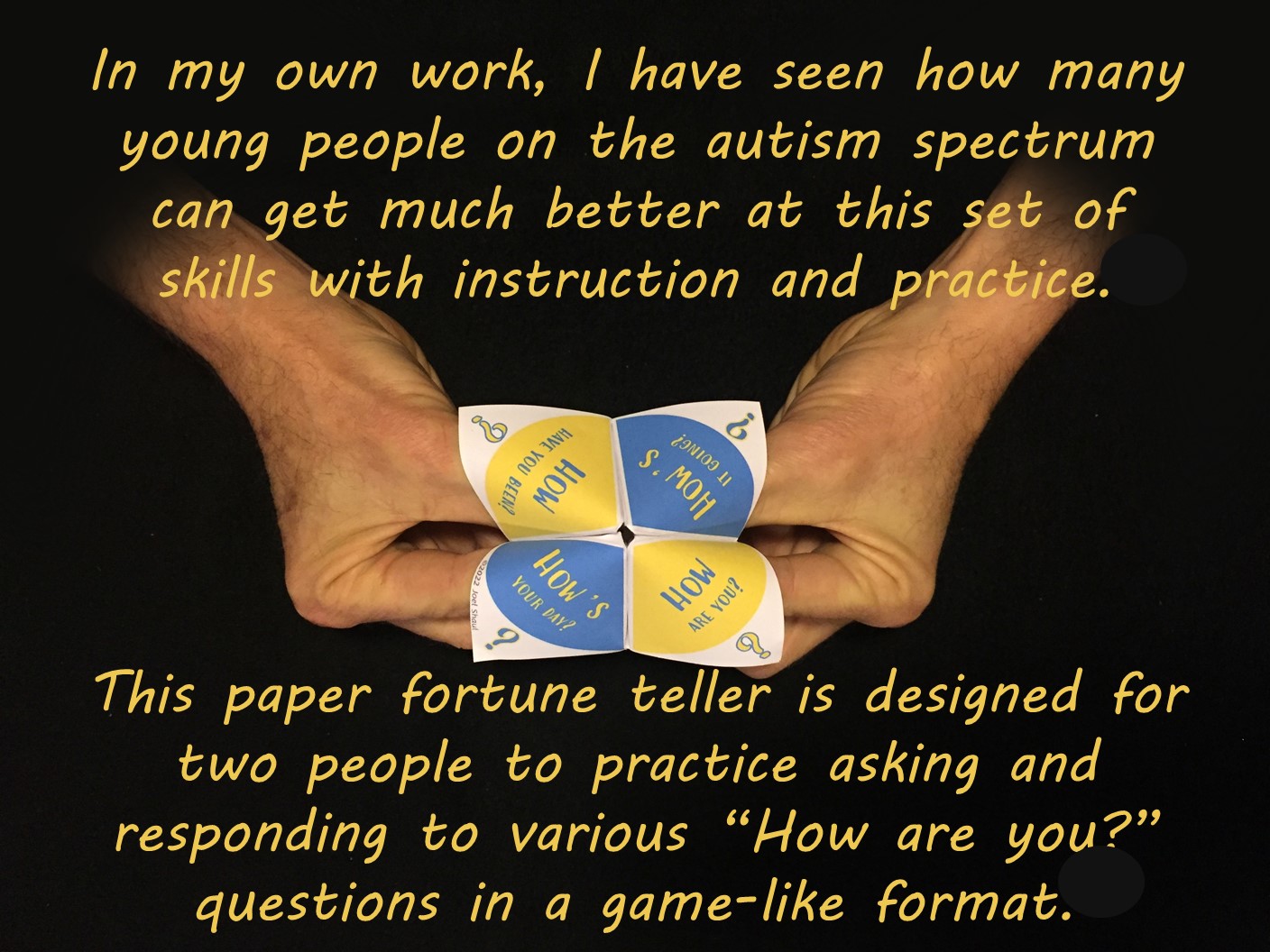
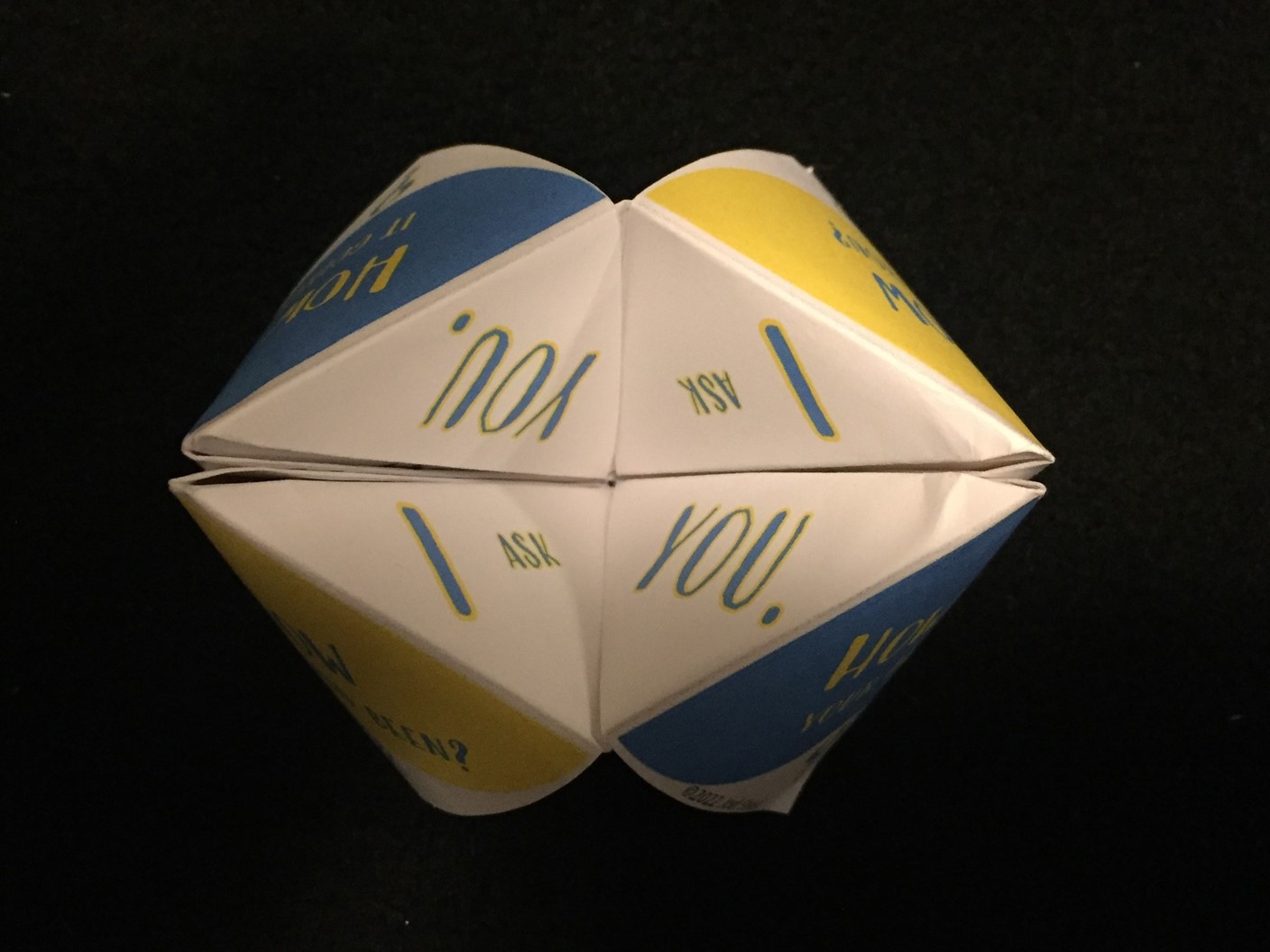
Paper fortune teller for practicing “How are you?” questions

This same resource, translated into German

[This is page 10 of the English and French versions of my book, The Conversation Train.]

Young people with autism and “How are you?” questions

When people with ASD are asked open-ended questions like “How are you doing?”, “What’s up?” or “How’s it going?”, they often can’t figure out just what it is the other person wants to know.  Also, individuals with autism might be inexperienced at employing various quick, formulaic replies like “Fine, thanks” or “I’m doing okay. You?”

When people with autism are expected to ask other people “How are you?” or “How’s it going?”, many just avoid saying it altogether. There are several reasons for this. First, the unfolding of a conversation containing “How are you?” can be very unpredictable in length and in content.  Asking a person how they are doing often elicits a lot of information that someone with ASD may feel unprepared to take in. Second, a person on the autism spectrum might not grasp the imperative of reciprocity in conversation, so when someone asks them “How are you?” they don’t end up asking the same thing in reply.

There are many other conversation-based paper fortune tellers on the website to practice other elements of social communication. I also show how to fold them.

Don’t miss these other free worksheets, games, and teaching / therapy resources for children on the autism spectrum:

Free social skills games & activities, emotional regulation skills for kids with ASD

Free social skills games & activities, communication / conversation skills for kids with ASD

Free social skills games & activities, social interaction skills for kids with ASD

Your comments on these resources are most welcome, and often helpful. Click HERE to send an email.

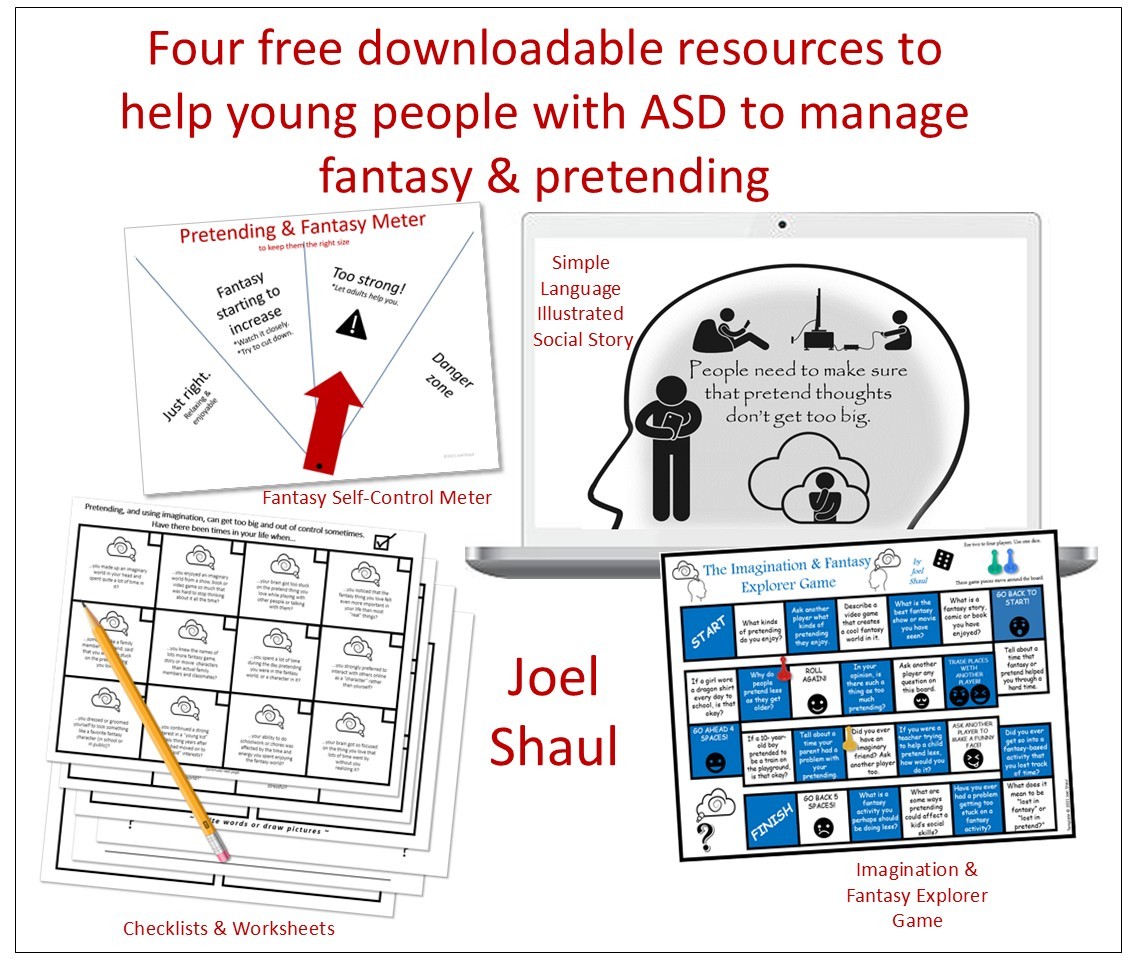
Autism and fantasy ~ Understanding, appreciating and helping young people on the autism spectrum with their fantasy worlds. Worksheets, game, illustrated social story.

[Updated August 16, 2025]

Autism spectrum disorder and fantasy obsessions

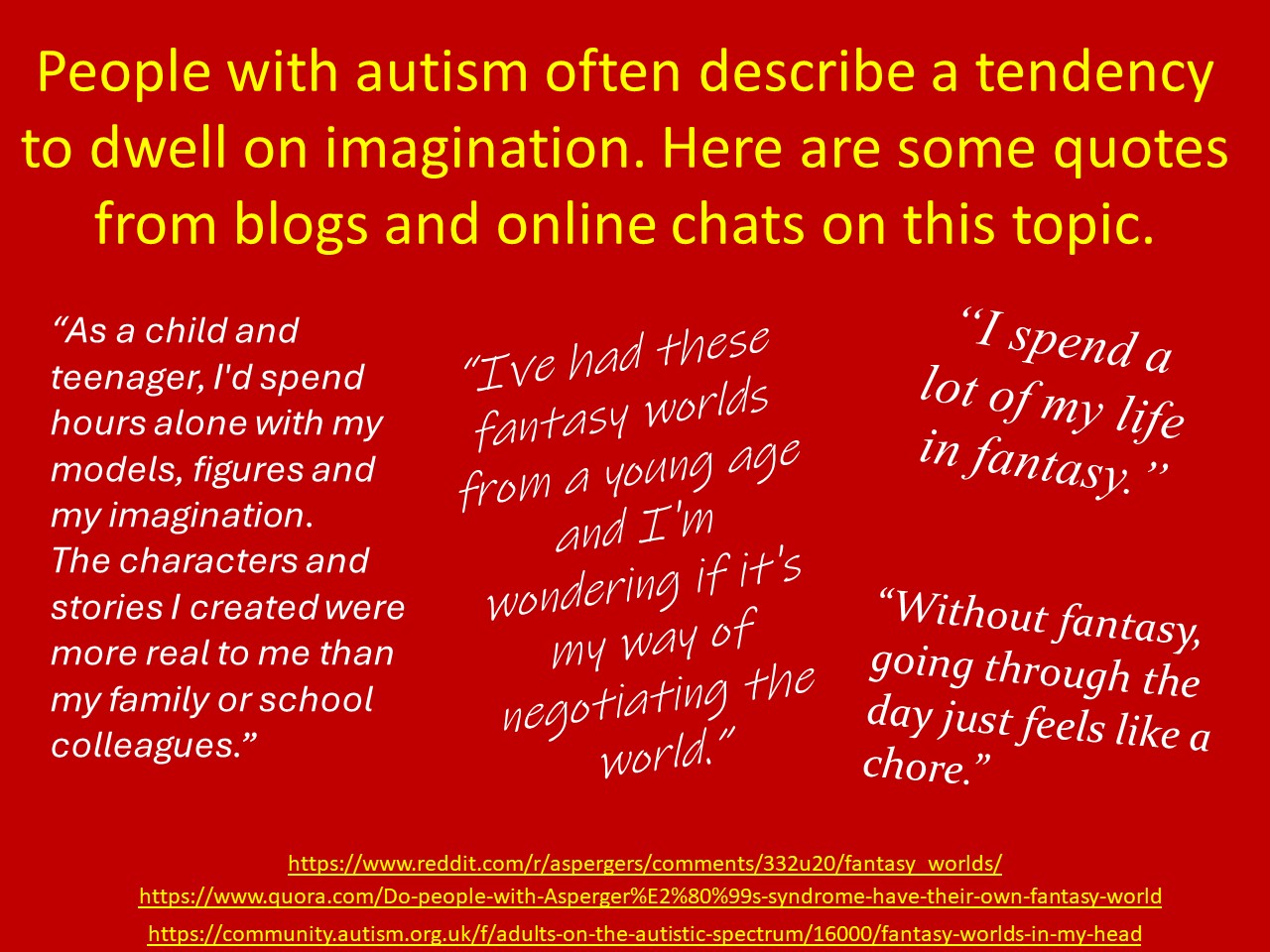
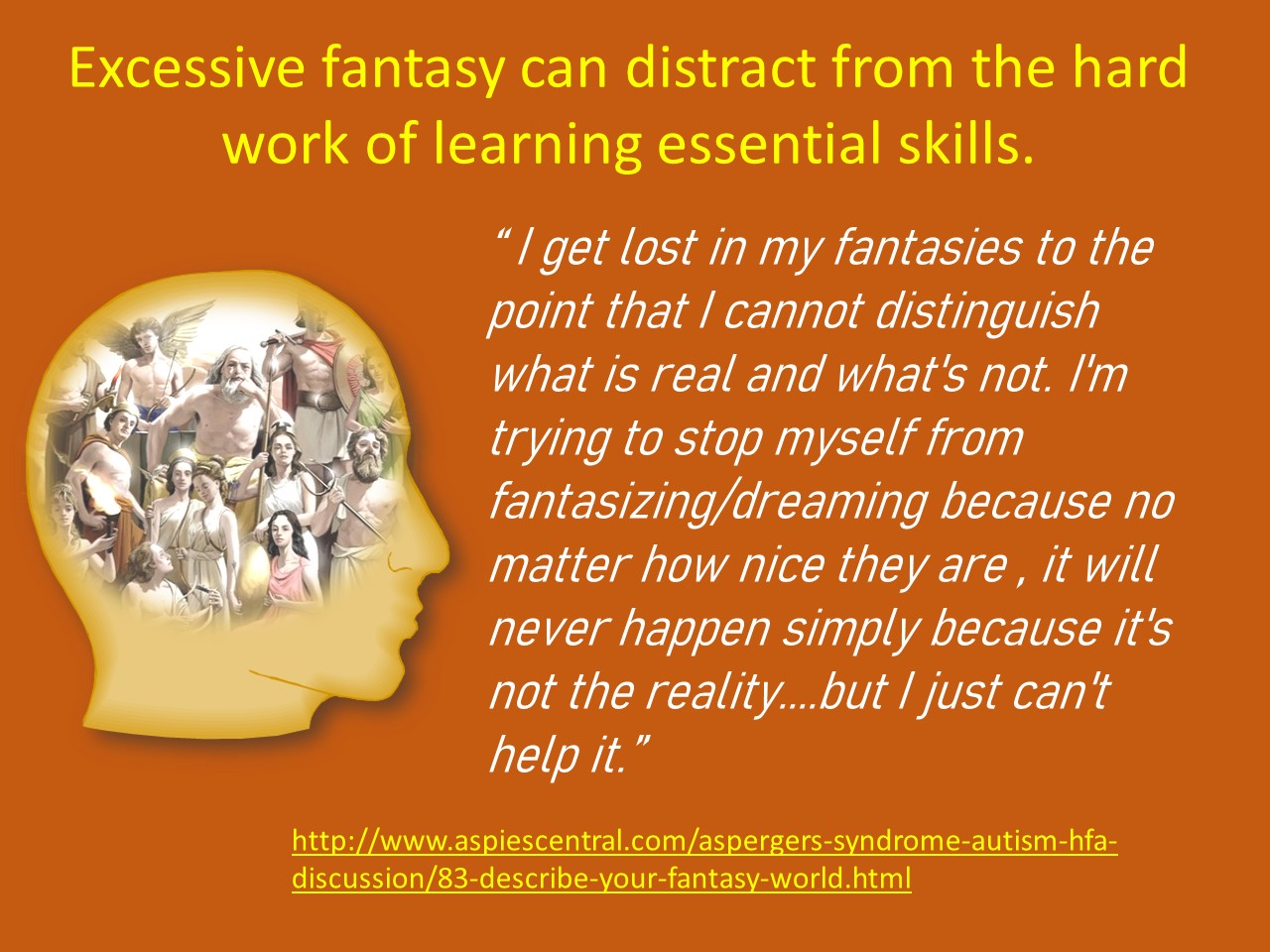
Years ago, when I first started working with children on the autism spectrum, I noticed right away that many of them had very rich fantasy lives. To learn more about it, I explored  books, blogs, chat rooms and YouTube videos in which adults with autism reflected on this aspect of their psychology. What autistic people have to say on this subject is important.

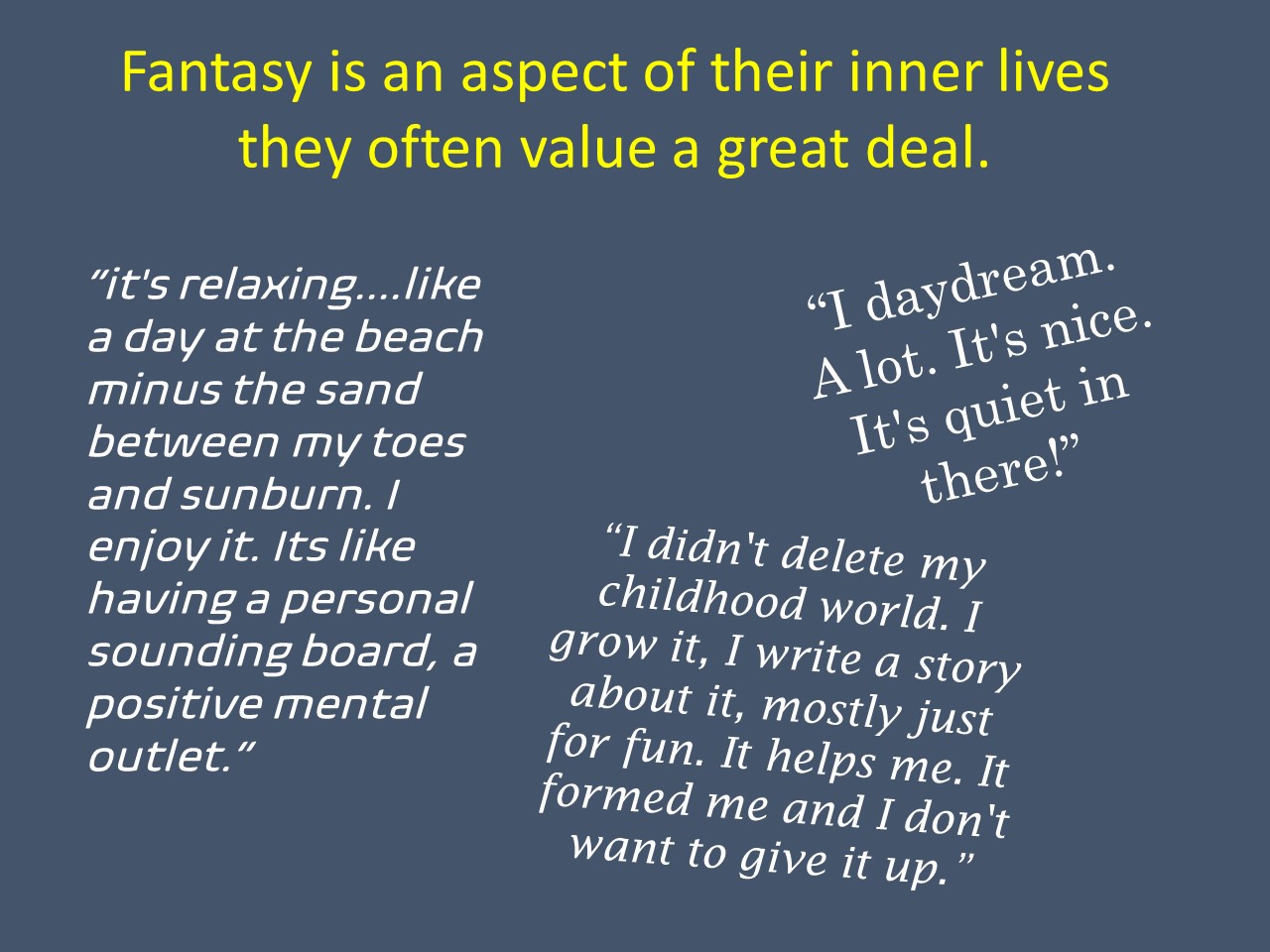
Imagination and fantasy are important and normal aspects of being human.  In our lives, we all have to work out how to enjoy pretending, use it to our advantage and control it. When life is difficult, it is certainly common for people to employ imagination to relieve stress and dream up possible solutions to problems. In my own work with children, teens and young adults on the autism spectrum who are dealing with anxiety, depression, social isolation and skills deficits, I do often find that my clients are using fantasy in ways that are helpful to them.


In my work with young people with ASD, I do however very often find that my clients become involved with fantasy-based interests and activities in ways that are problematic. These include:

*Enthrallment with the fantasy aspects of video games, contributing to withdrawal from social engagement and life skill activities

*Involvement with imaginary friends and imaginary worlds which lasts too long and assumes too much importance to the young person with ASD

*Awkward attempts to engage others in conversation and play based on the fantasy system

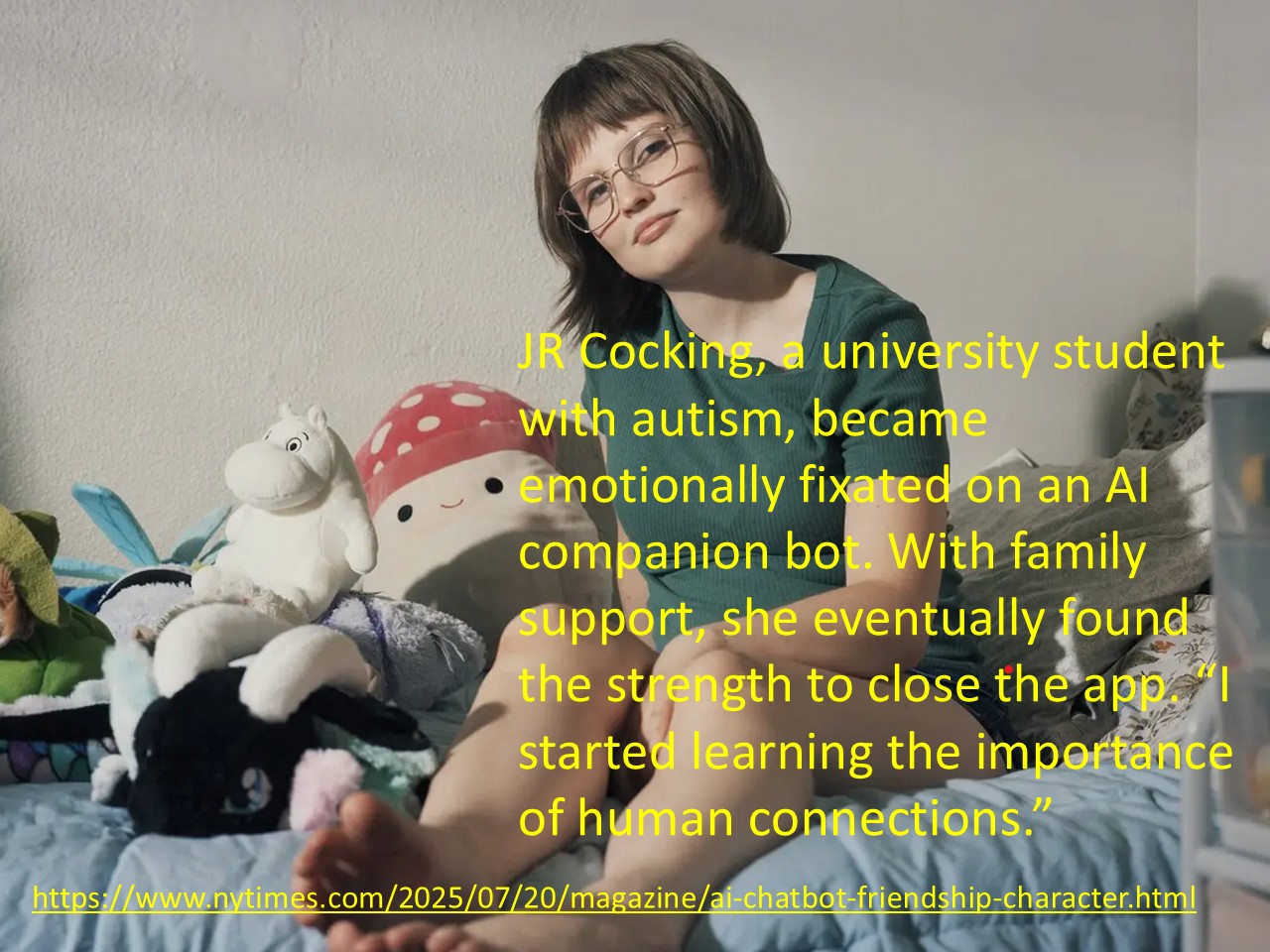
*Problematic engrossment with AI chatbots as companions

Vulnerability to excessive fantasy can affect all kinds of people, of course. In my own experience as a psychotherapist, I do find this problem is more common with autistic individuals. Many on the spectrum agree.


Some ways that therapists, teachers and parents can help young people with autism to understand and manage the ways they use fantasy and pretend:

*Help them to give candid and full descriptions of the fantasy-based thoughts and activities they value

*Validate their creativity and the functional aspects of activities powered by their imaginations

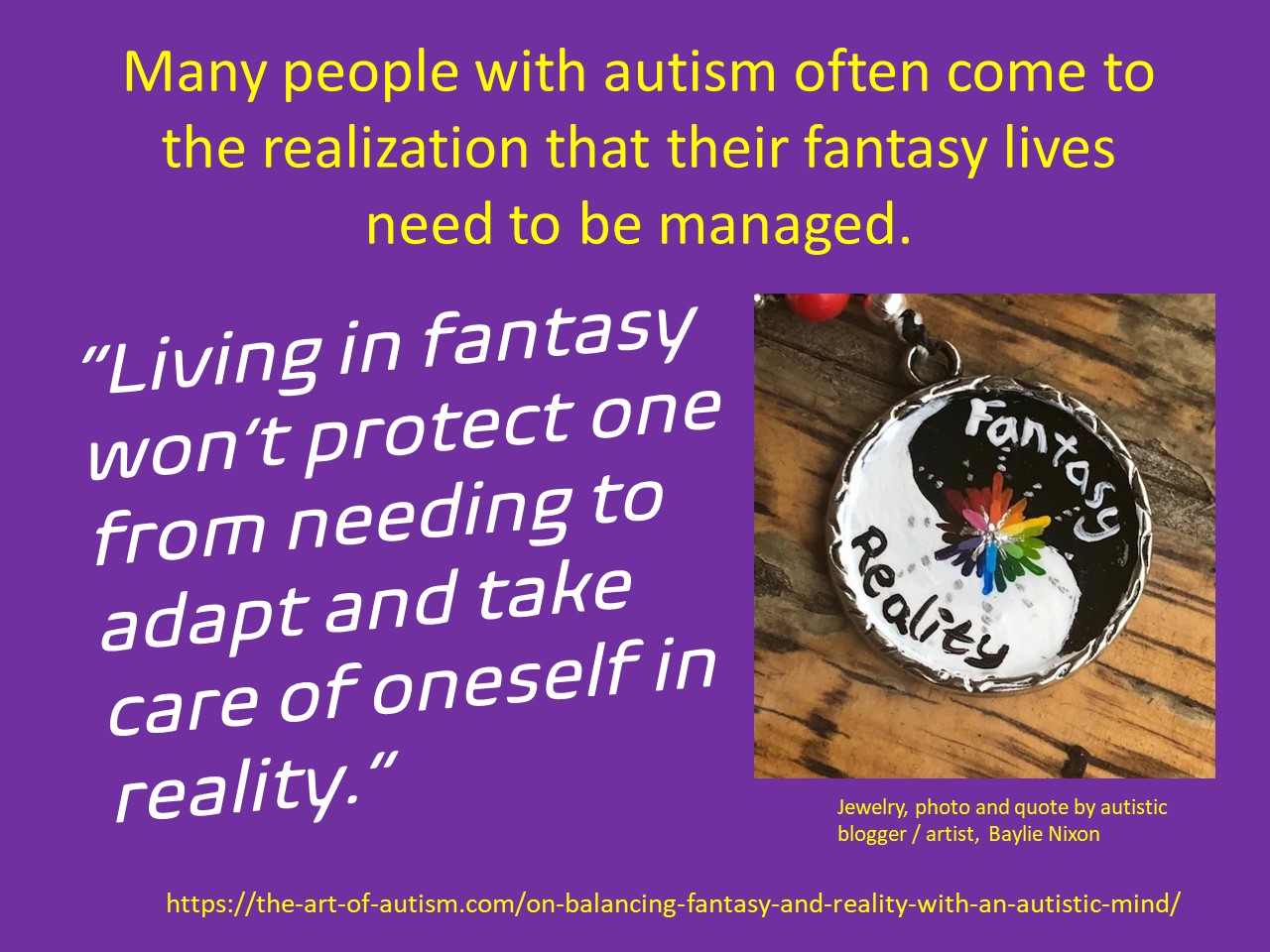
*Raise their awareness of ways that fantasy-based fixation can affect their lives and prospects adversely

*Reduce the severity of the problematic fantasy enthrallment and explore better ways to deal with boredom, anxiety and stress

*Engage parents and other family members in exploration of possible solutions

*Examine, and address, online sources of problematic fantasy obsession.


I have been working on the free download resources on this topic off and on for a long time. I use them a lot in my own work. I hope they are helpful in your work, too. I updated the worksheets in 2025 to reference the issue of online chatbots.

Joel Shaul


Don’t miss these other free worksheets, games, and teaching / therapy resources for children on the autism spectrum:

Free social skills games & activities, emotional regulation skills for kids with ASD

Free social skills games & activities, communication / conversation skills for kids with ASD

Free social skills games & activities, social interaction skills for kids with ASD

Your comments on these resources are most welcome, and often helpful. Click HERE to send an email.

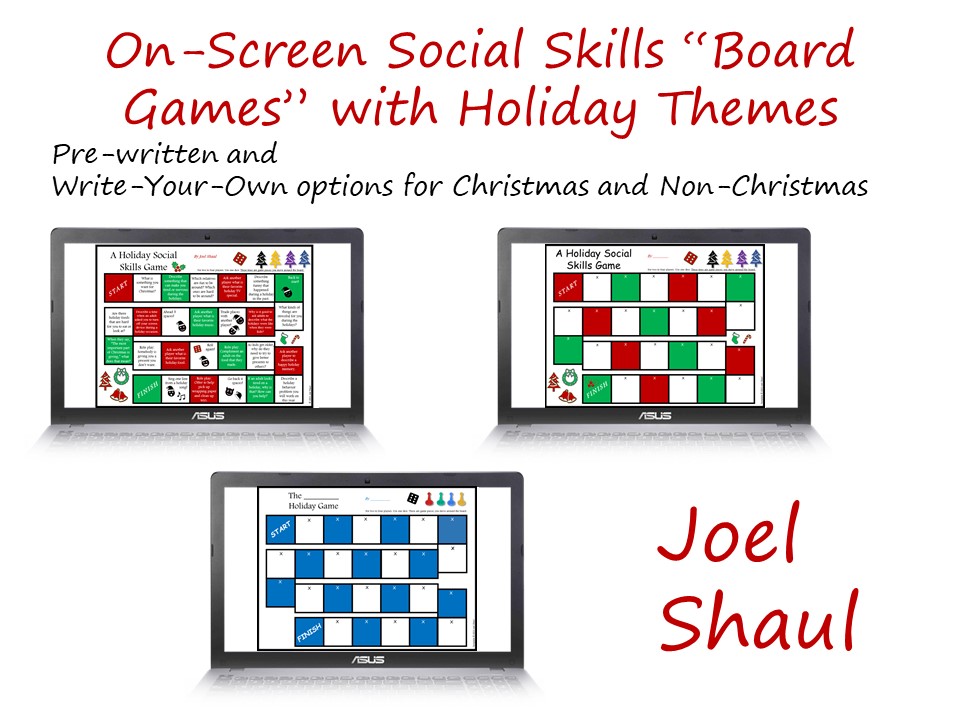
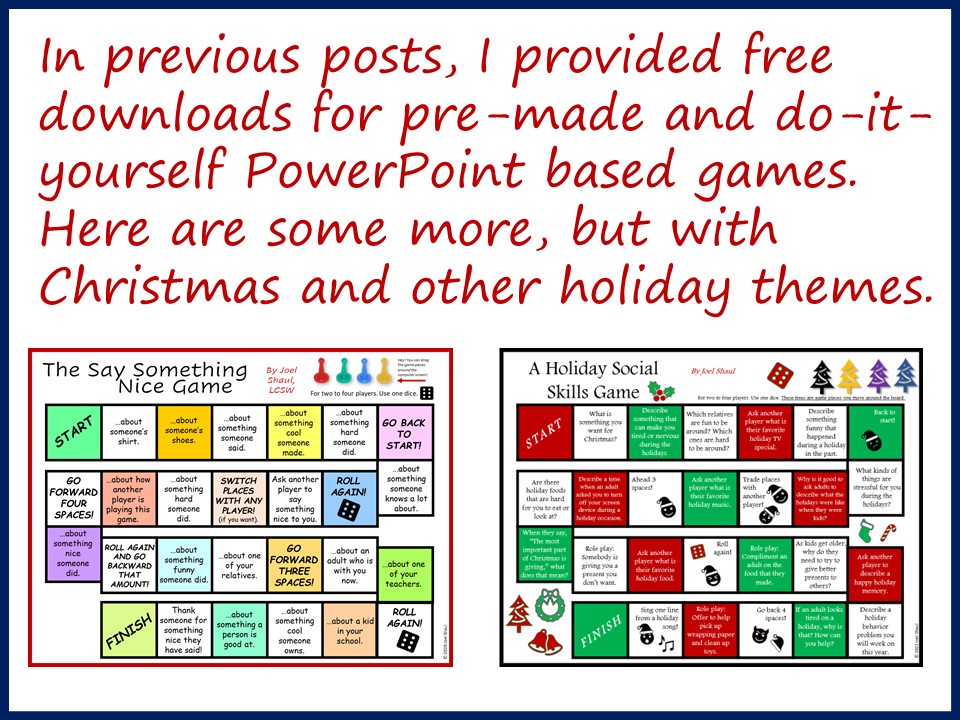
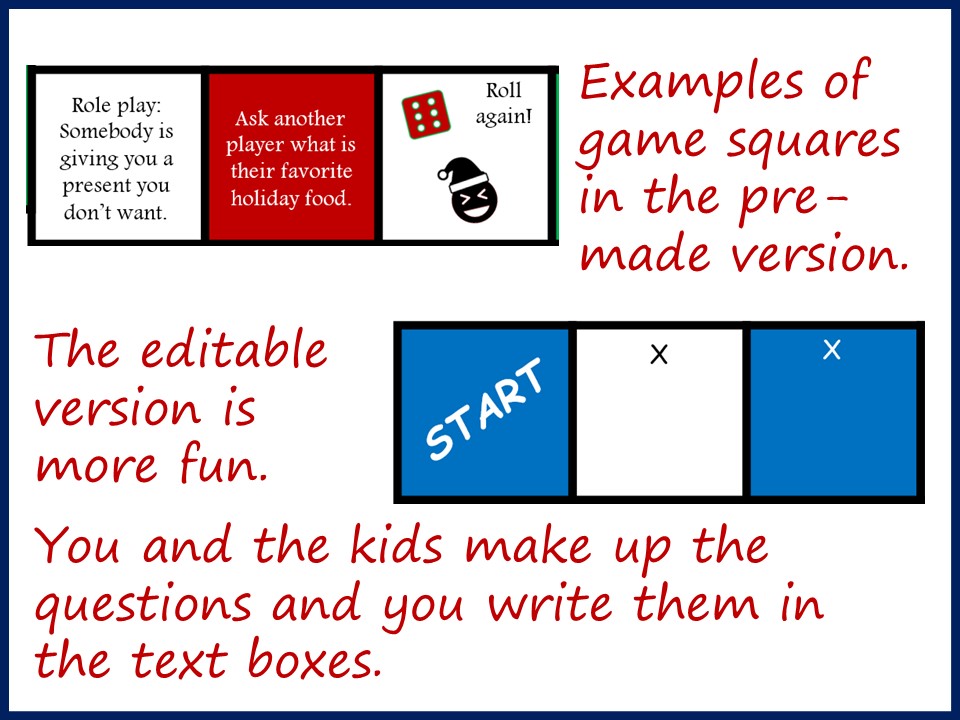
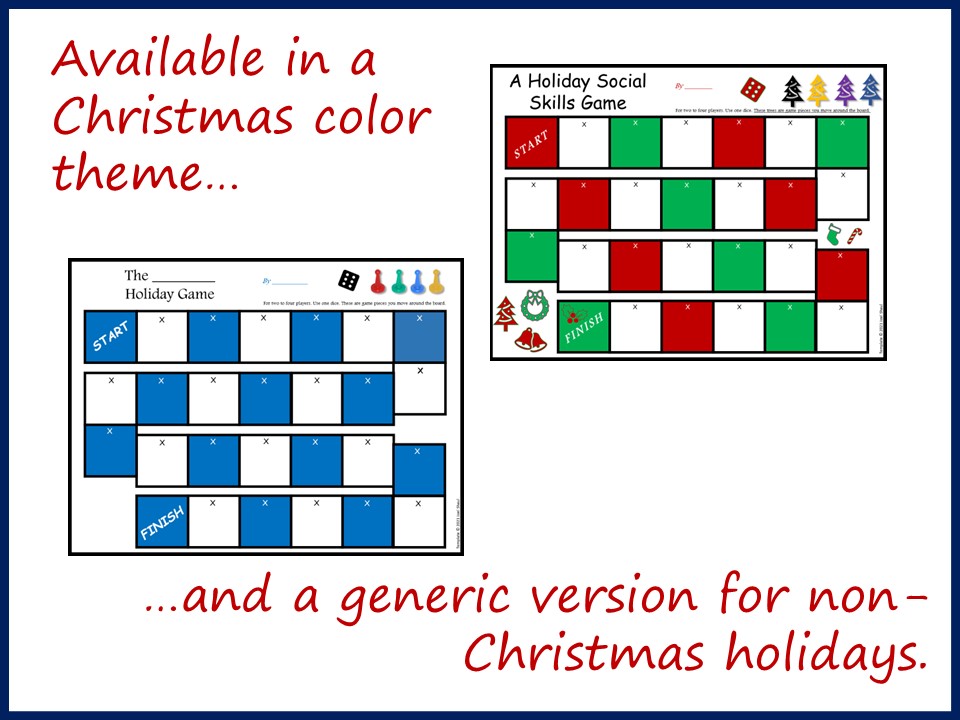
On-screen Holiday social skills “board games” for Christmas (and other holidays) social skills

(For OTHER on-screen social skills games, click here)

Christmas (and other holiday) social skills challenges for children with ASD

All children, including children on the spectrum, get excited about upcoming holidays. As teachers, therapists and parents, there are some things we can help them with ahead of time so they can enjoy the holidays as much as possible and cope with aspects of holidays that might be difficult for them.

Sensory issues: Children with ASD might experience aversion to unfamiliar foods and cooking aromas. They might feel uncomfortable in loud, crowded spaces such as family get-togethers and holiday concerts.

Conversation: Children with ASD often benefit from preparation and practice for the unique social communication opportunities that can occur during holidays.

Emotional regulation: Children who derive comfort from knowing what is going to happen next can find the unpredictable characteristics of holidays challenging, such as receiving unexpected  gifts and  experiencing sudden schedule changes.

Social expectations: During the holiday season, children with ASD can experience confusion regarding such social expectations as reciprocating generosity and acting more mature with increasing age.

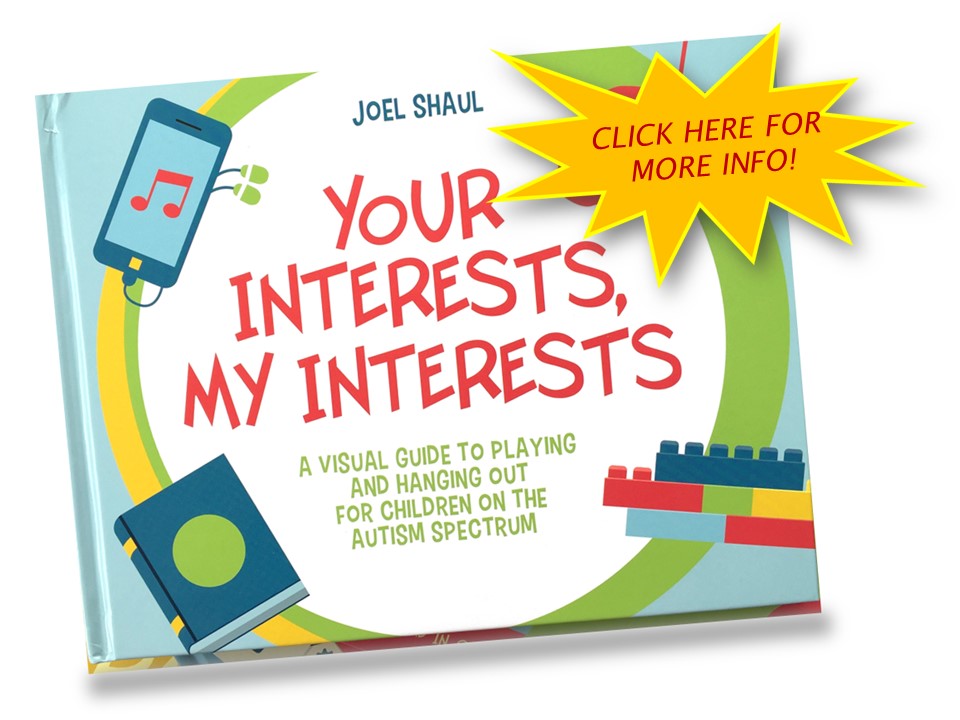
Your Interests Promo image for website

Don’t miss these other free worksheets, games, and teaching / therapy resources for children on the autism spectrum:

Free social skills games & activities, emotional regulation skills for kids with ASD

Free social skills games & activities, communication / conversation skills for kids with ASD

Free social skills games & activities, social interaction skills for kids with ASD

Your comments on these resources are most welcome, and often helpful. Click HERE to send an email.

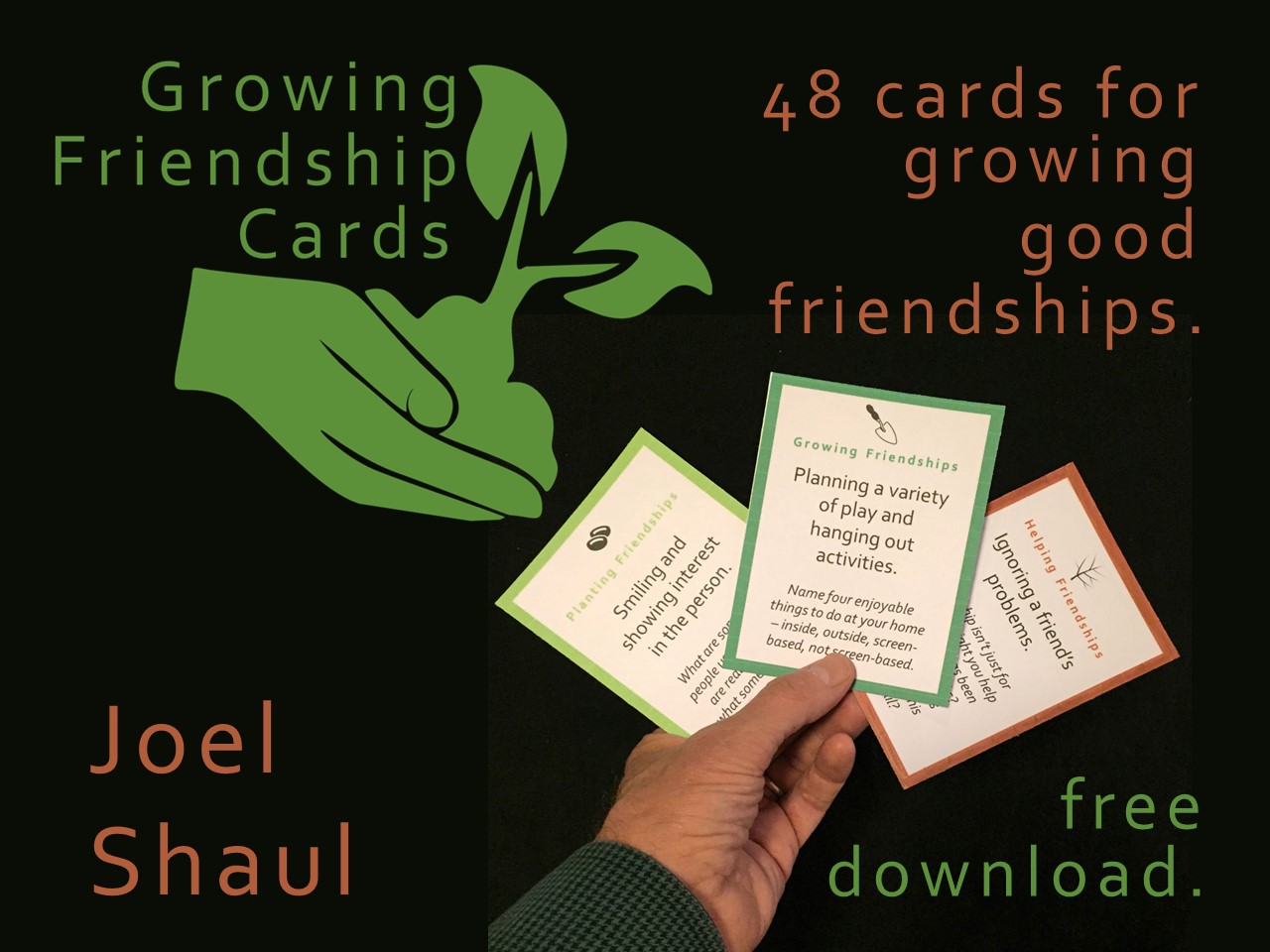
Friendship Growing Cards ~ social skills game to teach friendship skills for children with ASD

This resource in German: Karten für wachsende Freundschaften

This resource in Hebrew

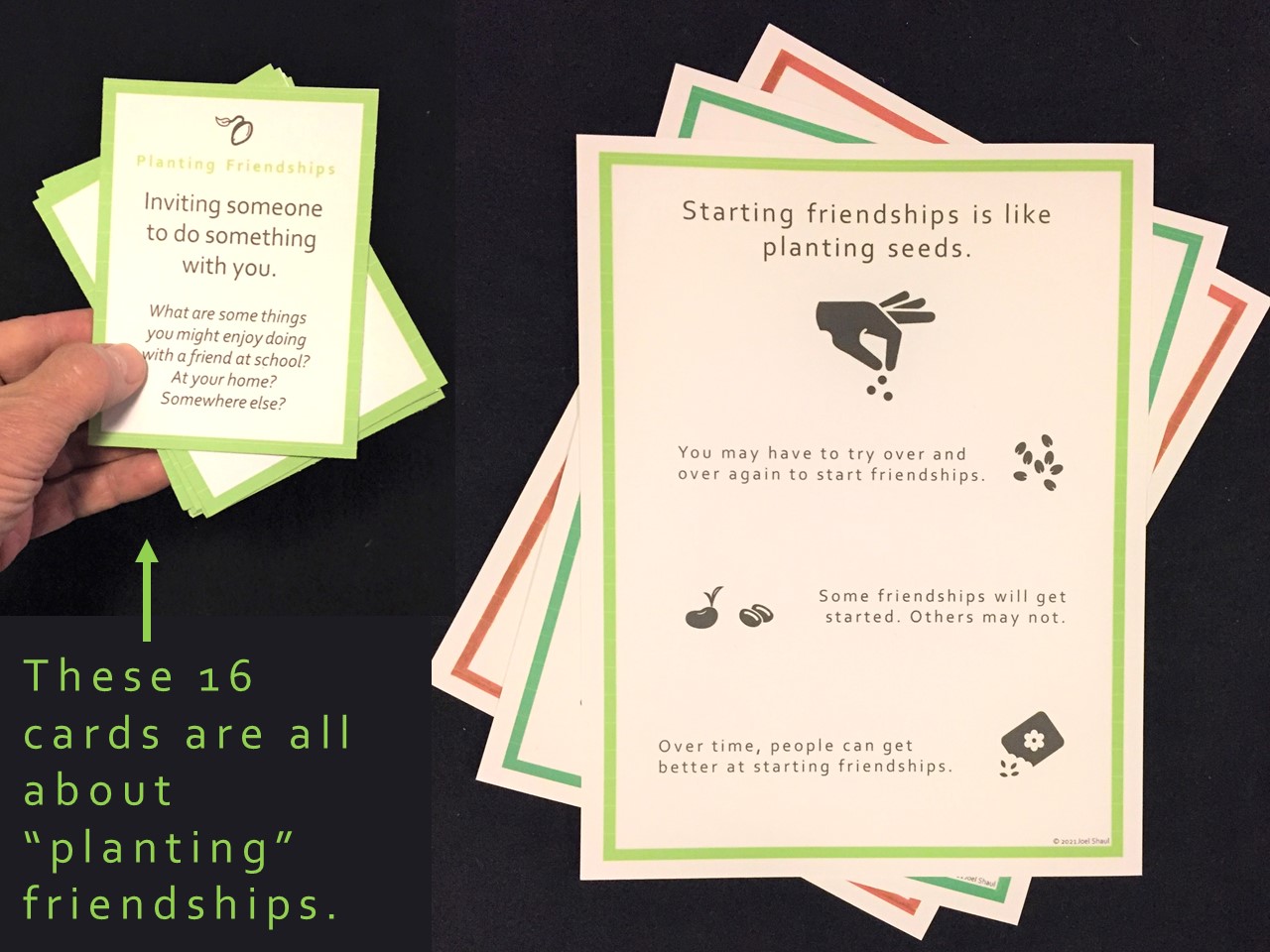
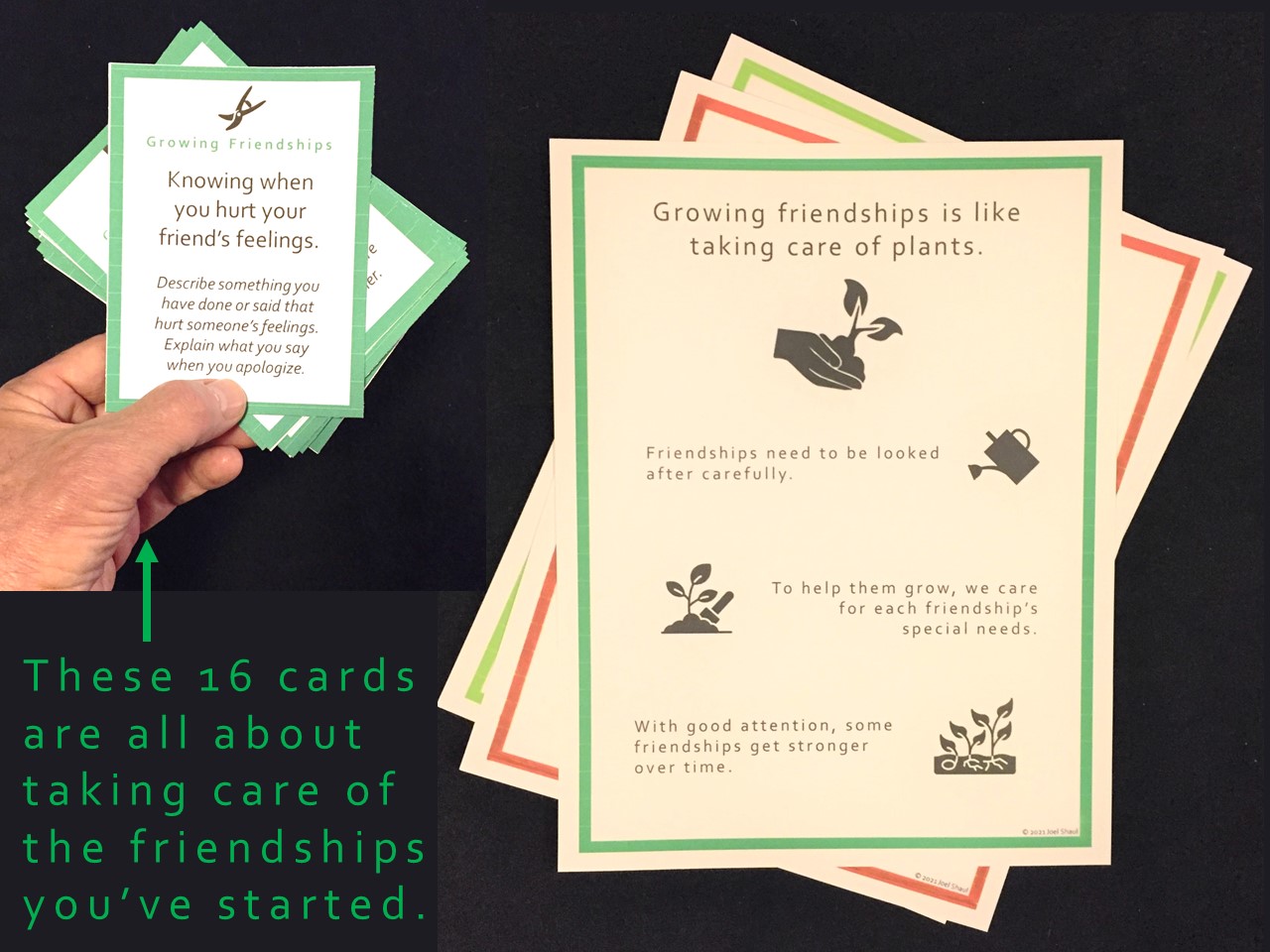
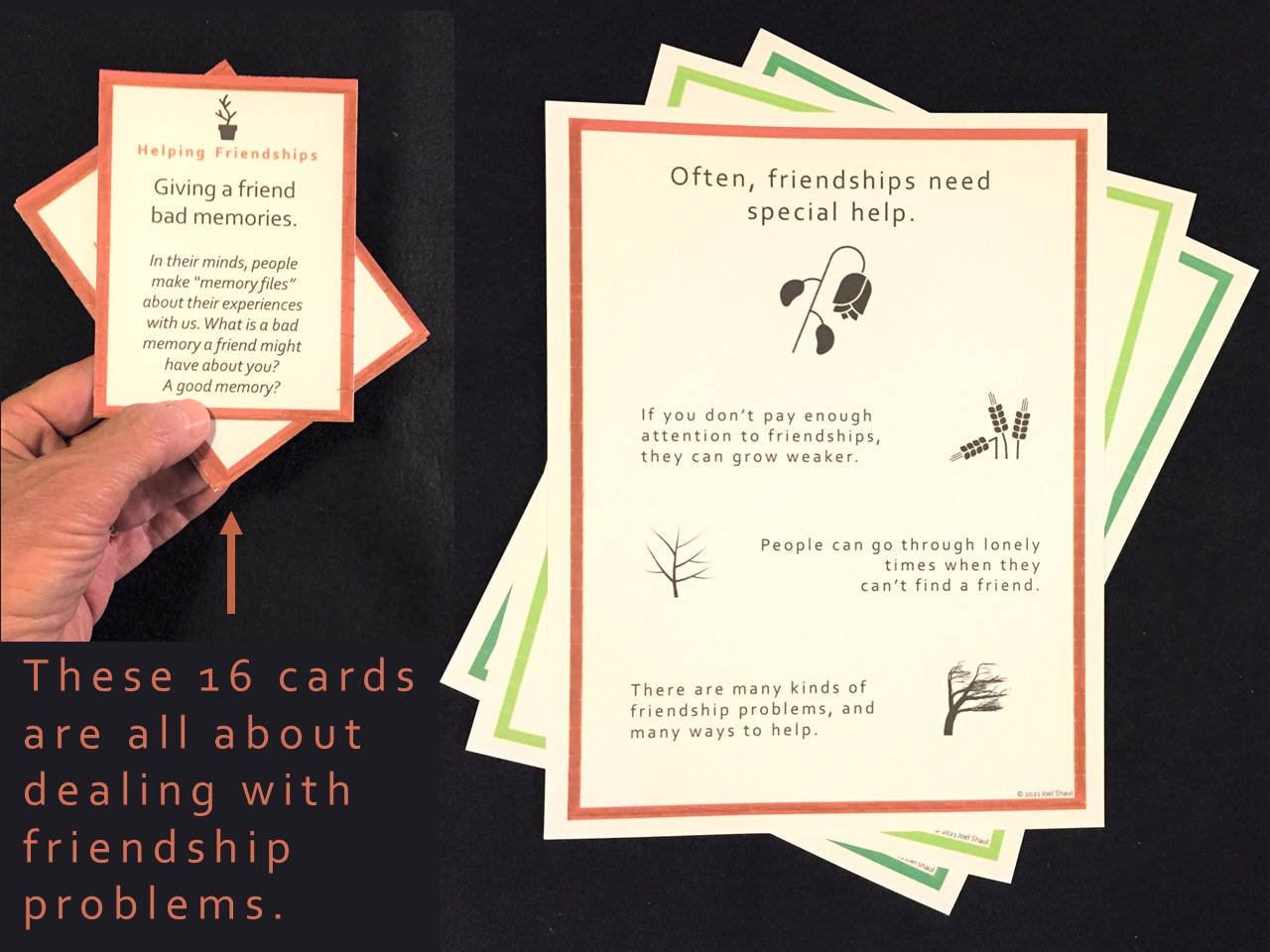
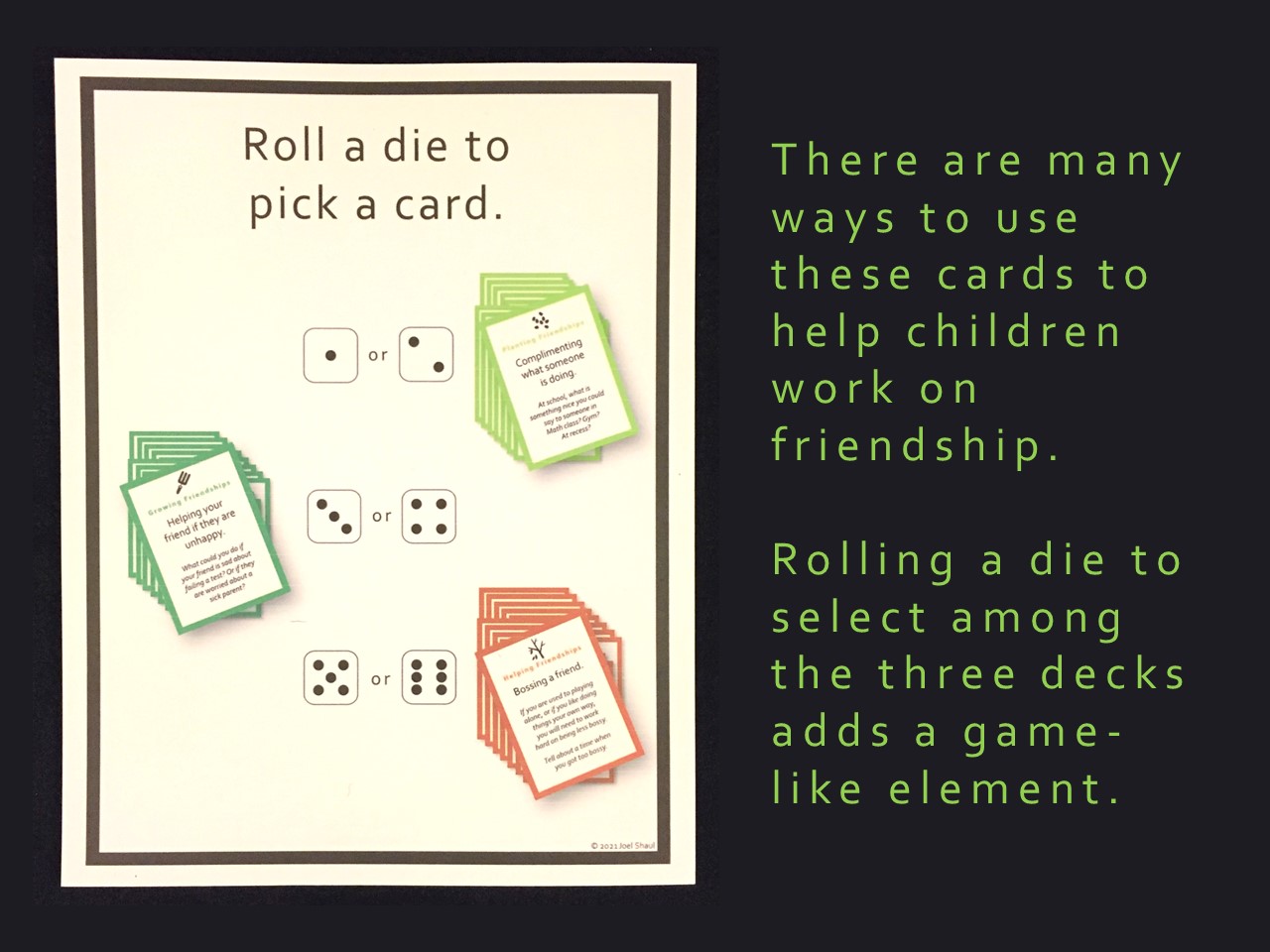
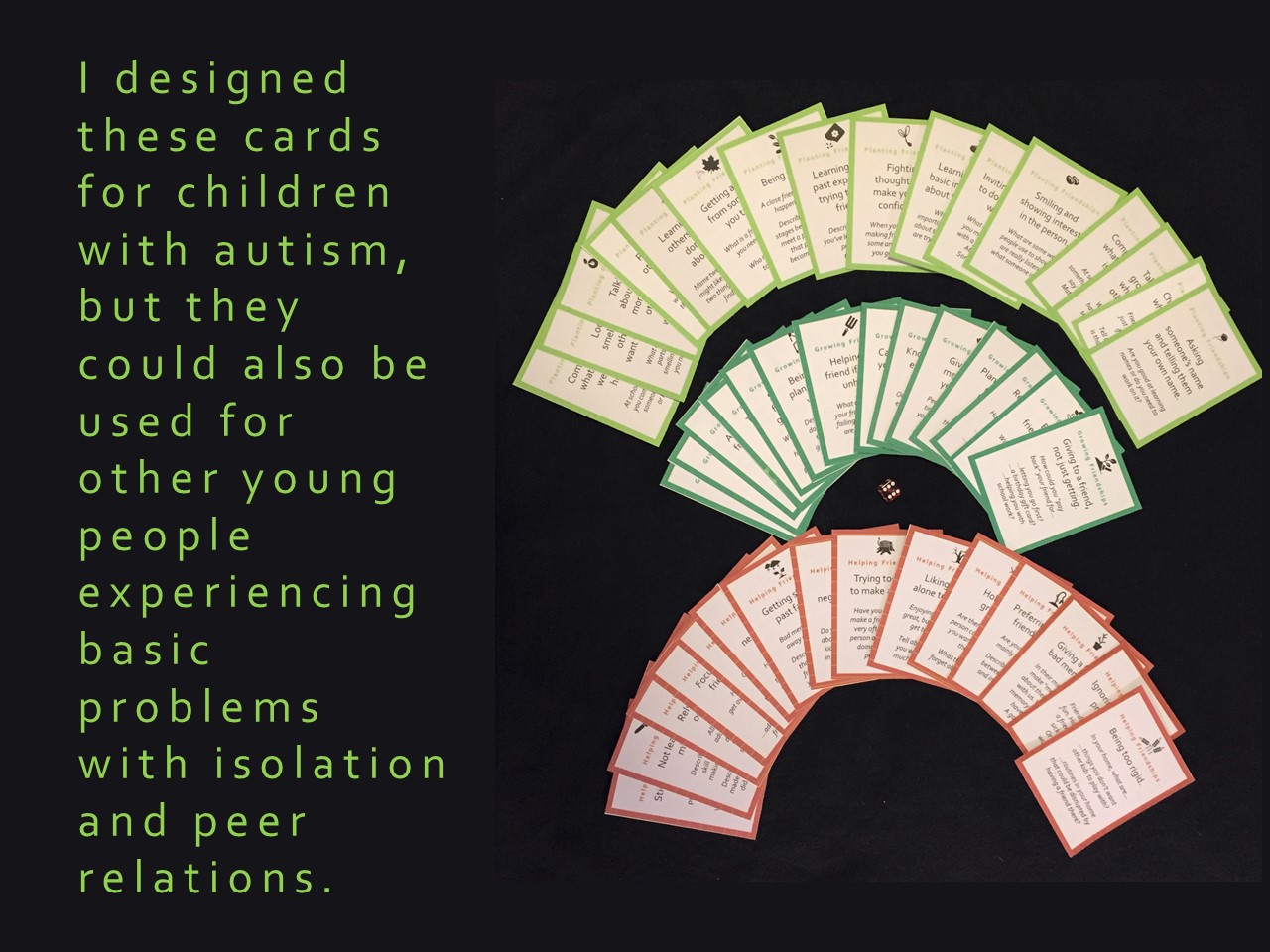
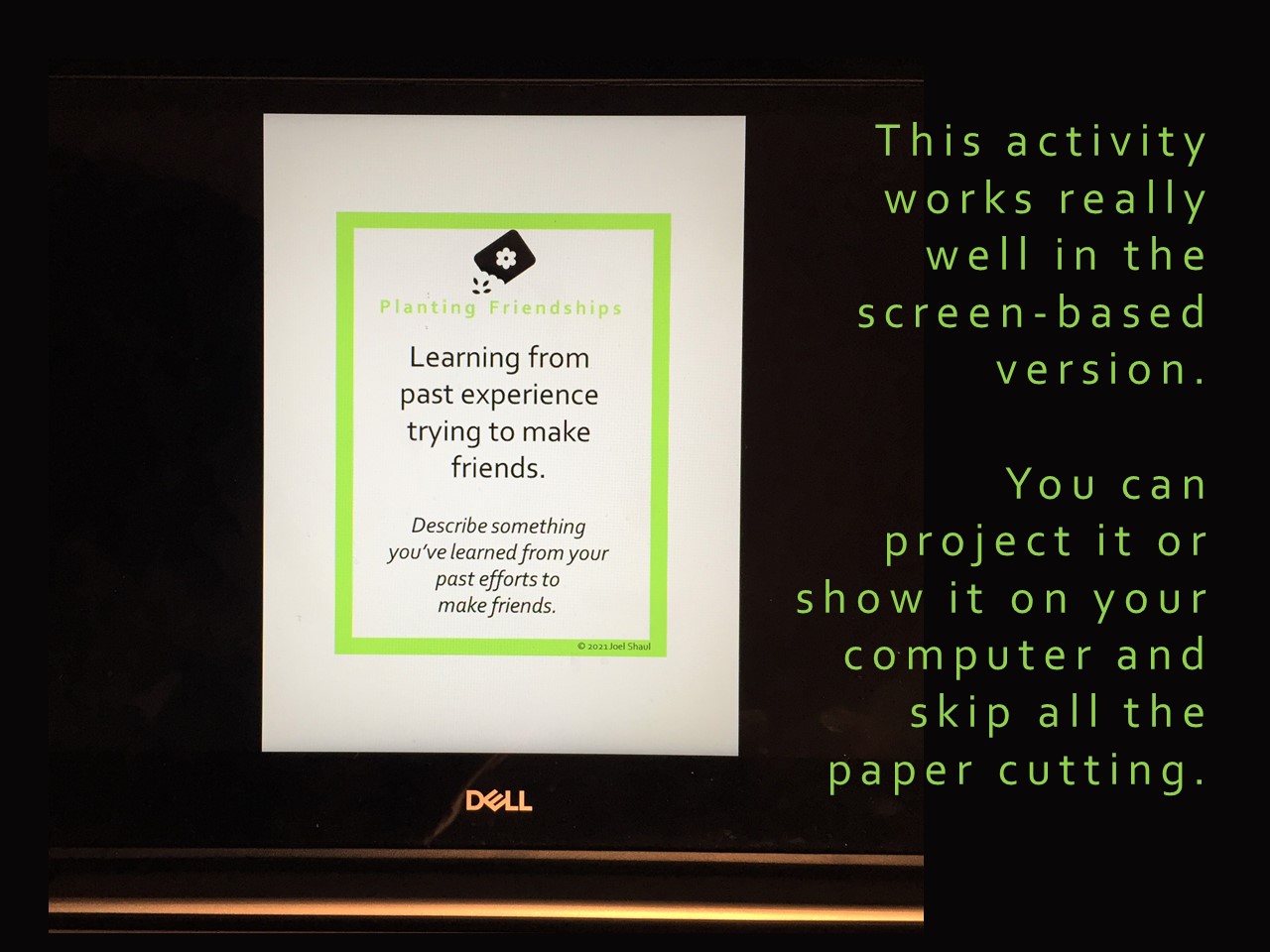
This social skills card game is designed to help children with autism to explore friendship. It can be used in a variety ways. You can print out the friendship social skills cards and use them with dice in a social skills game or you can use them in an unstructured Q & A format. A separate download allows you to skip printing the cards and instead display them on a computer, which makes this social skills activity adaptable for teletherapy or classroom use.

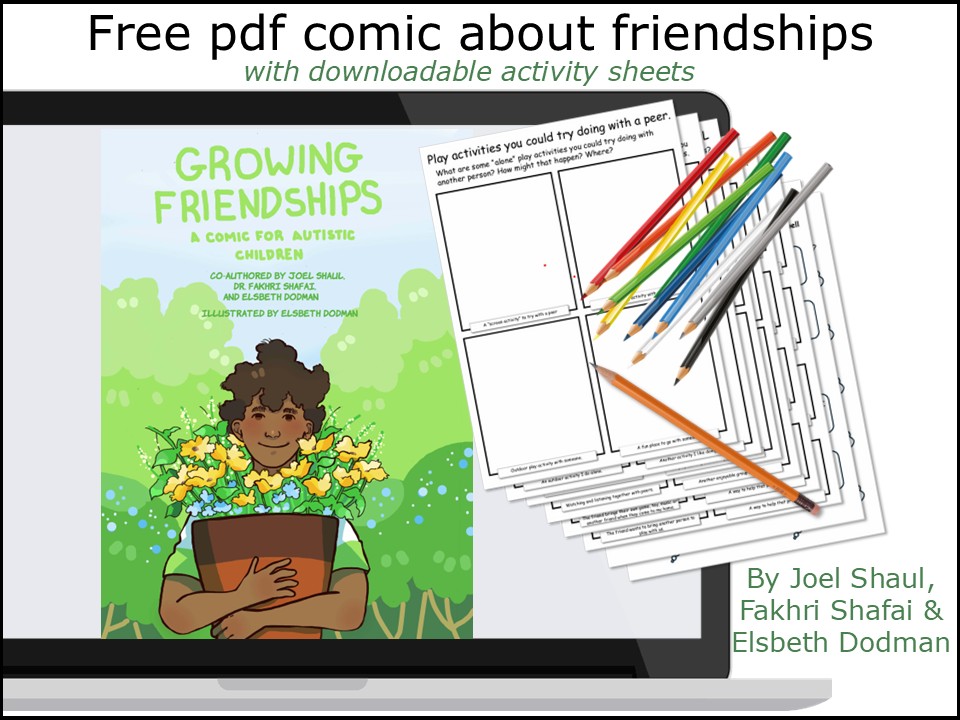
Here below is a free comic based on Growing Friendship themes: Growing Friendships – A Comic for Autistic Children.

Don’t miss these other free social & emotional skills games, worksheets and teaching / therapy resources for children & teens with ASD:

Free social skills games & activities, social interaction skills for kids with ASD

Free social skills games & activities, communication / conversation skills for kids with ASD

Free social skills games & activities, emotional regulation skills for kids with ASD

Your comments on these resources are most welcome, and often helpful. Click HERE to send an email.

Your Interests Promo image for website

testing testing