Social skills conversation game to help children with autism practice small talk
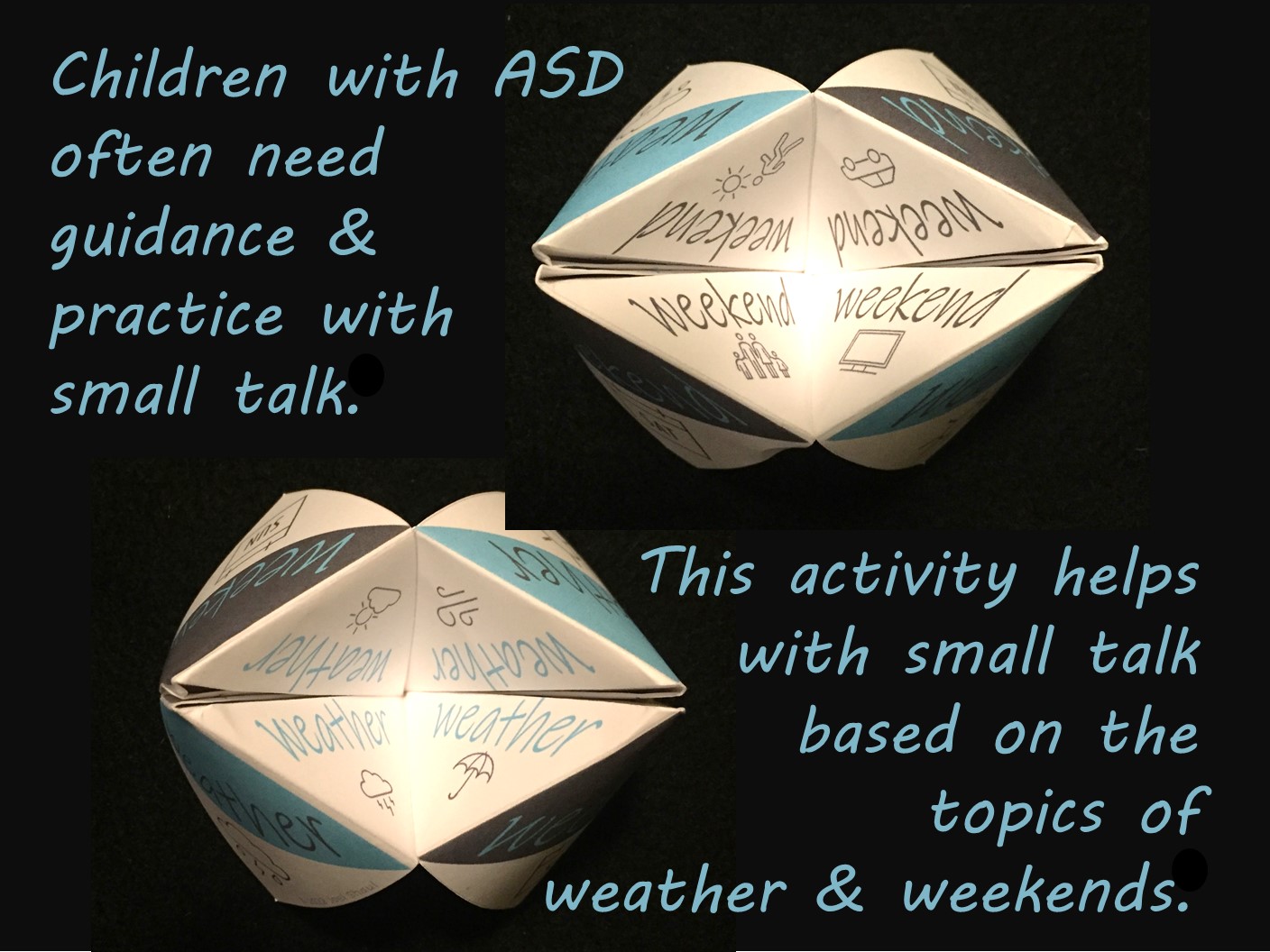
For many young people on the autism spectrum, doing small talk does not come naturally, and in fact it can be really difficult. Many benefit from mastering certain typical, common ground topics. Since learning these skills is very hard work, we need to keep it as enjoyable as possible.
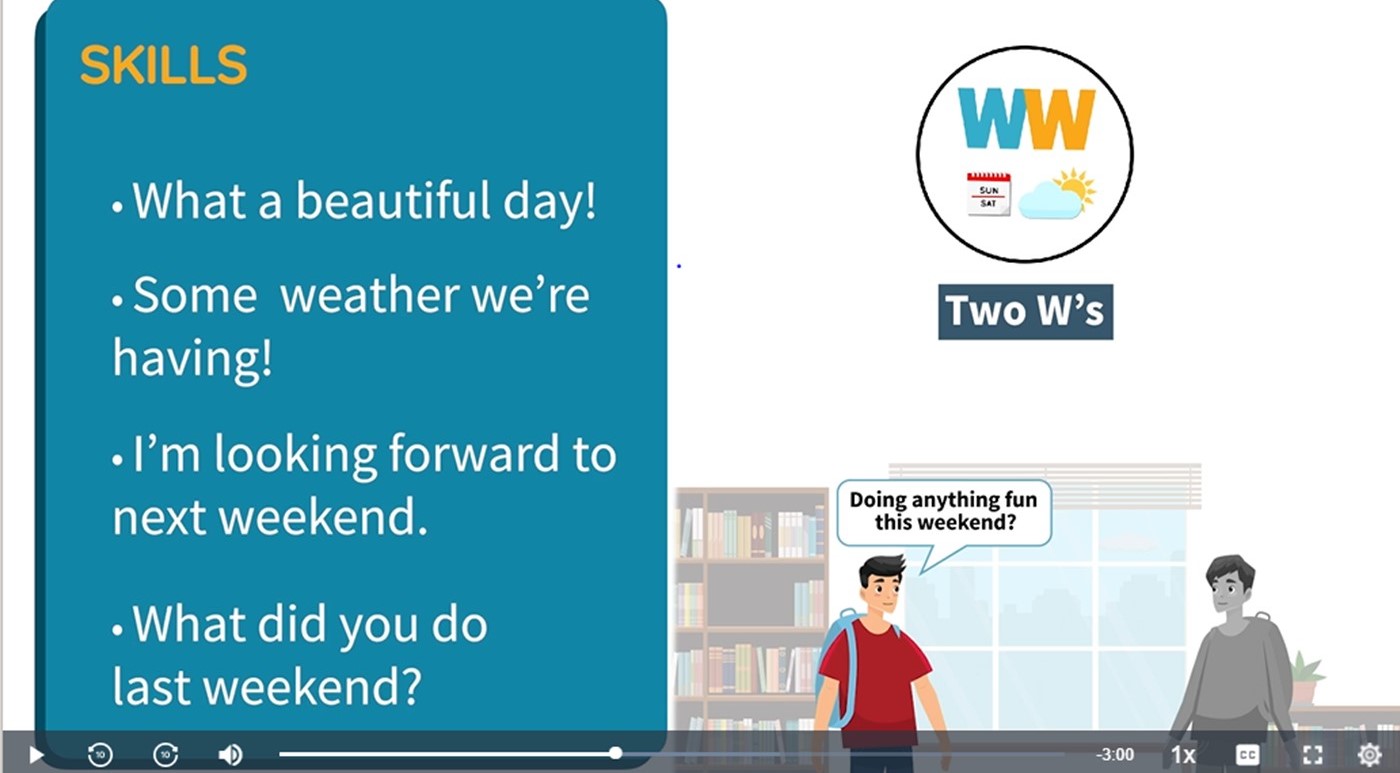
For some time, in my own work, I have been helping children practice conversation by introducing typical topics of weekends and weather, among others. In March 2021, Everyday Speech Videos featured a training video for children on the spectrum on this topic.
Screen shot from Everyday Speech Video on this topic. This company’s videos are pretty terrific.
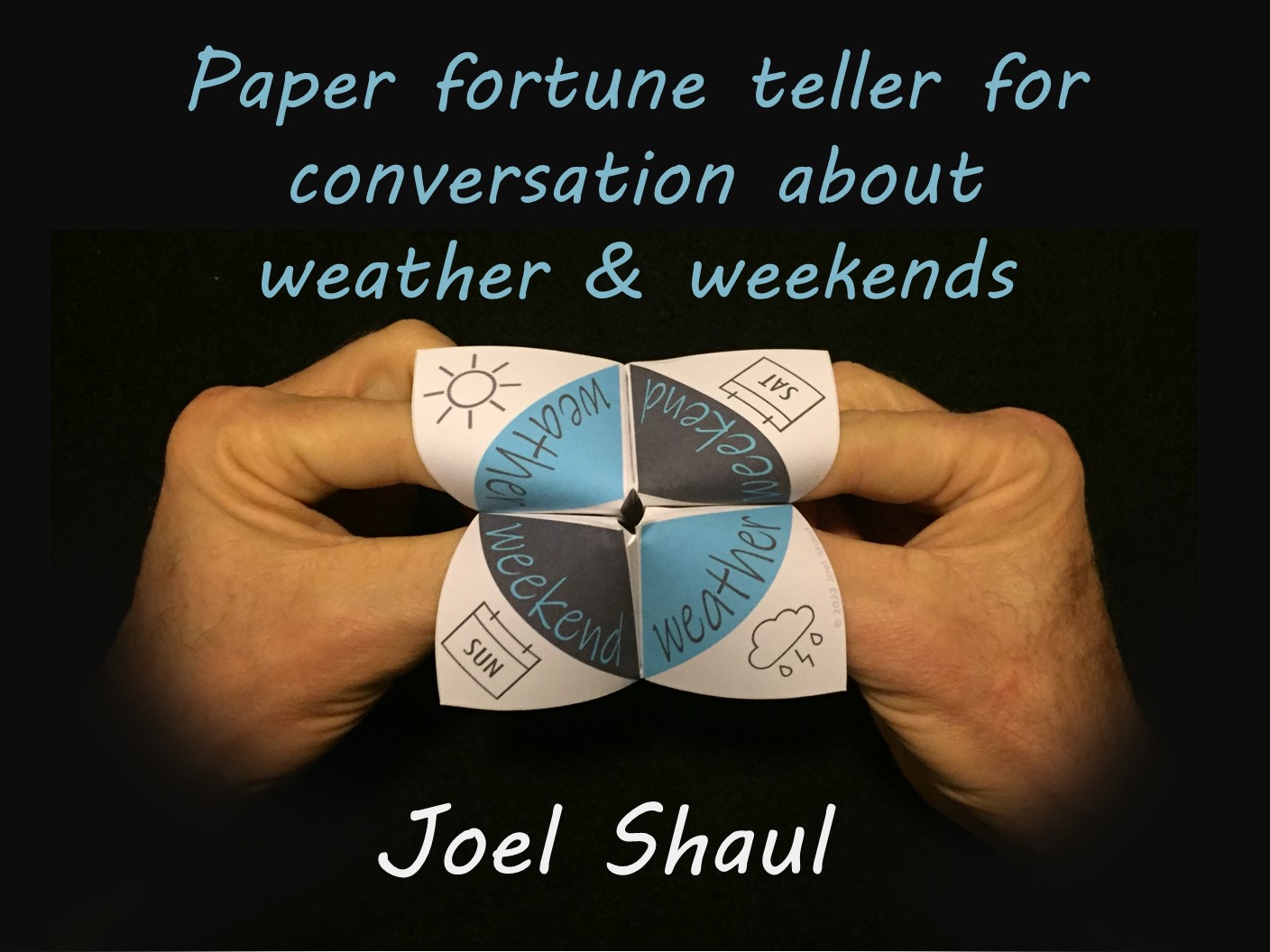
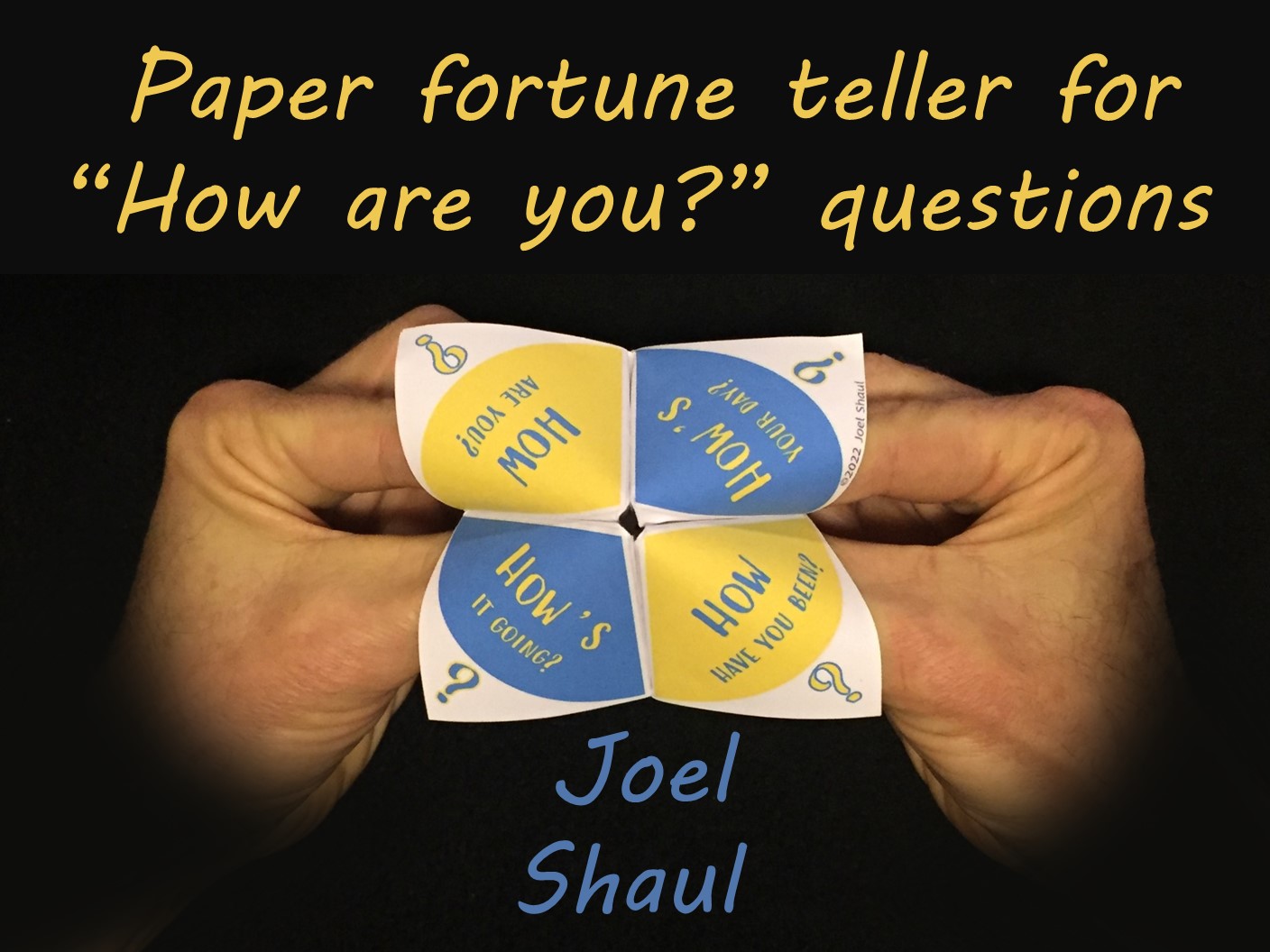
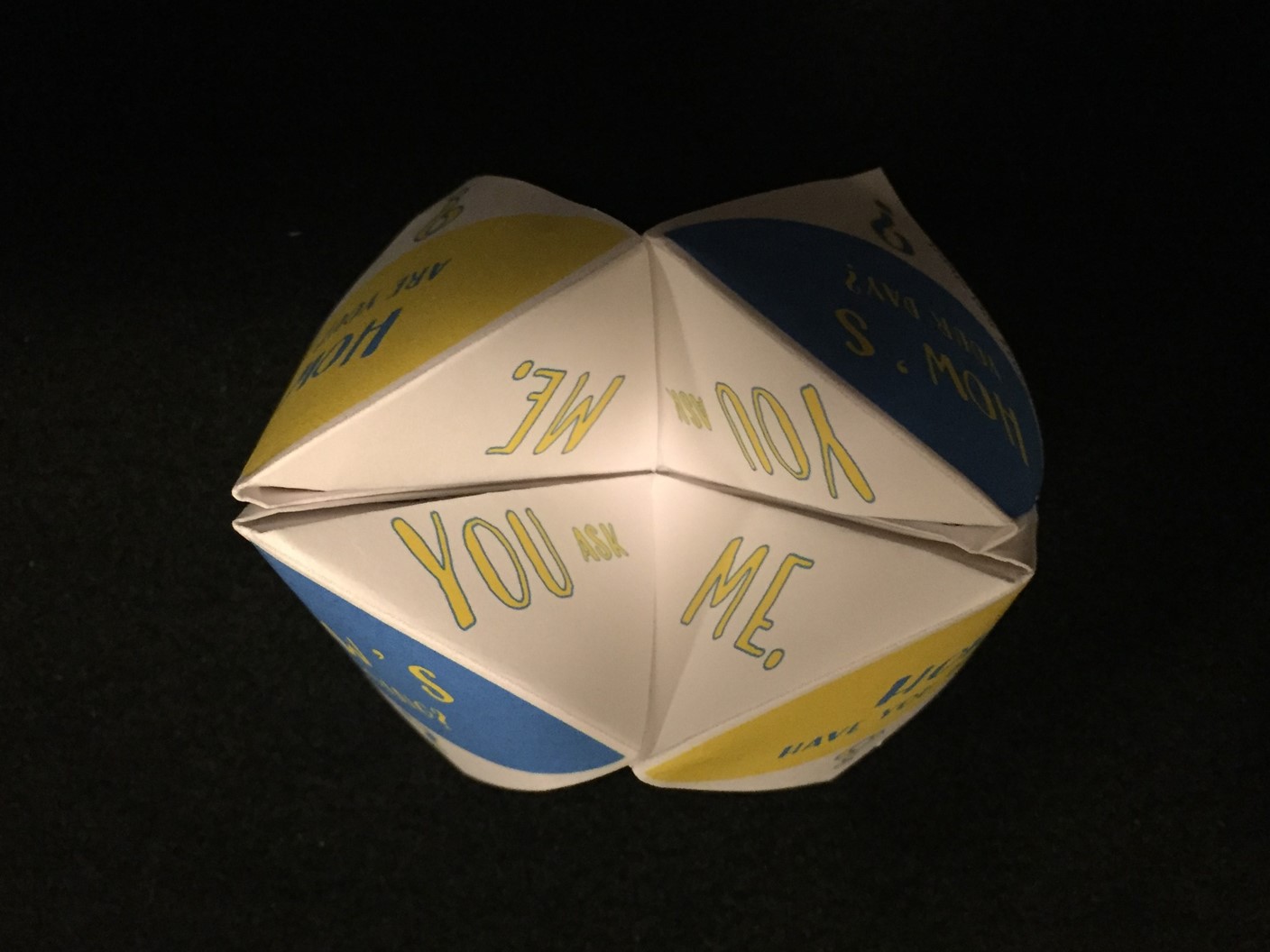
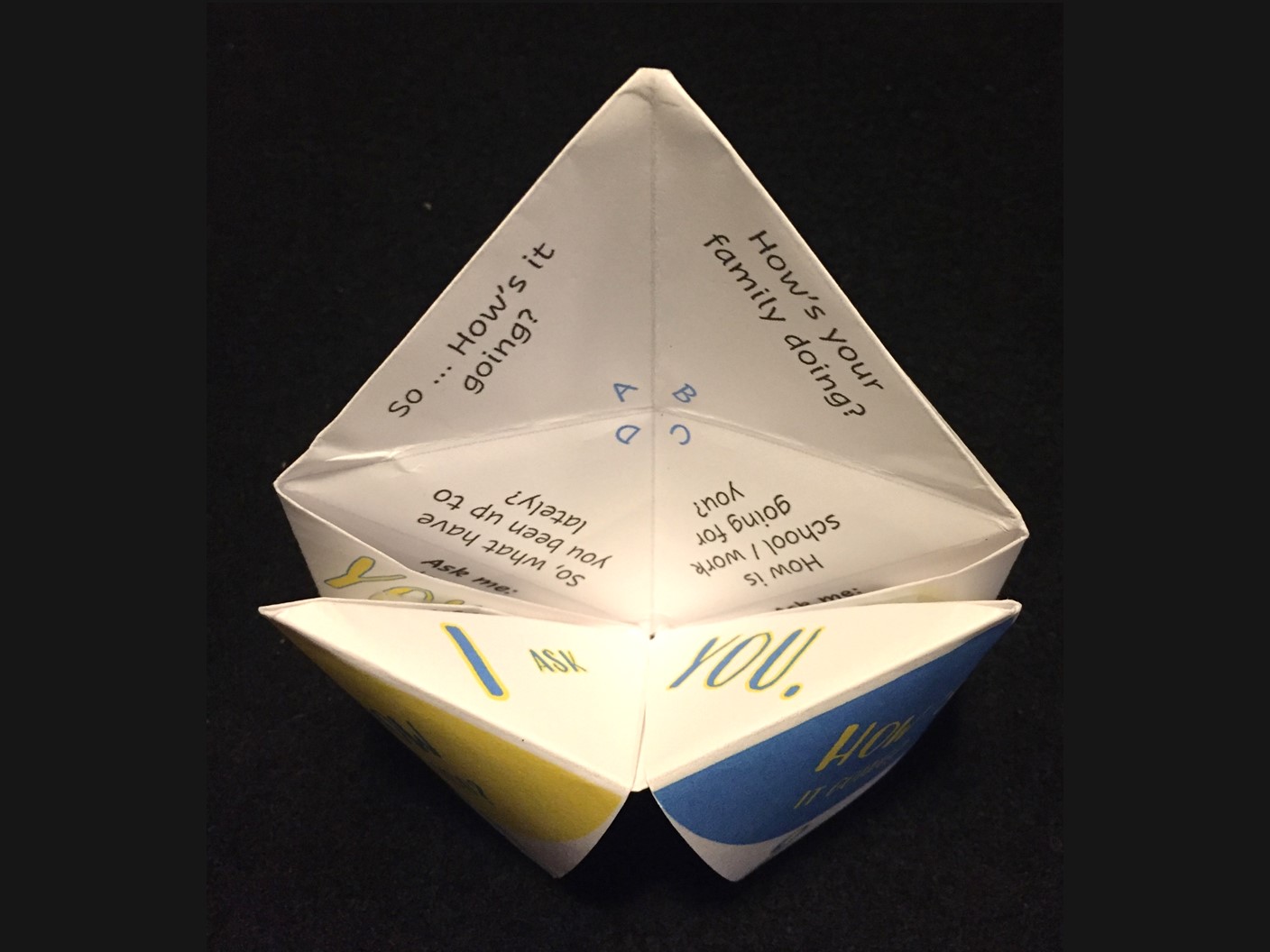
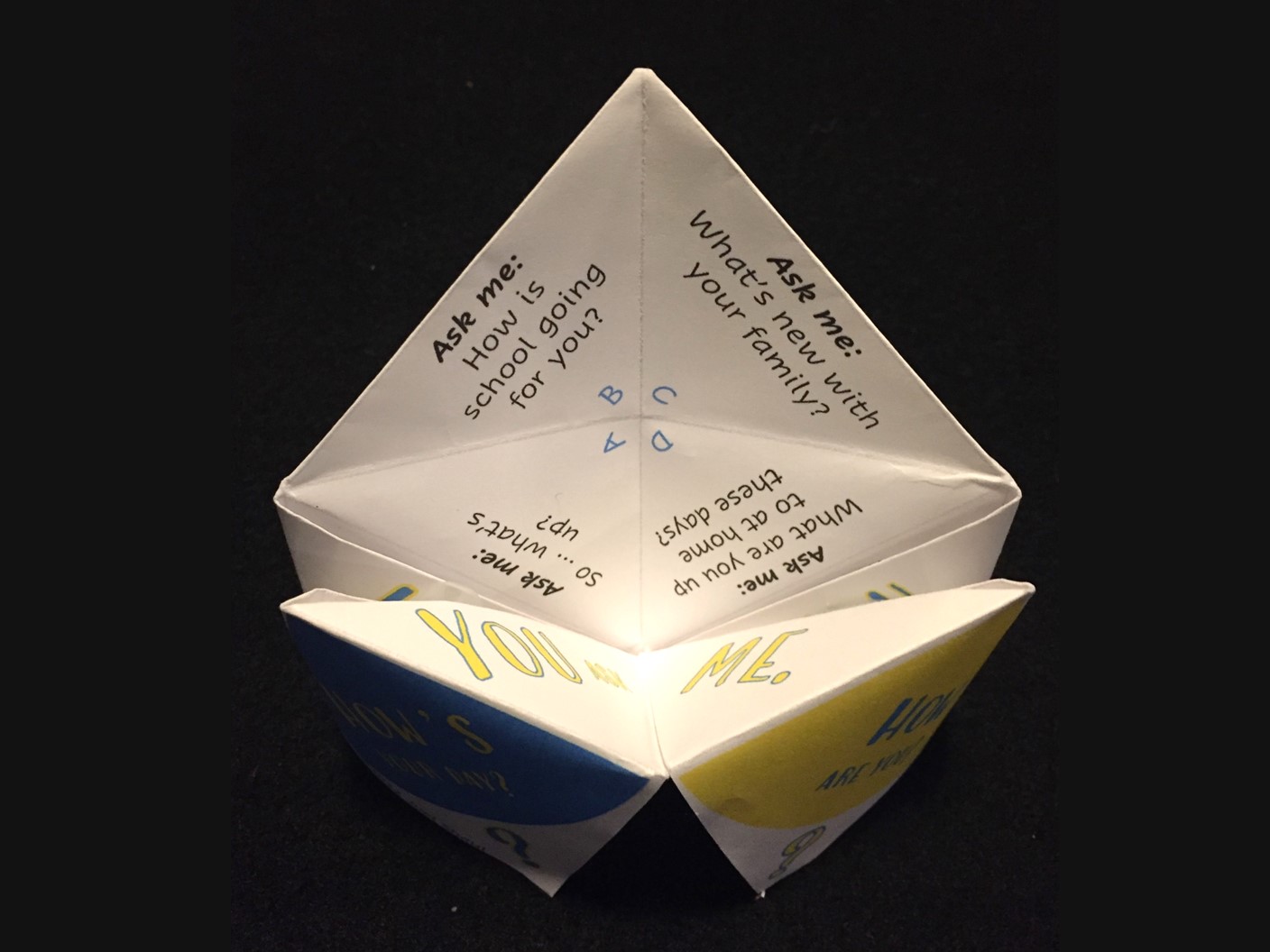
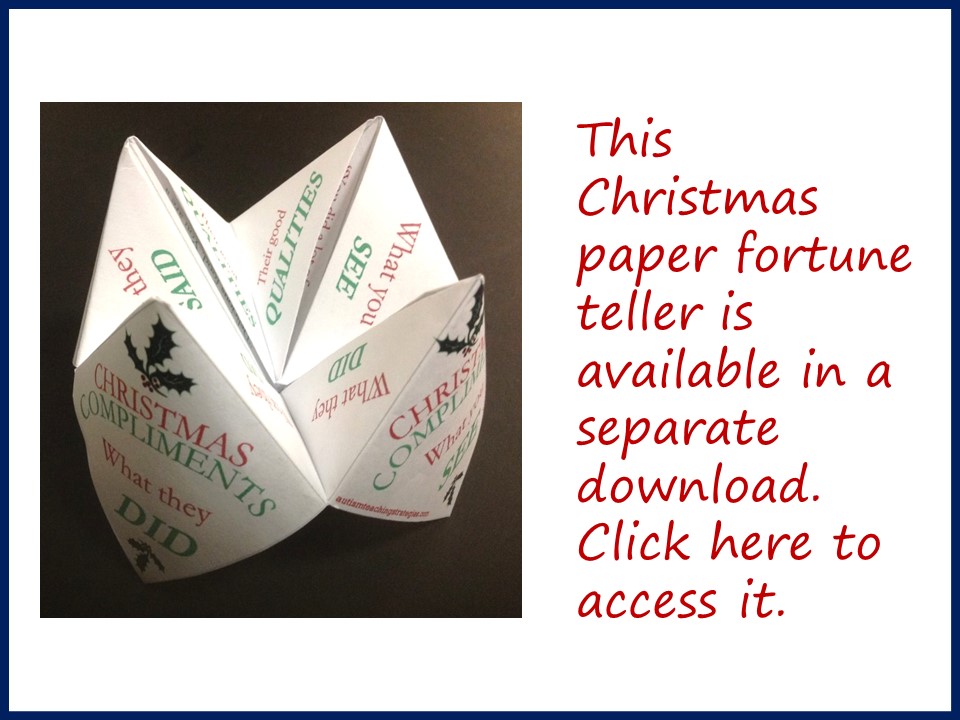
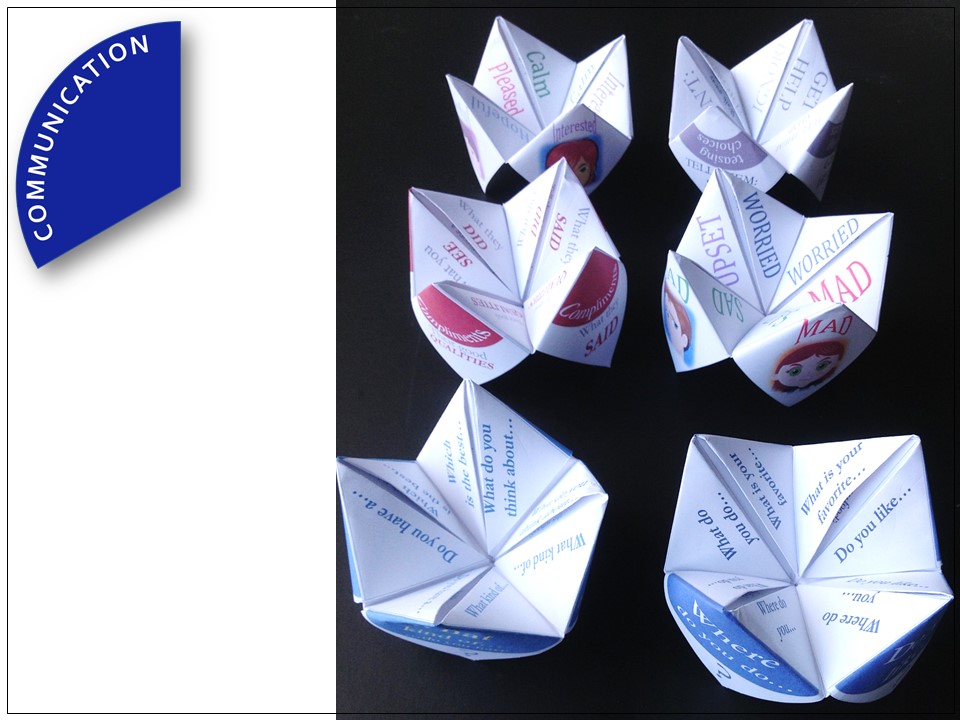
I felt inspired to create a paper fortune teller on this theme.
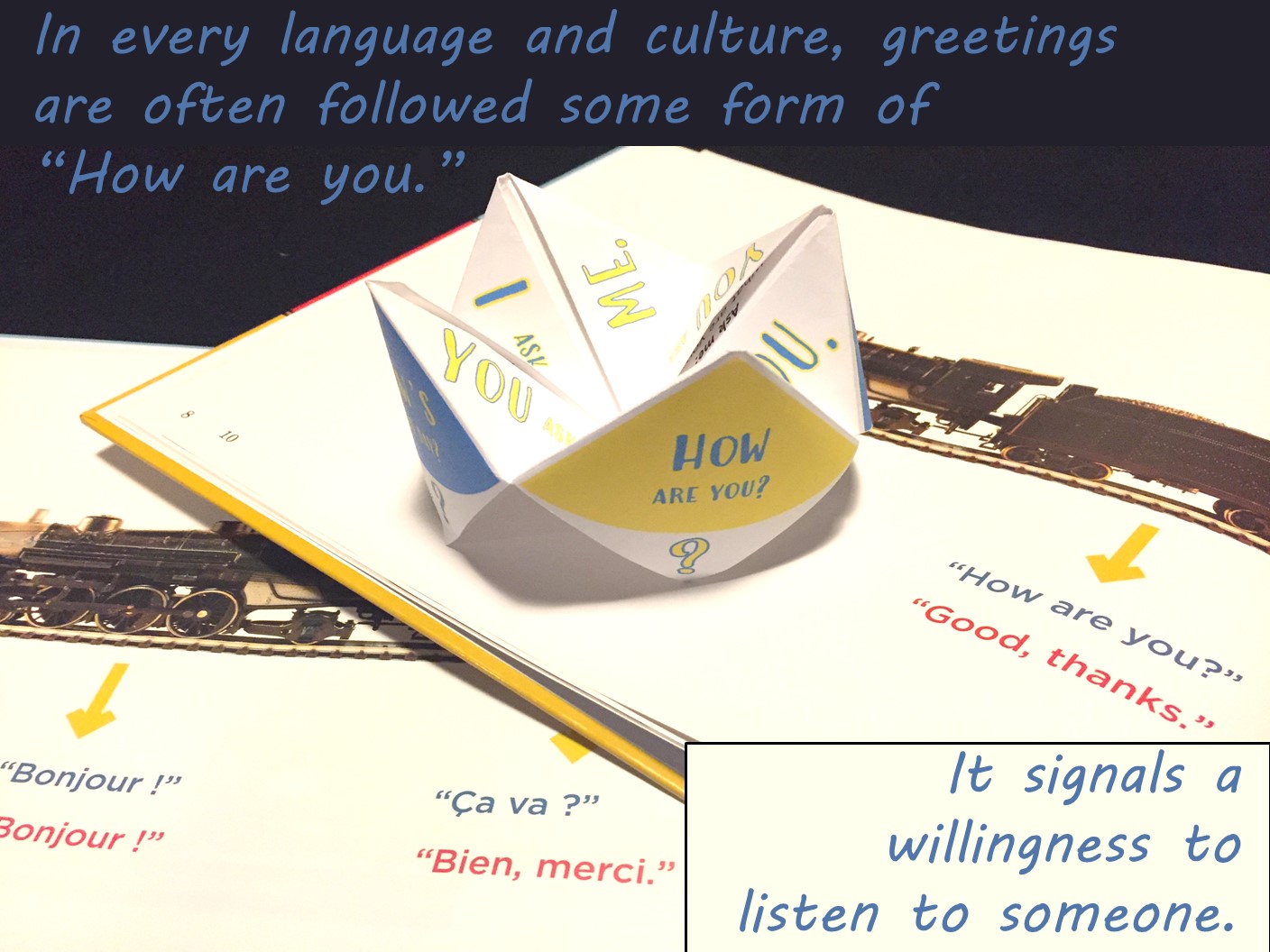
[This is page 10 of the English and French versions of my book, The Conversation Train.]
Young people with autism and “How are you?” questions
When people with ASD are asked open-ended questions like “How are you doing?”, “What’s up?” or “How’s it going?”, they often can’t figure out just what it is the other person wants to know. Also, individuals with autism might be inexperienced at employing various quick, formulaic replies like “Fine, thanks” or “I’m doing okay. You?”
When people with autism are expected to ask other people “How are you?” or “How’s it going?”, many just avoid saying it altogether. There are several reasons for this. First, the unfolding of a conversation containing “How are you?” can be very unpredictable in length and in content. Asking a person how they are doing often elicits a lot of information that someone with ASD may feel unprepared to take in. Second, a person on the autism spectrum might not grasp the imperative of reciprocity in conversation, so when someone asks them “How are you?” they don’t end up asking the same thing in reply.
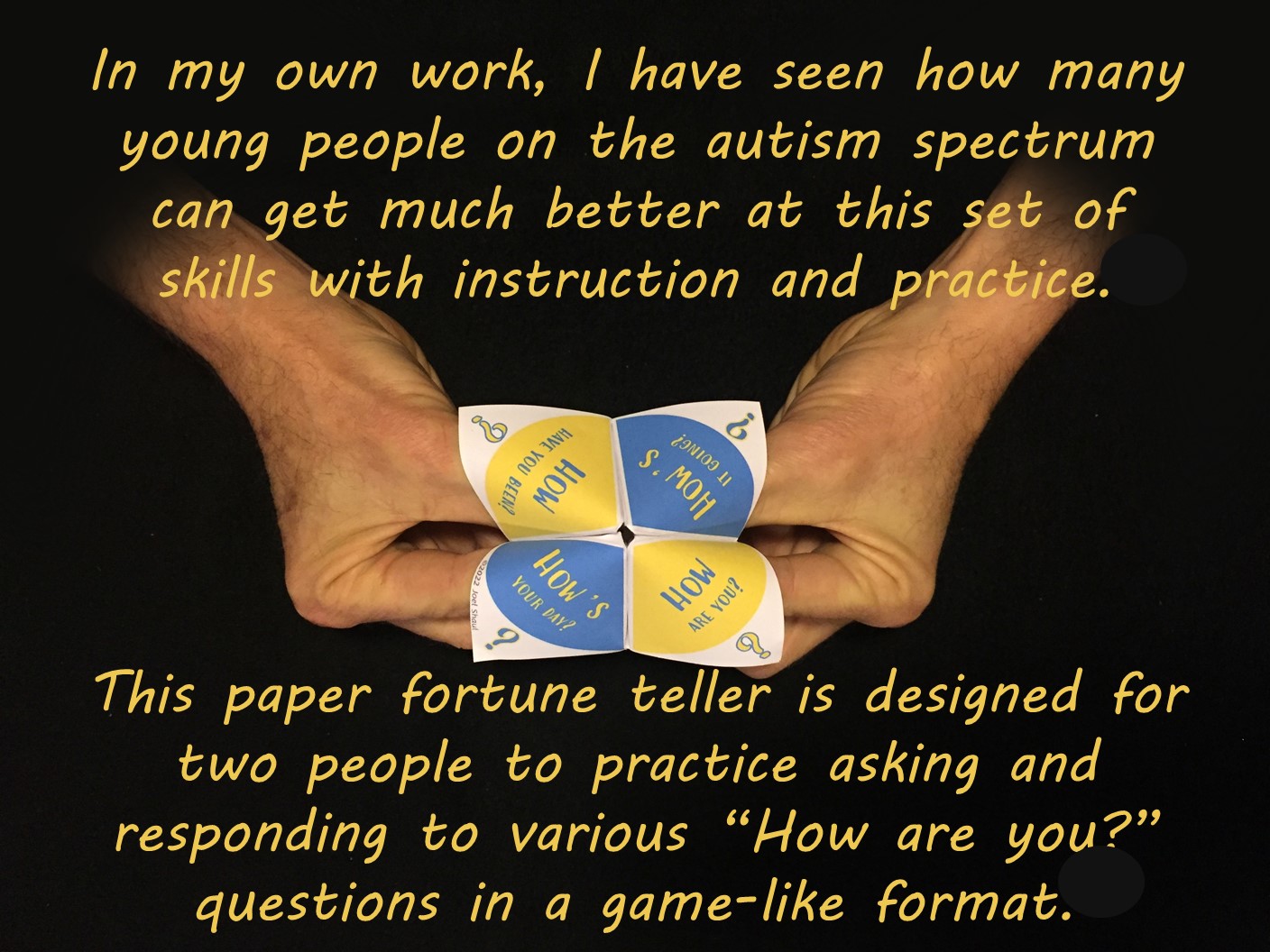
In my own work, I have seen how many young people on the autism spectrum can get much better at this set of skills with instruction and practice.
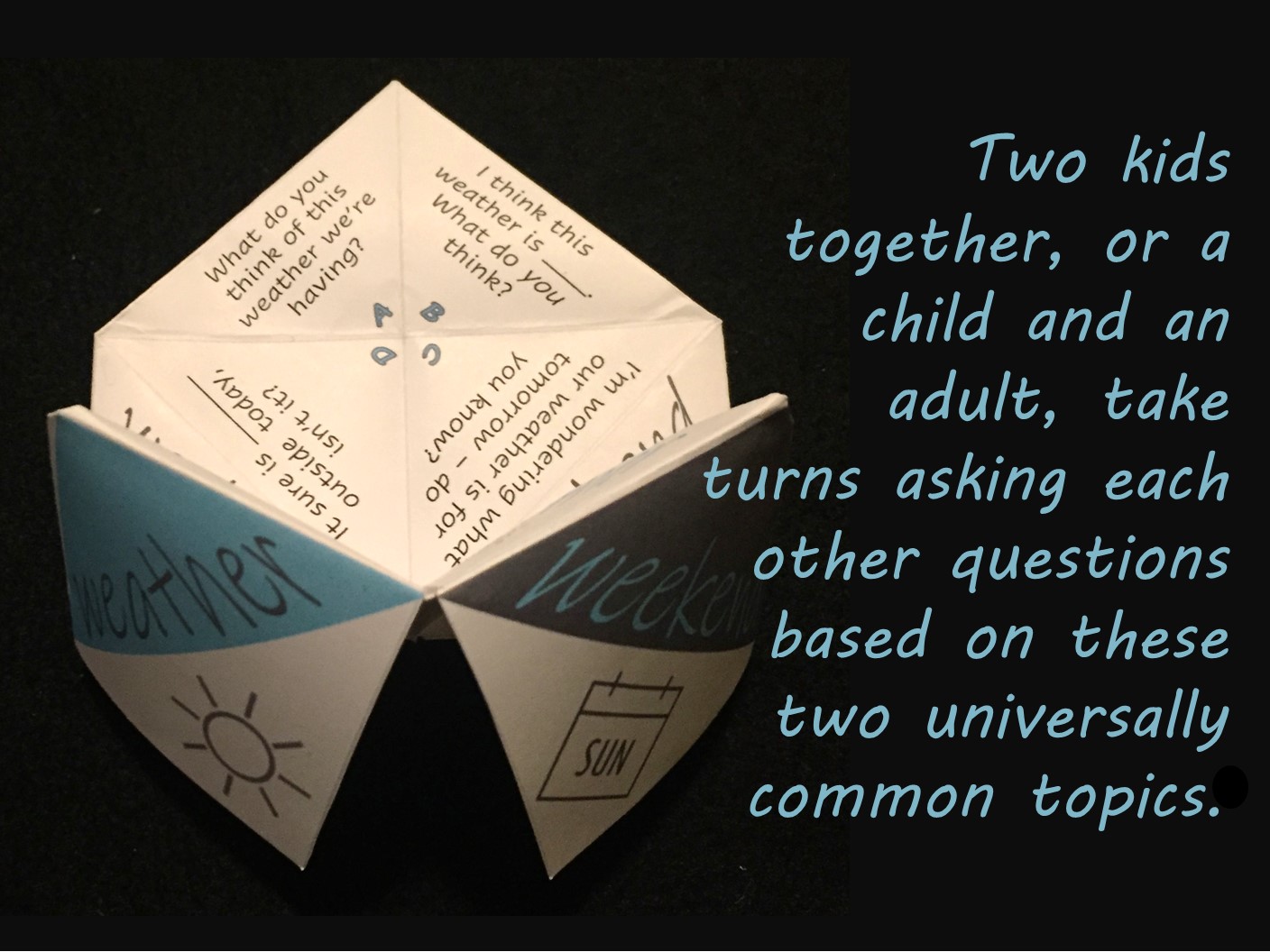
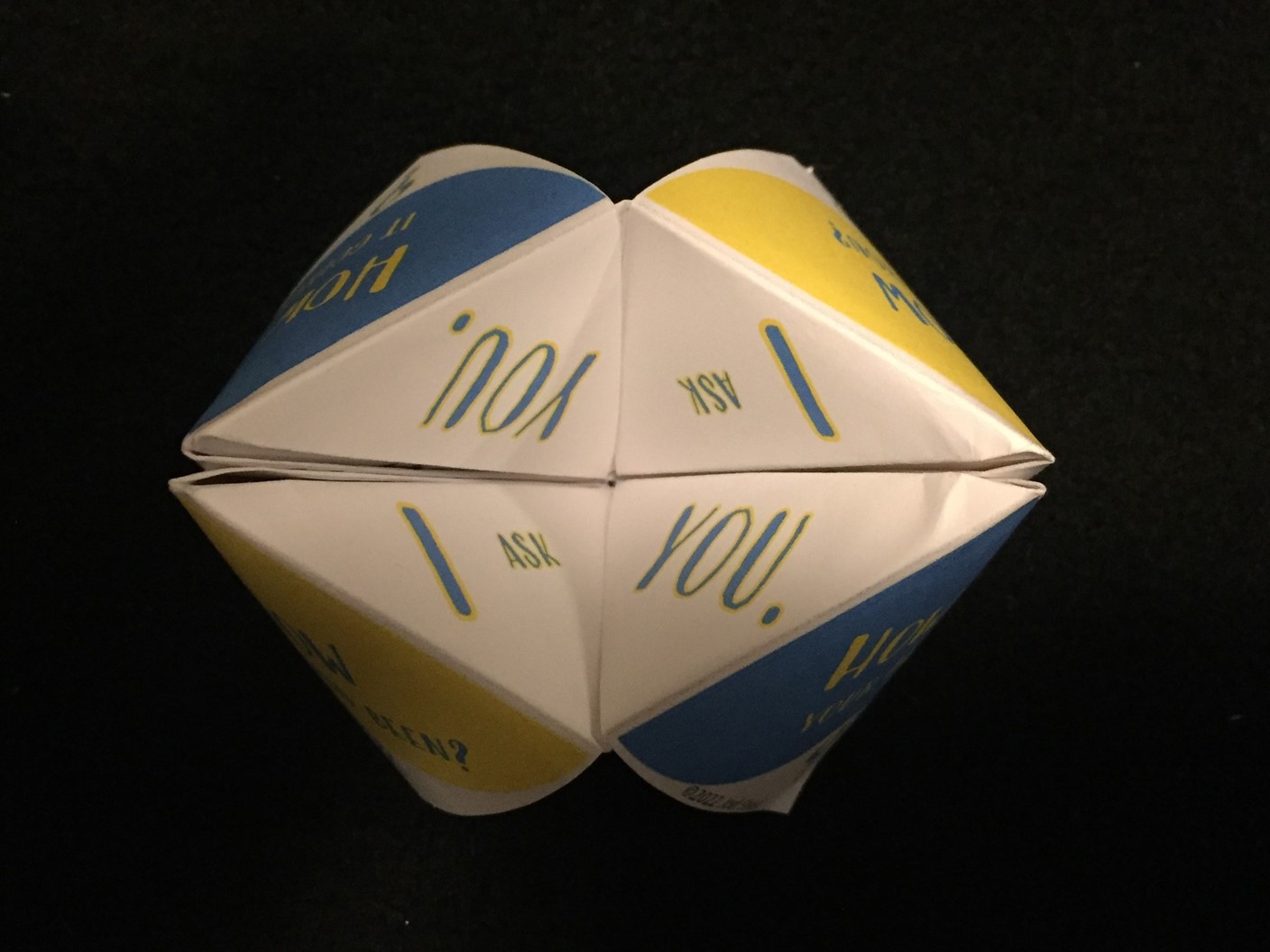
Paper fortune tellers work well for two children, or an adult and the child, to practice specific conversation skills. I have used my own, custom-designed ones for many years in my work. There are many other conversation-based paper fortune tellers on the website to practice other elements of social communication. I also show how to fold them.
Don’t miss these other free worksheets, games, and teaching / therapy resources for children on the autism spectrum:
Years ago, when I first started working with children on the autism spectrum, I noticed right away that many of them had very rich fantasy lives. To learn more about it, I explored books, blogs, chat rooms and YouTube videos in which adults with autism reflected on this aspect of their psychology. What autistic people have to say on this subject is important.
Imagination and fantasy are important and normal aspects of being human. In our lives, we all have to work out how to enjoy pretending, use it to our advantage and control it. When life is difficult, it is certainly common for people to employ imagination to relieve stress and dream up possible solutions to problems. In my own work with children, teens and young adults on the autism spectrum who are dealing with anxiety, depression, social isolation and skills deficits, I do often find that my clients are using fantasy in ways that are helpful to them.
In my work with young people with ASD, I do however very often find that my clients become involved with fantasy-based interests and activities in ways that are problematic. These include:
*Enthrallment with the fantasy aspects of video games, contributing to withdrawal from social engagement and life skill activities
*Involvement with imaginary friends and imaginary worlds which lasts too long and assumes too much importance to the young person with ASD
*Awkward attempts to engage others in conversation and play based on the fantasy system
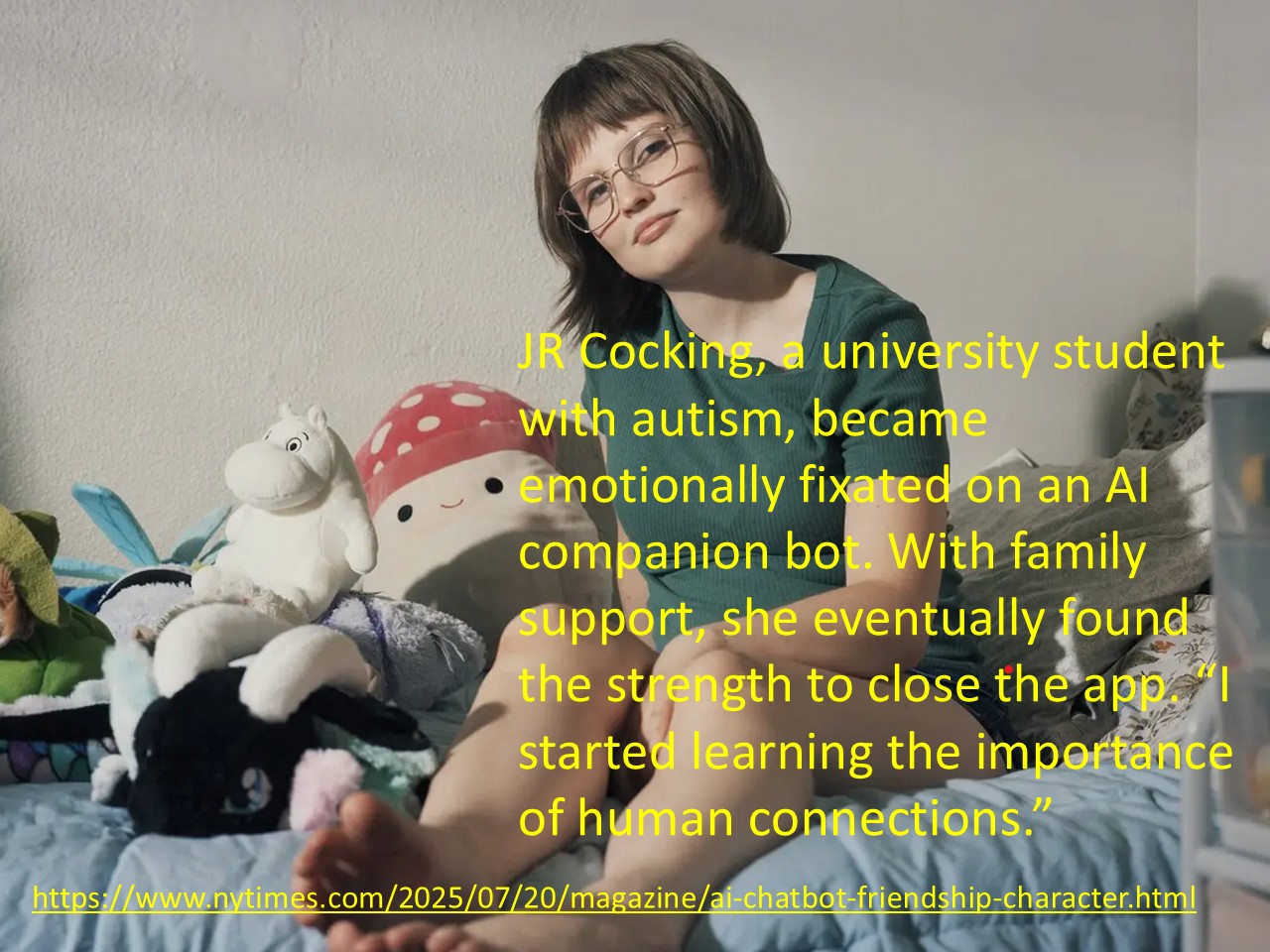
*Problematic engrossment with AI chatbots as companions
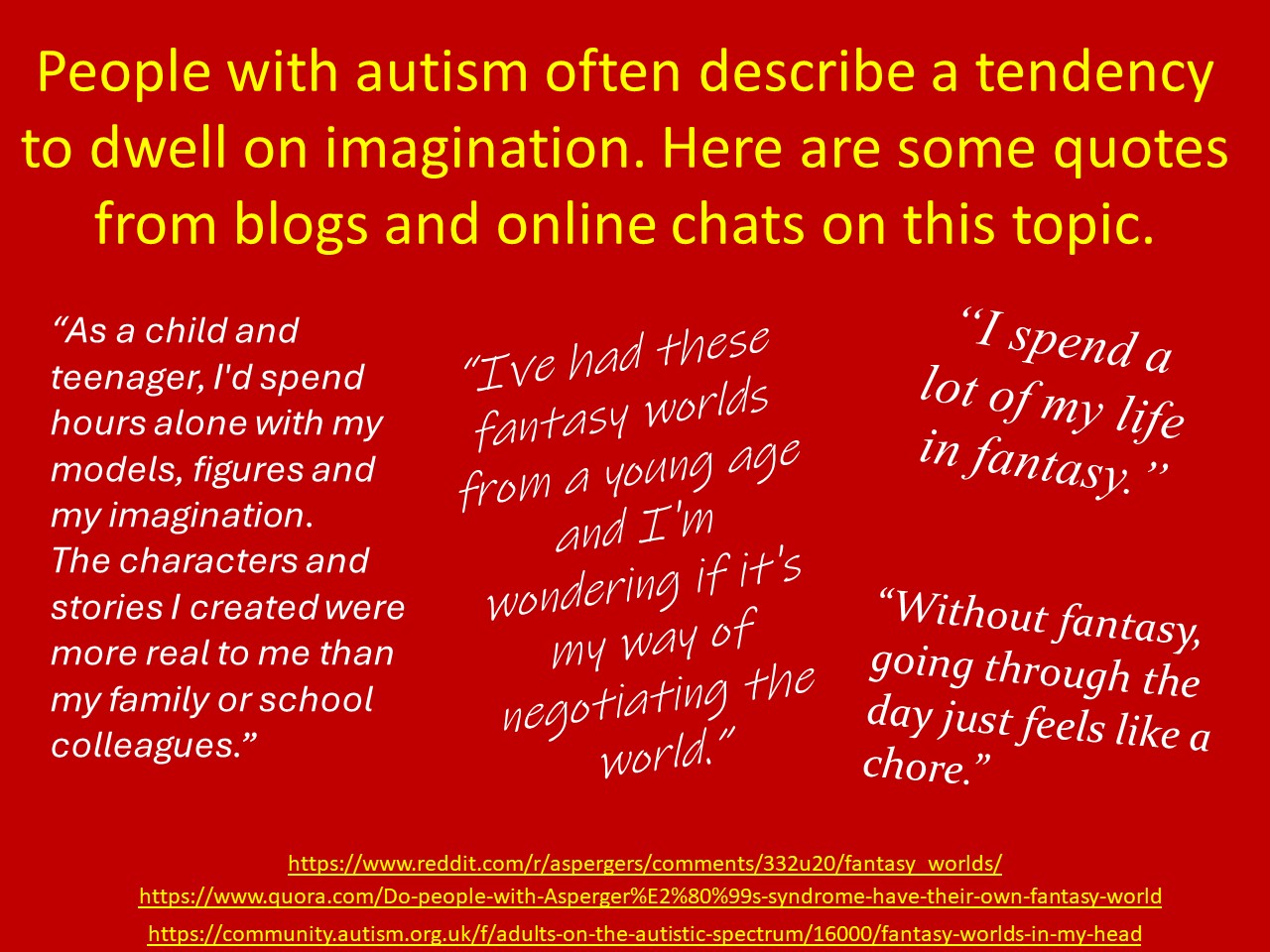
Vulnerability to excessive fantasy can affect all kinds of people, of course. In my own experience as a psychotherapist, I do find this problem is more common with autistic individuals. Many on the spectrum agree, as the following testimonials appear to confirm.
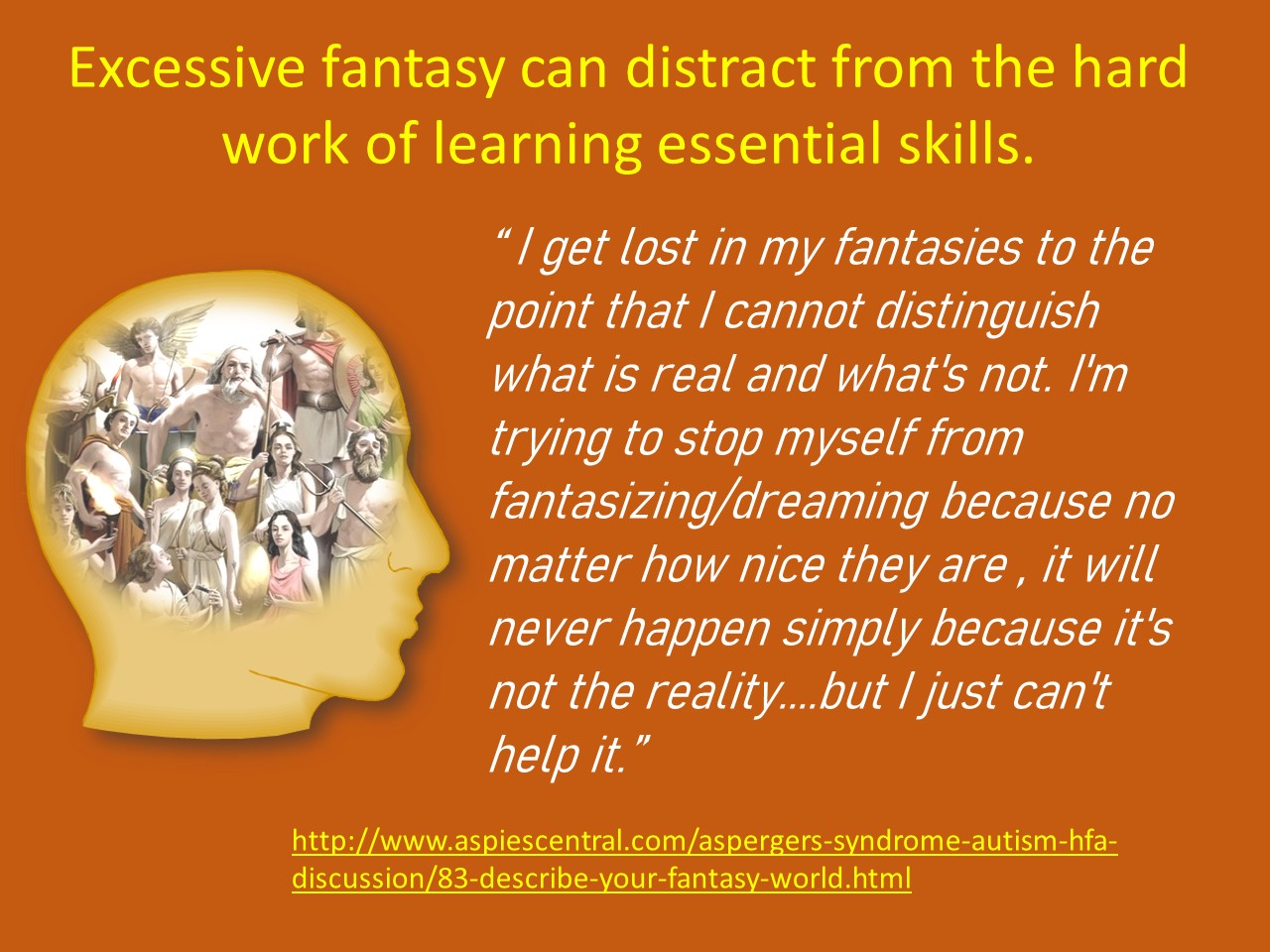
Excessive fantasy cna distract from the hard work of learning essential skills, as this testimonial indicates.
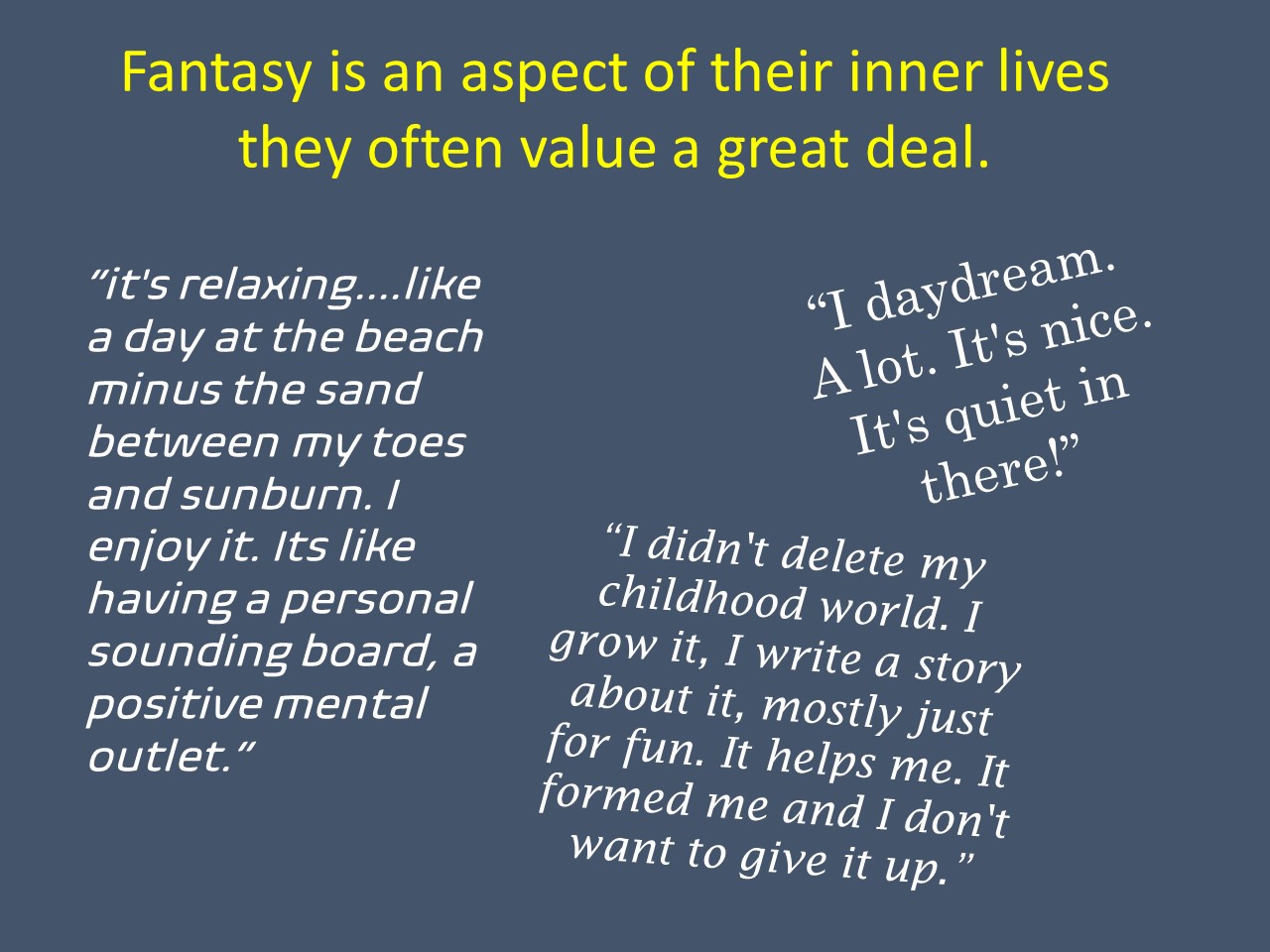
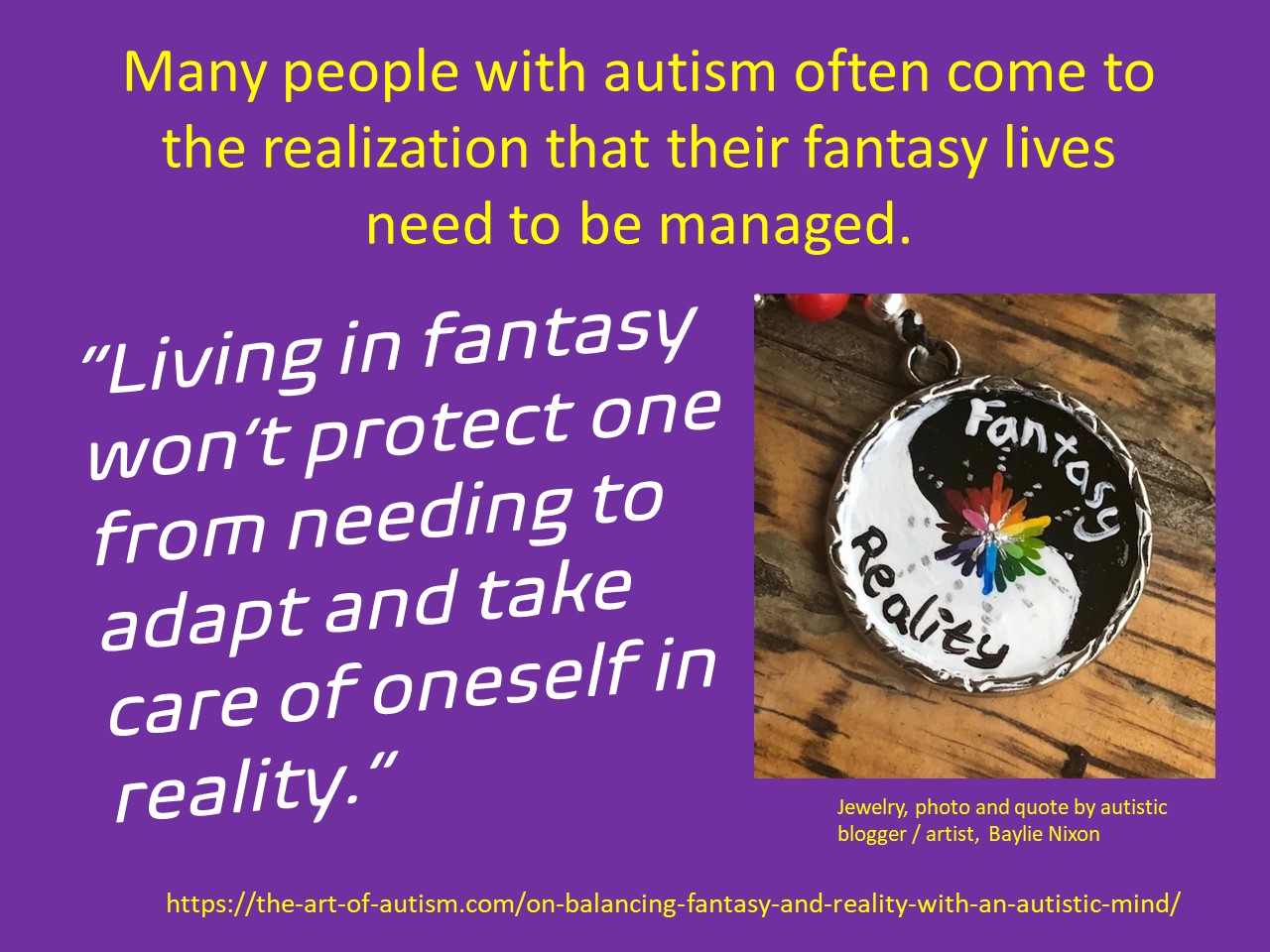
People who help those with autism can help by appreciating their imaginations but to also control their powers of fantasy. The following testimonies by adults with autism demonstrate this.
Some ways that therapists, teachers and parents can help young people with autism to understand and manage the ways they use fantasy and pretend:
*Help them to give candid and full descriptions of the fantasy-based thoughts and activities they value
*Validate their creativity and the functional aspects of activities powered by their imaginations
*Raise their awareness of ways that fantasy-based fixation can affect their lives and prospects adversely
*Reduce the severity of the problematic fantasy enthrallment and explore better ways to deal with boredom, anxiety and stress
*Engage parents and other family members in exploration of possible solutions
I have been working on the free download resources on this topic off and on for a long time. I use them a lot in my own work. I hope they are helpful in your work, too. I updated the worksheets in 2025 to reference the issue of online chatbots.
Joel Shaul
Don’t miss these other free worksheets, games, and teaching / therapy resources for children on the autism spectrum:
Christmas (and other holiday) social skills challenges for children with ASD
All children, including children on the spectrum, get excited about upcoming holidays. As teachers, therapists and parents, there are some things we can help them with ahead of time so they can enjoy the holidays as much as possible and cope with aspects of holidays that might be difficult for them.
Sensory issues: Children with ASD might experience aversion to unfamiliar foods and cooking aromas. They might feel uncomfortable in loud, crowded spaces such as family get-togethers and holiday concerts.
Conversation: Children with ASD often benefit from preparation and practice for the unique social communication opportunities that can occur during holidays.
Emotional regulation: Children who derive comfort from knowing what is going to happen next can find the unpredictable characteristics of holidays challenging, such as receiving unexpected gifts and experiencing sudden schedule changes.
Social expectations: During the holiday season, children with ASD can experience confusion regarding such social expectations as reciprocating generosity and acting more mature with increasing age.
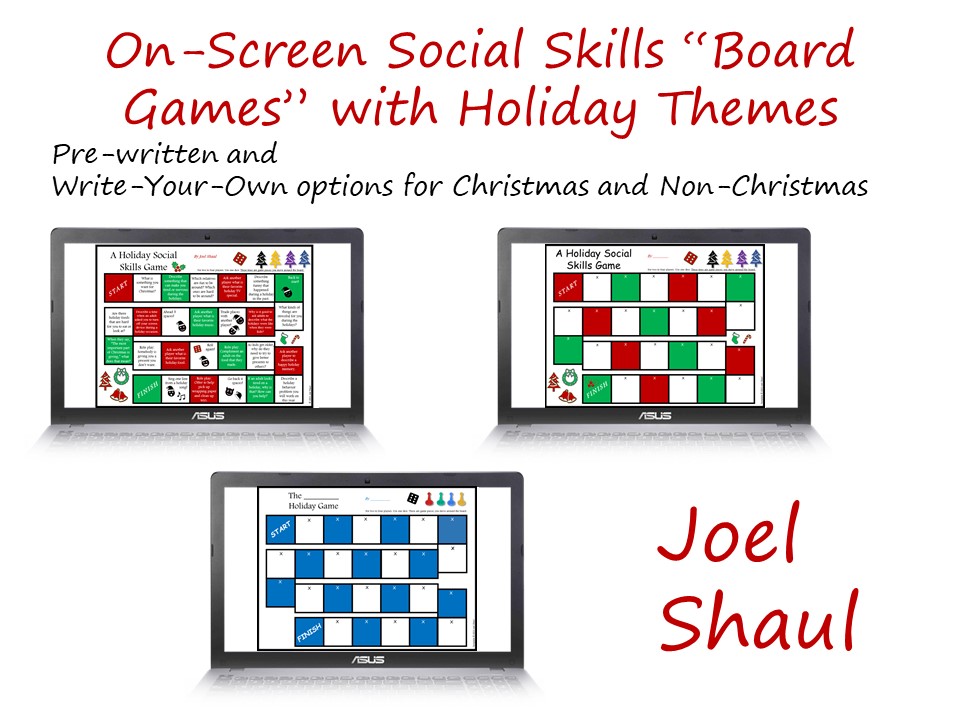
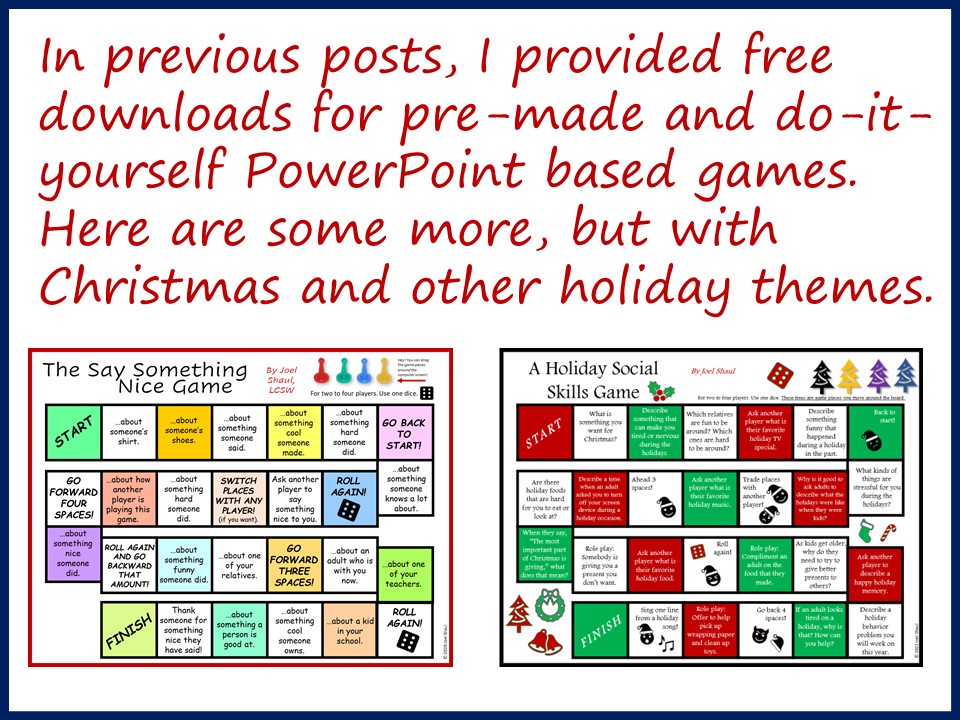
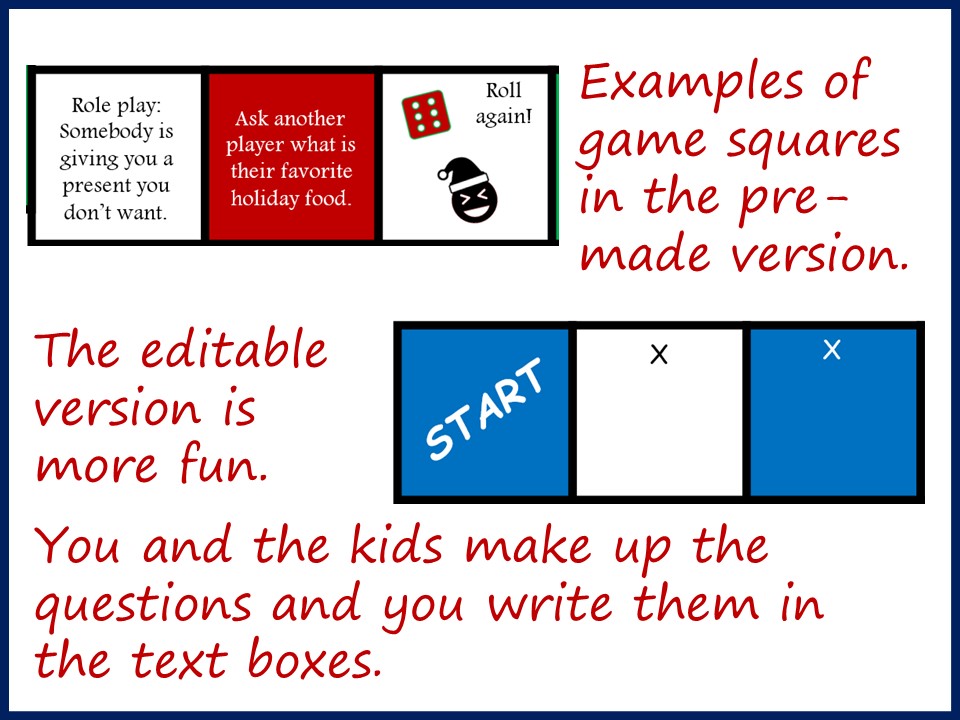
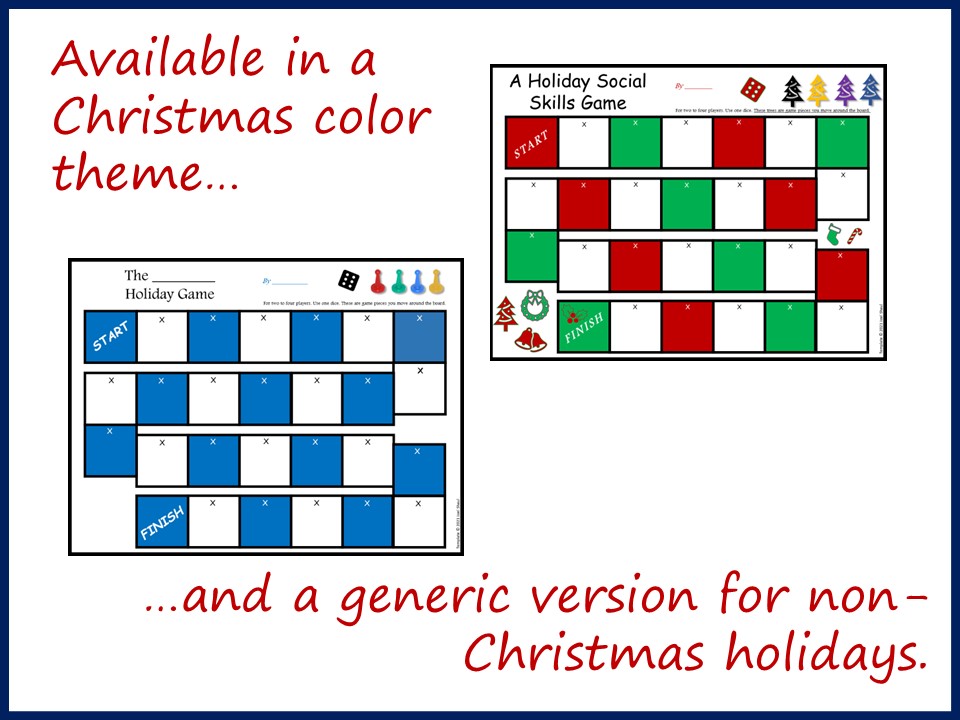
In earlier posts, I showed how to put together and play simple social skills “board games” using my simple PowerPoint template. This free kit I offer you here is a set of pre-made, holiday themed games that are ready to play. Each square on the game board poses a social skills question pertaining to holidays.
The pictures below provide more information and details.
Don’t miss these other free worksheets, games, and teaching / therapy resources for children on the autism spectrum:
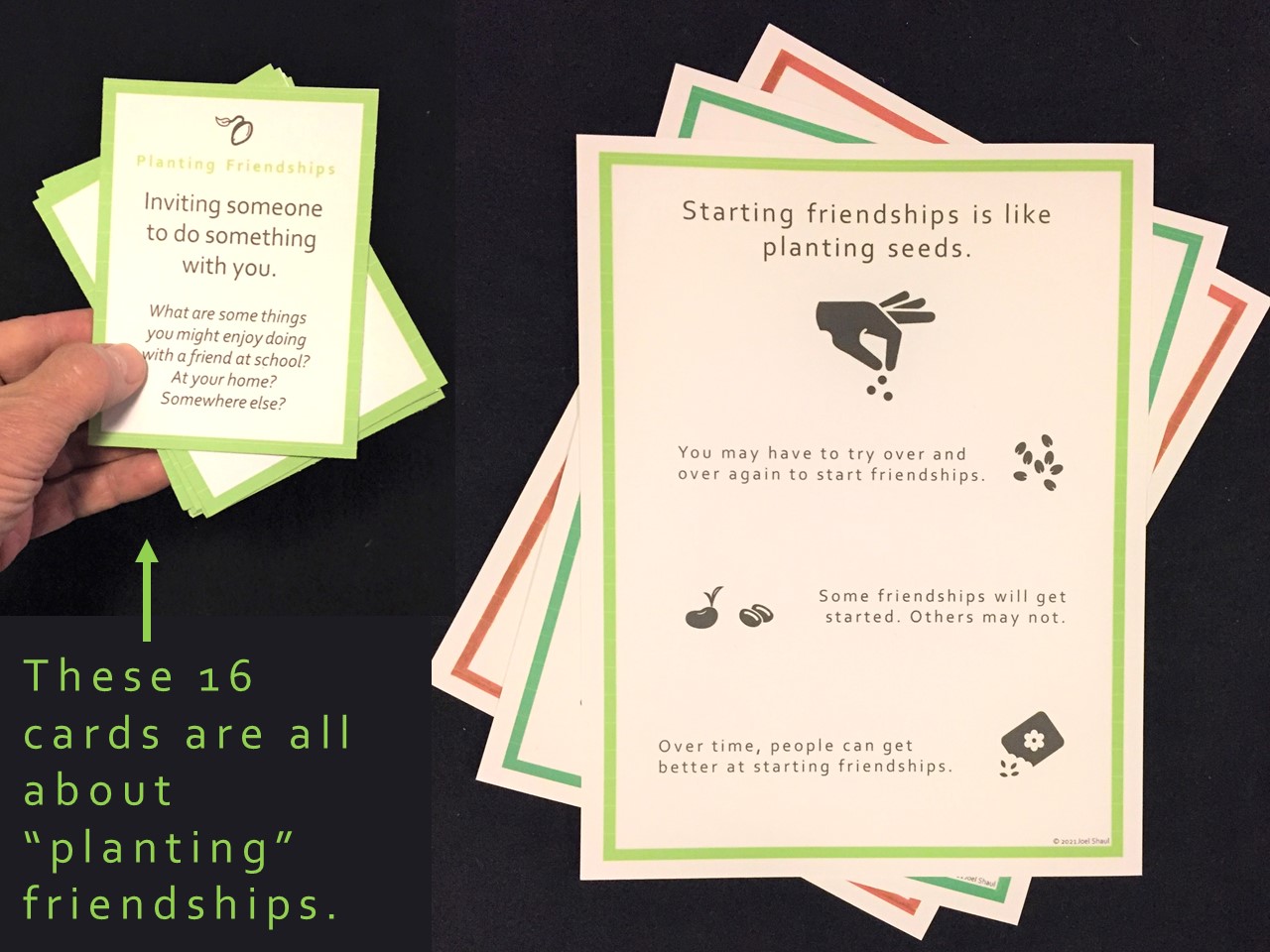
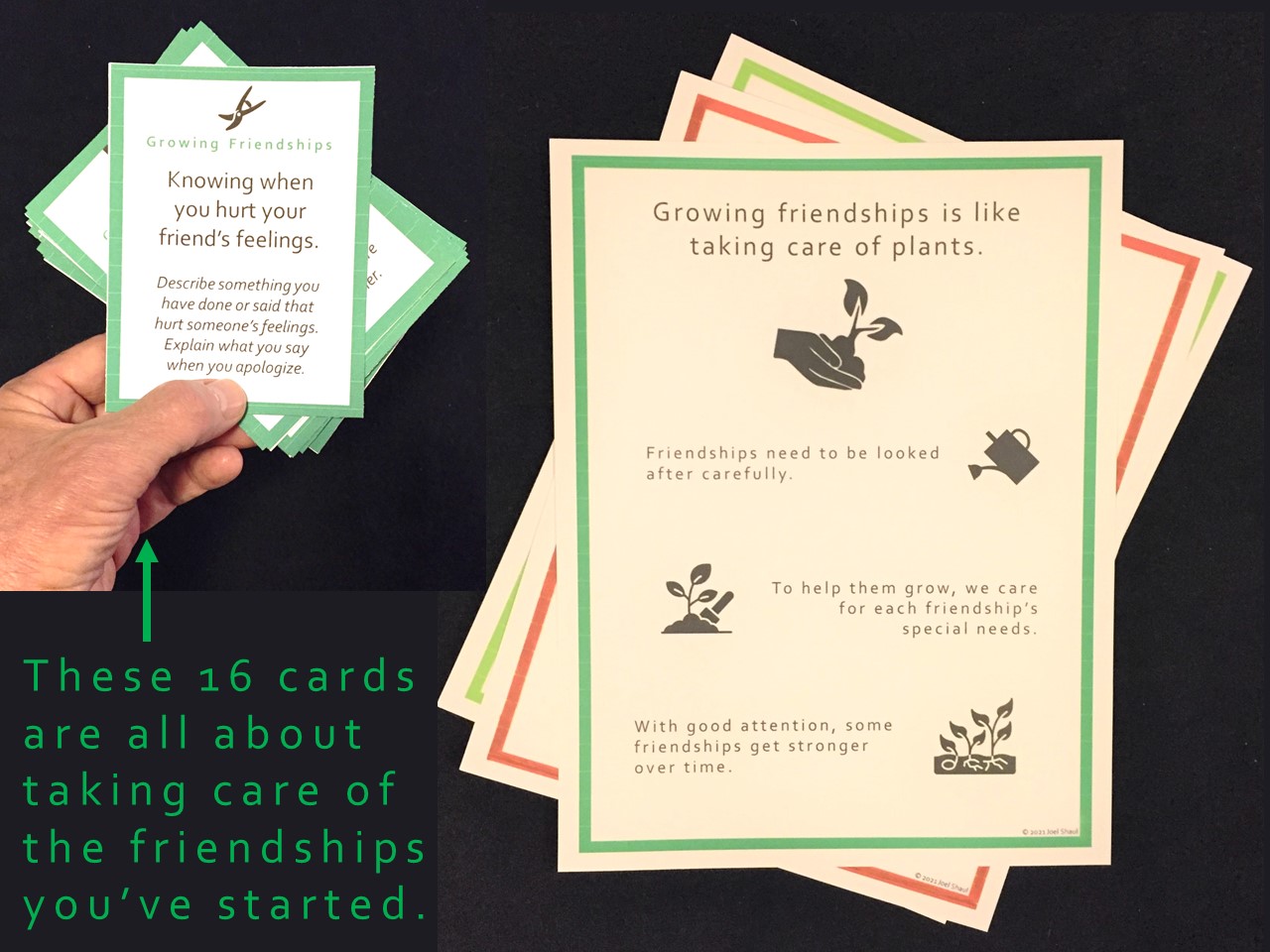
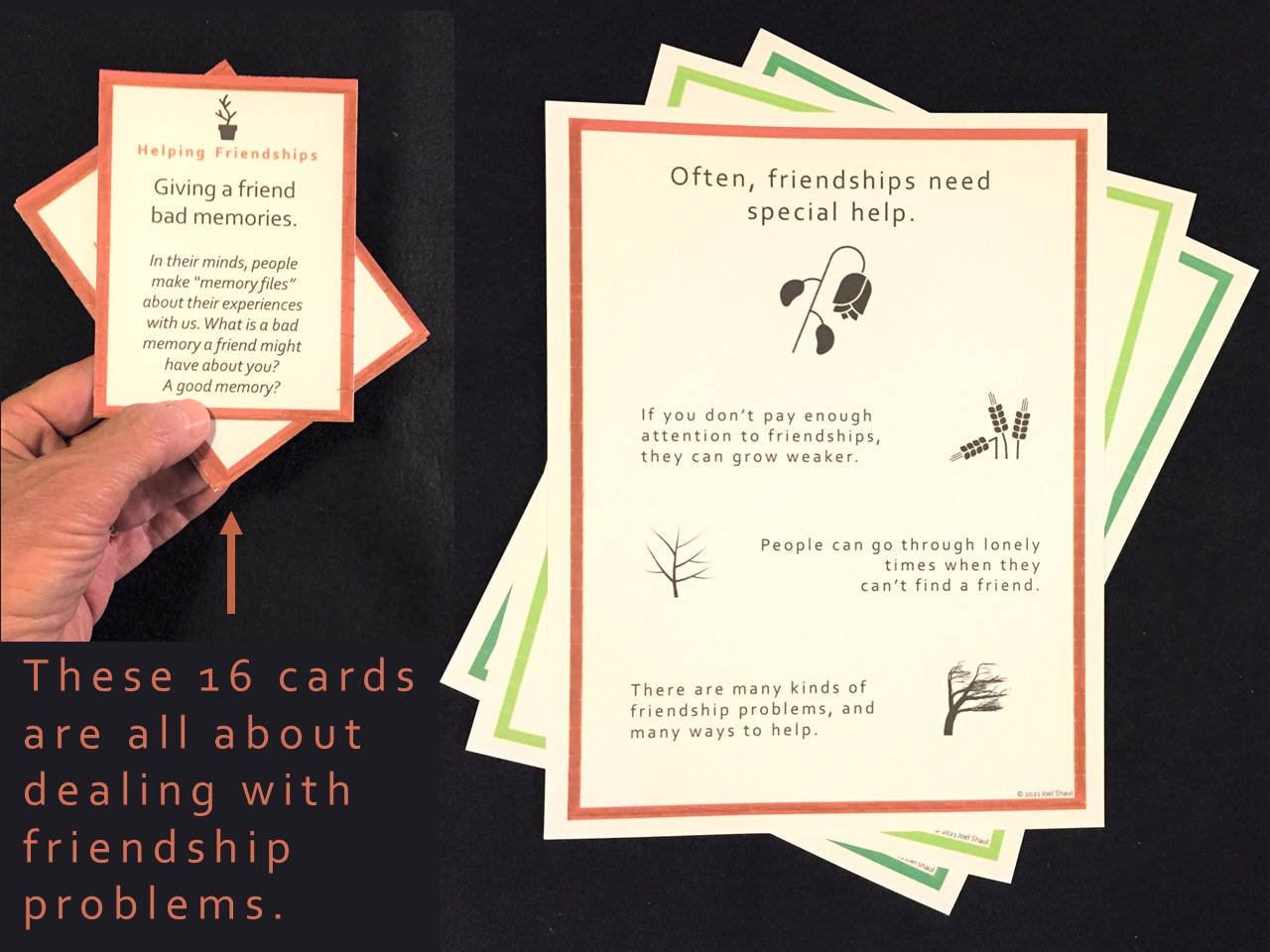
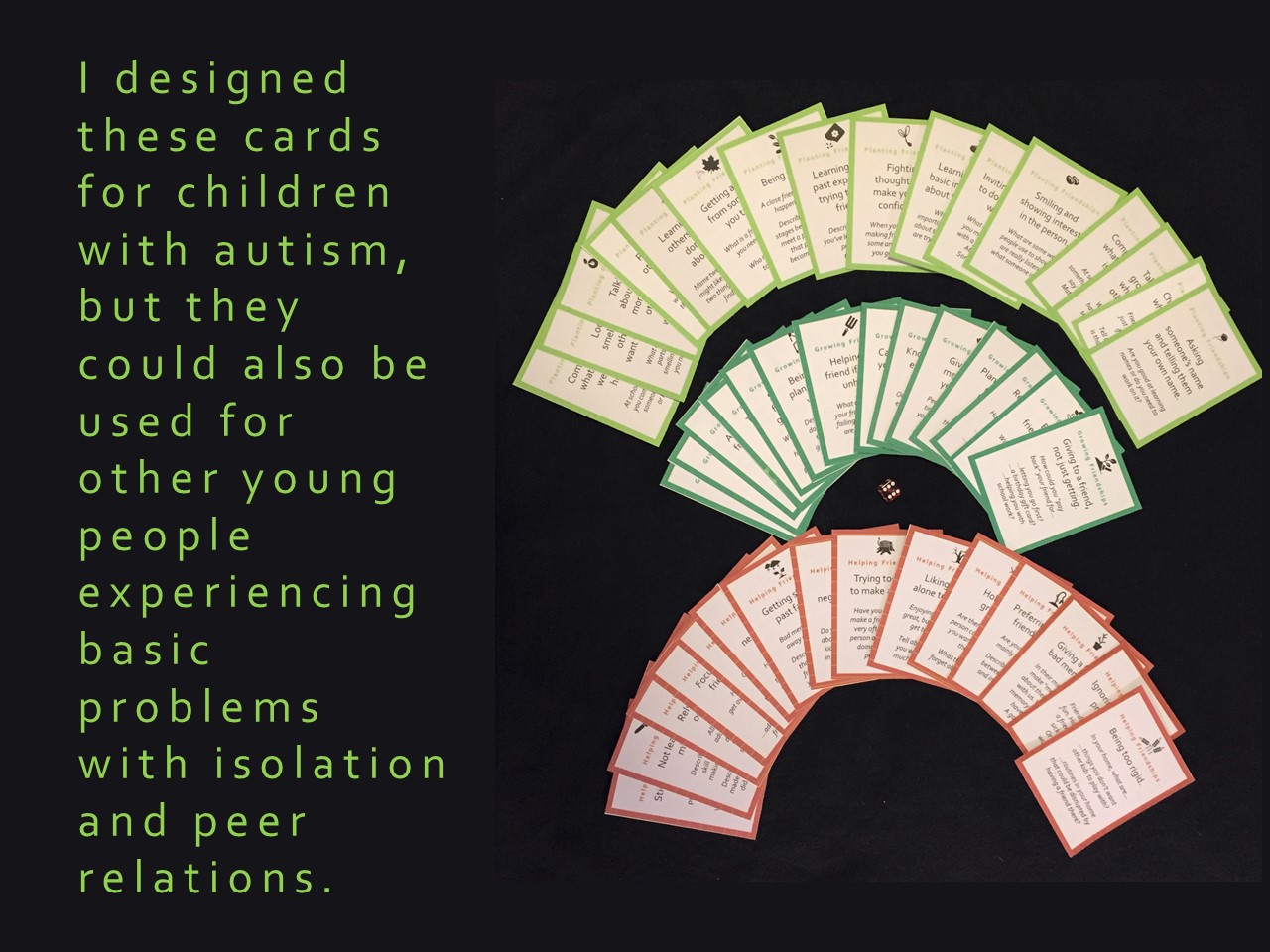
This social skills card activity is designed to help children with autism to explore friendship. It can be used in a variety of ways. You can print out the friendship social skills cards and use them with dice in a social skills game or you can use them in an unstructured Q & A format. A separate download allows you to skip printing the cards and instead display them on a computer, which makes this social skills activity adaptable for teletherapy or classroom use.
The pictures below demonstrate what elements of friendship are represented in the three card categories: Planting friendships, Growing friendships, and Working out problems in friendships.
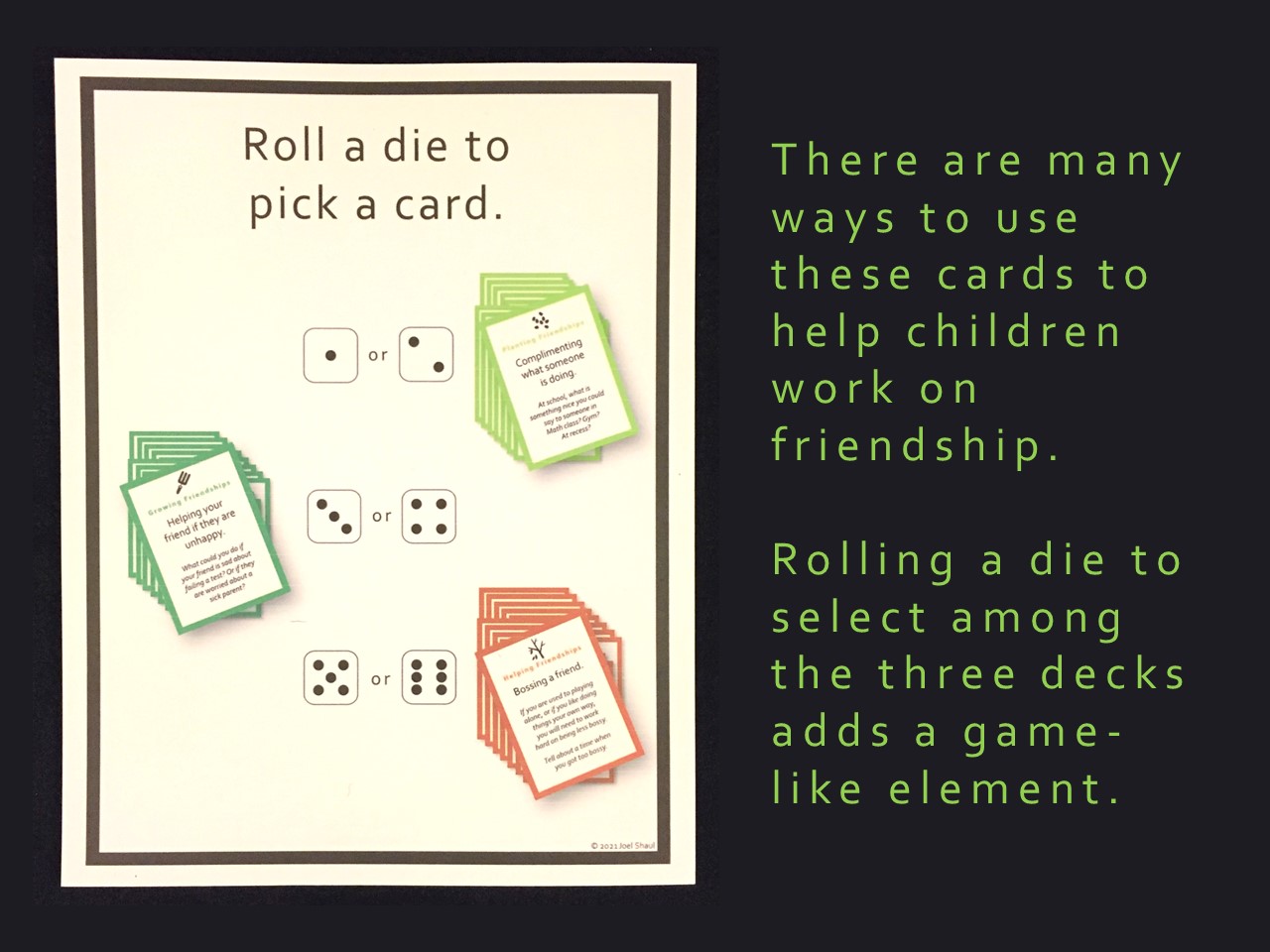
To add a game-like element, you can roll a die to guide card selection from among the three categories, as explained below.
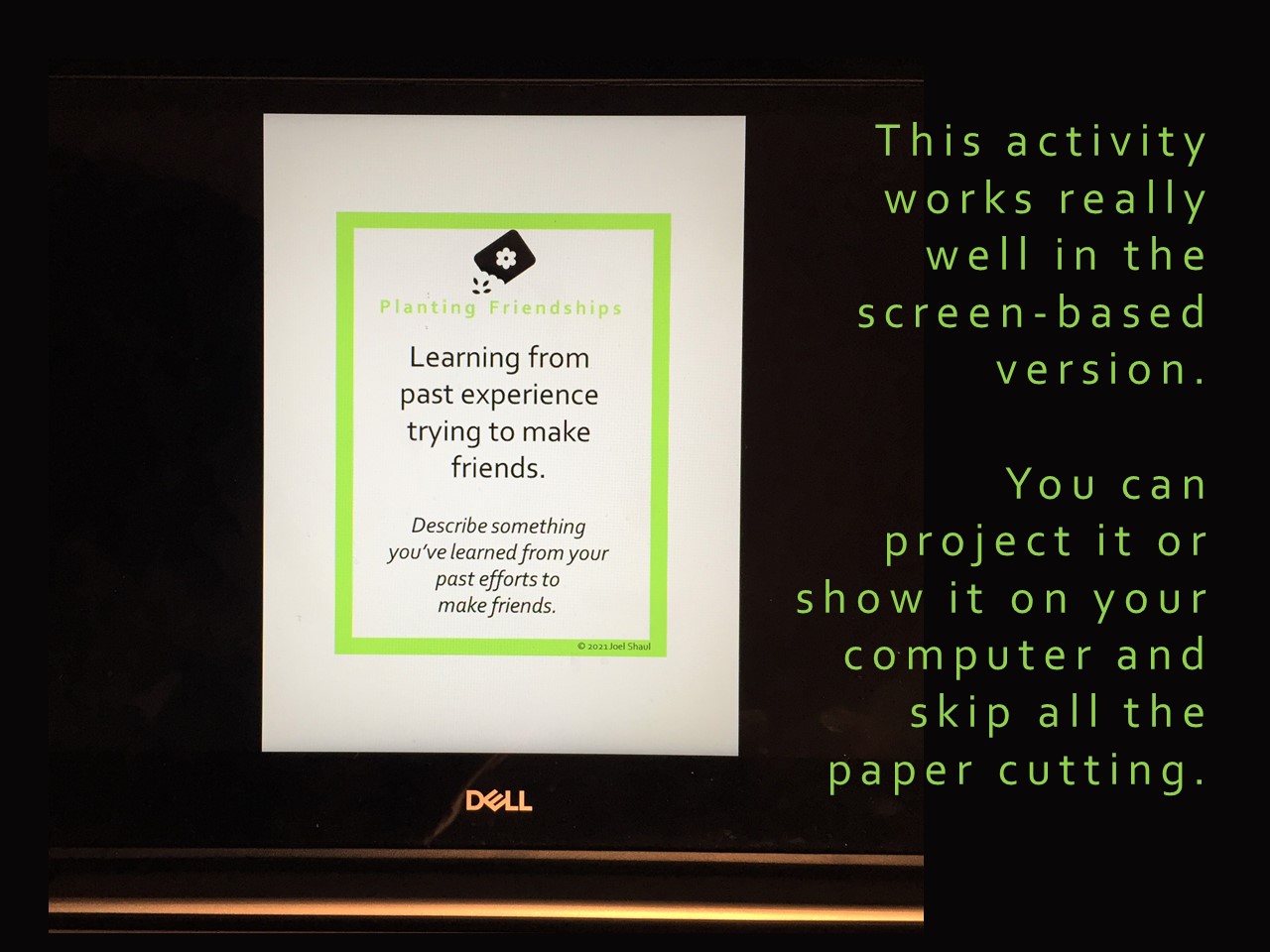
In my own use of these cards in social skills groups, I have used the projected version of the Friendship Growing Cards as often as I have employed the printed-out cards. Projected, each individual card offers the advantage of allowing all participants to clearly view the card in question.
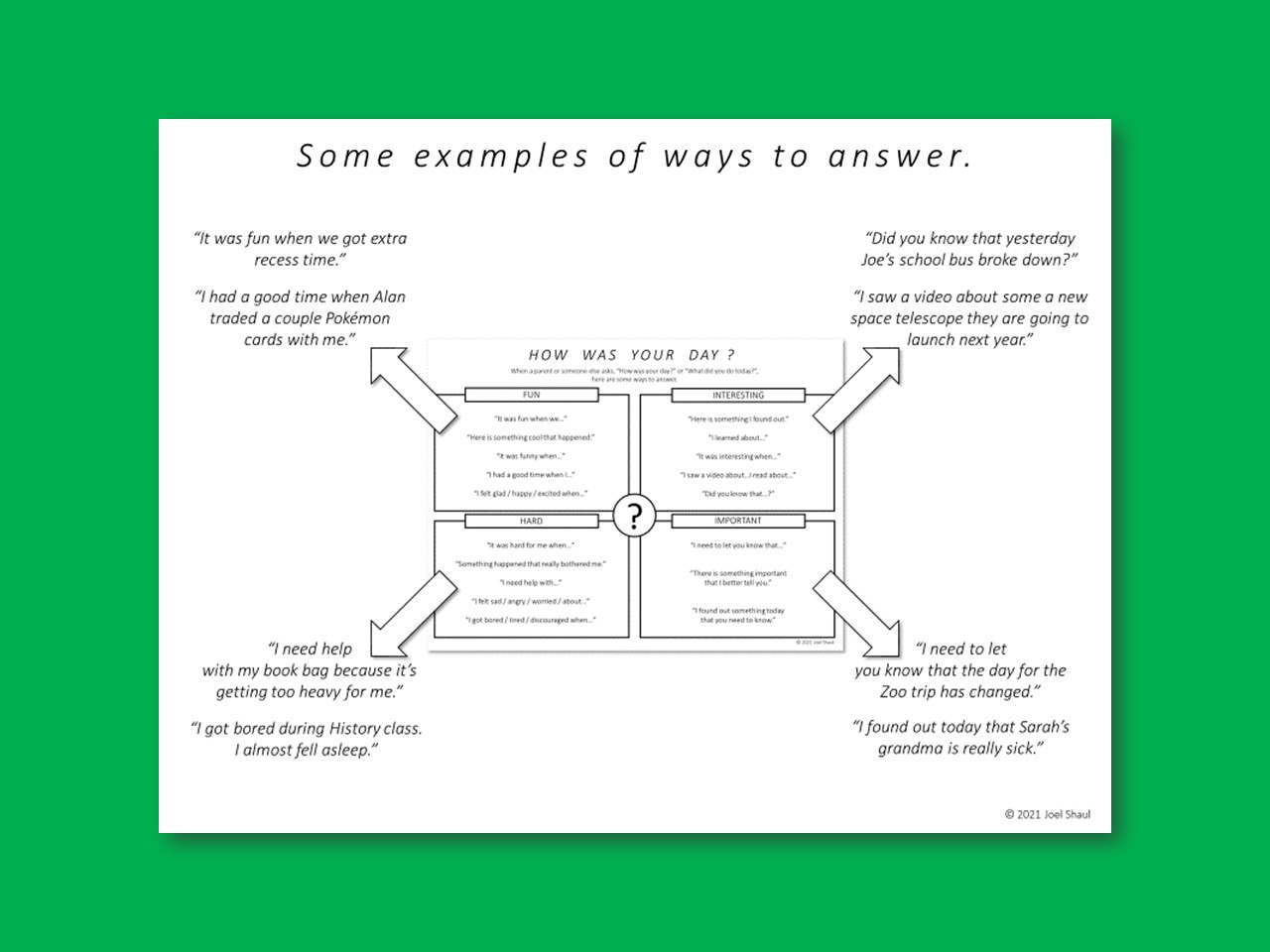
Many children, especially children with autism spectrum disorders, have difficulty answering these questions from their parents at the end of the day. Children might be tired or distracted. They might not grasp the importance of exchanging information about the school day. They may have an impaired sense of what the parent knows or does not know.
I designed these sheets so that:
*Parents can use them as written prompts
*Mental health therapists and speech therapists working with children with autism can use them for guidance and practice for this important aspect of the parent-child relationship.
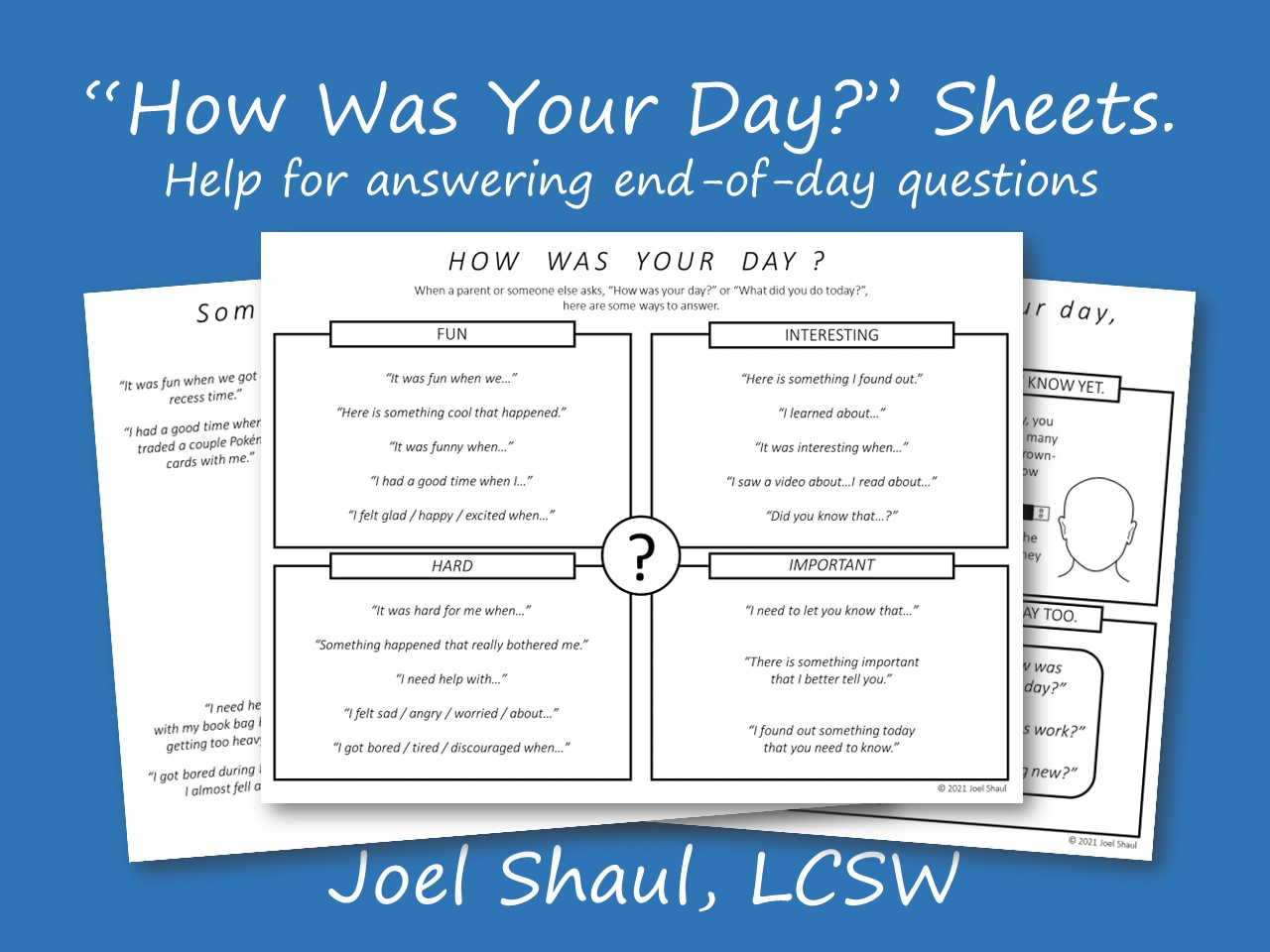
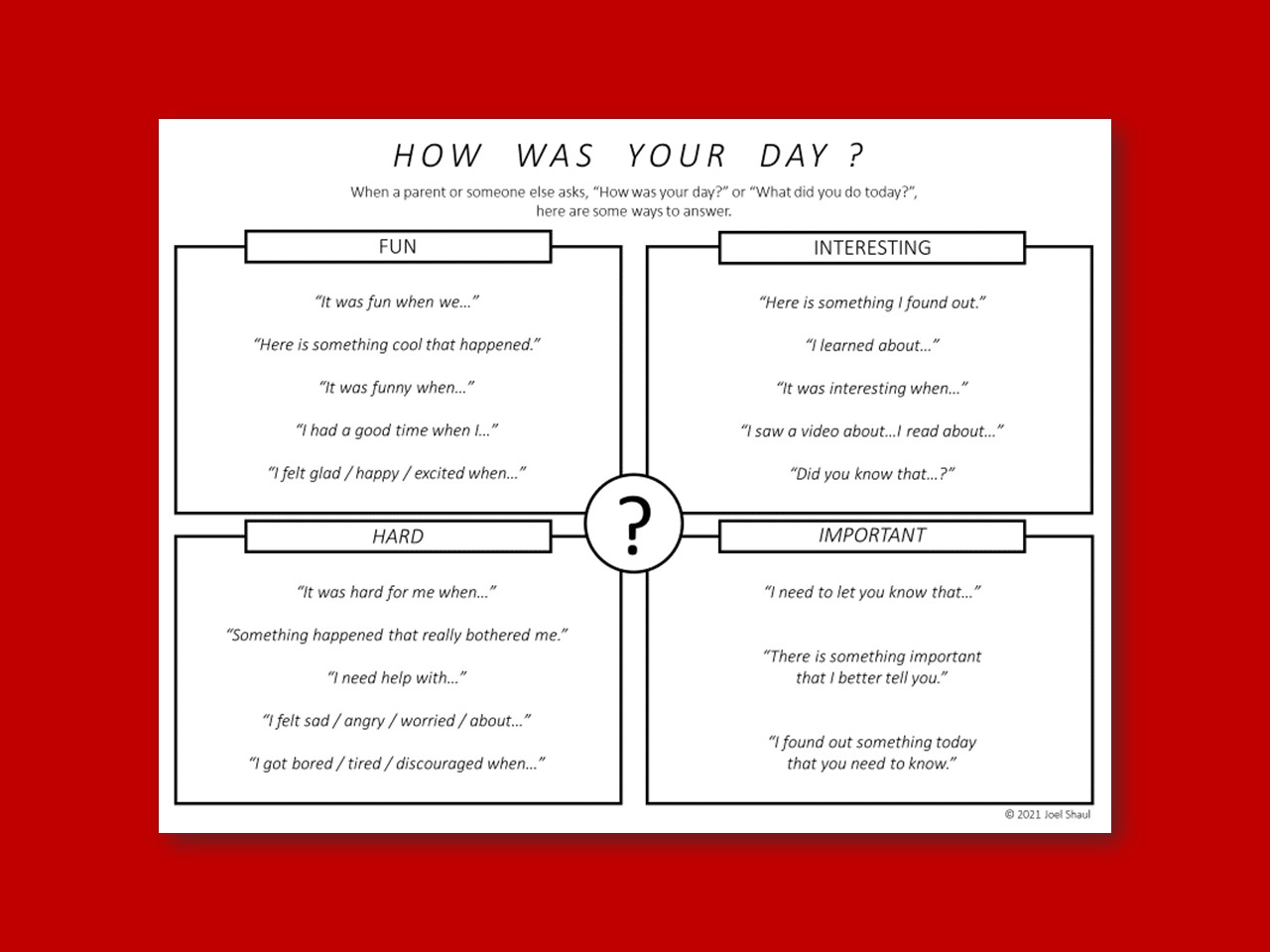
This first sheet offers examples, in thematic categories, of useful statements and phrases to use when answering “How was your day” kinds of questions.
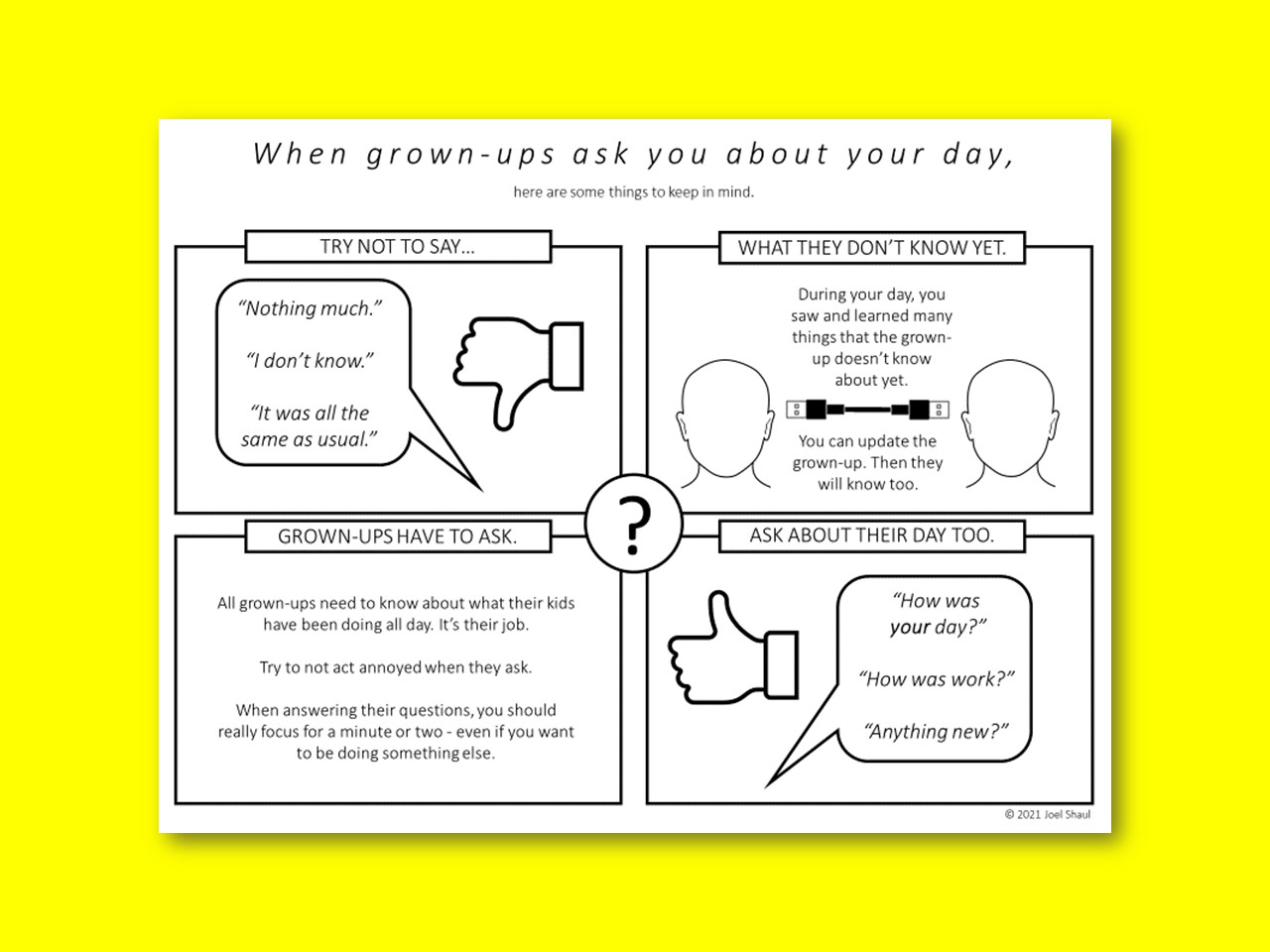
This second page offers a variety of helpful suggestions.
The third sheet offers examples of how to use the phrase prompts from page 1.
In my own work with the parents of children on the spectrum, I have gotten a lot of good feedback about the design and utility of these conversation prompts. I hope that you also find them useful.
Joel Shaul, LCSW
For more materials to facilitate conversation between the child and family members, here is another set of free materials: Talk to Family Picture Sheets.
For more practice on asking and responding to “How are you?” questions, here is a cool and fun paper fortune teller on that topic.
For Young Adult Cards specifically for workplace readiness skills, click HERE.
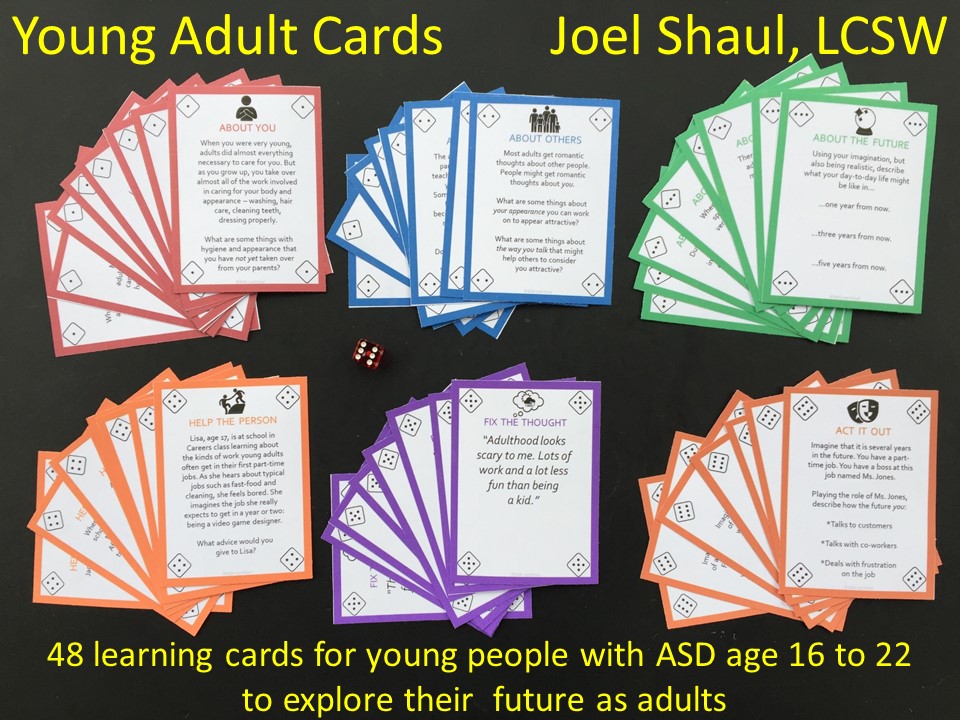
In my work with young adults on the spectrum, in individual therapy, school settings and group therapy, I often found it useful to incorporate game-like activities to promote productive discussion and problem solving of diverse young adult challenges. After some experimentation I eventually finalized this set of Young Adult Cards, which I then often used in my own work.
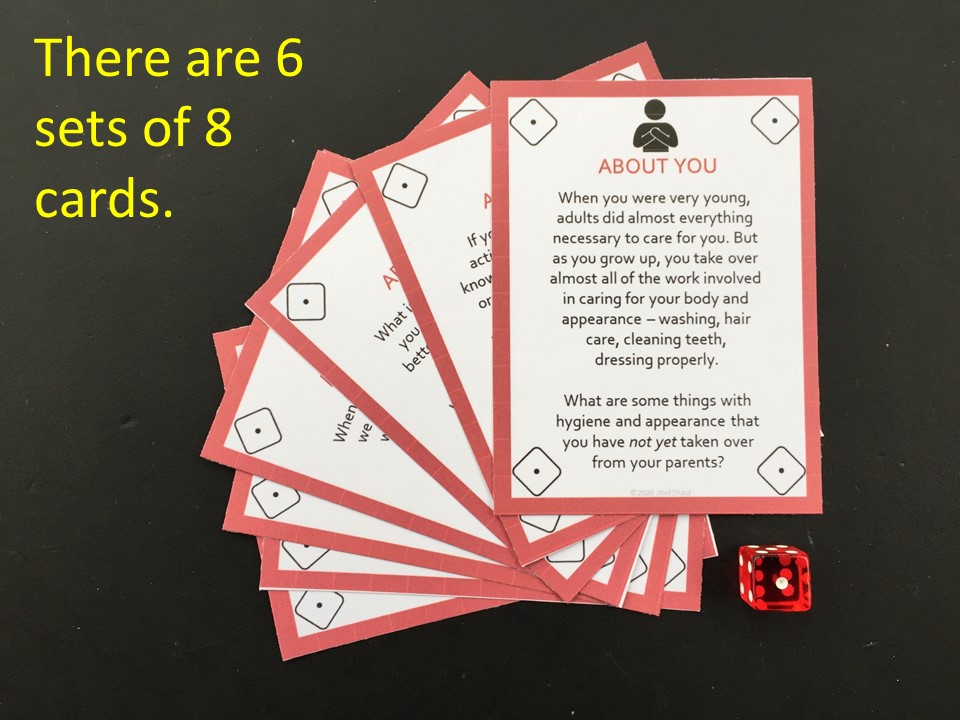
The first of the 6 card categories, About You, poses questions pertaining to typical problems faced by young adults on the spectrum. There are 8 cards in each of categories.
The second category, About Others, poses questions about how the young adult’s words and actions might affect others in the social network.
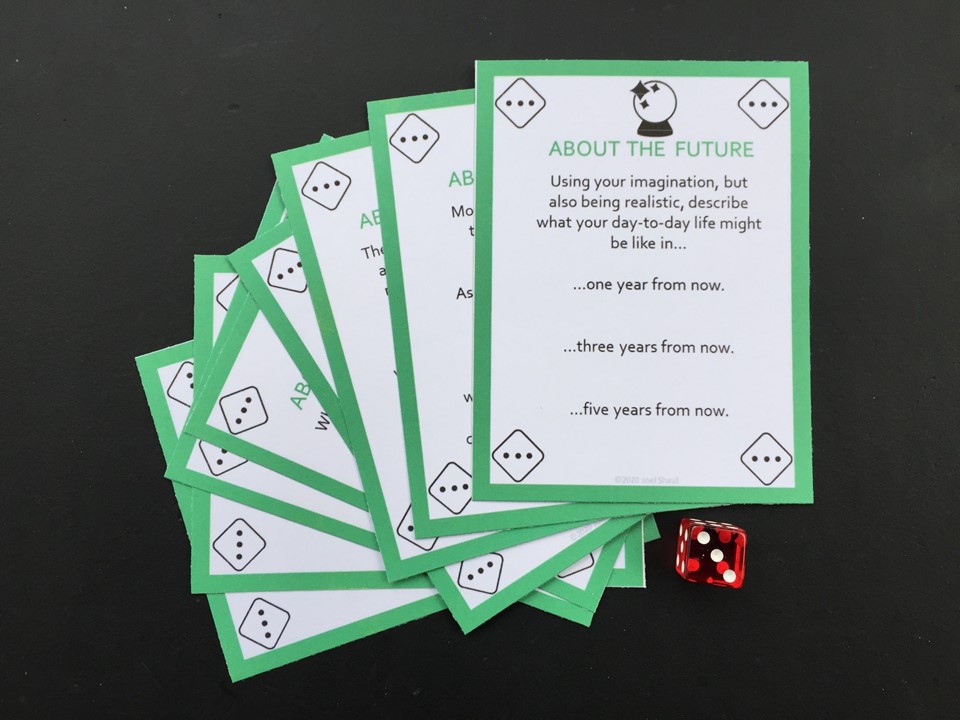
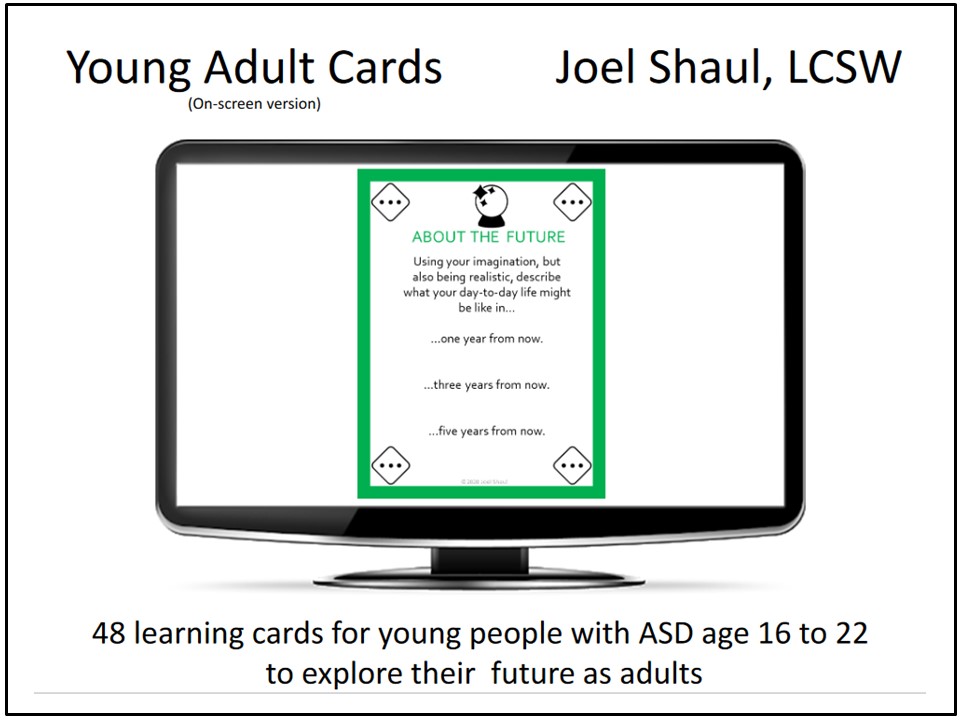
The About the Future cards task the player with imagining their future as an adult and how they will cope with new opportunities and challenges. Here they are.
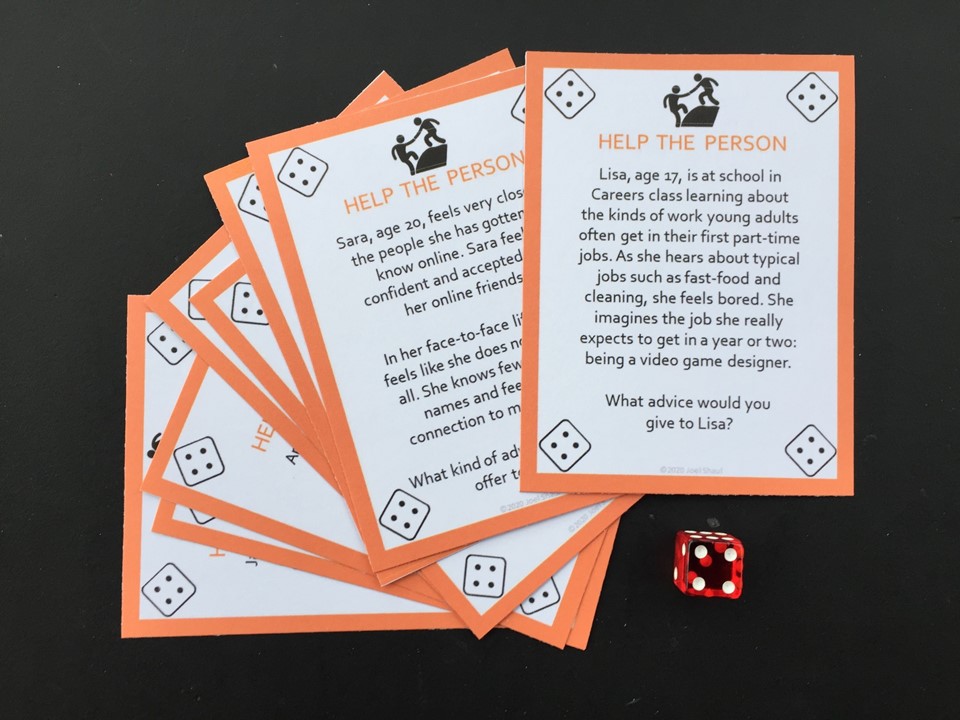
The Help the Person cards describe hypothetical social dilemmas faced by various young adults, for which the card player must offer solutions. Check out the examples below.
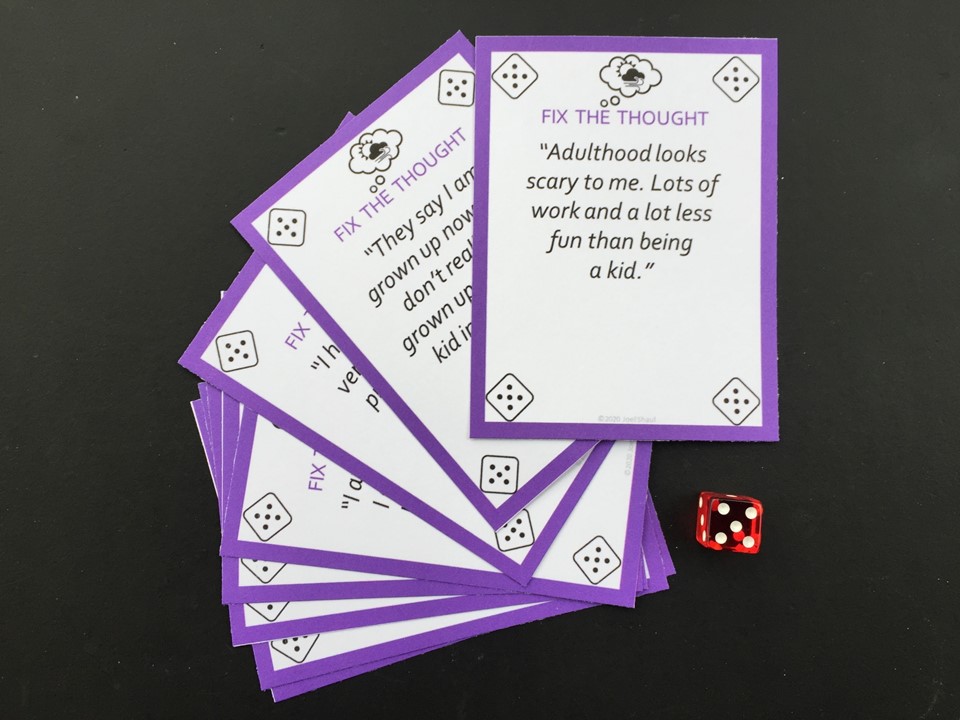
The Fix the Thought cards each describe typical negative thoughts experienced by many young adults with autism, and asks the card player to offer positive, rational counter-thoughts. See example below.
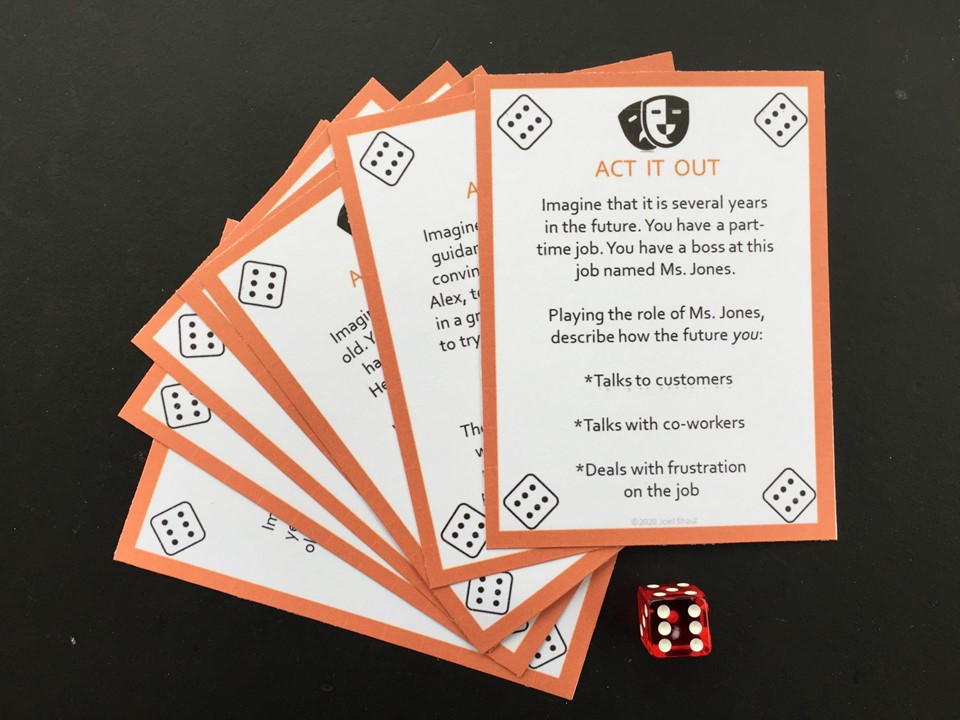
The Act it Out cards set up short role play scenarios on various social dilemmas described on the cards. Here is an example.
There are many ways to use these cards, in individual therapy, small group, or classroom settings.
There is a similar set of cards available on a specific young adult theme, preparing for the workplace. They are called Workplace Preparation Q & A cards.
Whether you are doing teletherapy, or you wish to try screen-based therapy games and activities in your office-based sessions, you will find lots of variety on this website.
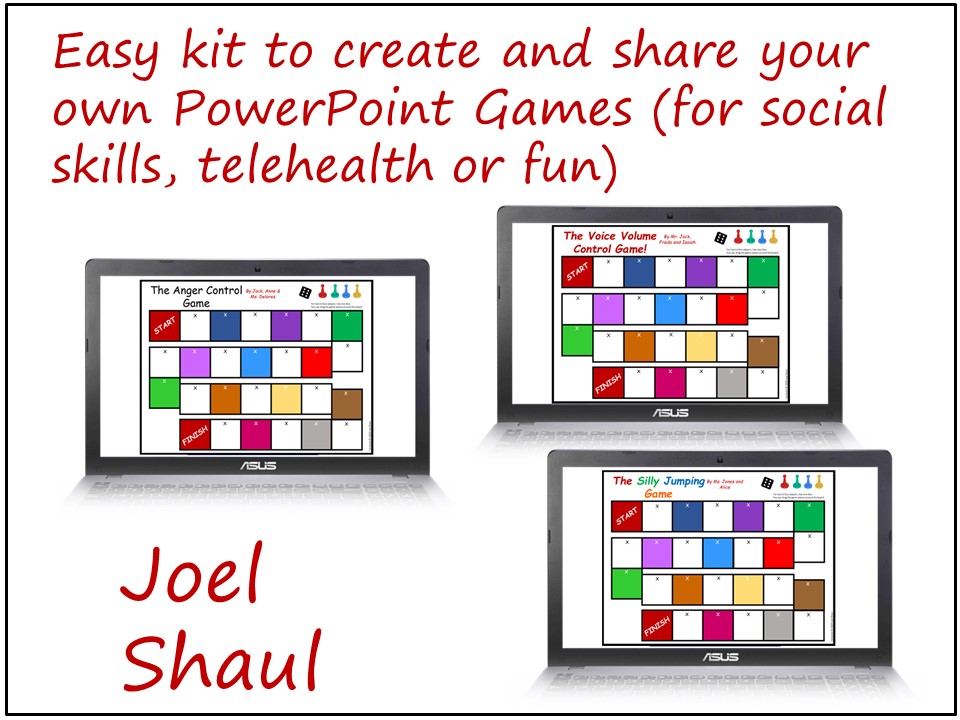
The kit to quickly create PowerPoint “board games” on your computer is remarkable easy to use. You can customize this tool for the particular needs of the child.
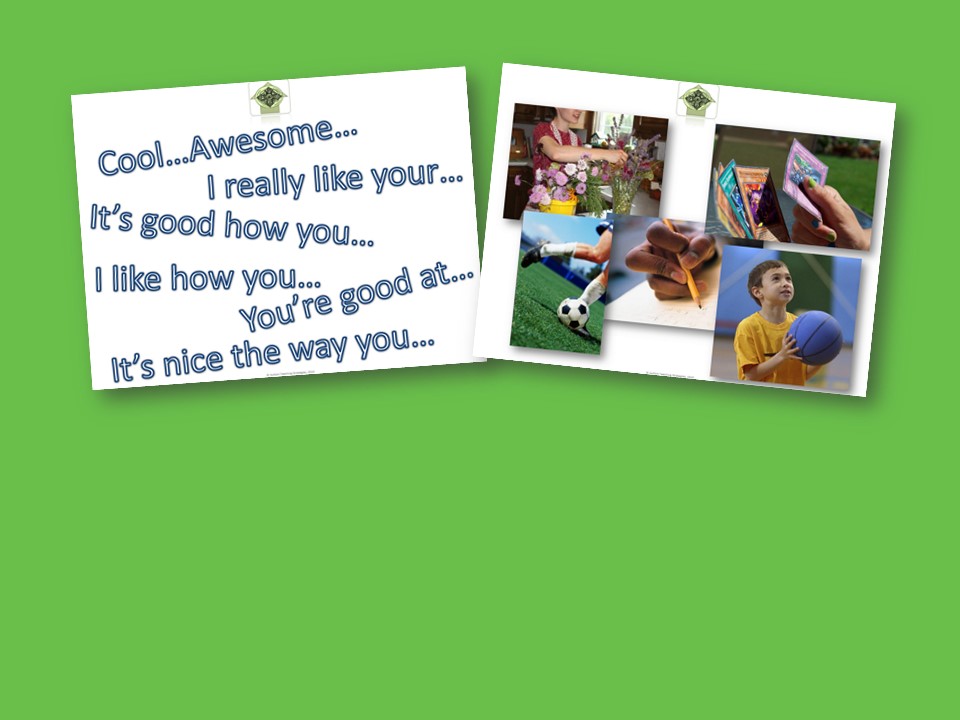
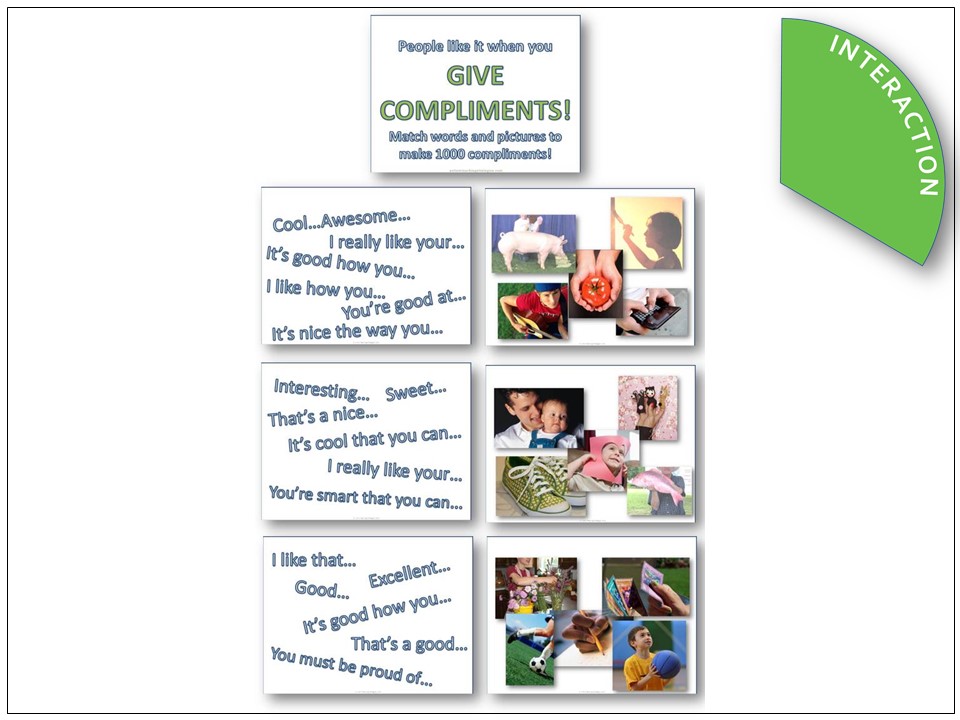
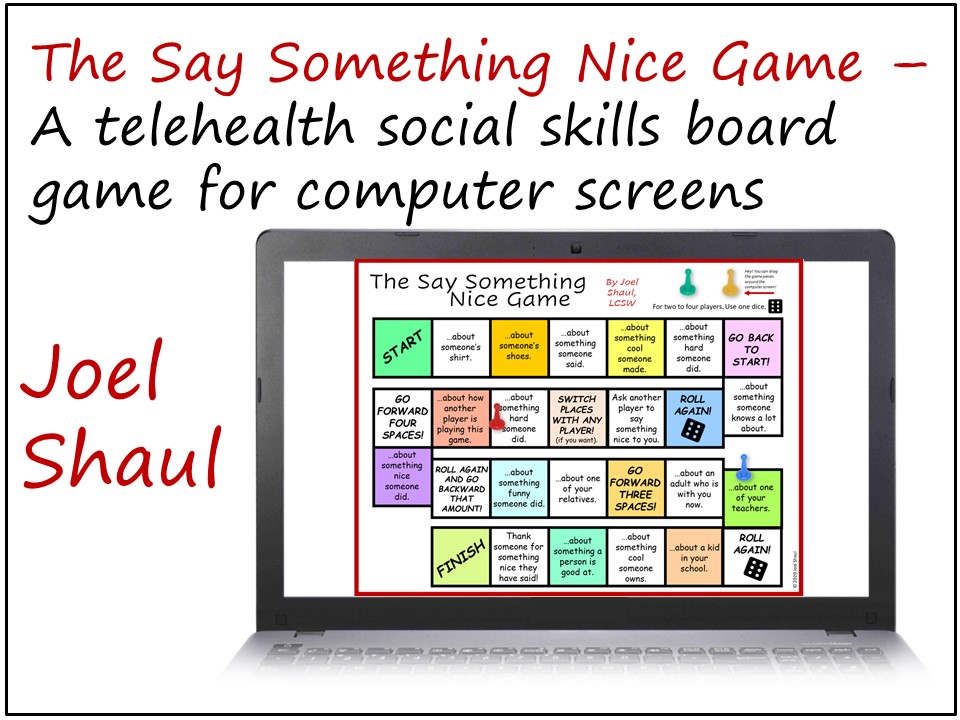
The Say Something Nice Game, which teaches the social skills or making compliments, is ready to play and requires zero prep time.
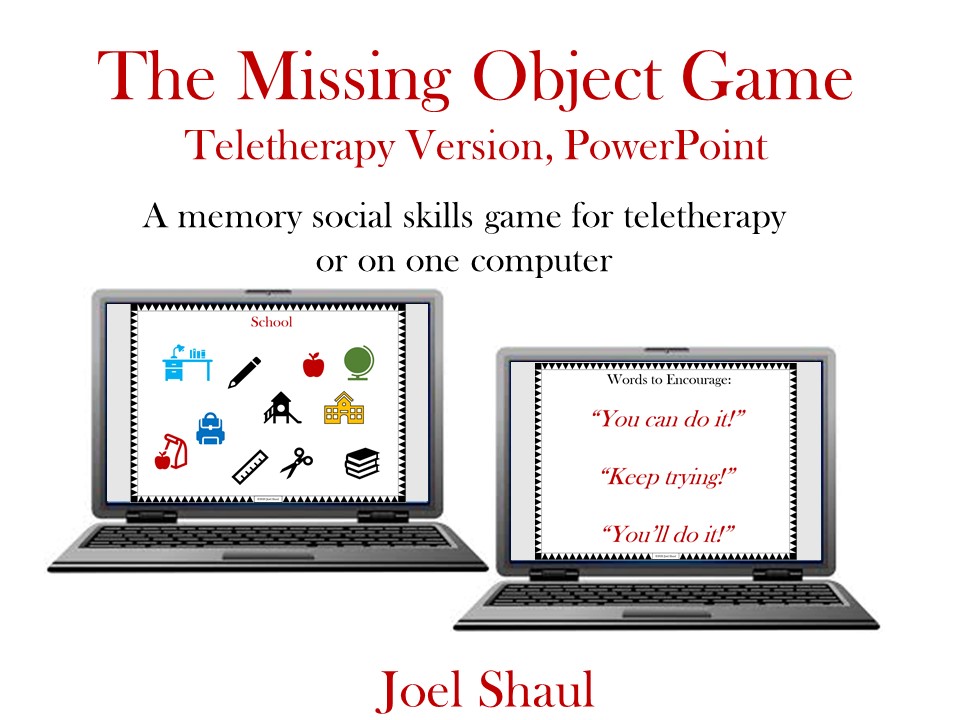
The Missing Object Game, which teaches aspects of sportsmanship, can be played on-screen, or you can play it in person by putting together your own collection of random small objects.
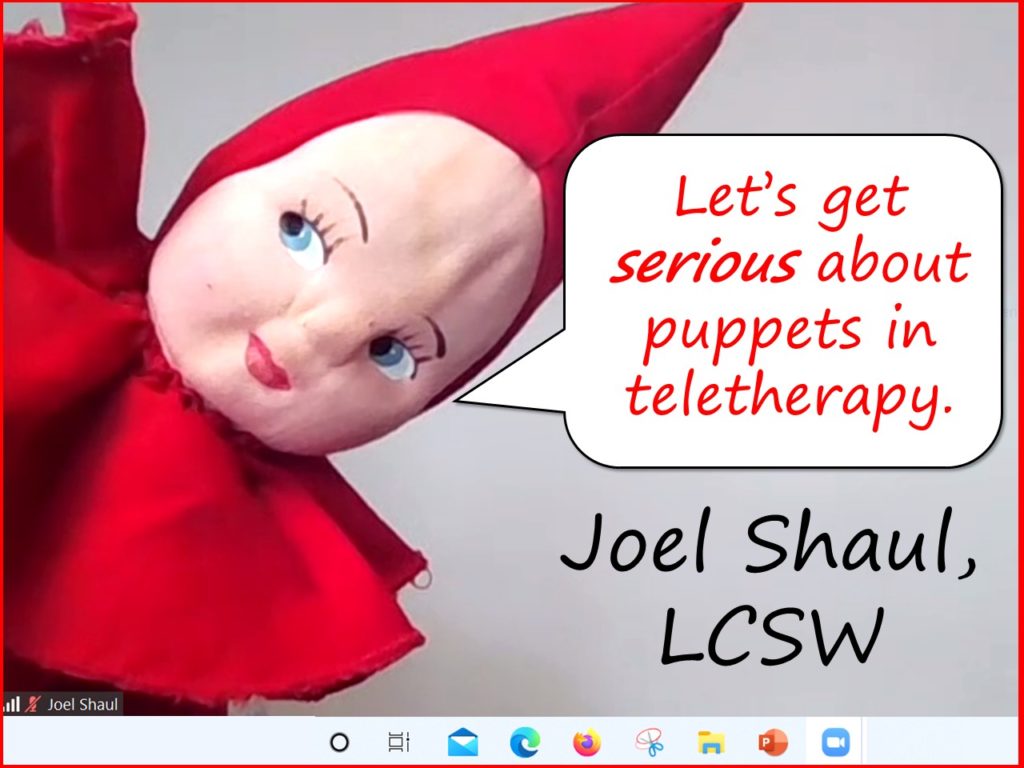
If you haven’t tried using puppets in therapy, check this out.
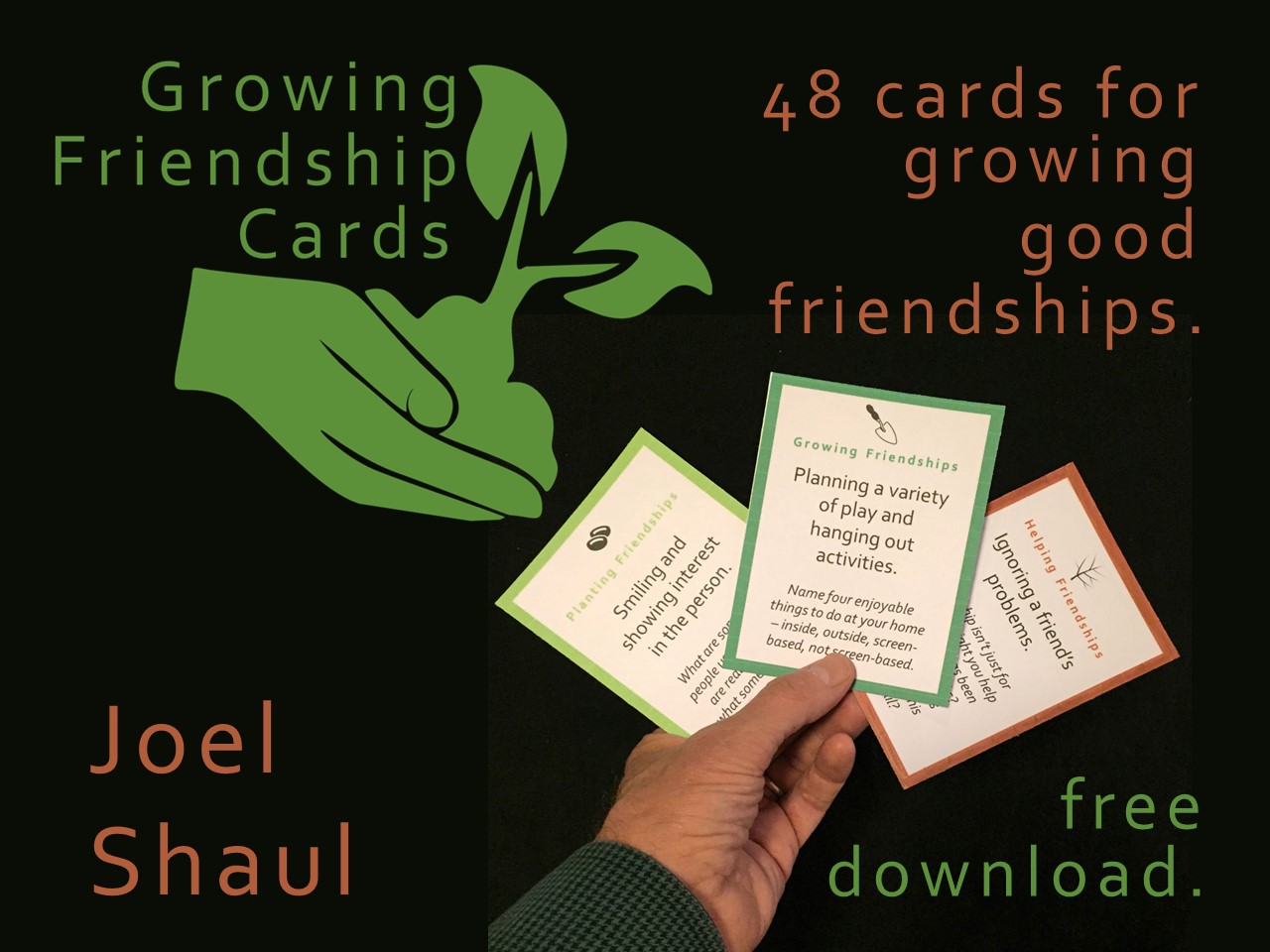
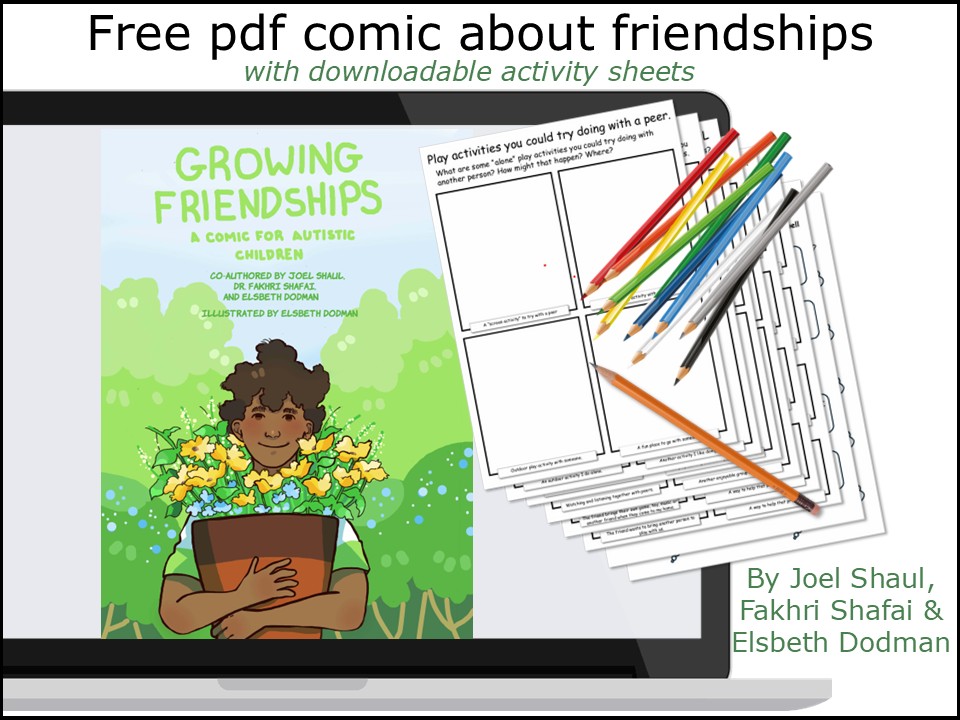
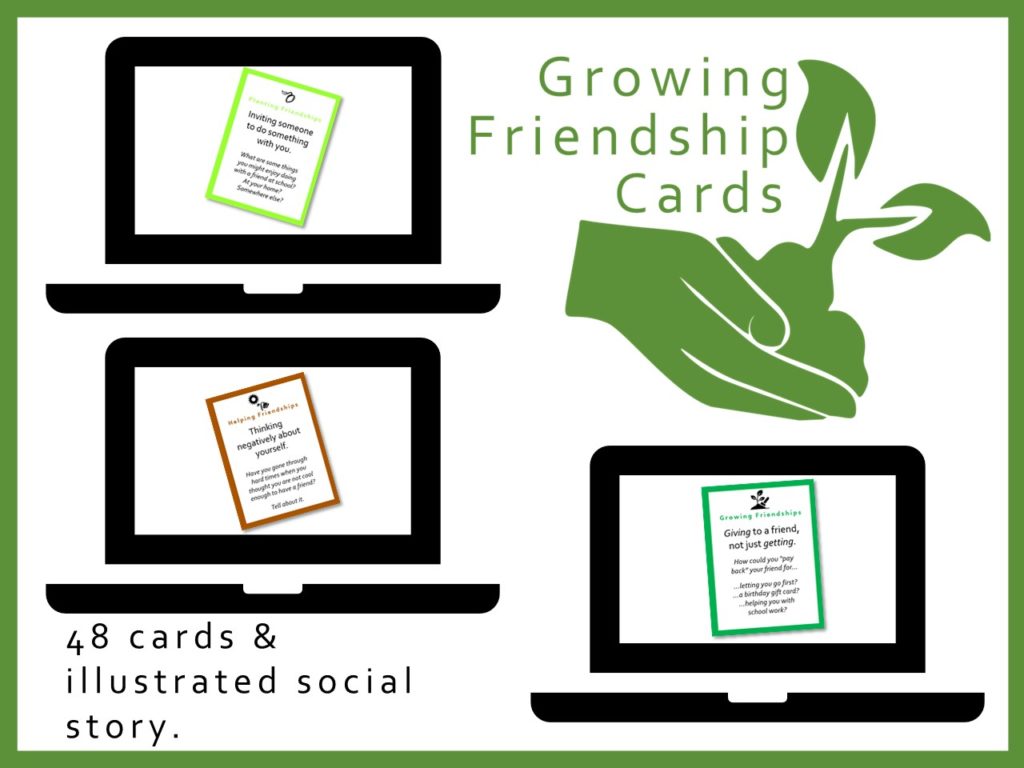
The Growing Friendship Cards can either be printed out to create conventional cards, or each card can be viewed individually via a second download.
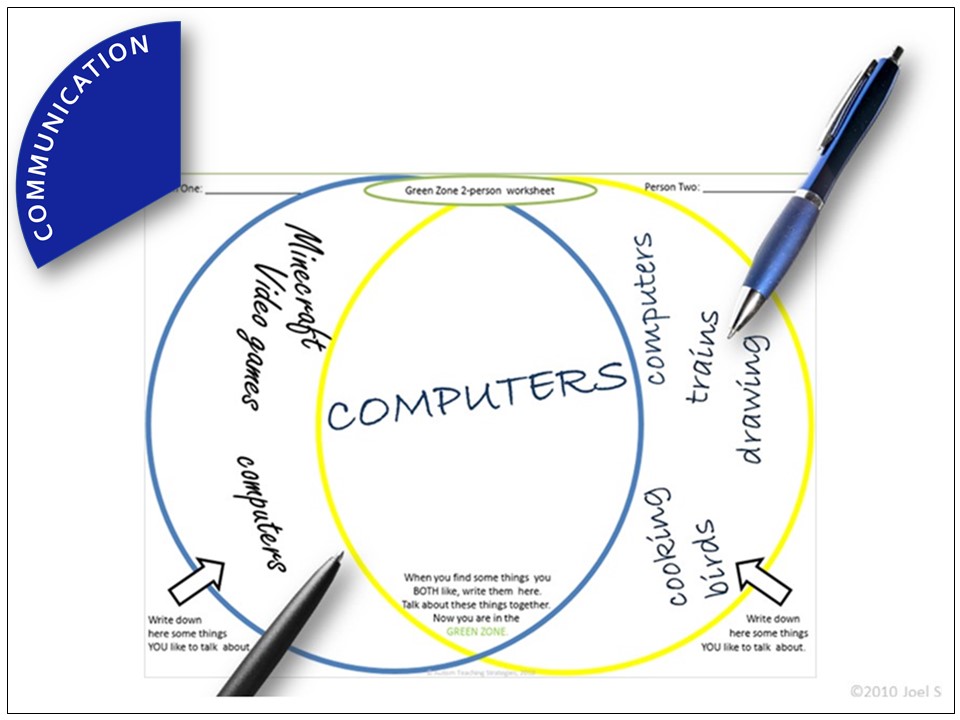
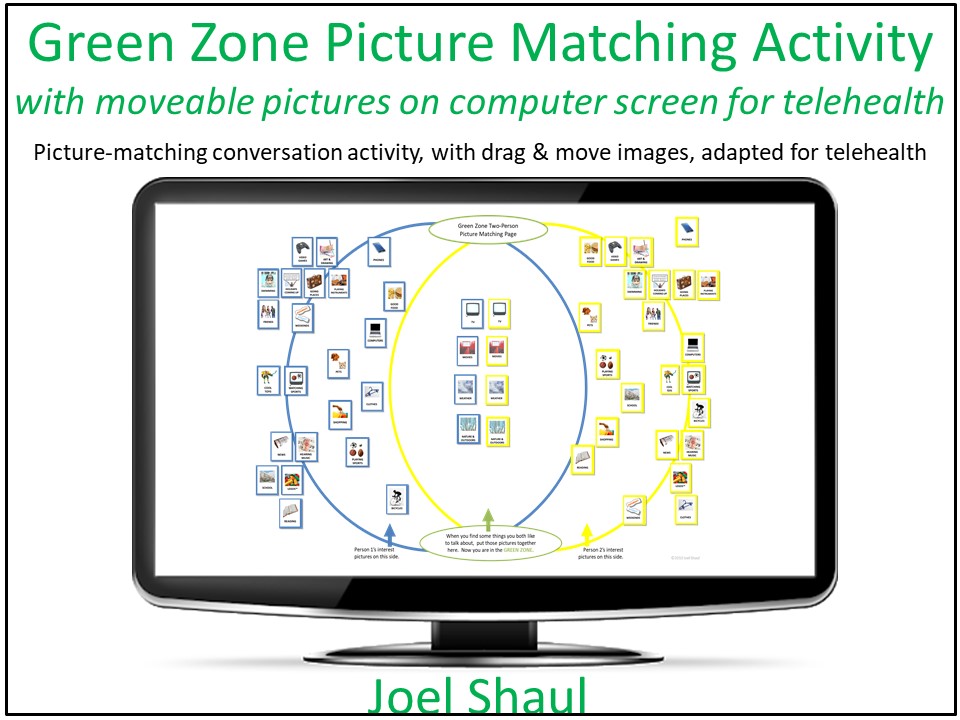
This activity, which uses Venn diagrams to raise awareness of common ground as a basis for conversation, works very well in this screen-based version.
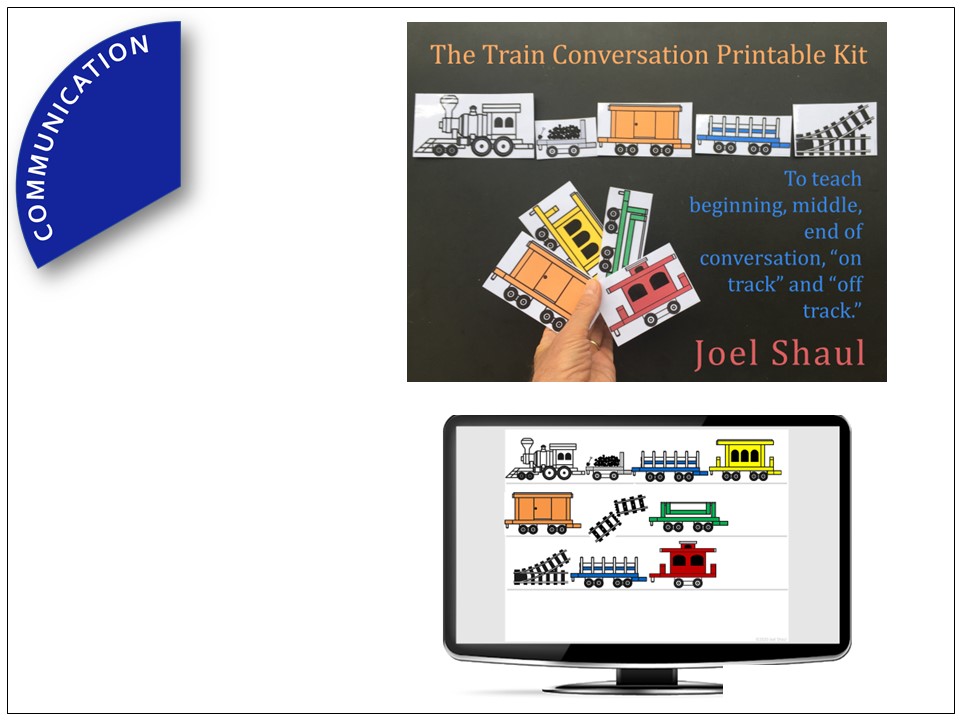
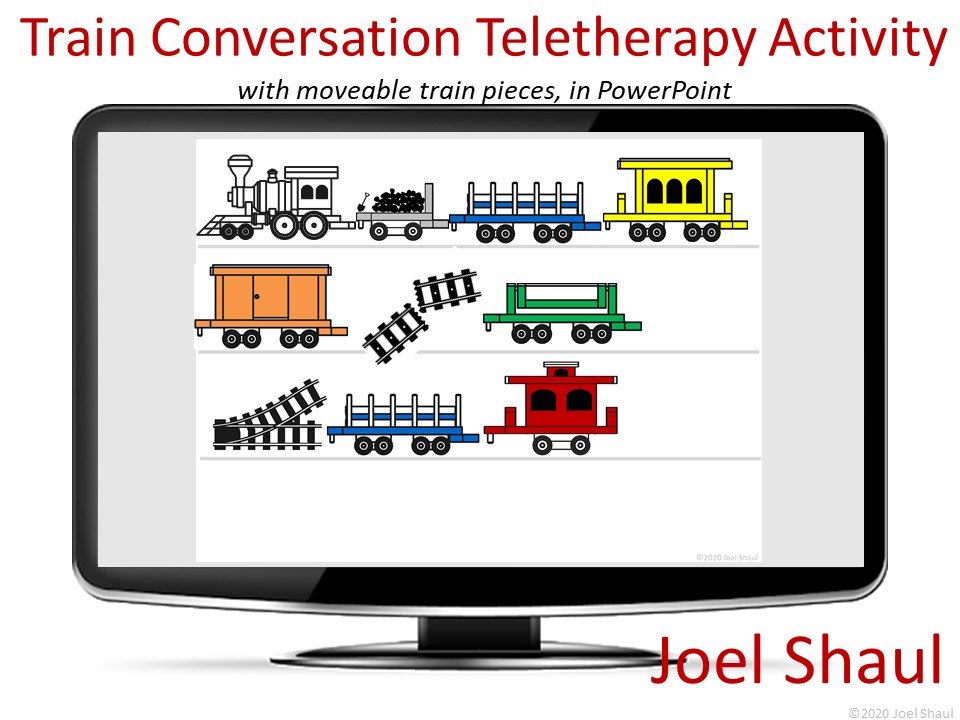
This is the screen-based version of The Train Conversation activity. You move the various train images around on the screen to demonstrate how to keep conversation “on track” with beginning, middle and end of conversation.
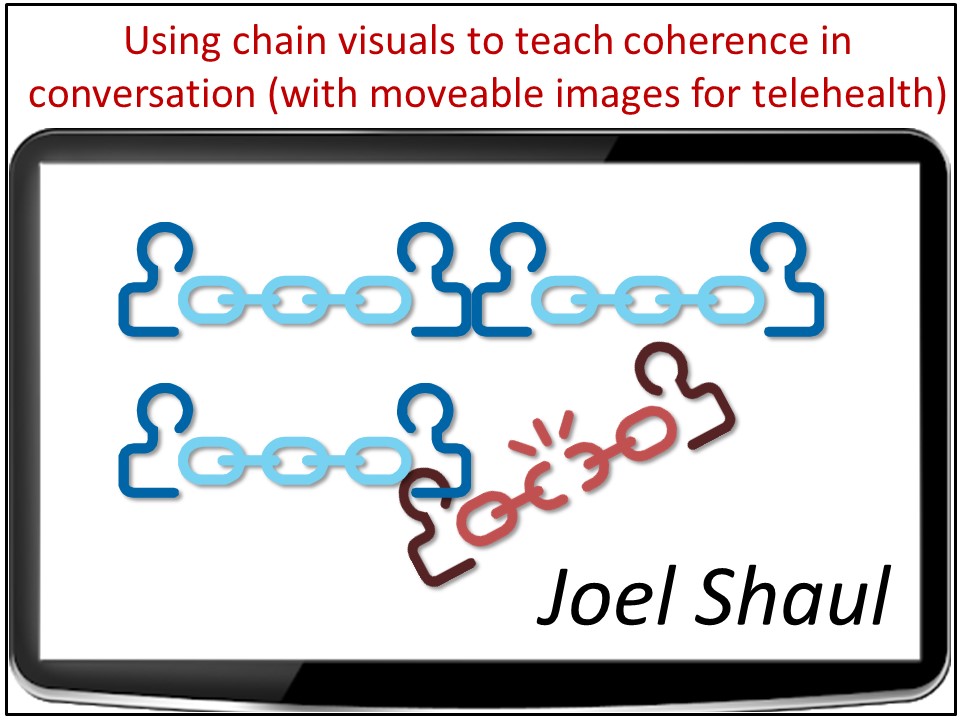
Somewhat similar to the Train Conversation activity. You move chain and broken chain images around to demonstrate when conversation is “connected” or “a broken chain.”
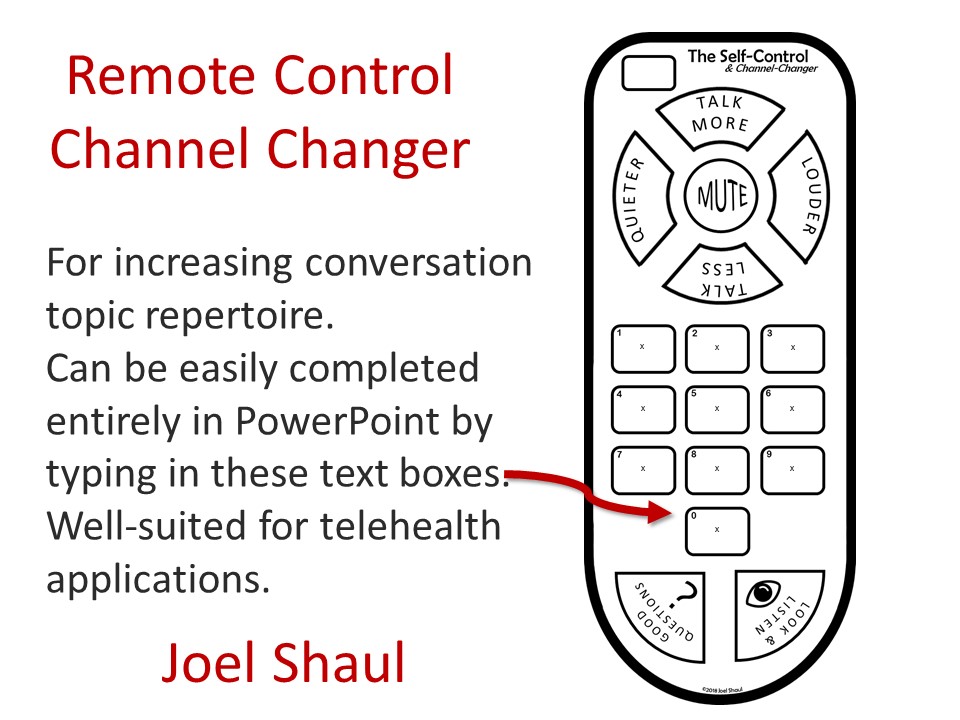
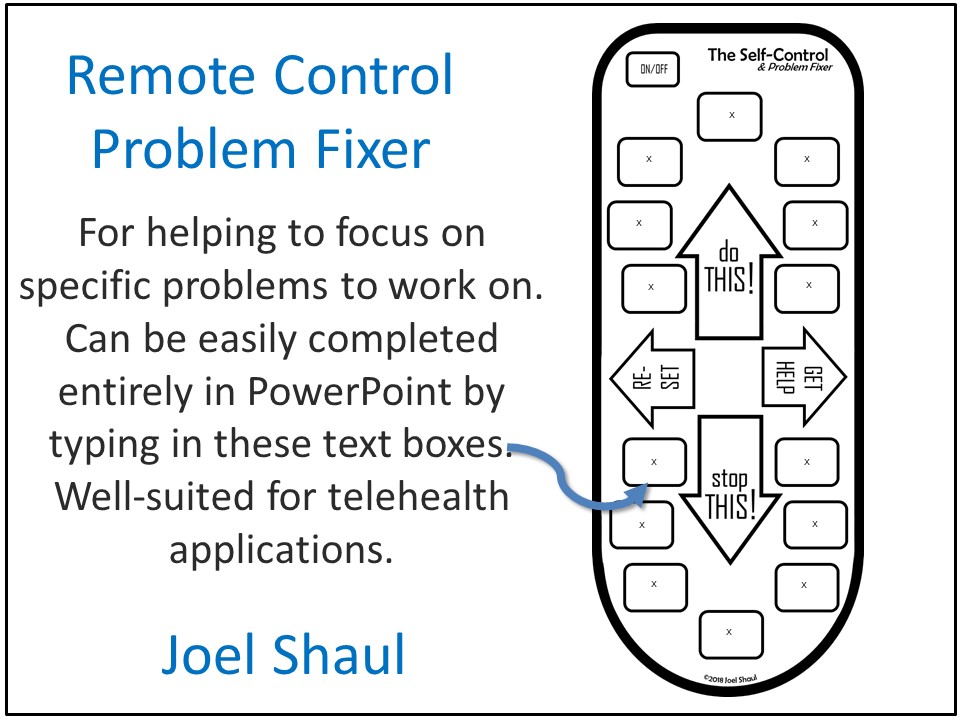
The Remote Control Channel Changer is to teach children to vary their conversation topics. On your computer, you and the child write in conversation topics on each of the ten channel buttons.
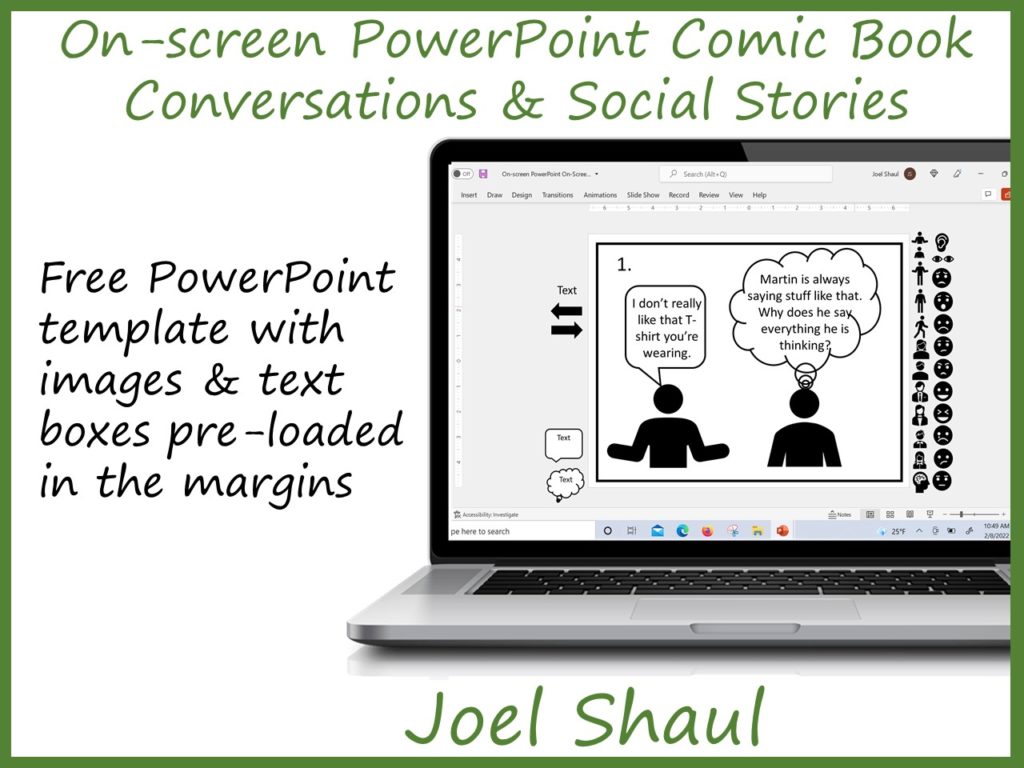
Most of us working with autistic children are used to making Comic Book Conversations with pencil and paper. This on-screen kit enables you to make these things faster and better – write on the computer screen.
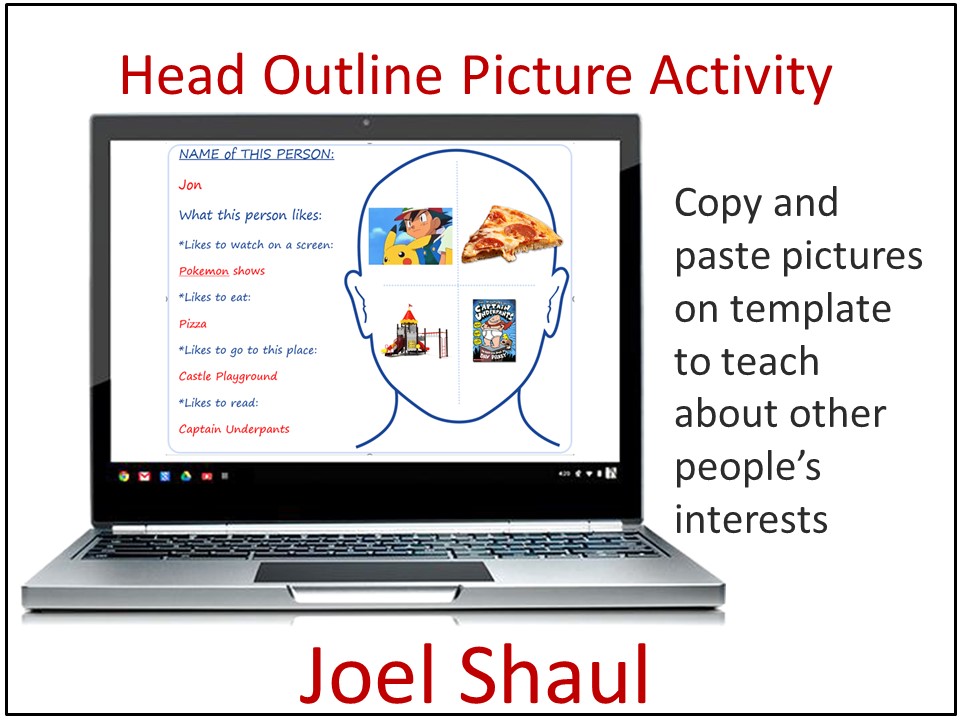
The Head Outline Picture Activity allows you, using my PowerPoint template, graphically demonstrate what other people like to talk about. It’s easy to create a number of these with a child, and they can then be used for the child to boost his conversation skills with friends and family.
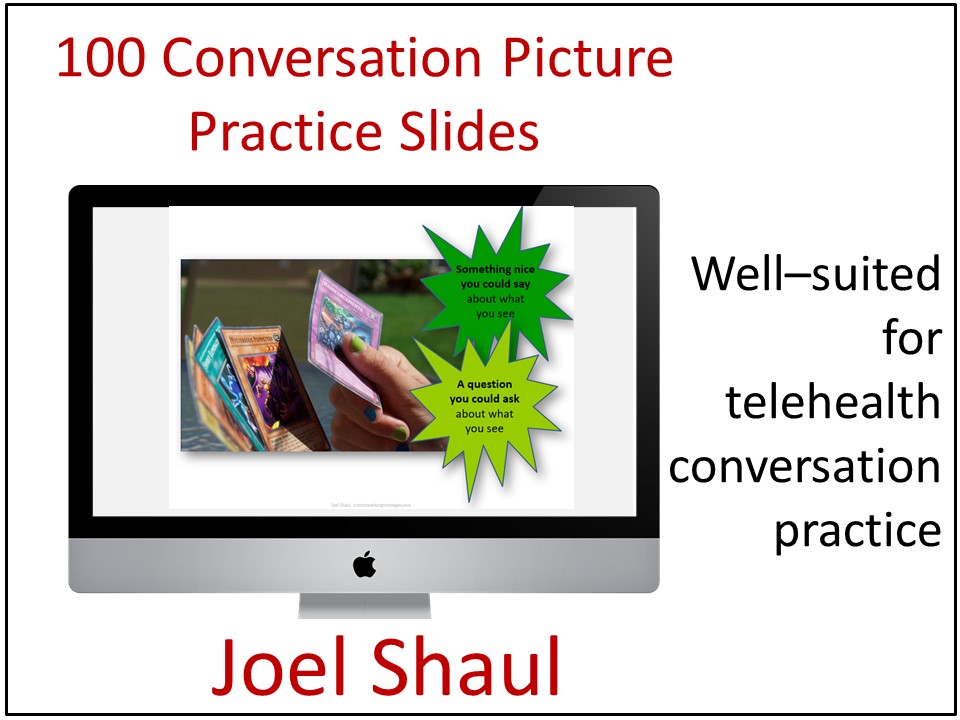
100 Conversation Picture Practice Slides lets you set up conversation practice with 100 hypothetical people – based on what they are wearing, holding or doing in the photos.
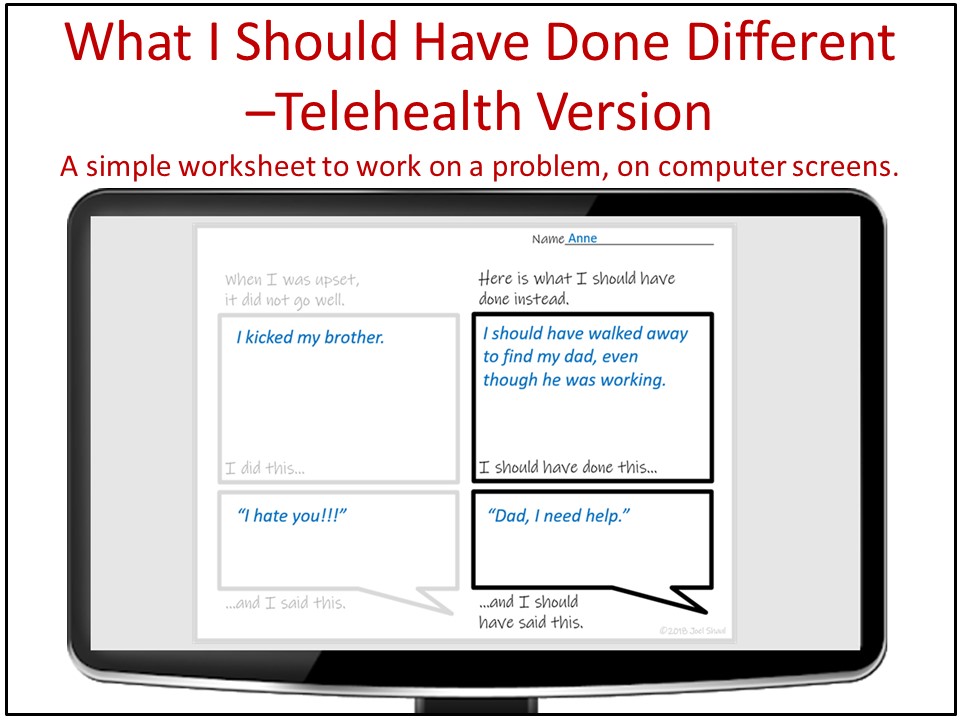
The What I Should Have Done Different worksheet, a simple and popular resource, is available in a screen-based version.
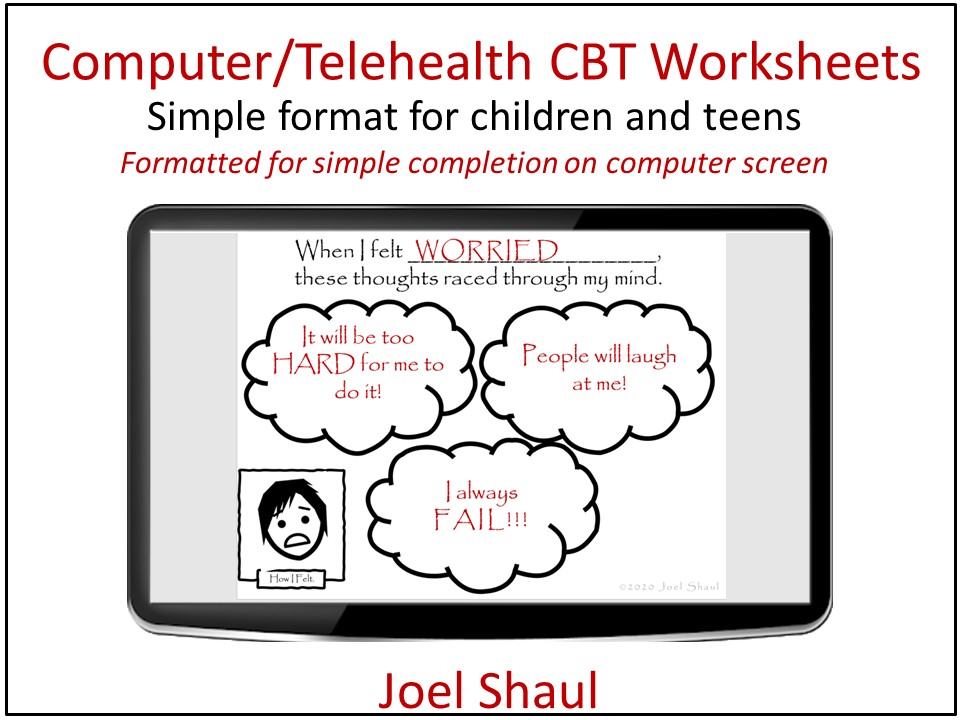
7 Simple CBT Worksheets. I designed this many years ago as a printed worksheet. It is also available in this screen-based version.
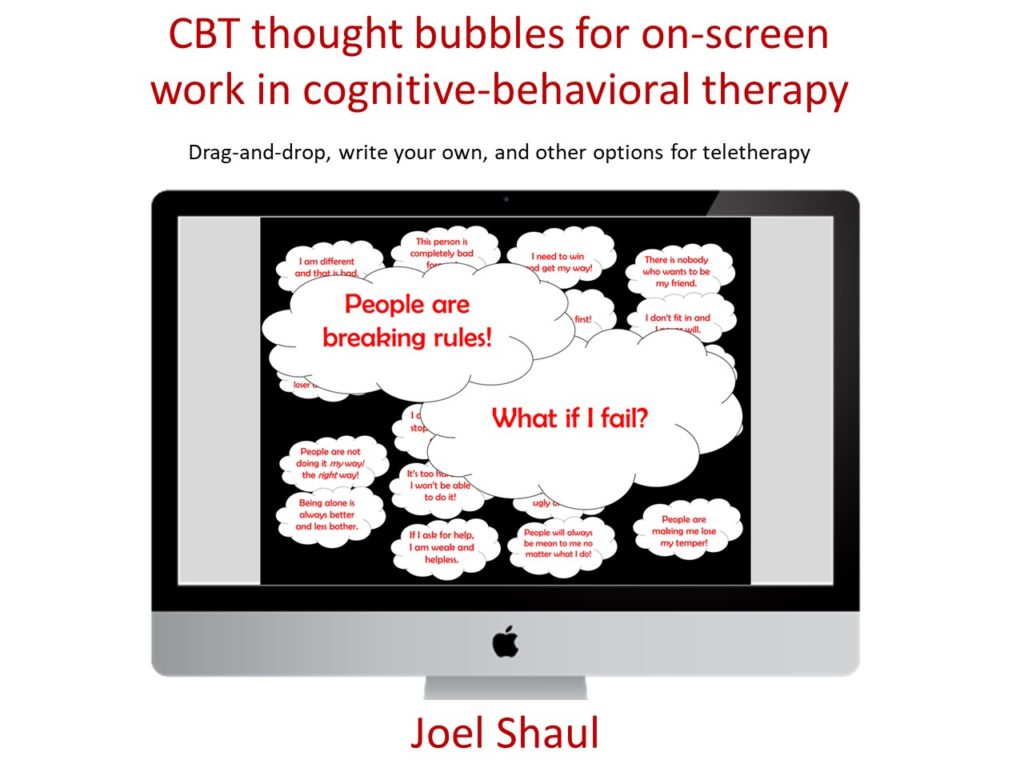
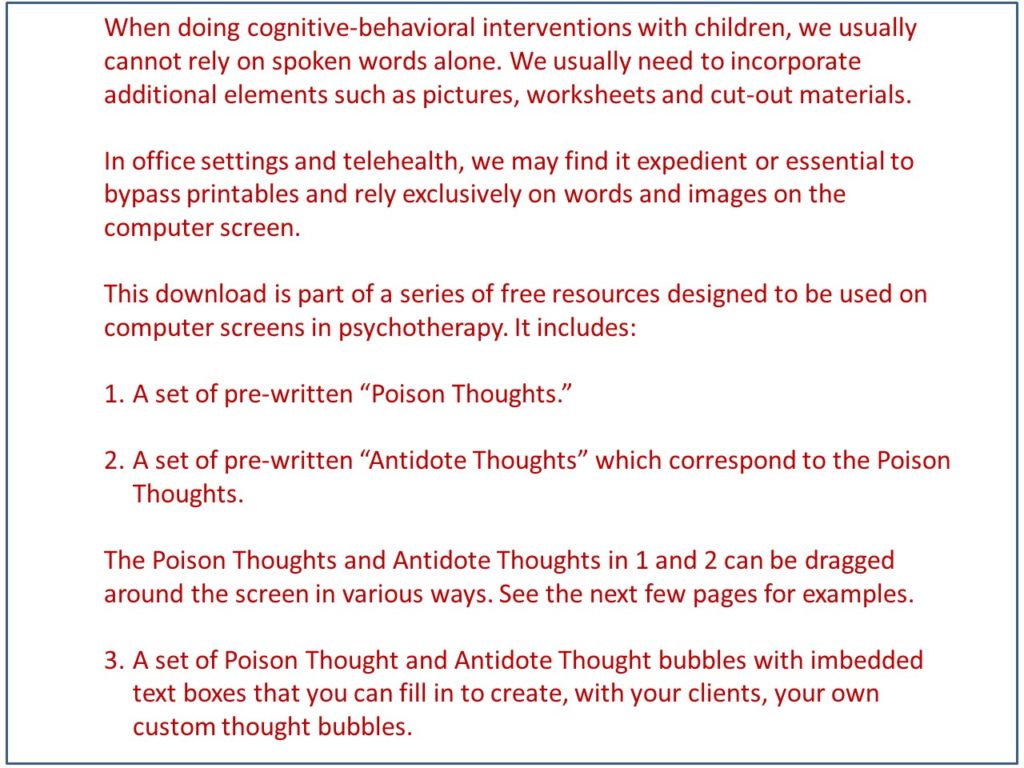
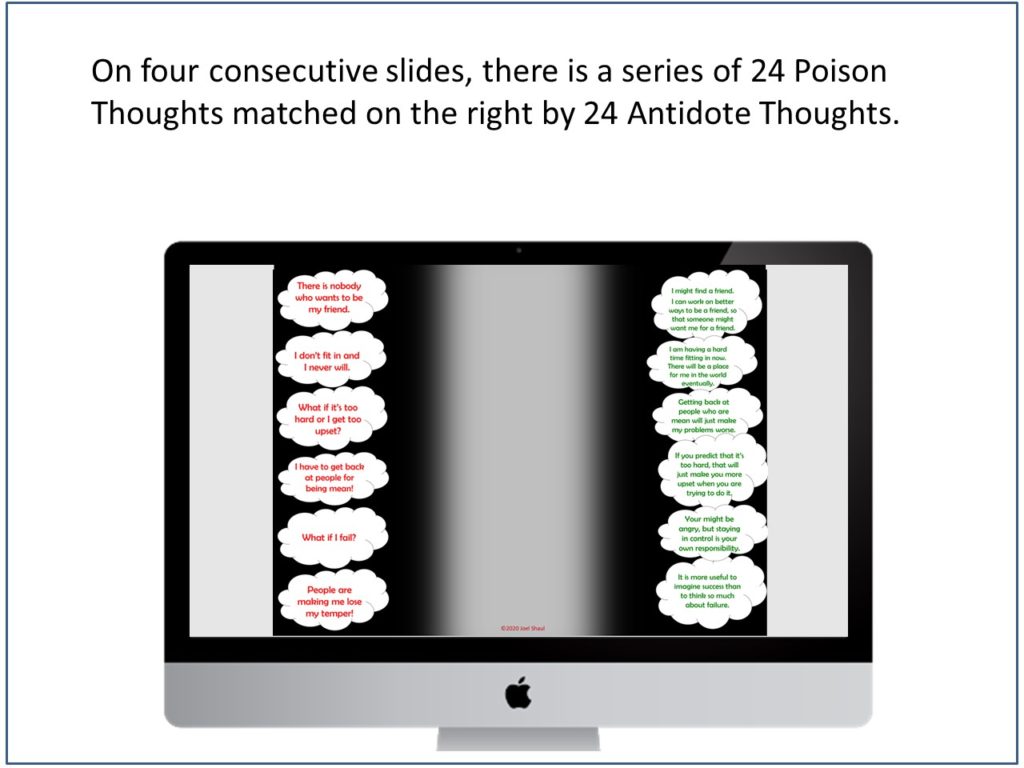
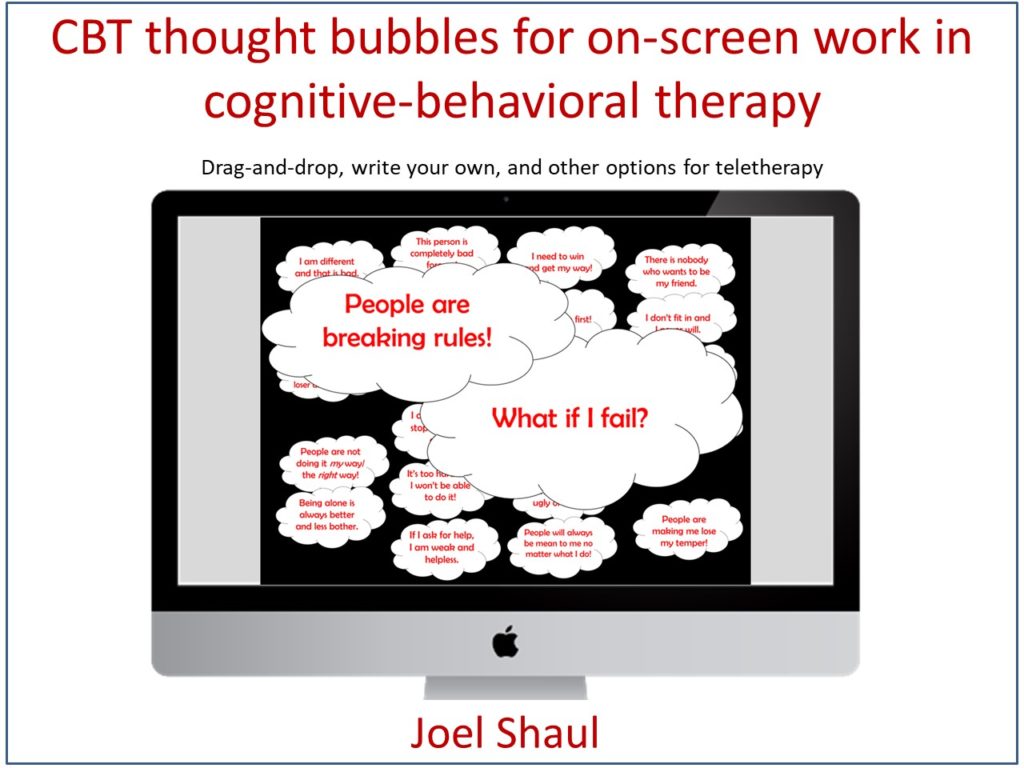
These 48 CBT Thought Bubbles are available in a screen-based version. I have used it a lot – this format works well.
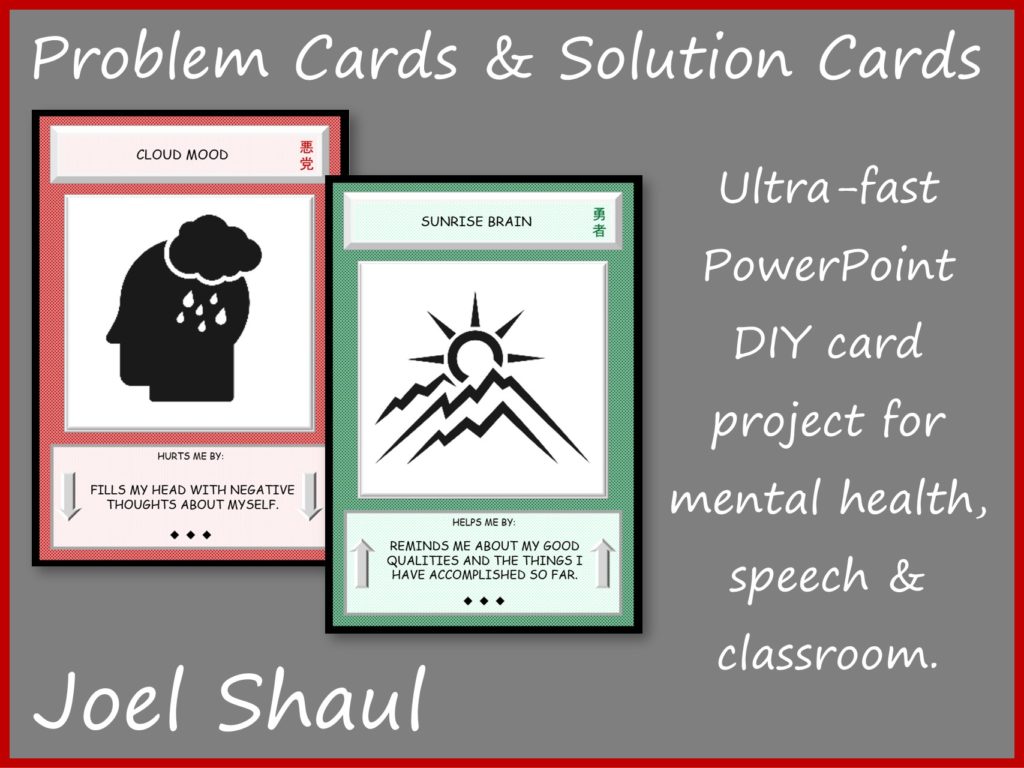
Problem Cards and Solution Cards allow you to quickly put together cards that look a lot like Yu-gi-oh cards. These are PowerPoint templates with built-in textboxes and multitudes of appealing images in the margins that you can easily drag and drop into place. It works best if you design these in close partnership with the child.
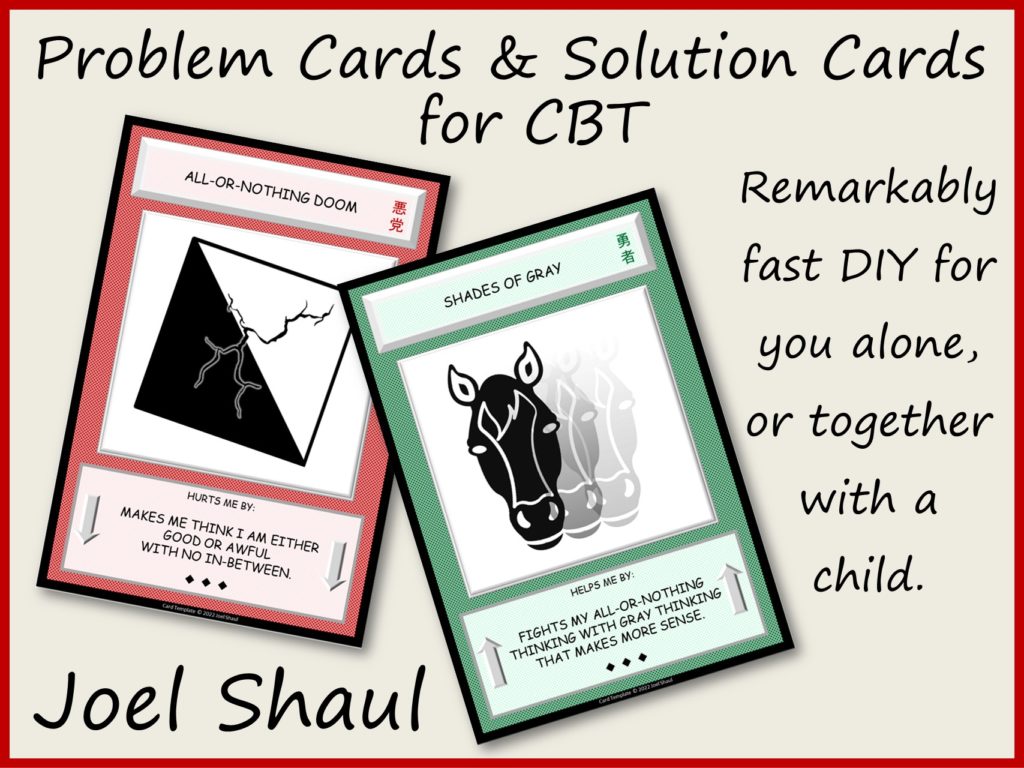
Problem & Solution Cards for CBT are just like the other cards just described, but I provide a completely different set of images to choose from – images that are specifically suited for mental health work.
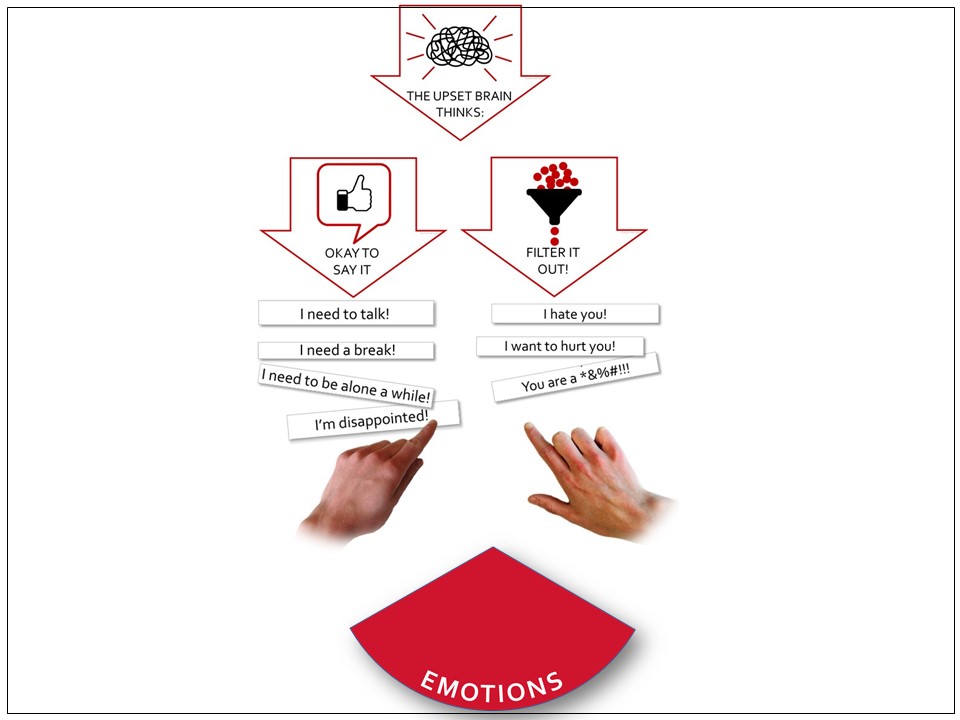
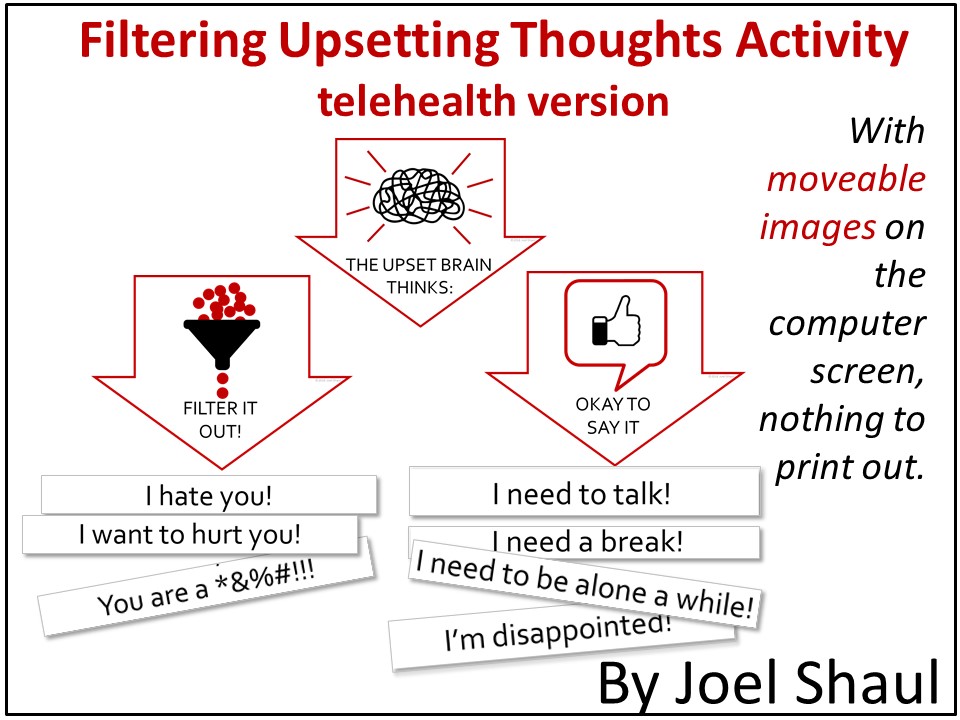
Having used both the print-out version and this on-screen version of the Filtering Upsetting Thoughts activity a number of times, I think that both work very well.
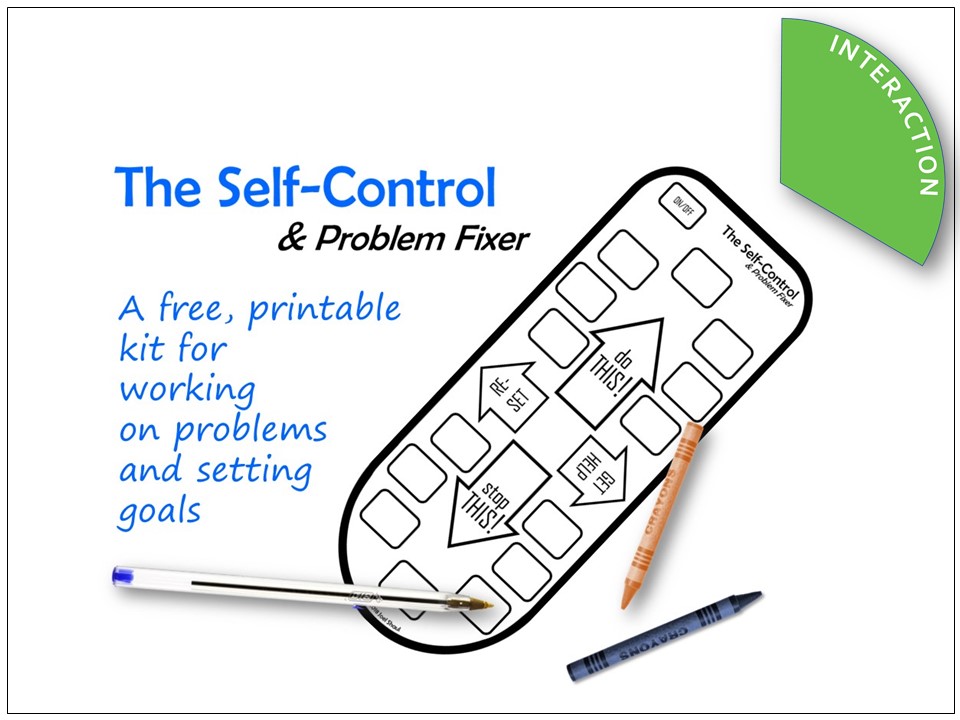
The Remote Control Problem Fixer is to help children focus on specific problems to work on. It can also be printed, cut out and colored.
These are 48 cards that guide productive discussion on the challenges of becoming an adult. The screen-based version is useful if you don’t have the time to print and cut out these cards.
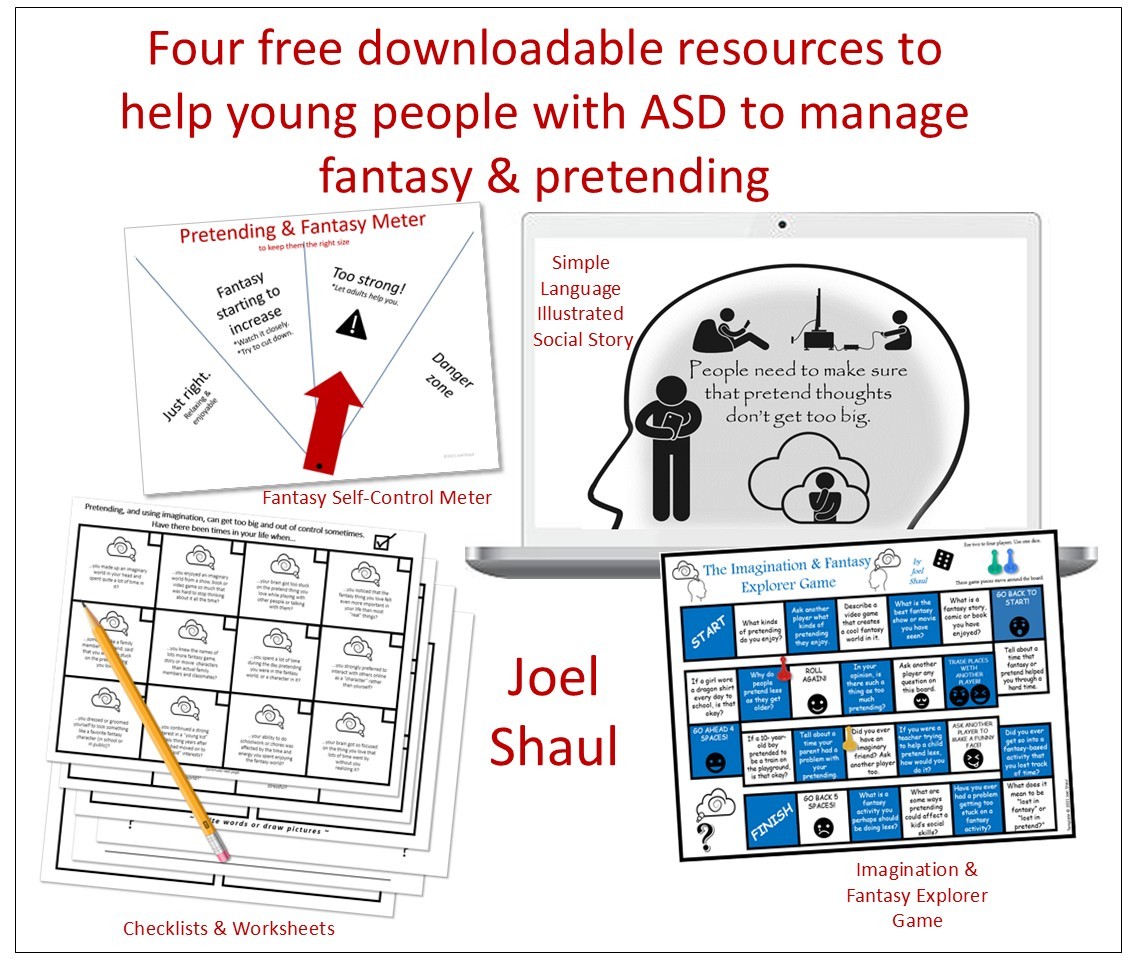
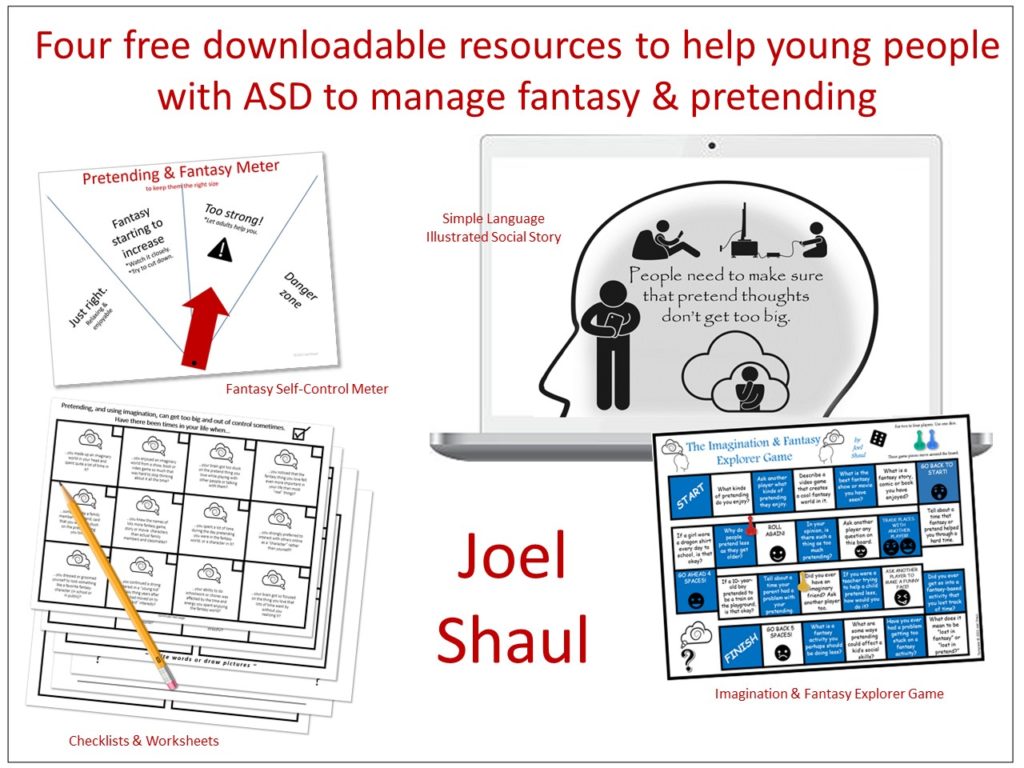
Four resources for helping young people with ASD to manage fantasy and pretending. Children and teens with autism often have rich imaginations. These four resources are designed to increase awareness of imagination and fantasy, promote appreciation of these qualities, and raise awareness of the problems associated with fantasy enthrallment.
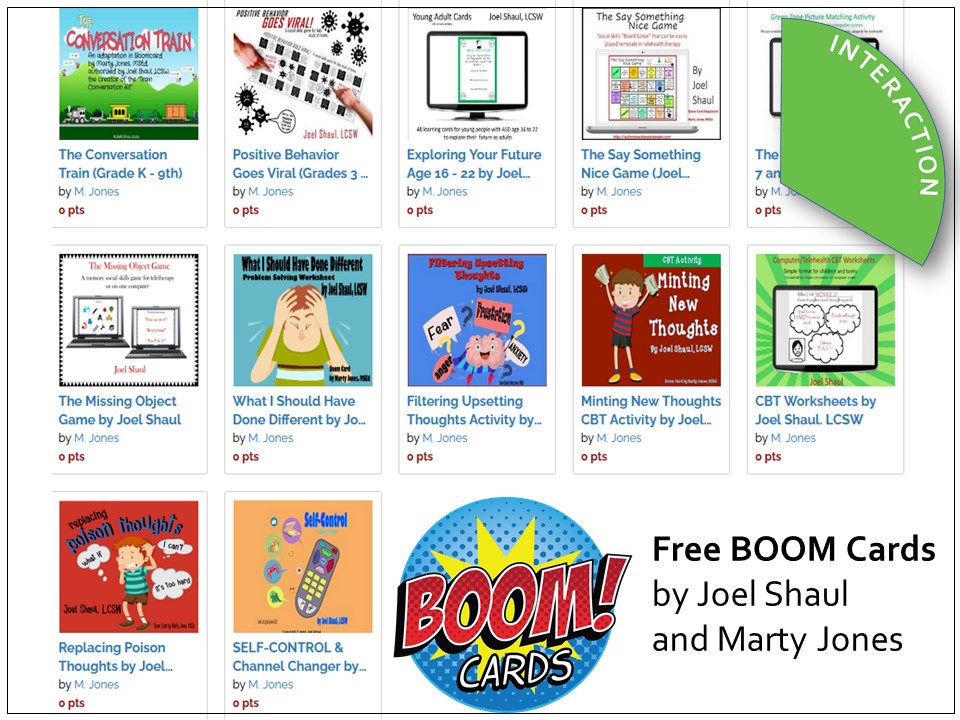
Marty Jones, a special education teacher in Texas, created lots of outstanding Boom Cards for my free online resources. Check them out if you use Boom Cards.
My CBT Videos for Kids have gotten over 700,000 views. If you do mental health work with children, please check them out.