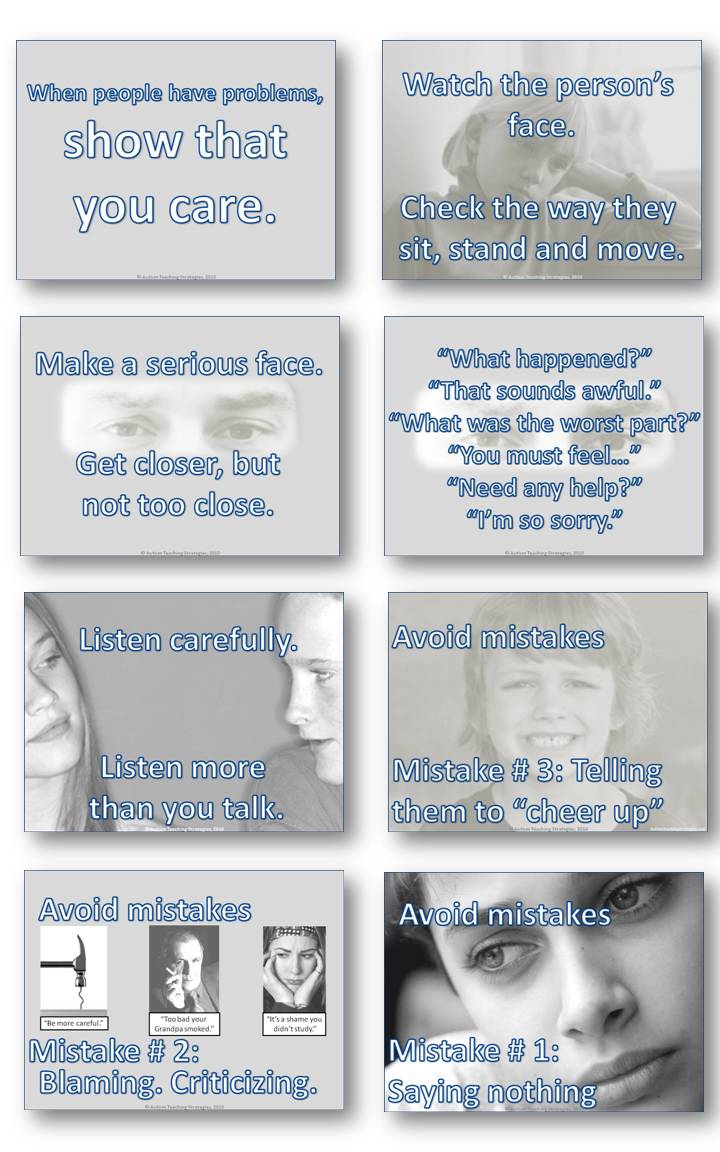

This is the first of seven panels you can easily click on and print out. Use them as talking points when you are teaching, or display them on a wall. Children on the autism spectrum often find “showing concern” a very difficult skill to learn.
This is the first in the series of posts on the topic of teaching the skill of “showing concern” to children with Asperger’s and other autism spectrum disorders. (The other “Showing Concern” downloadable panels are found at the bottom of this blog post.)
To go to Part 2 in the Empathy series, click here.
Children on the autism spectrum often have great difficulty with this important skill. They often spend less time observing others than typical children, and they might not notice another person’s distress. They often are perplexed by the typical signs of upset feelings in another person. They might have normal feelings of sympathy for the other person, but they might be at a loss regarding the necessity to express concern and the social conventions for going about it.
The series of panels I am making available for you to download here are one small part of a visuals-based social skills training kit I sell called “People Points”
In this series of blog posts, I will explain:
*How to help children with autism to increase their awareness of the need to show concern for others in various situations
*How to make your social skills teaching visual, fun and game-like on this topic
*How to use a video camera in a simple and effective manner in your therapy/teaching
I invite you to come back to the blog to leave your own comments and suggestions.

This is the first panel. Click on it, open in another window. Enlarge it and print. Suggestion: Open a blank powerpoint. Copy and past each image onto a separate slide of the powerpoint. Enlarge the image to adjust to the size of the slide. Print the whole powerpoint.

Kids with autism often need help with making a “concerned expression.” It really helps to have them practice on video. Shoot a brief video of their “concerned face” with your phone and play it back for them.

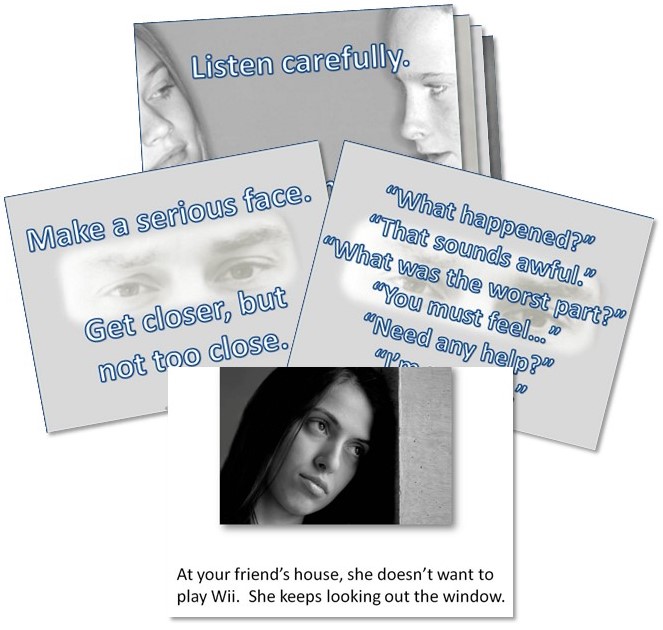
Idea: Find movie clips of people in distress. Turn off the sound and watch them together. Another idea: Have kids act out, silently, the roles of people in various upsetting circumstances.

One of the biggest mistakes kids with autism make when showing concern is to talk too much and not listen. Suggestion: Two adults act out a “concern” role play. The person showing concern talks excessively and in a self-referential manner. Kids critique.

It really helps to provide the child with autism specific words to use. Later in your teaching, when you are having kids practice in role plays, keep this panel handy to use as a visual prompt.

Suggestion: To raise awareness of how “saying nothing” might make another person feel, create a simple comic strip with thought bubbles. Fill out the thought bubble of the distressed person to show how he feels to be ignored.

Suggestion: In your social skills teaching on this topic, have two adults do role plays showing these various “mistakes.” Have the kids with autism ask the distress person how this makes him/her feel.

To raise awareness about the enduring effects of being upset, ask the kids, “How long before the person forgets being upset? An hour? A week?” The young person with autism might be surprised to learn how long another person might be sad, angry, worried.