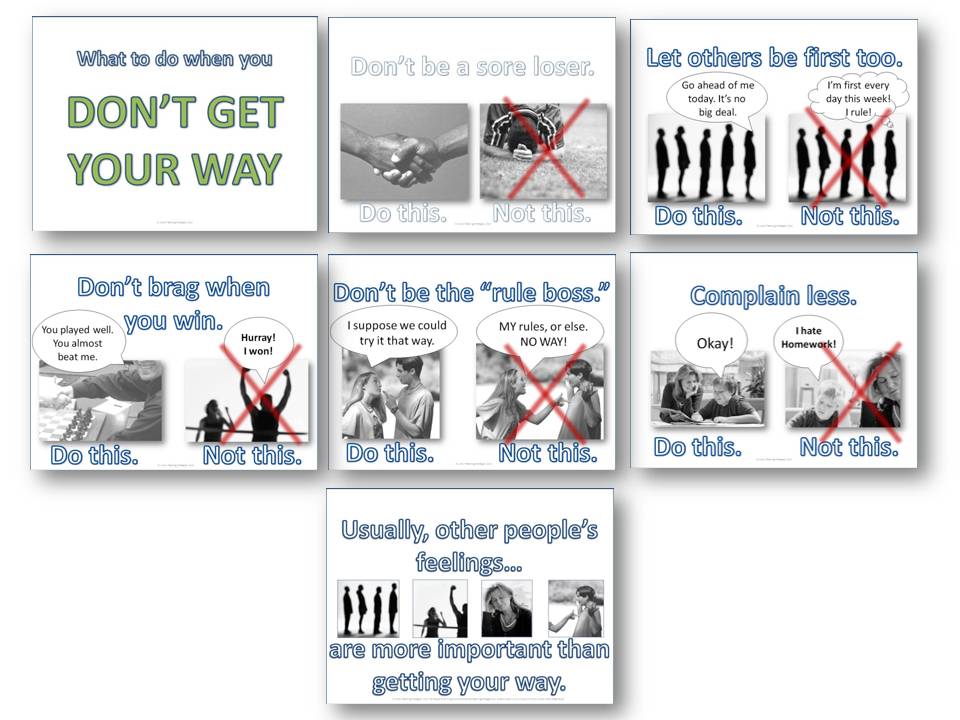
Helping children with autism spectrum disorders to deal with losing and disappointment
Children with ASD often have particular problems with losing: Not getting their way, not being first, not being chosen or called on, not winning. Here are some reasons for this. First, their lack of perspective-taking abilities can make children with ASD less aware of unwritten social agendas: others also want to be first; others like to win, too. Second, many children with autism struggle with problems regulating upsetting emotions. Third, lots of kids with ASD have tough lives day to day. When something does not go their way, it might be the last straw in a long string of deeply frustrating experiences.
The illustrated panels are for you to use either as talking points in a discussion in a social skills lesson or counseling session, or to place on your wall. The lessons apply to all children, not just those on the autism spectrum.
Good luck in your social skills counseling and social skills teaching.
Joel Shaul, LCSW
Here is a related resource to explore, a free social skills game for children with autism designed to teach sportsmanship skills, The Missing Object Game.
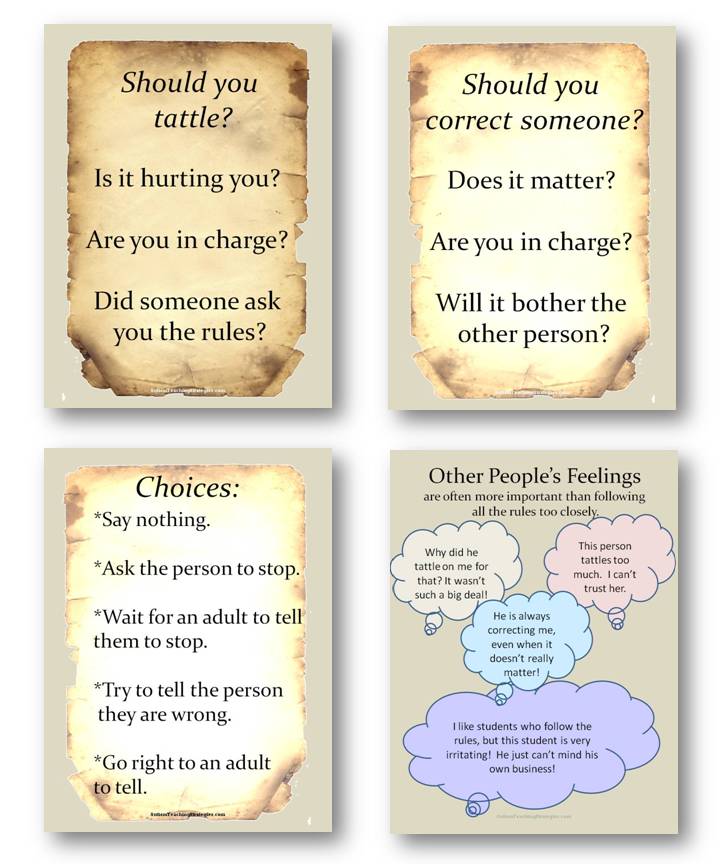
Social skills games and learning activities for tattling and correcting
I created these materials ten years ago and just finished a re-design of the whole kit.
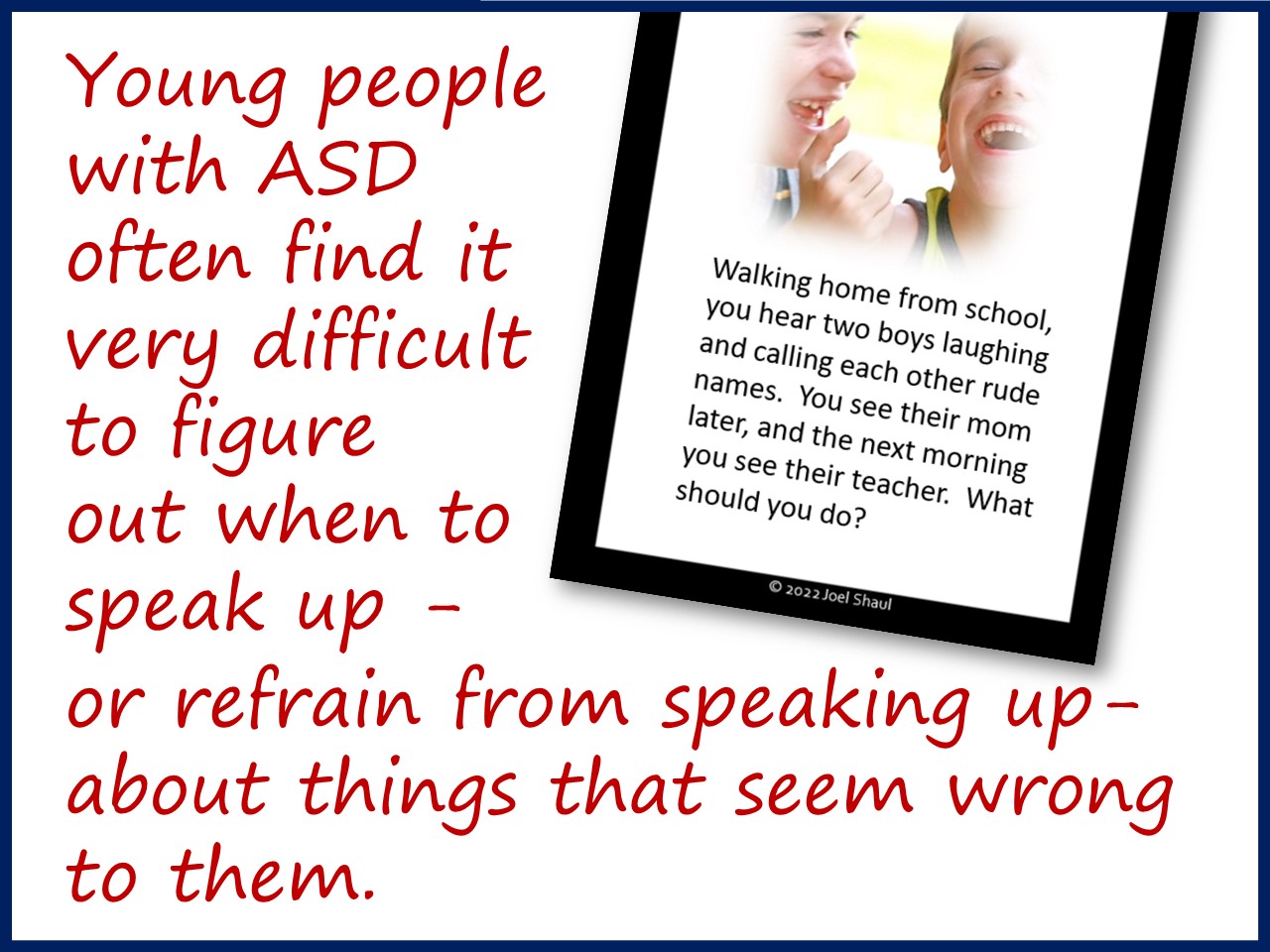
Young people on the autism spectrum can come across as rigid and bossy at times to their peers. Children with ASD can misinterpret complex social situations and express themselves too openly, without considering the broader social consequences.
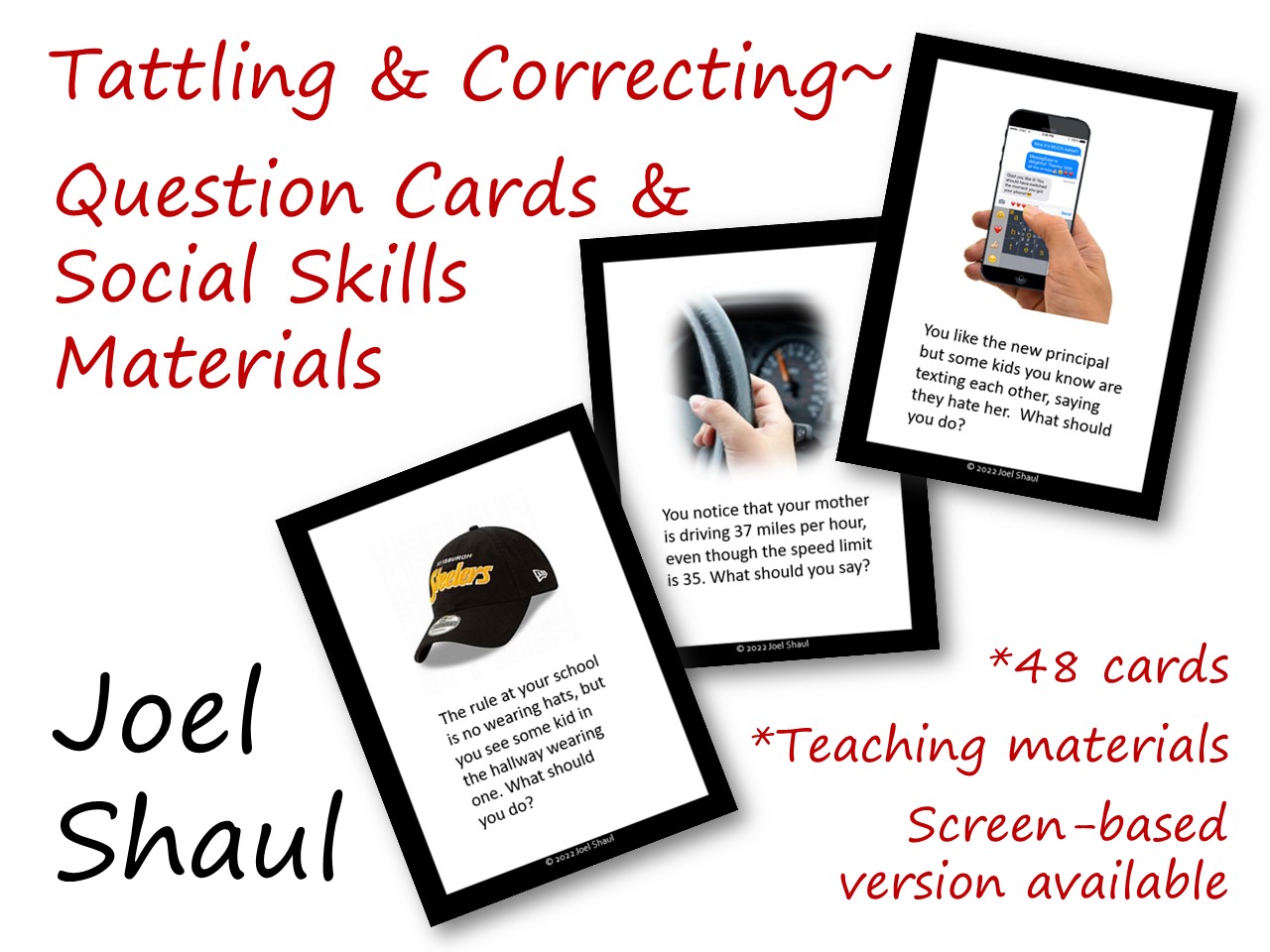
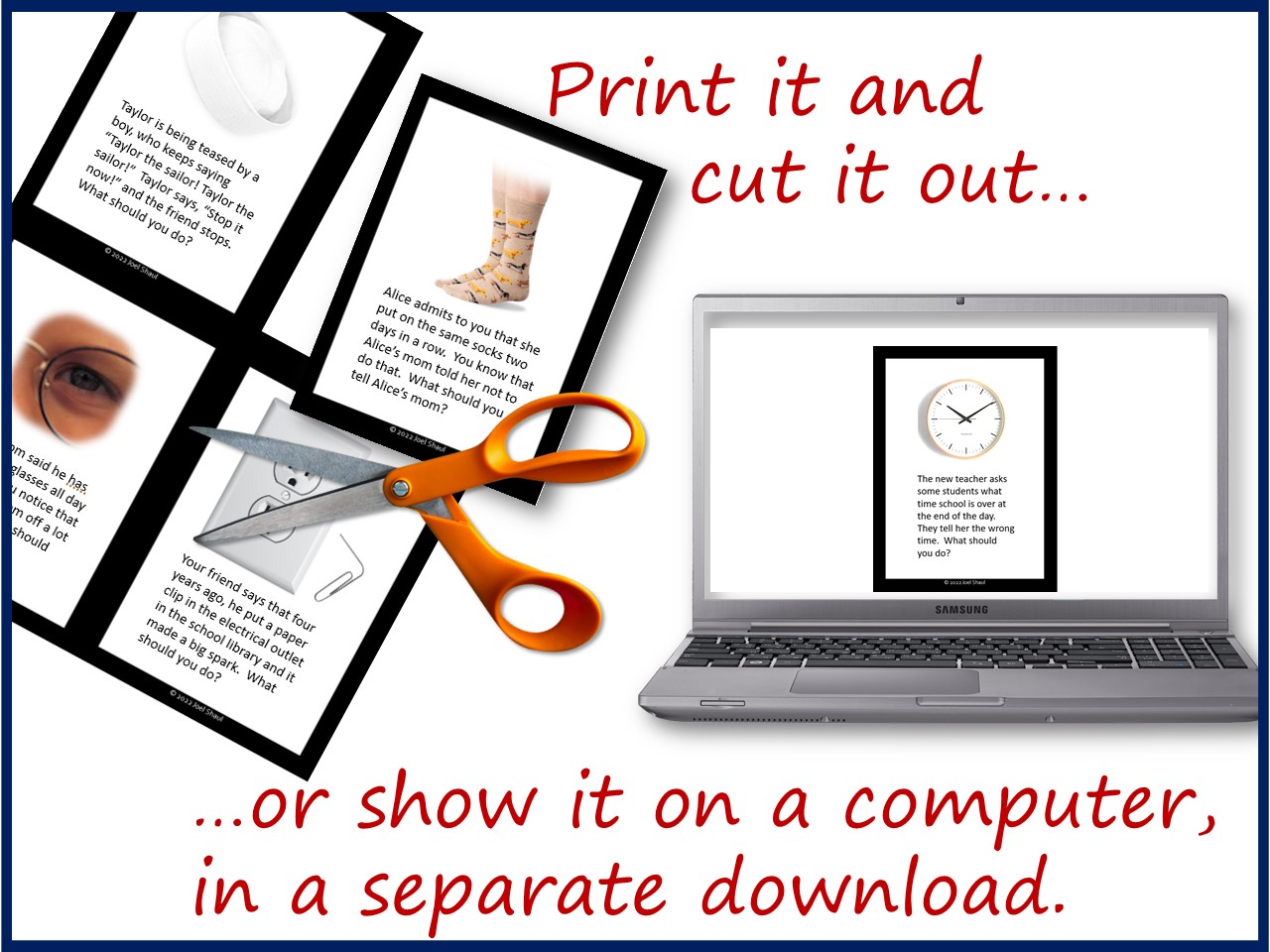
Figuring out when to “tattle” or correct someone is very hard. I designed the 48 question cards to include not just “easy” ones but also a lot of challenging questions that don’t have clear-cut answers.
When you use the cards, feel free to go through the deck and select the ones that seem best for the young people you are helping, based on their age, level of comprehension and particular issues they are dealing with.
Children like to hold the cards and have an actual “deck” to play with, but this social skills activity also really works well in the screen display version (which is the version I most often use myself, for groups and teletherapy).
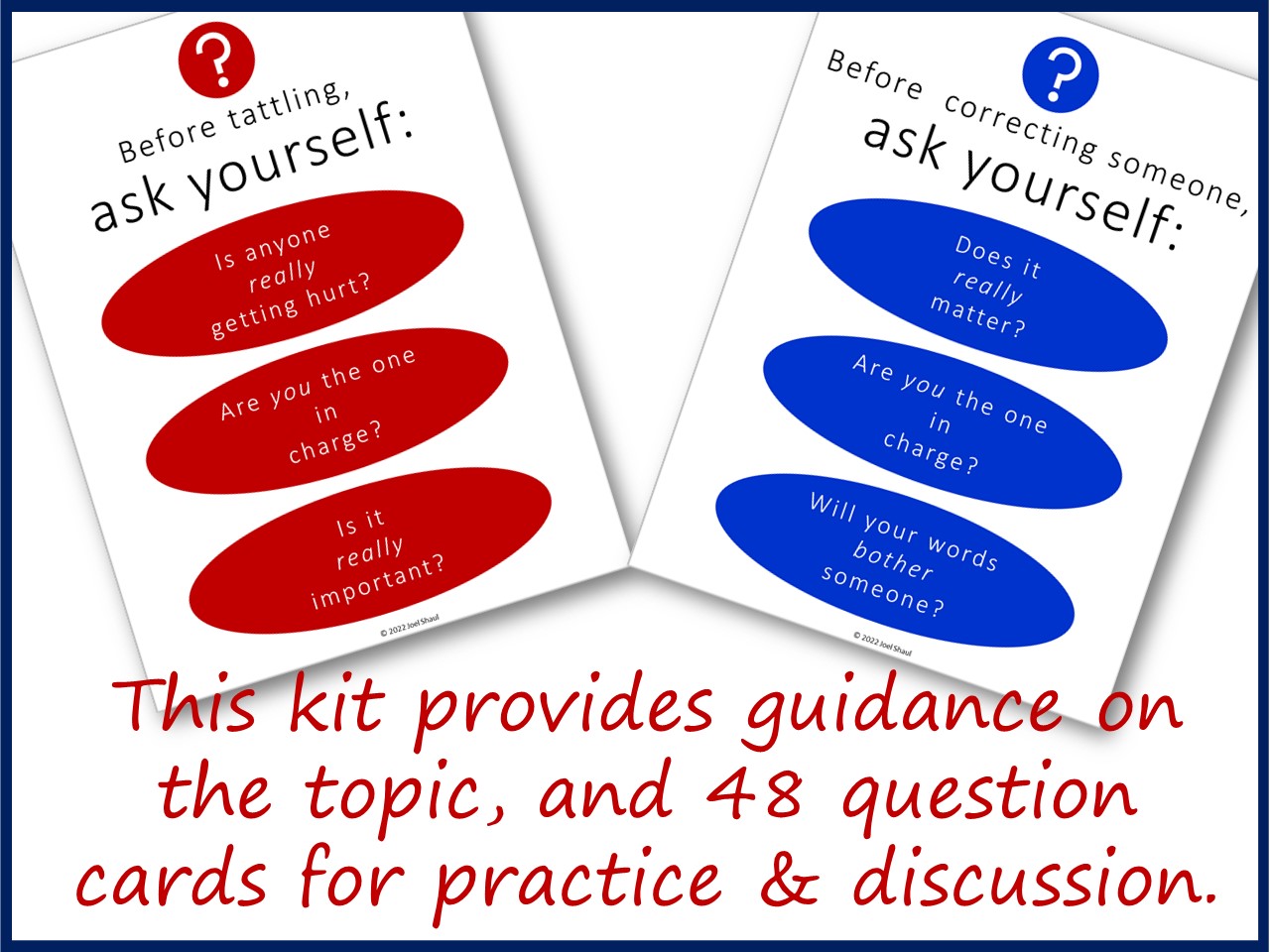
I have gotten good feedback from teachers, who sometimes post the two one-page summaries (Before Tattling, Ask Yourself and Before Correcting, ask yourself) on their classroom walls.
I hope these materials are useful for you in your work.
Free check-off worksheets for children with ASD’s to explore conversation topics with family members
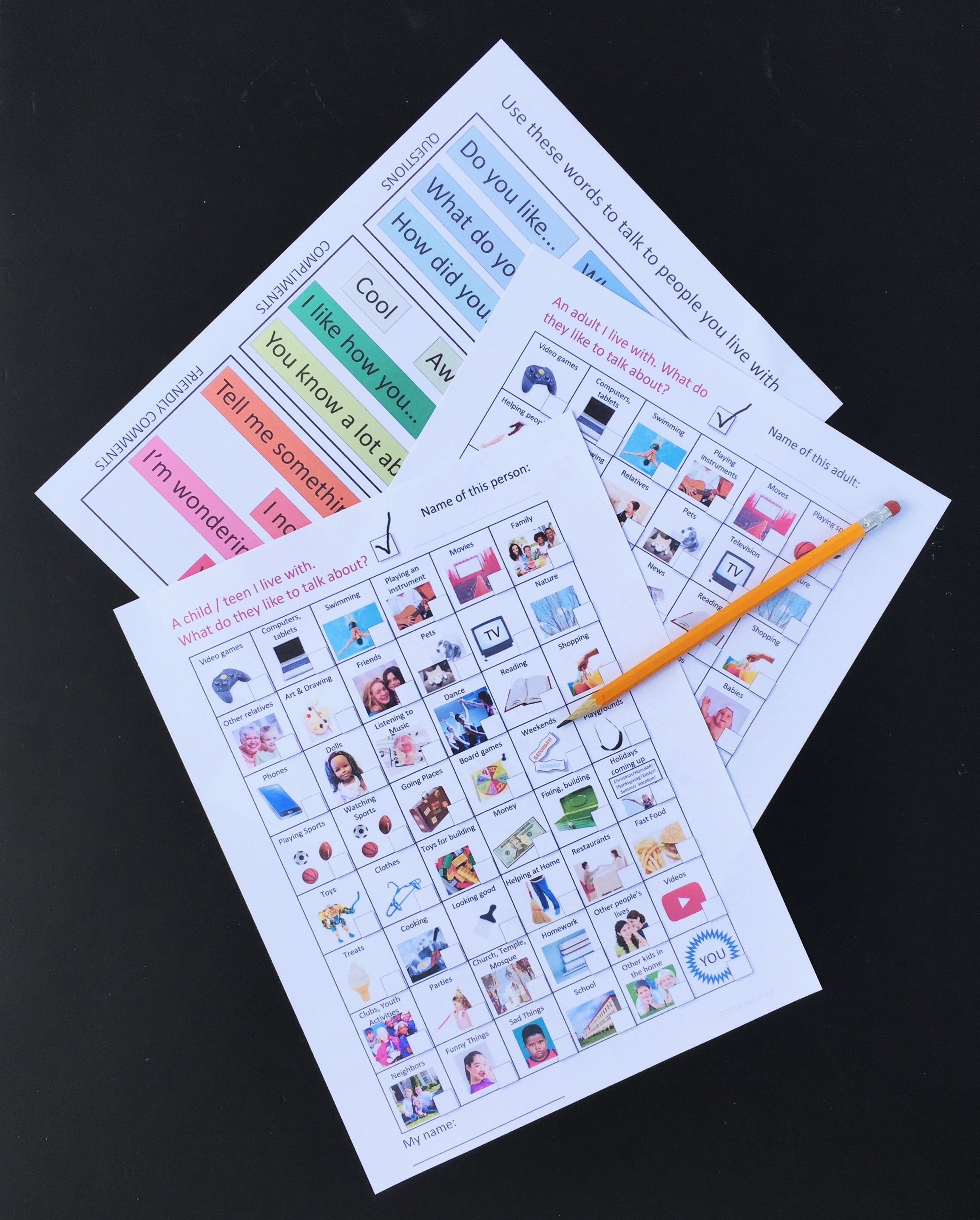
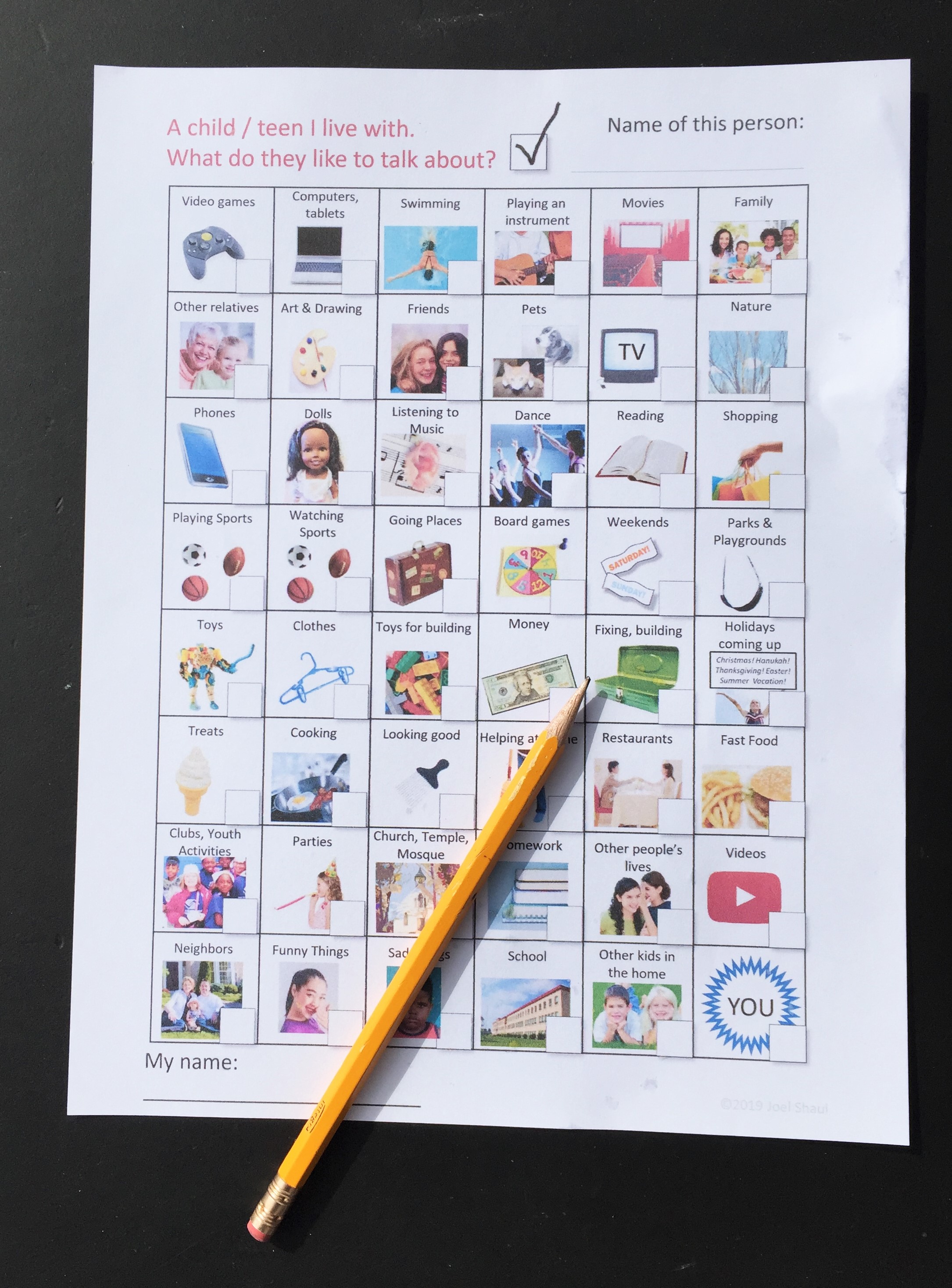
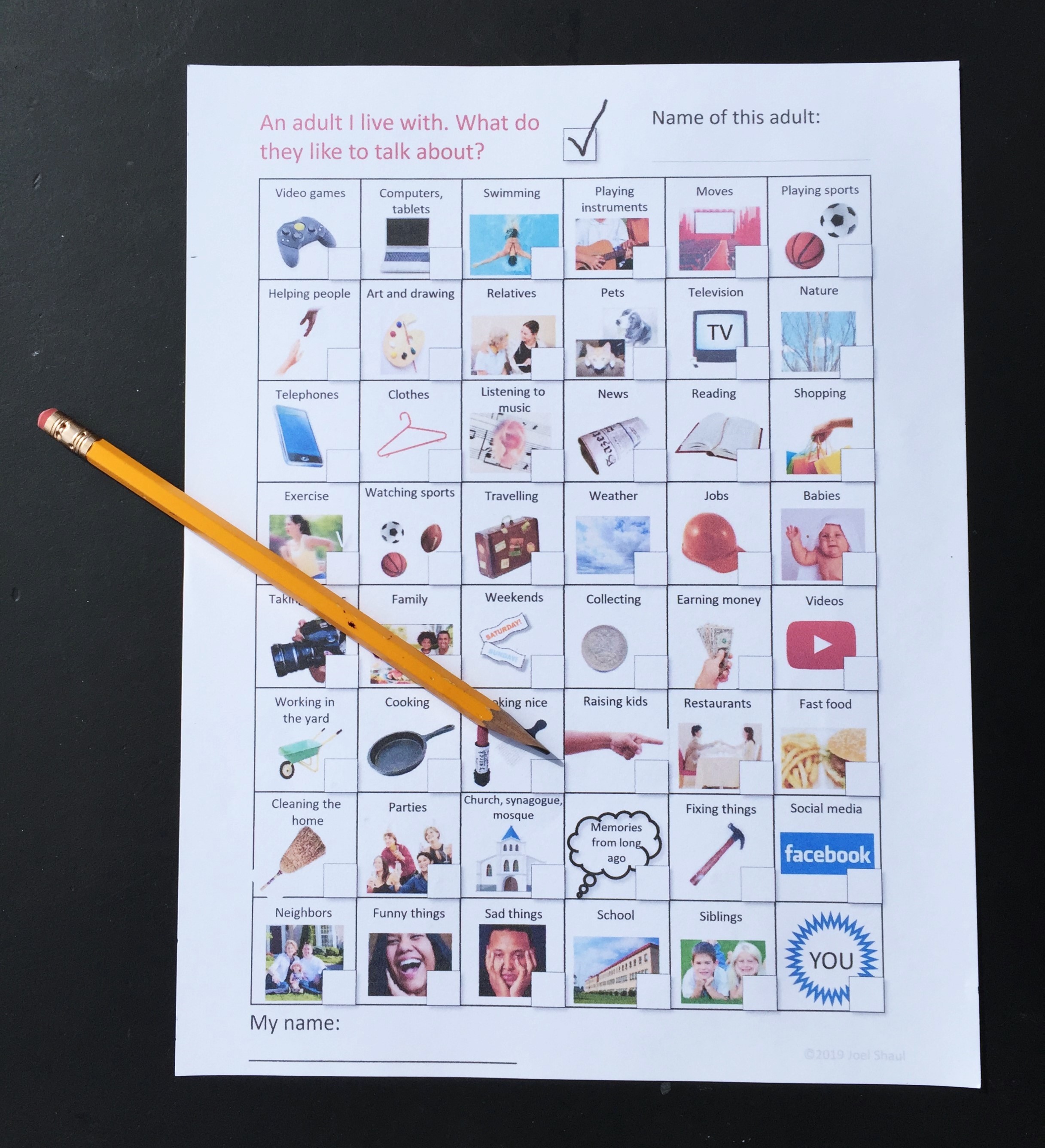
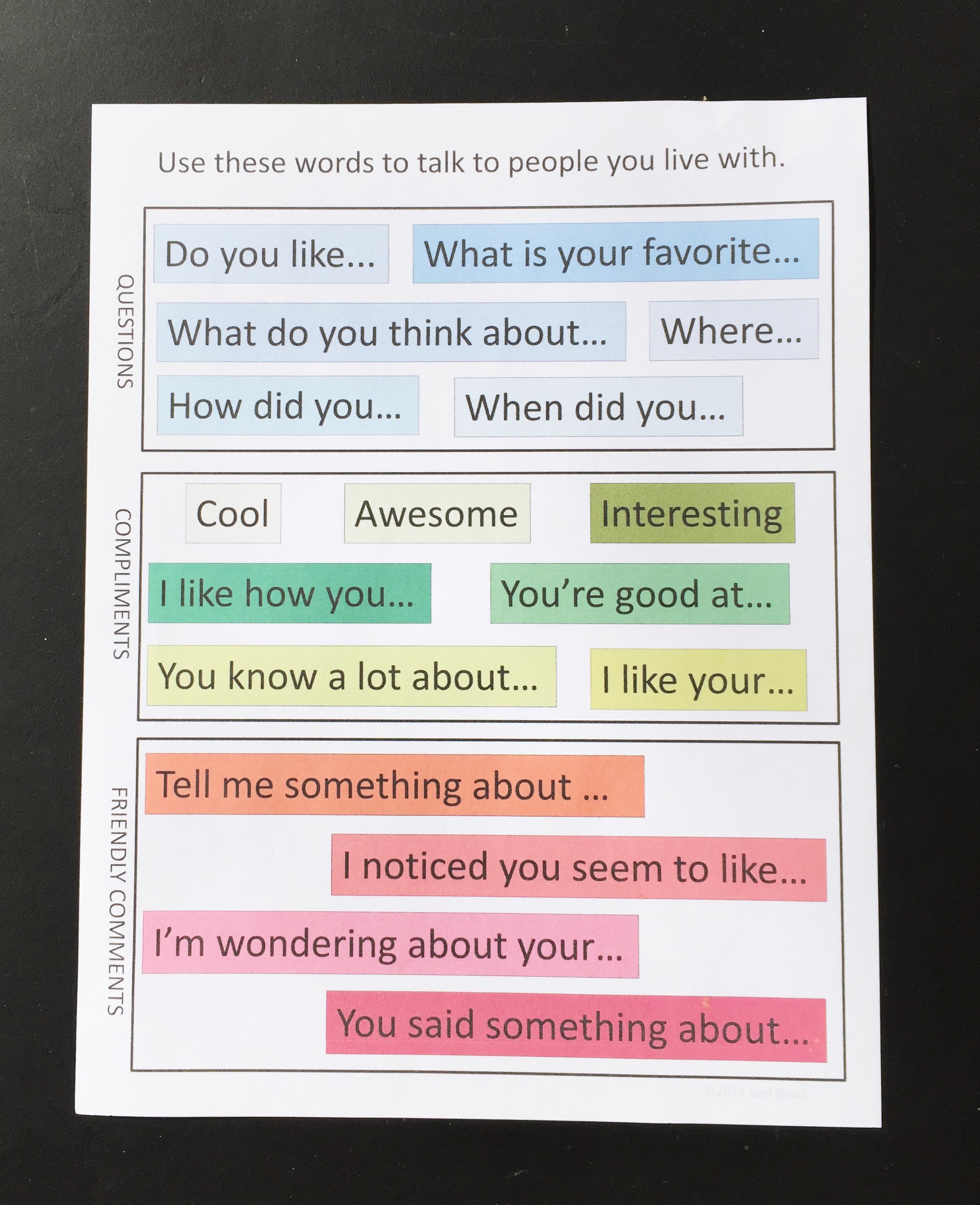
Children with autism spectrum disorders often have difficulties having conversations with the people they live with. It really helps to use picture guides. Here is a set of easy-to-use worksheets for classroom, speech room and home.
How to use the worksheets:
1. Have the child put check marks next to the photos they think represent the person’s interests.
2. Go over the images one at a time with the child. Explain that the family member probably has many interests that are different from the child’s own interests.
3. The sheet “Questions, Comments, Compliments” can be used to set up role plays and actual conversation practice with family members.
4. Have family members fill them out for the child to use as a reference.
5. Project the sheets using a smart board or projector – this really helps for small group or classroom discussions about family members.
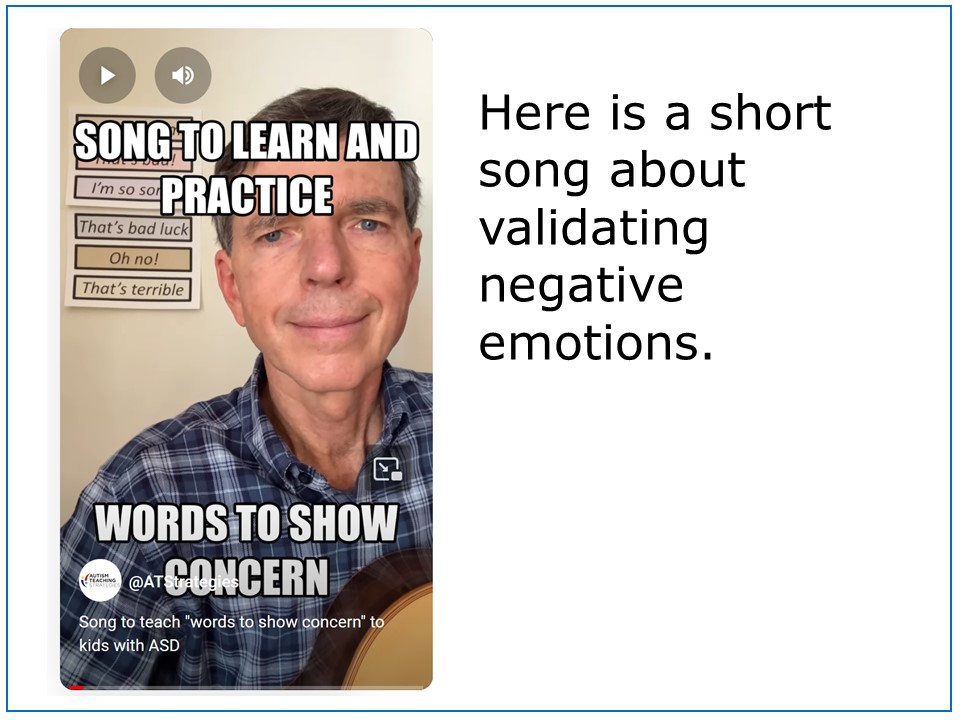
Children on the autism spectrum often do not make typical and expected statements in conversation to indicate interest. This happens for two reasons. First, they might not be at all interested in what the other person is saying. Second, they might be interested, but they are not aware of the importance of validating words and phrases in conversation and they are not well practiced in using them.
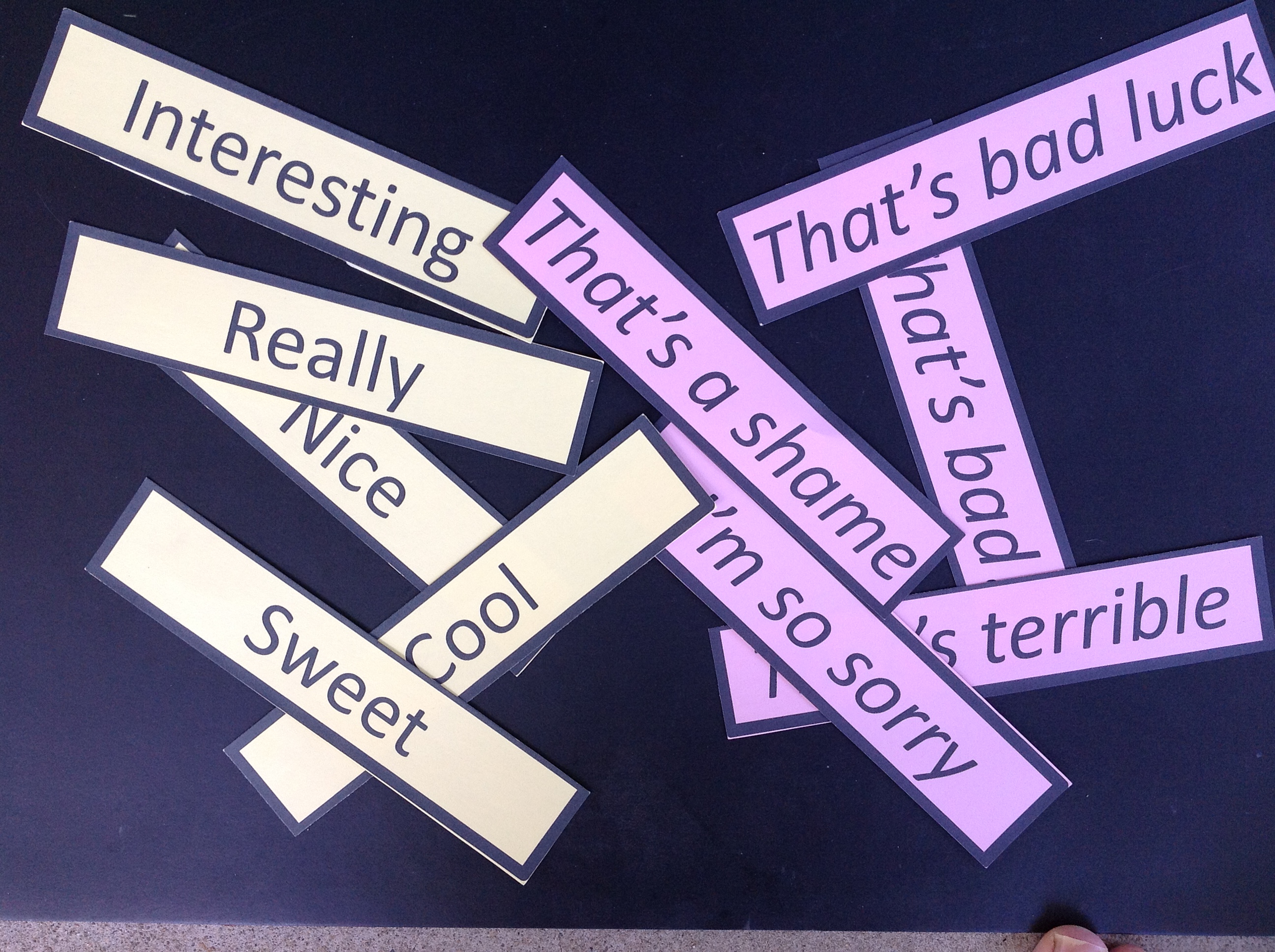
Validating words and phrases, such as “cool,” “you don’t say,” “really,” how about that” and others are very common in typical conversation. But many individuals with autism spectrum disorders use these words very seldom. Without the special lubrication of validating words and phrases, the conversation can fall flat.
My short Youtube video on how to use validating language prompts is available through this link: http://bit.ly/wiL3dW . If you watch it, a lot of this will probably become much more clear.
How make the written prompts:
Print out the PDF onto card stock or else paper that you laminate.
How to use the written prompts:
1. Hold up the prompts during times when validating language is called for.
2. Switch roles. You play the person who does not know how to use these words. Have the kids hold up the cards while you are talking to someone so you know what to say.
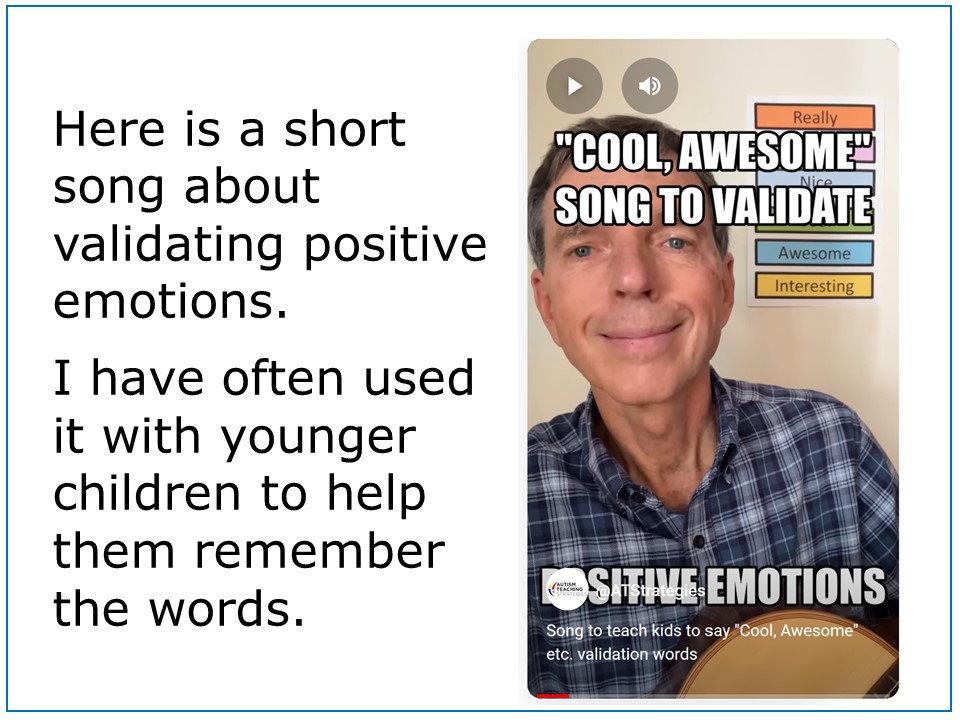
3. Learn and use these short, easy songs from the YouTube video (with younger kids). This helps them to learn and remember these important words.
Many of my social skills resources for children with autism include large visuals that can be used either as accessories during teaching or as wall displays. Below you will find links to eleven of my blog posts which feature large, illustrated panels as part of the kit.
To go to the resource, click on the PICTURE.
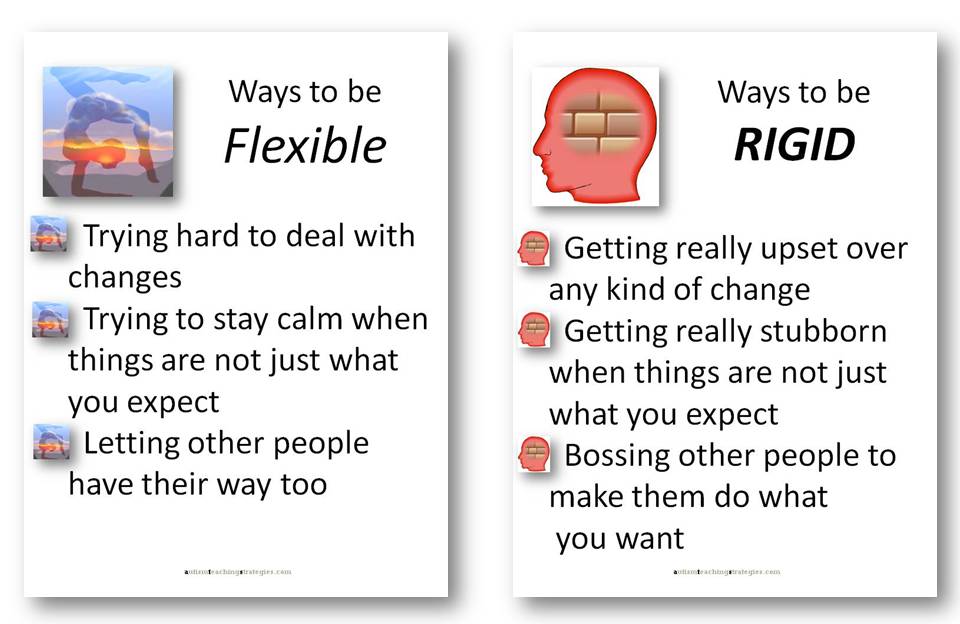
Rigidity / Flexibility Panels
These are part of a social skills kit which includes lots of scenario and role play cards.
Dealing with Losing and Disappointment Panels
Tattling and Correcting Panels
These are a part of big free download kit which includes dozens of picture cards
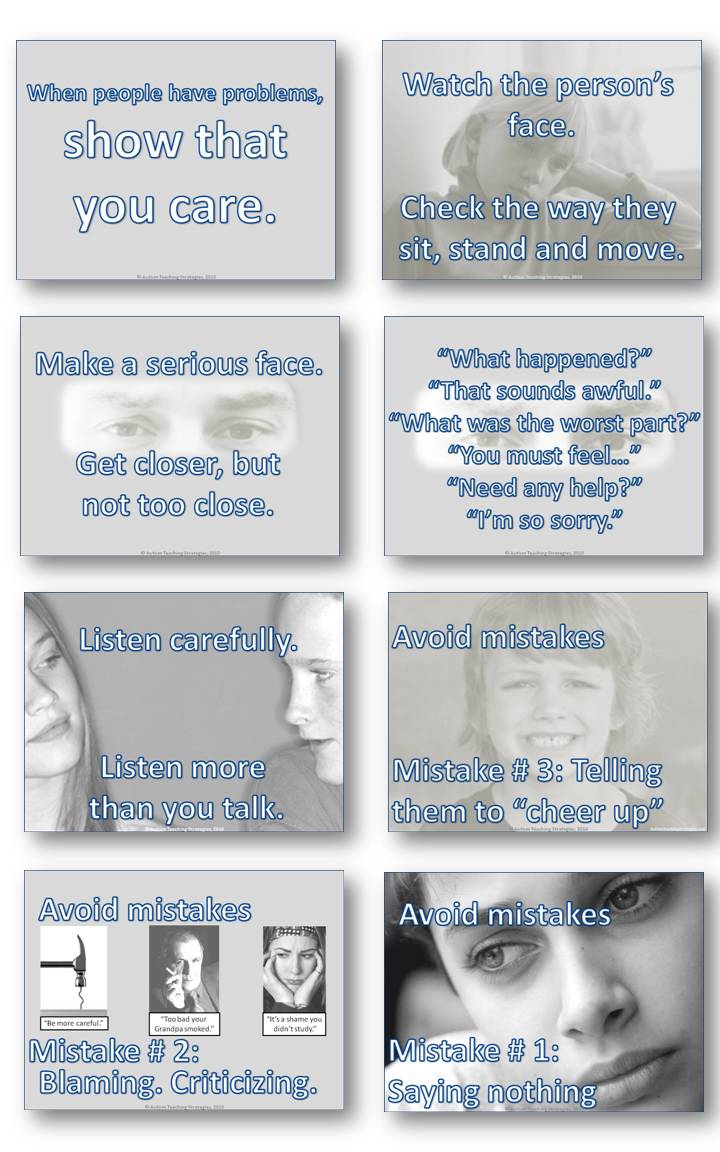
Showing Concern Panels
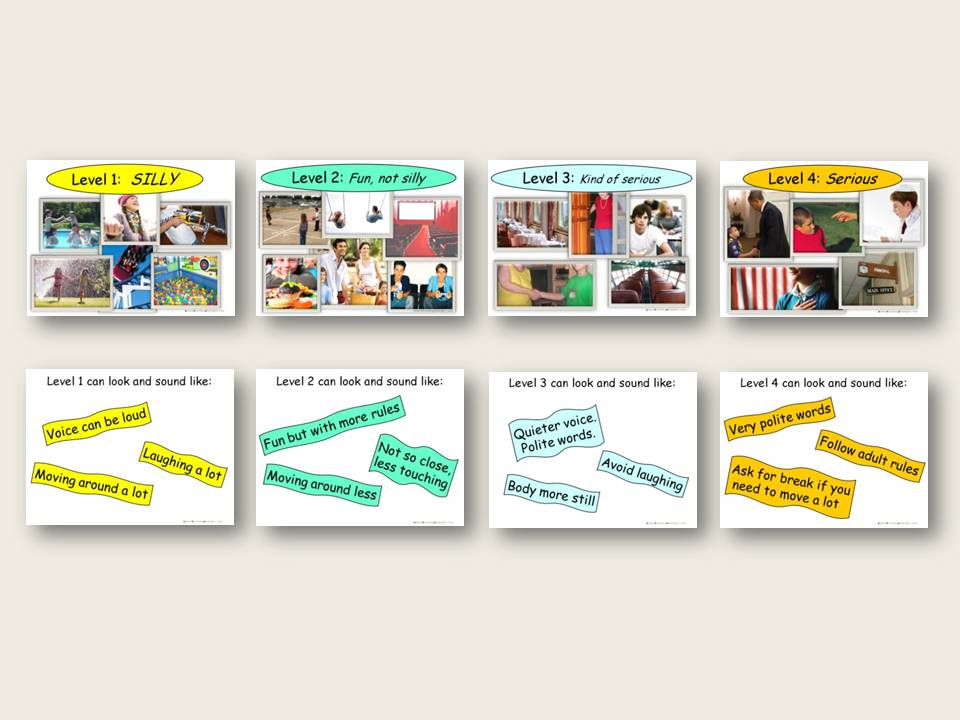
Silly to Serious Kit
These are part of a big kit that includes dozens of situation and role play cards. Many teachers in autistic support classrooms have found the panels useful for behavioral classroom management. You can put an arrow on one of the four levels and say “We are at this level now.”
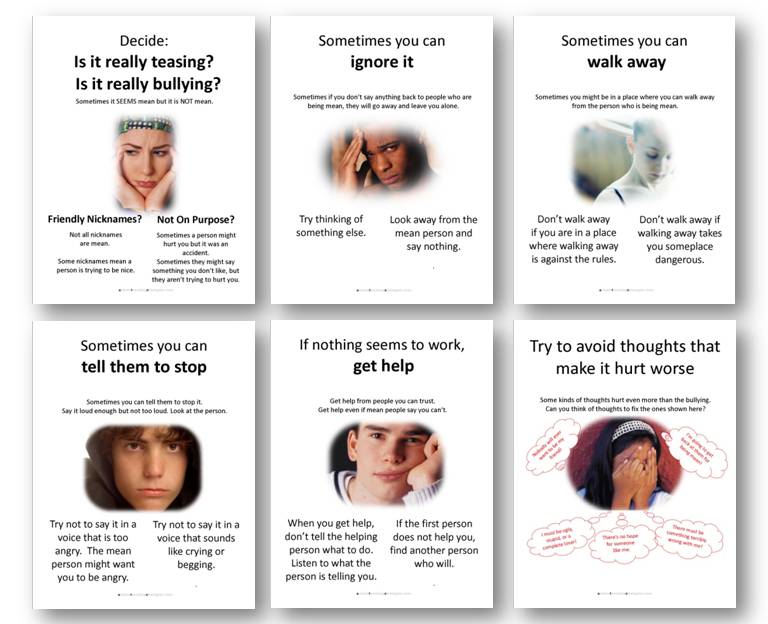
Teasing / Bullying Panels
This is part of a larger kit which includes a lot of situation and question cards to help children with autism to deal with the practical and emotional aspects of being teased and bullied.
Components of Listening Panels
There is also a simple worksheet using the same set of visuals.
Reciprocal Conversation Panels
This is part of a kit that includes a card game activity for conversation activities with children on the autism spectrum. It is derived from a concept of RDI.
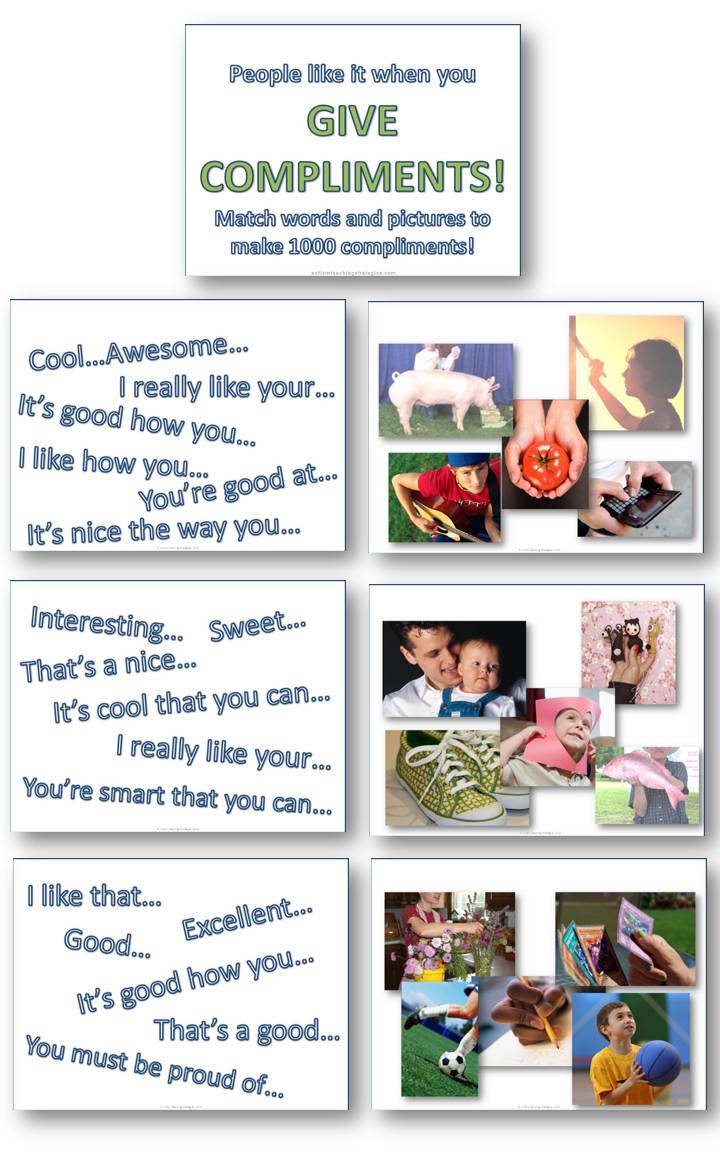
Compliment Matching Panels
These panels, a sample from the People Points kit I sell, is to help children on the autism spectrum to practice the social skill of giving compliments.
Panels on Relating to Girls
These are part of a kit which includes role play and situation cards for teen boys on the autism spectrum who are learning social skills relating to female peers.
NOTE: For an updated variation of this activity with the option of drag-and-drop images in PowerPoint, follow this link to “Problem & Solution Cards” below:
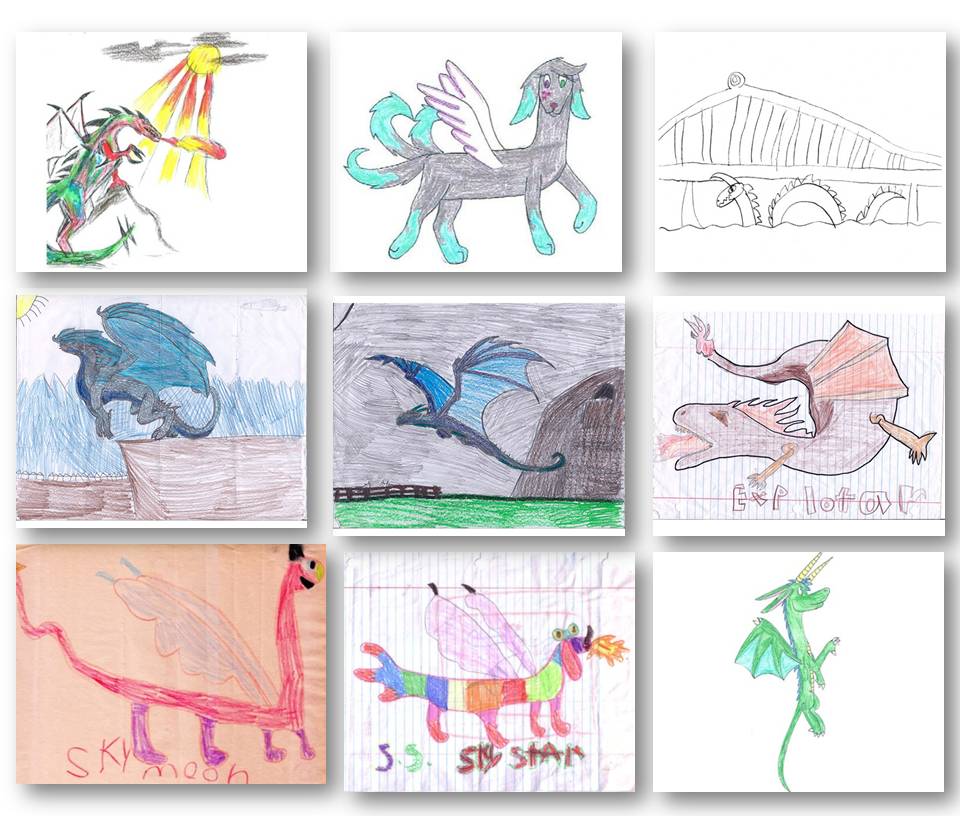
Many children with autism spectrum disorders are quite fond of fantasy characters. Social skill teaching interventions which employ fantasy characters can tap into these predilections, increase insight and sustain interest in the social skills teaching work.
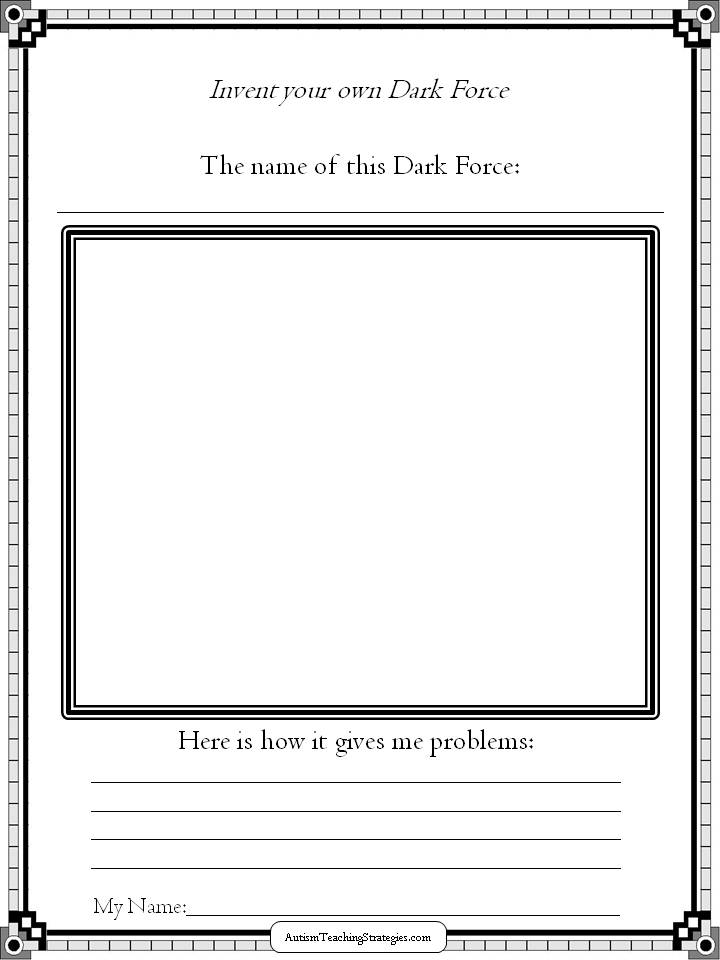
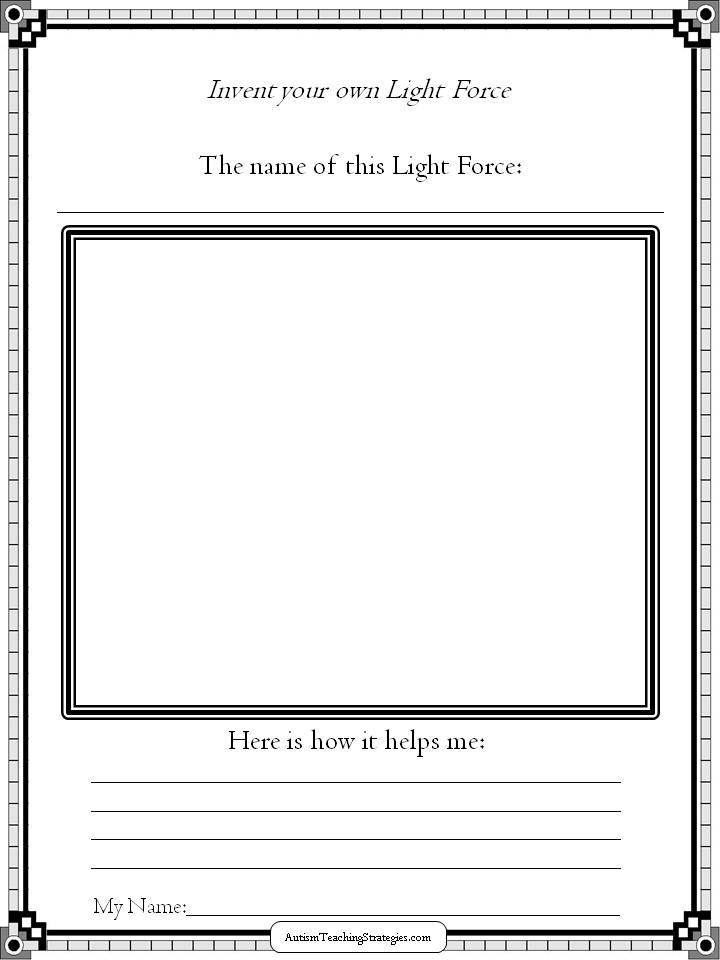
These “Dark Force – Light Force” social skills worksheets are a great way to help children and teens with ASD’s to think about issues affecting them and possible solutions.
Many children can be engaged in learning activities quickly if we employ imagination to capture and sustain their interest.
Why bother to incorporate imagination and art into social skills work with kids on the spectrum?
1. Children with ASD lose stamina in social skills work if we don’t lighten it up a little. Think about it. Many are in for years of listening to people like us scrutinize and edify them.
2. Children with Asperger’s and other autism spectrum disorders very often have a special fondness for fantasy worlds.
3. Children with ASD often do much better identifying problems if we employ a strategic, indirect approach to it. If you ask a child on the spectrum, “Are there ever any problems with changes or dealing with new schedules and routines?”, the child might answer “No, not really.” But if you show the same child a picture of Rock Brain (from Social Thinking) or Rigidity (a Ryuu character), and ask, “Do these characters ever cause any problems for you?”, you will very often get a completely different answer.
Drawing worksheets, based on fantasy characters, to explore social skills challenges in kids with ASD
Start by introducing social skills fantasy character kits such as the two introduced in Part 1 of this blog series.
Then, to introduce the drawing activity, you can try using language like this:
“No one is perfect. Almost everyone has lots of problems. There is a very important kind of smartness called “insight.” That means, you are able to look inside yourself to see what things you are good at and also what things are hard for you. People who have lots of “insight” are especially good at noticing what problems they have.
I wonder which of you kids is going to be good at knowing what your problems are?
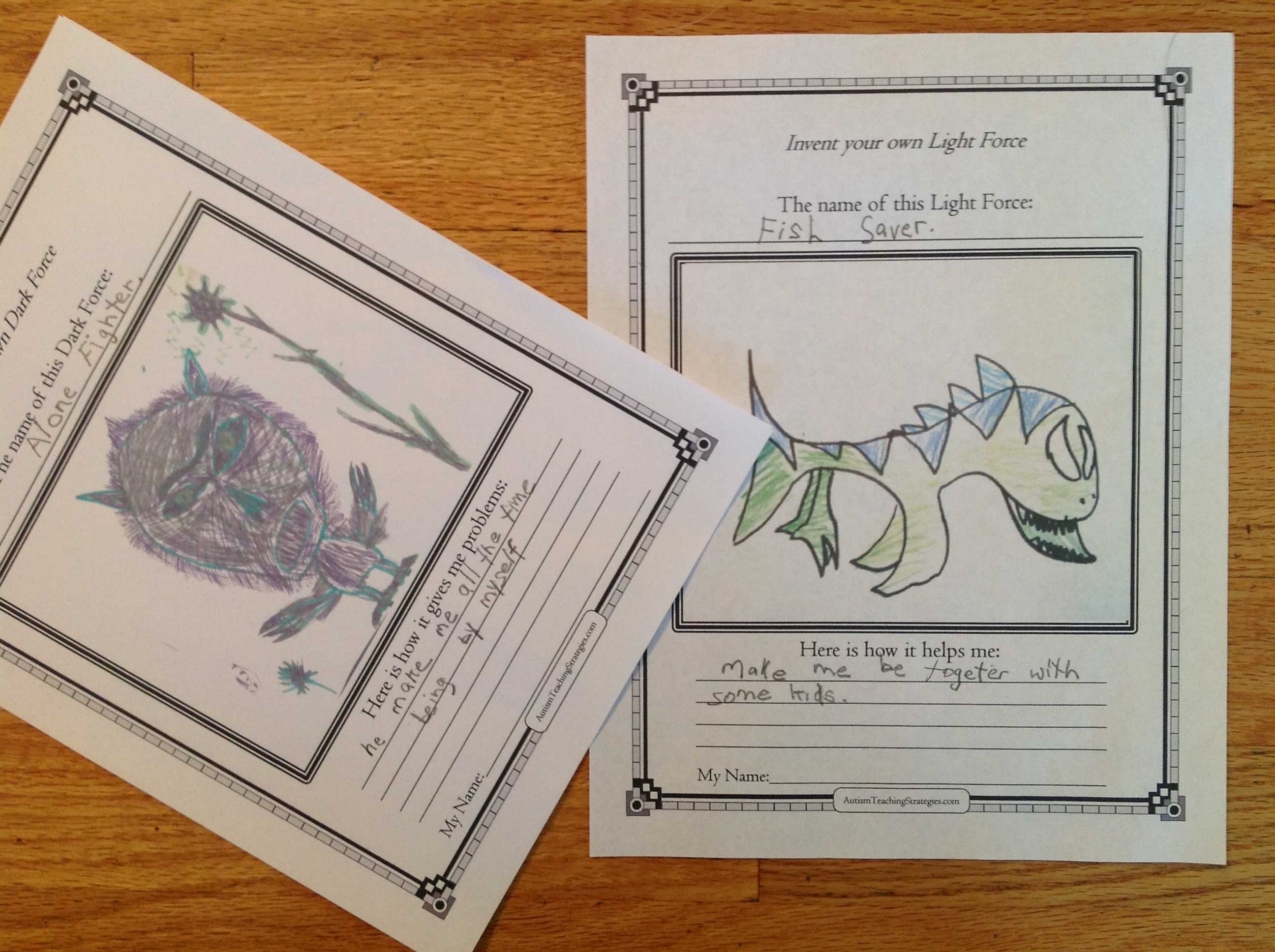
To find out, we are going to do a fun and challenging drawing activity. Here is how to do it. Think of a problem that you are working on. Now, give it a name, and think about what it might look like if it were actually alive! Draw a picture of it on the Dark Force sheet and write about it in the blank on that page.
Next, think about how you could work on that problem. Imagine that this “Light Force” is also a creature with a name. Write down the name of this Light Force, draw a picture of it, and then write about it on that page.”
The worksheets are are designed to be completed in pairs, with a “Light Force” opposing a “Dark Force”
You can suggest these possible categories below before the kids start inventing and drawing.
1. Dealing with anger
2. Dealing with worries
3. Dealing with sadness
4. Calming down your body. This could cover hyperactivity, or else finding appropriate places and times to stim.
5. Getting along with others. This could cover cooperation, conflict avoidance, concern for others, friendship skills.
6. Spending too much time alone
7. Trouble being organized
8. Talking too loud or too soft
9. Talking too much about what YOU like
How to print out the worksheets:
Click on the red PDF link at the top of this blog post.
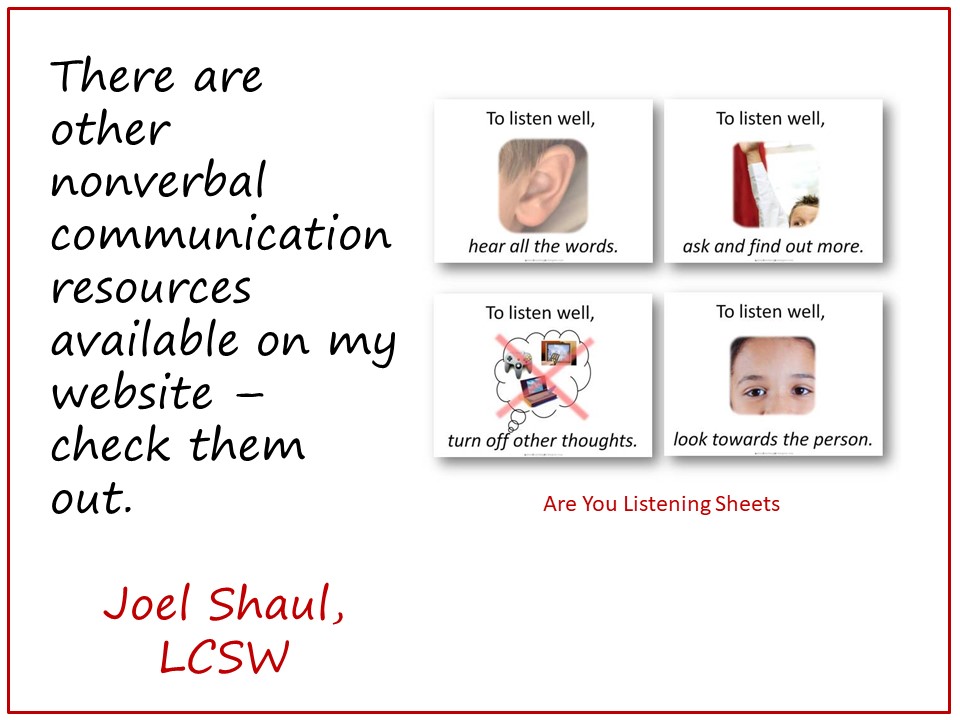
Visuals to help children with autism spectrum disorders to improve listening skills
Children on the autism spectrum can find it painfully difficult to tune into the words and meaning of other people. They may hear extraneous sounds in the room. They may be distracted by more interesting things to look at. The person talking may be competing unsuccessfully with the autistic child’s inner thoughts.
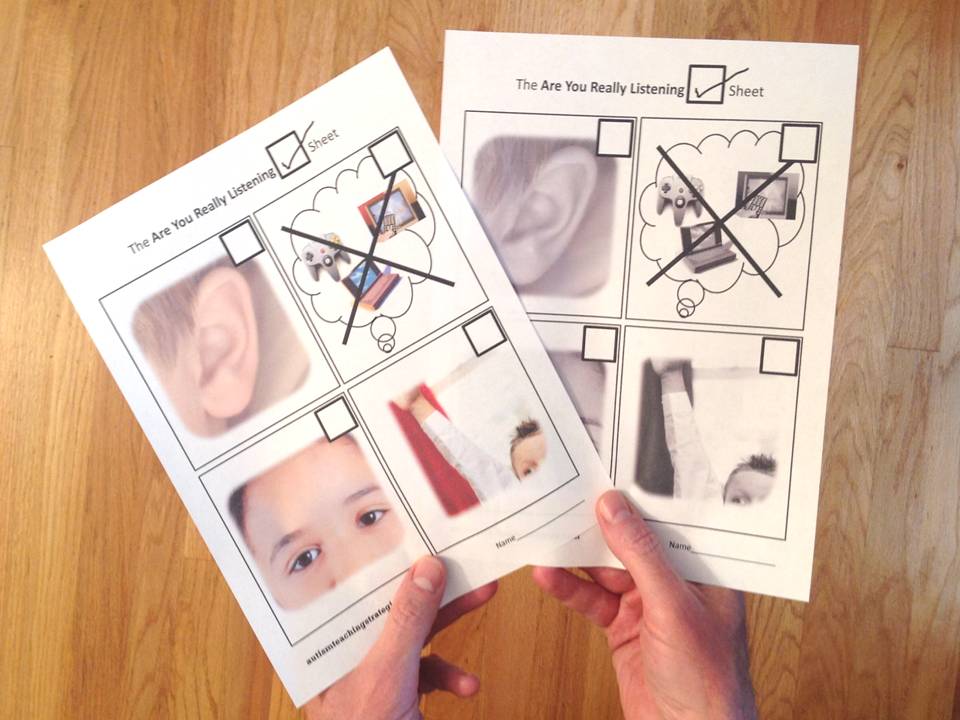
Picture worksheet to raise awareness of the components of listening
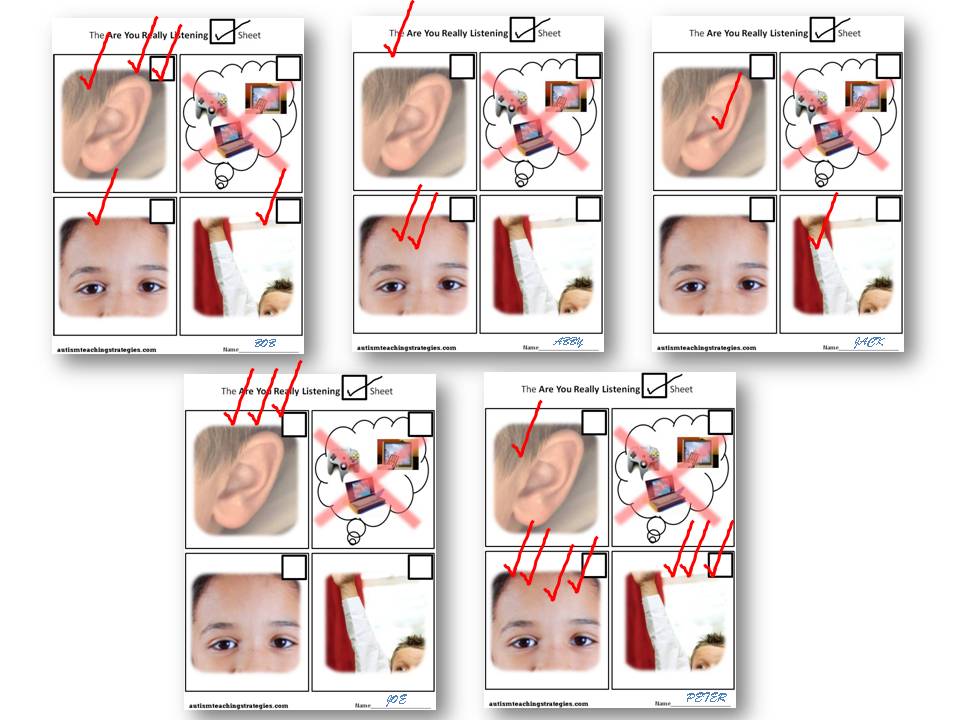
I have made a very simple sheet to help kids to focus when the teacher or another person is talking. Here are two suggestions on how to use it.
1. Place it on the child’s desk. Taping it down securely might be a good idea for some kids. Either you or the child can be the one to put check marks on the sheet. Putting little reward stickers on the various boxes should work nicely as well.
2. When you are working with a small group: Get a worksheet for each child in the group, and write their names on them. Place these worksheets on a vertical surface next to you, facing the group participants. As your group activity progresses, put check marks on each worksheet within the various categories to indicate observed success within the various categories. If you happen to be running your activity with a co-worker, this system works even better.
Here is one way to use the worksheets, which is explained above.
Here is one very simple use of the worksheet, sent in to me by someone who downloaded the images from the website. She put the sheet in a plastic sheet in a student’s folder to reinforce his listening during class time.
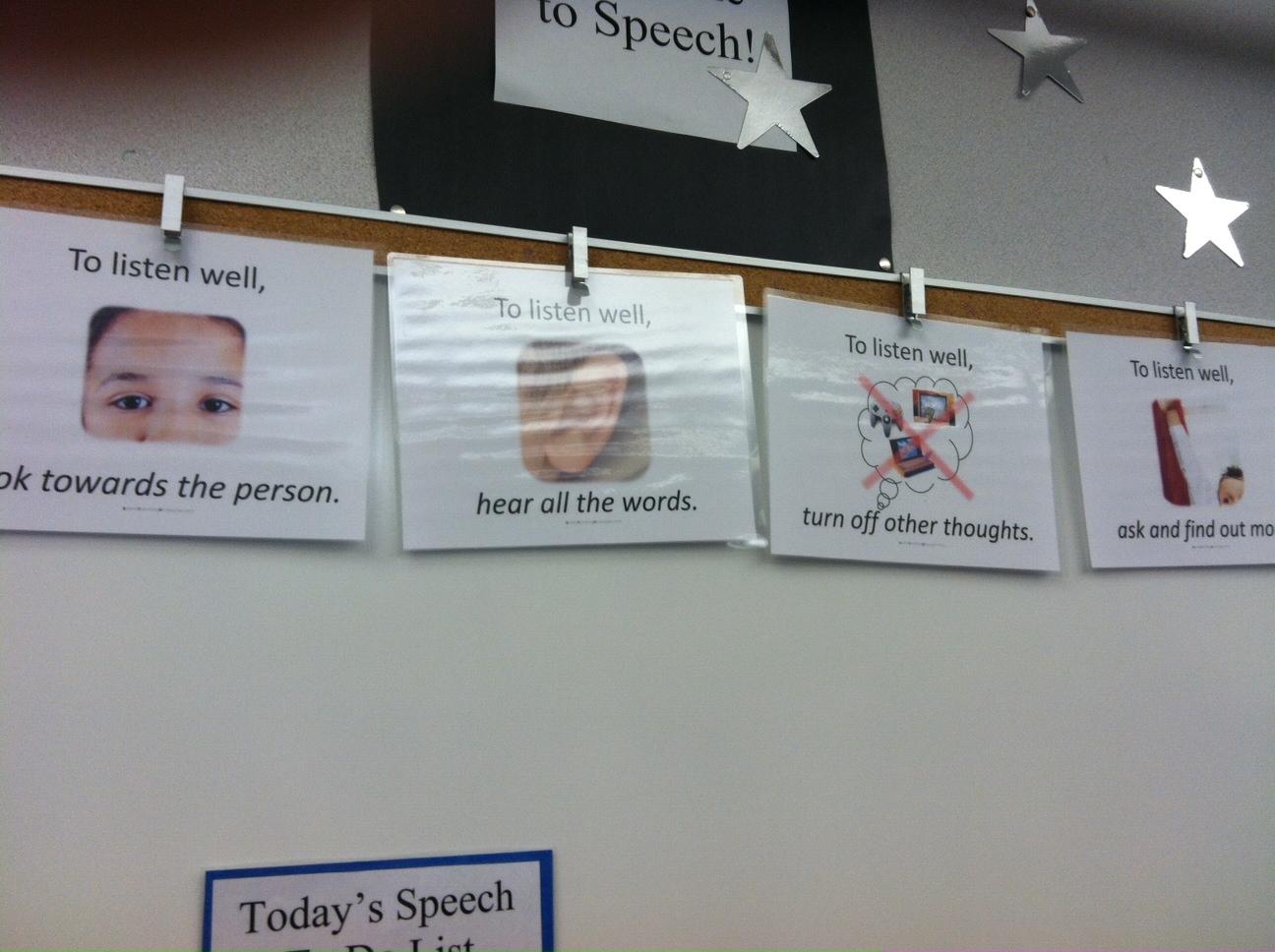
A speech language professional in California sent in this photo.
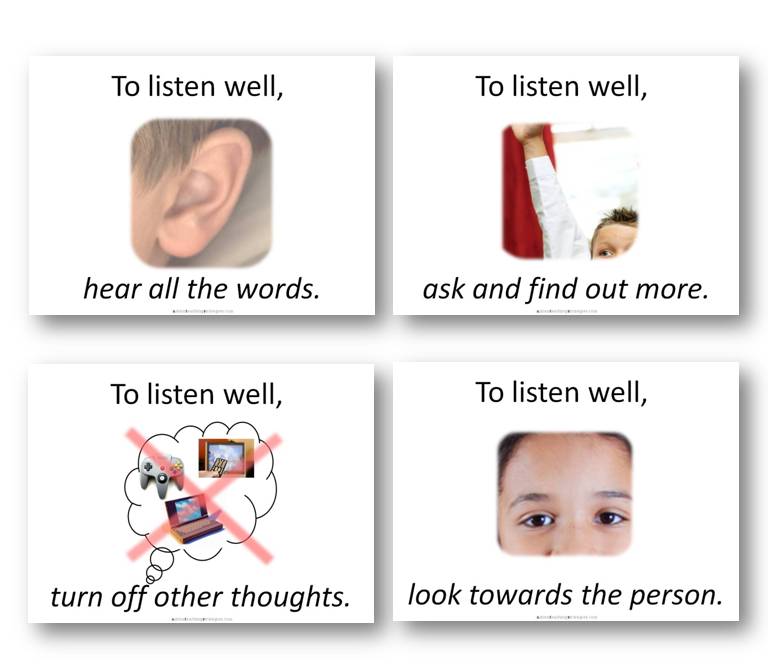
Wall display to help kids with ASD with listening skills
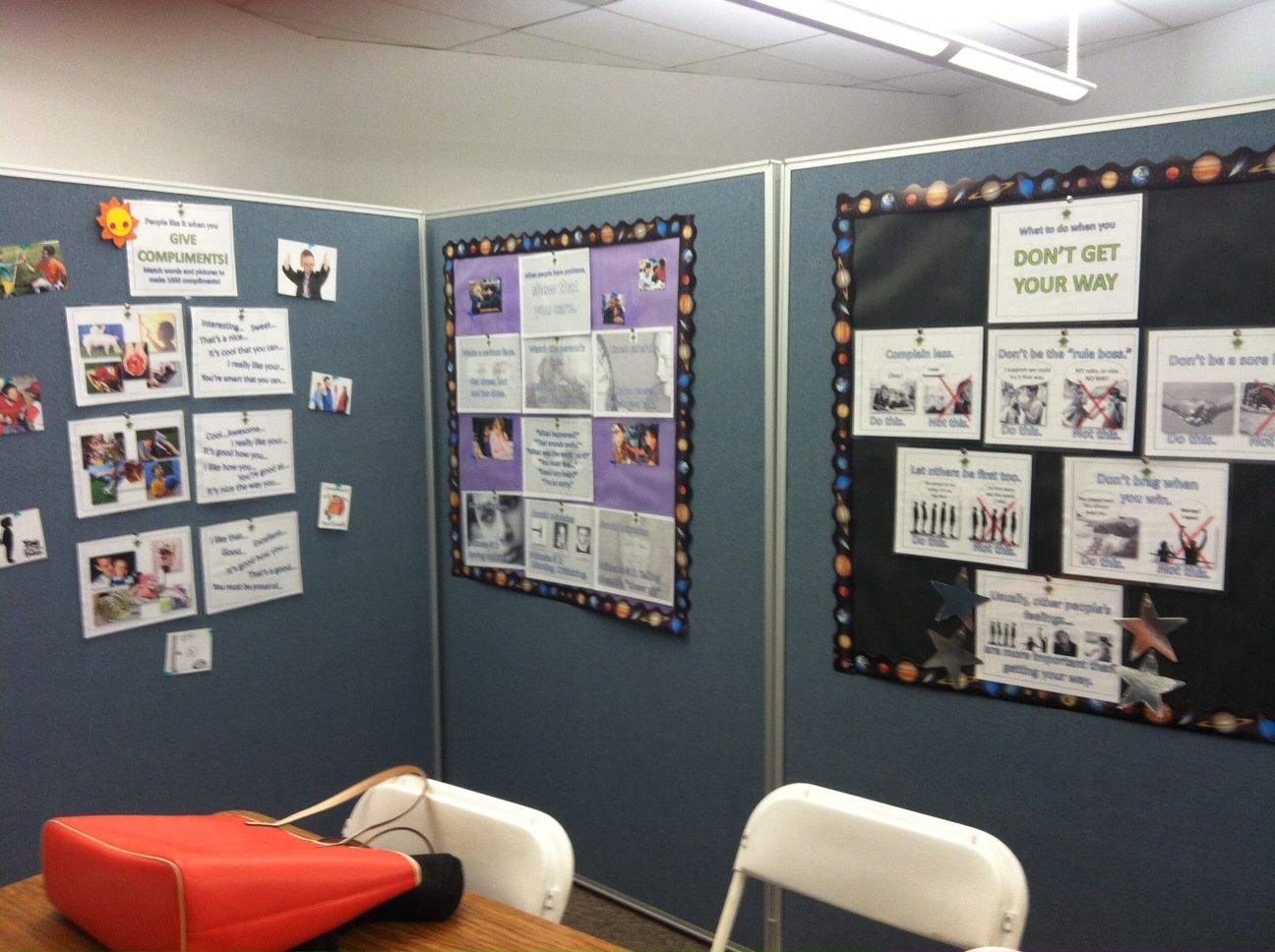
I designed these wall panels as simply as possible with a minimum of words, so they might be used in a range of grade levels. Here is what they might look like on your wall:
An SLP in California sent in this photo showing how she displayed this resource.






![Listening-blog-post-Wall-Display-blog-display[1]](http://autismteachingstrategies.com/wp-content/uploads/2013/05/Listening-blog-post-Wall-Display-blog-display1.jpg)