For children on the autism spectrum who talk too much – or too little – in group situations, this is a useful visual strategy.
Children with autism who talk too much or too little in group situations
Neurotypical people find this skills difficult also! Remember that person who would not stop talking at the last party you went to? Young people with autism spectrum disorders can find reciprocal conversation skills particularly perplexing. They may say little or nothing on the playground or in class discussions. Or they may hold forth in a lecture of monologue fashion, not noticing the signs that others are becoming impatient.
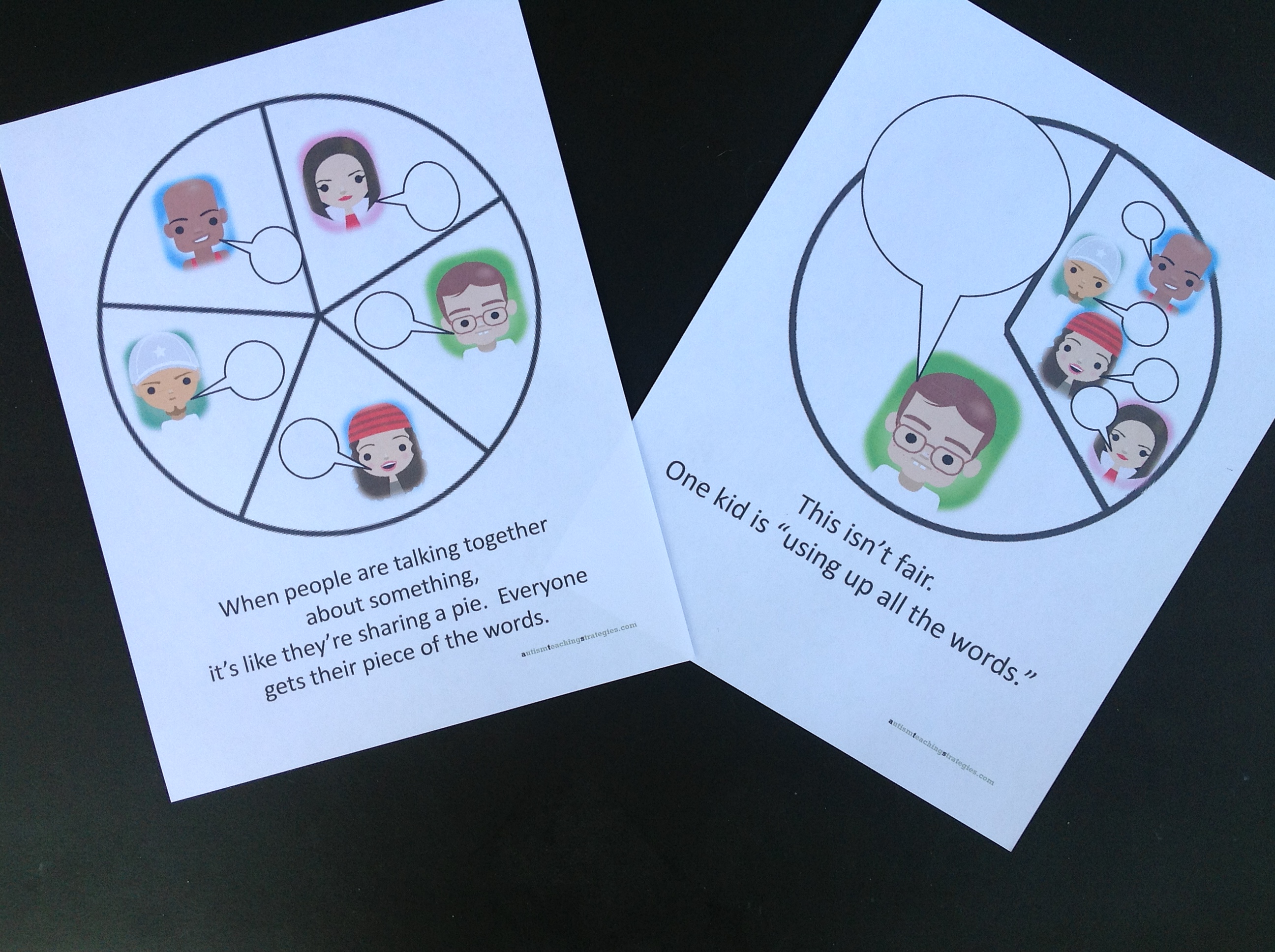
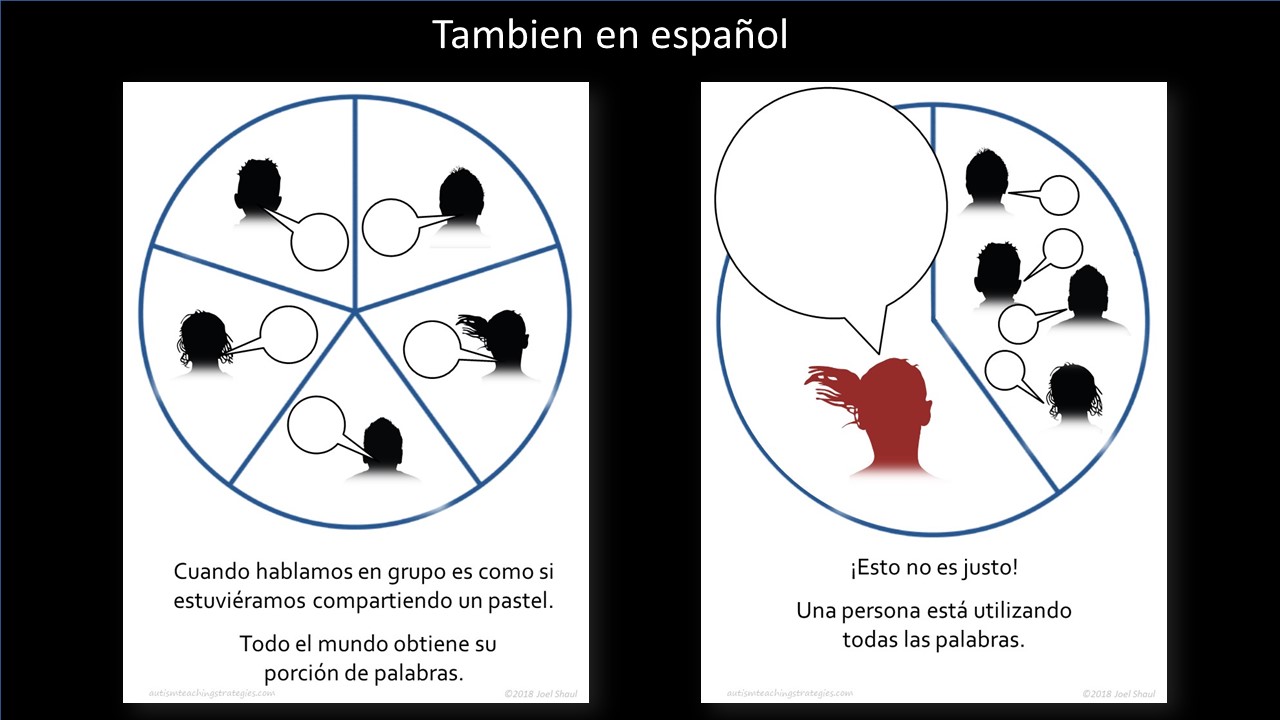
Often, explaining a social skill combined with a meaningful visual will make a lot more sense for a child on the autism spectrum. This particular visual can be very helpful. If you make a few copies of the pie chart sheets below, I believe you will use them often.
*Use simple language while describing the sheets. For example: “When people talk together, it’s like people sharing a pie [or cake or whatever in case the kid does not like pie!]. Everybody gets their turn to take their share. If one person is talking too much and not letting others talk, it’s not fair. He is “using up all the words.” Also, if somebody is just listening and is not sharing their own thoughts and words with the others, that’s not good. Everybody’s ideas are important.”
*One way to help a child who lectures and monologues in your class or group is to ask him to become your “helper.” Prepare for him the blank circle sheet below, and divide it into the number of kids who are present in your class or group. If you like, you can write into each “slice” the names of each person present. Then, you can ask the child to shade in with a pencil the various slices as the various children speak. This directs the attention of the monologuing child towards what others are saying and raises his awareness of proportion and reciprocity in group conversation.
I wish you success with this simple visual technique for helping kids with ASD to have better group conversation skills.
Joel Shaul, LCSW
Here is a related conversation social skills resource for reciprocity in conversation, but for when just two people are talking.
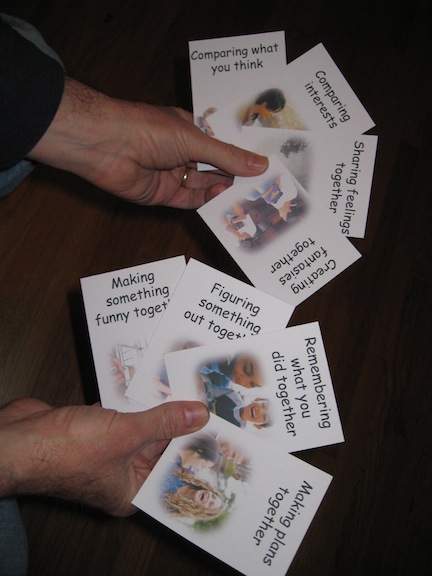
Children on the autism spectrum usually don’t easily grasp the many functions of conversation. Here is a good activity to help them. The various functions of two-way conversation are clearly explained and word examples are provided. It is loosely based on concepts outlined in Relationship Development Intervention (RDI). ( This activity requires some reading ability. Please see links below to conversation learning activities that rely less on reading.)
Here is what this set of resources looks like when you print it out. It’s a set of simple cards and a matching set of explanatory picture panels.
How to create the Conversation Box activity:
Follow the directions for PDF download below.
Here is the box I use for my own Conversation Box cards.
Put the cards in a box. It’s nice to decorate it.
How to do the Conversation Box activity with kids on the autism spectrum:
Use words something like this:
“We are going to play the Conversation Box activity. It’s a fun activity to help us to practice all the good ways to talk back and forth with other people. Inside the box are cards showing all the good ways that people talk back and forth with each other.”
Now, show them the cards, as well as the eight prompts providing word examples for each card category.
“We will take turns reaching inside the box to randomly draw a card. When you pick a card, you have to have a back-and-forth conversation with another person here. You can look at these signs [show them the eight word prompts] to help you know what to say.”

 To download this free resource, click on this red link below here: