
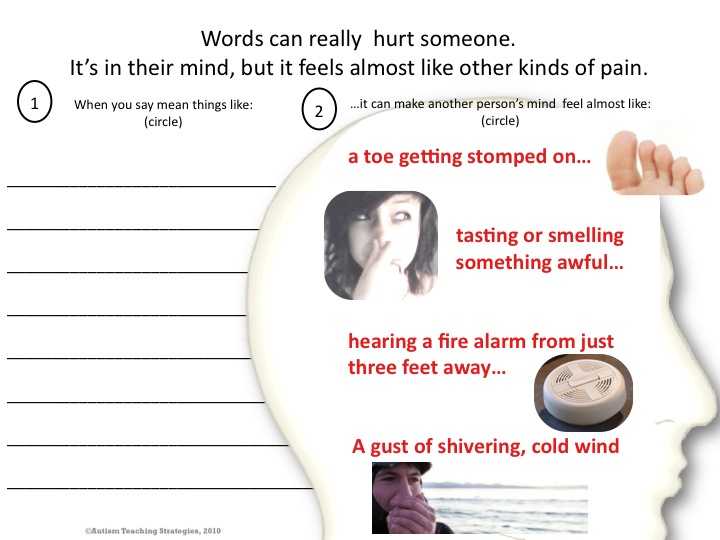
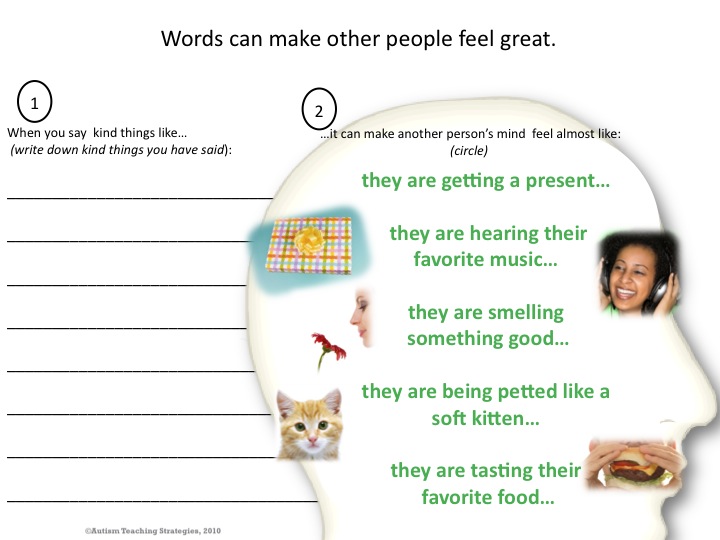
To download the two worksheets shown below, click on the links below:
Words Hurt, Words Help Worksheets Download
[In German: Worte-tun-weh-Worte-helfen]
[In Polish]
[In Hebrew]
When I work with children with ASD on social skills, I often ask them: “How long will another person remember what you do or what you say?” A typical answer I get is: “About five minutes.” These answers are enlightening. Frequently, young people with ASD have the impression that other people just don’t remember too many details about what other people say and do. A young man who sometimes neglected to button his shirt insisted that no one ever noticed. “And even if they did see my shirt unbuttoned, they would just forget in a second.”
Young people on the autism spectrum may experience difficulty understanding the social consequences of their words and actions. This lack of awareness can affect them in several ways. First, the child with ASD may be less likely to say something encouraging or complimentary to another person. Second, the child may fail to discern the harmful effects of hurtful words, and blurt out “unfiltered” statements with harsh, judgmental or violent content. The combination of these distorted beliefs lowers their motivation to make good impressions and also lowers their conviction that altering their own words and behavior really makes any difference anyhow.
When we try to help children with autism increase their ability to use kind words and refrain from hurtful ones, it seems very helpful to use clear visuals. It also helps to equate the other person’s emotional pain and pleasure to physical pain and pleasure. My clients seem to “get” that other people feel physical pain and pleasure much better than they understand other people’s emotional pain and pleasure.
I developed these illustrated social story worksheets to help children to realize that their words have the power to hurt and to help, and that their words and actions matter.
Joel Shaul, LCSW
Here is another set of free social skills worksheets on the topic of social cause and effect and what others remember: Pencil Memories and Pen Memories
Pencil Memories / Pen Memories Social Cause and Effect Worksheets
Your comments on these resources are most welcome, and often helpful. Click HERE to send an email.