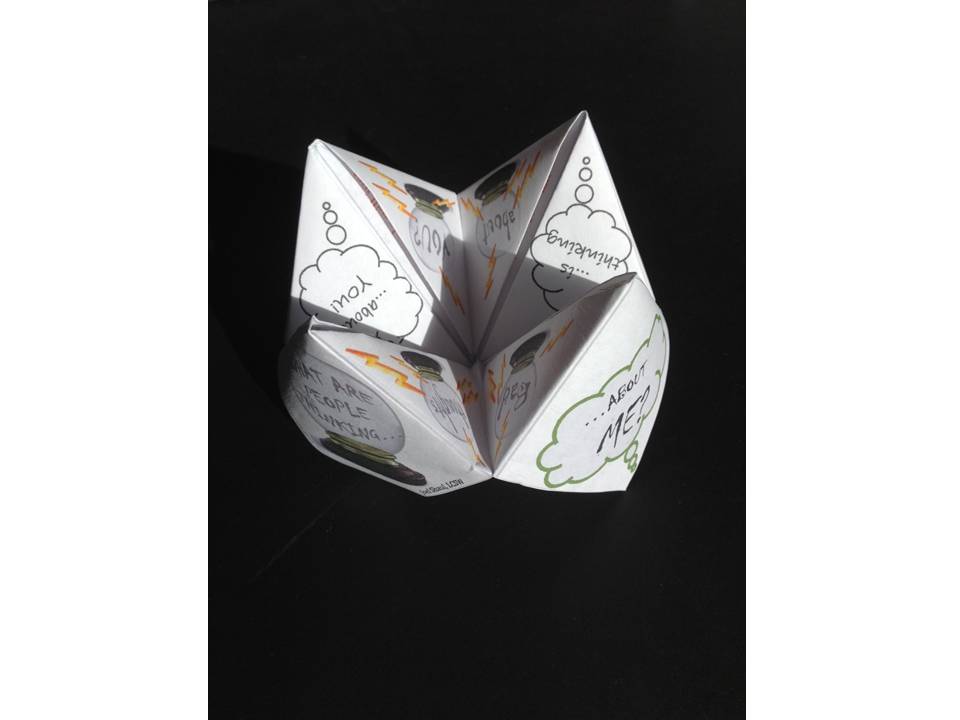
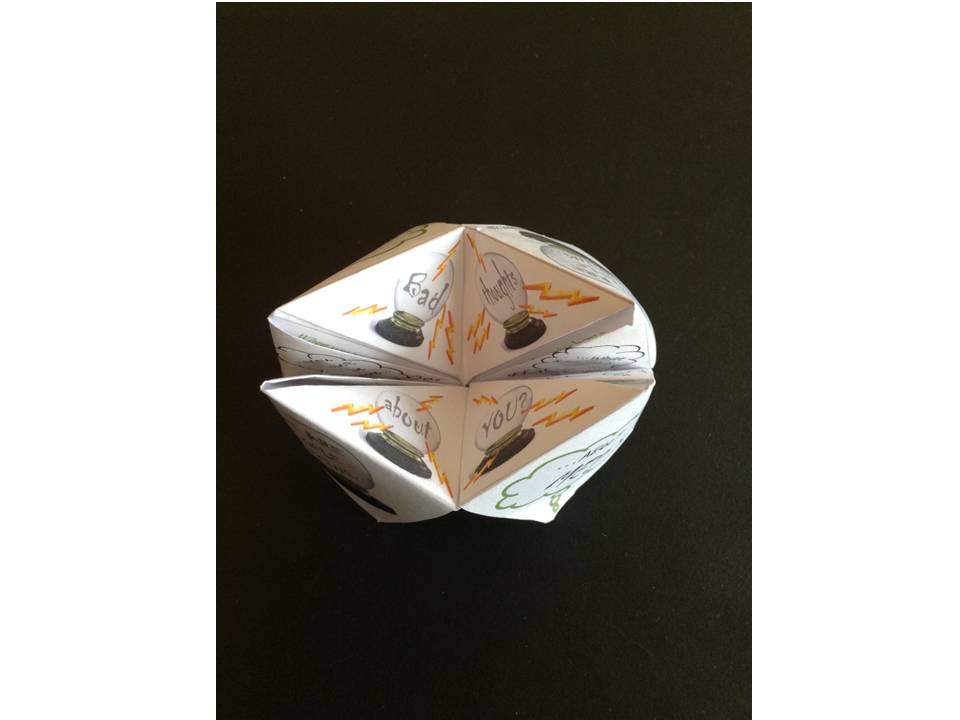
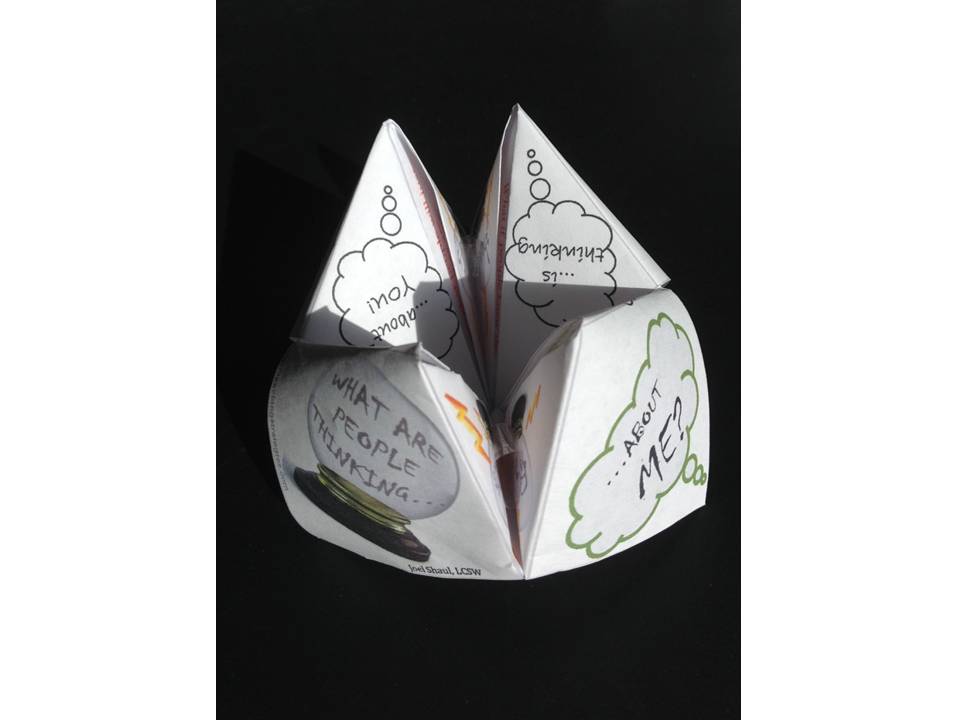
Helping children to work on upsetting emotions using cognitive behavioral therapy game activities
Many young people have persistent problems with anxiety, sadness, anger and other upsetting emotions. To maintain engagement in counseling and psycho-education, we need to provide novel approaches and introduce some levity whenever possible.
To check out a dozen other paper fortune tellers, on diverse social skills themes, please click here.
For a summary and links to all the free CBT materials on my website, please click here.
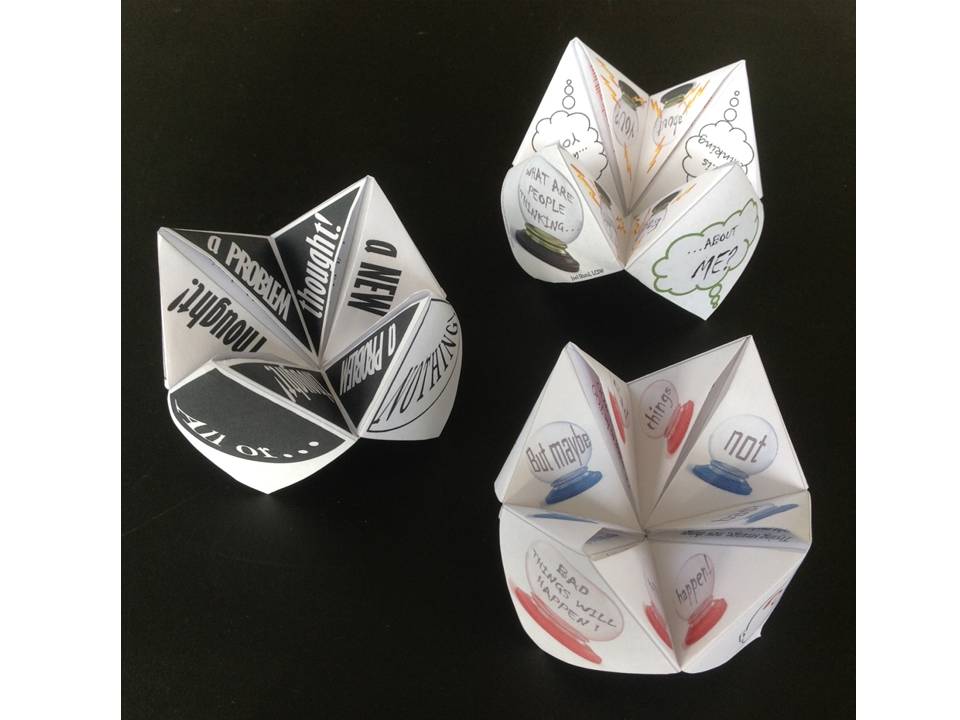
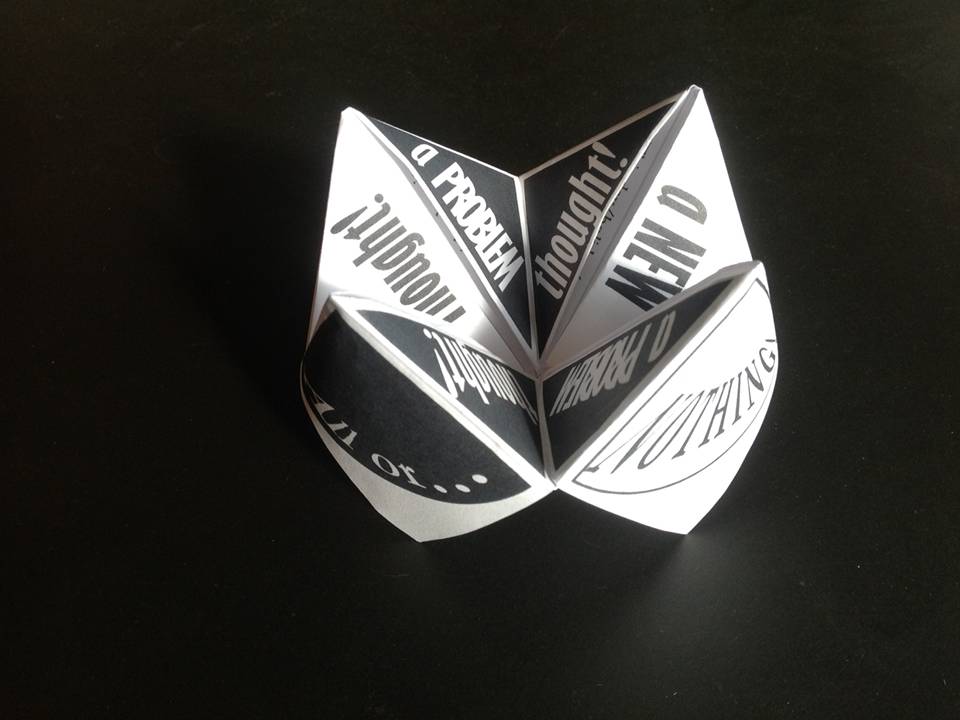
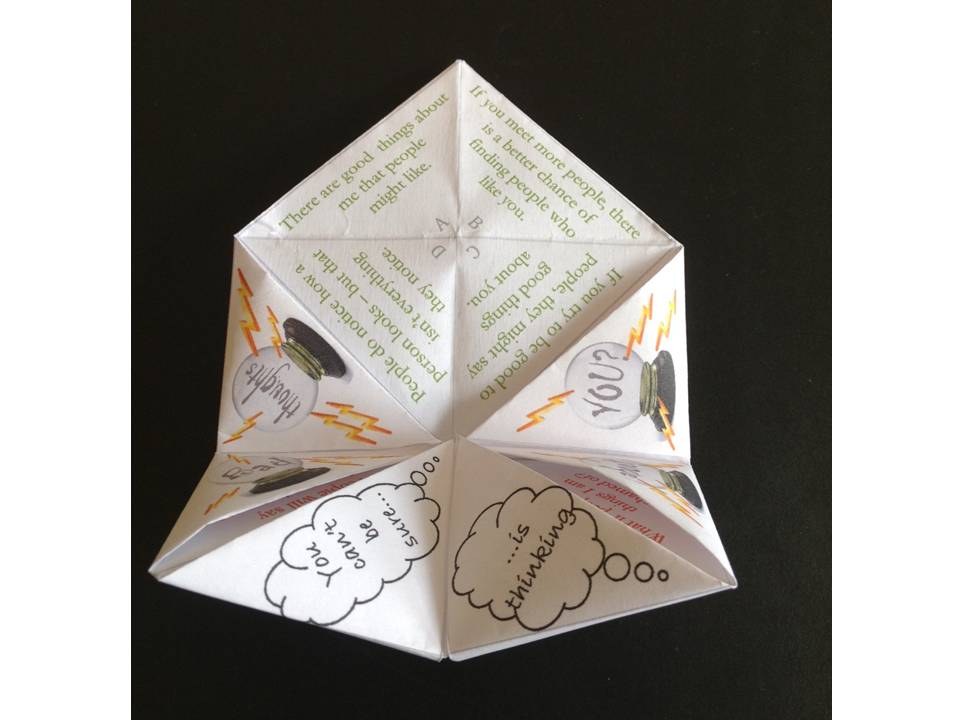
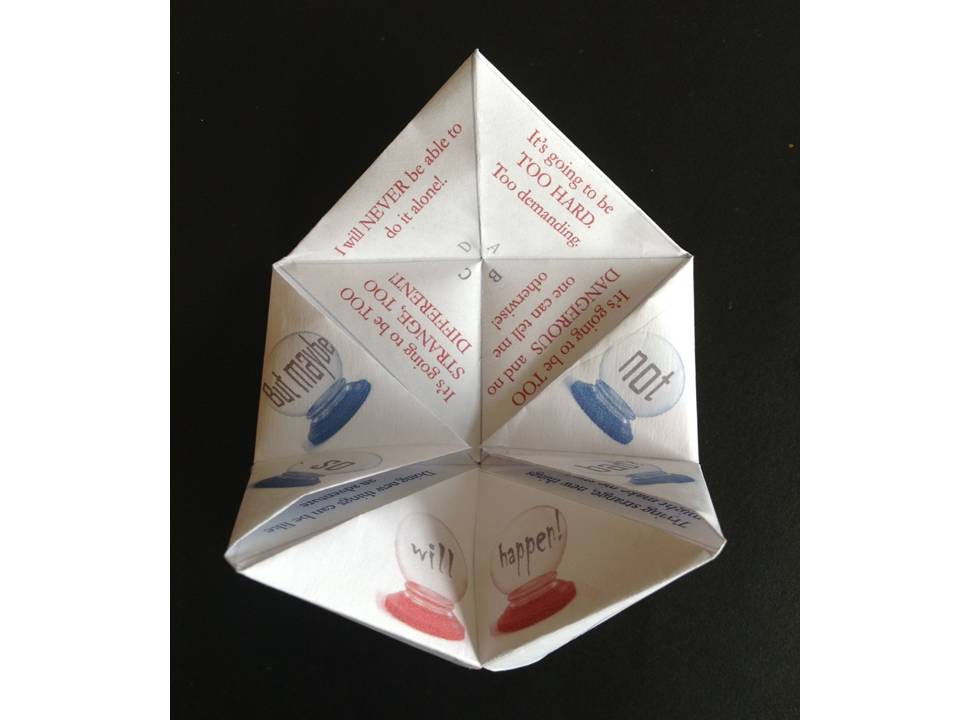
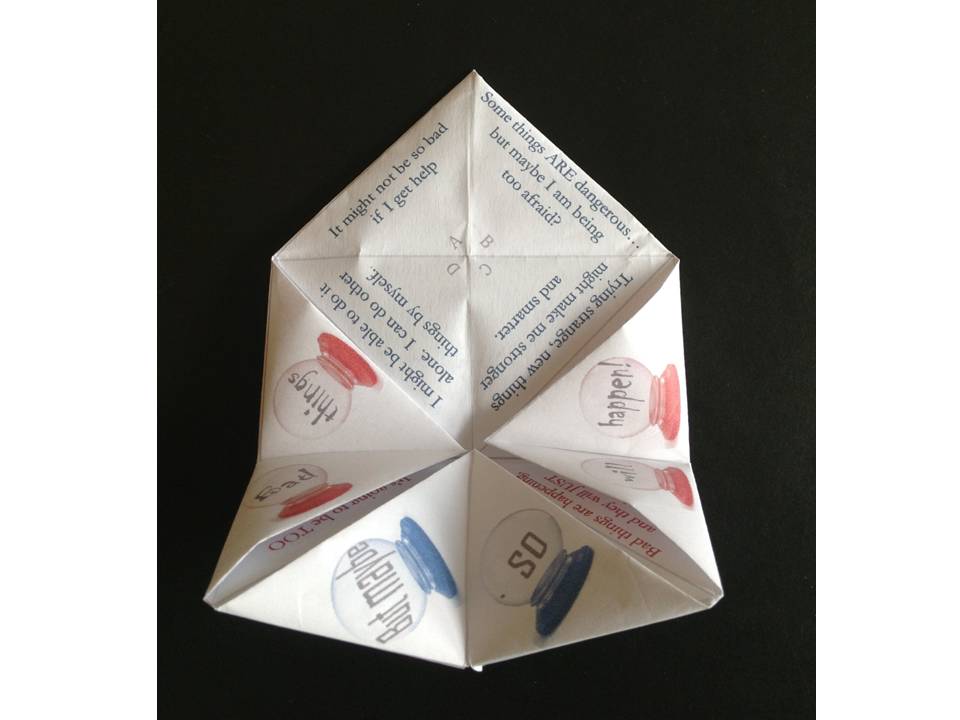
Some suggestions for introducing these Fortune Tellers:
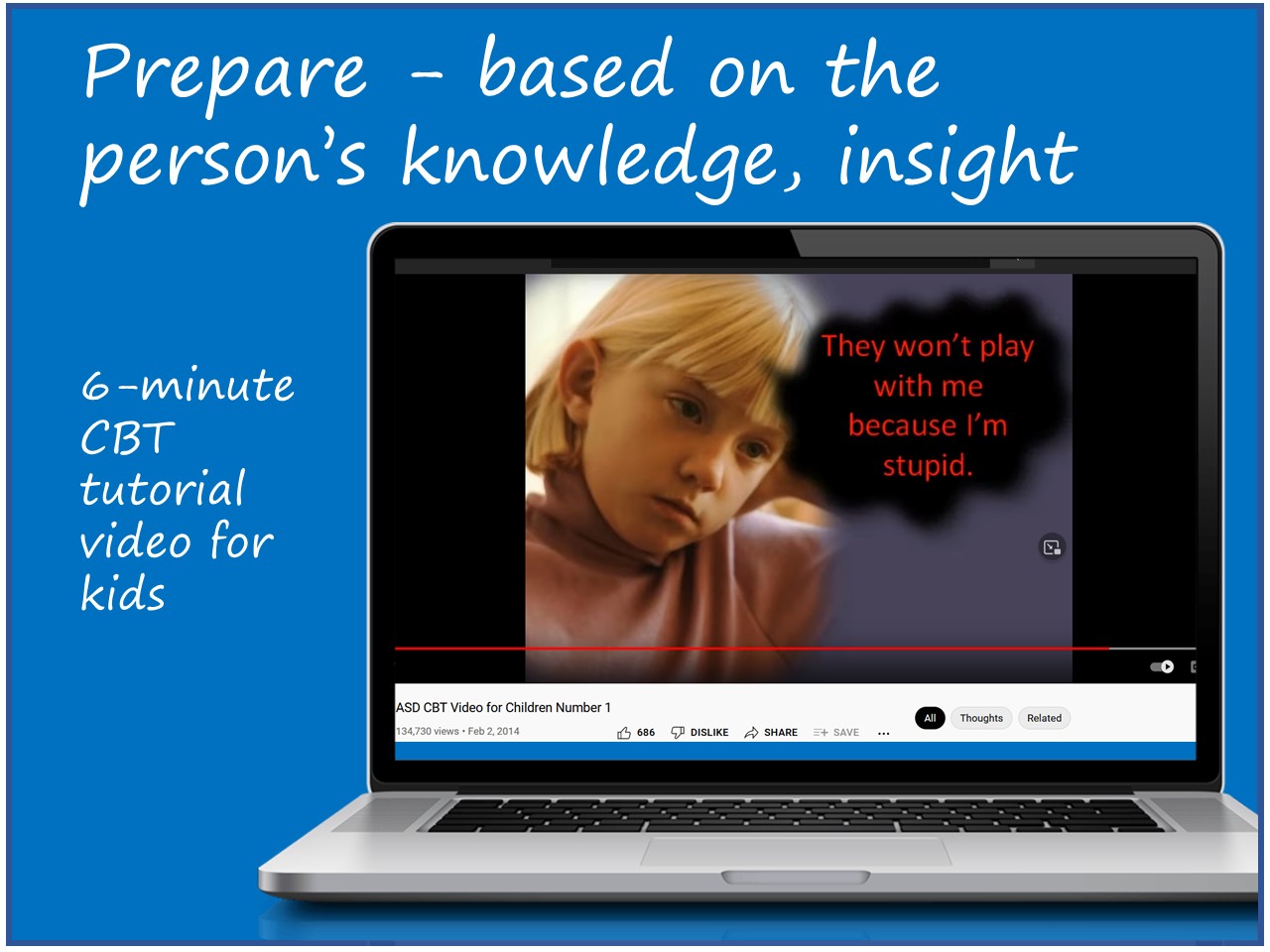
1. Introduce some basics concerning the connection between automatic negative thoughts and negative emotions. I suggest you do this by viewing , with children, this very short video I made:
2. Working in pairs, and taking turns, person number one says, “Spell your name.” For each letter, the child holding the Fortune Teller manipulates the device back and forth.
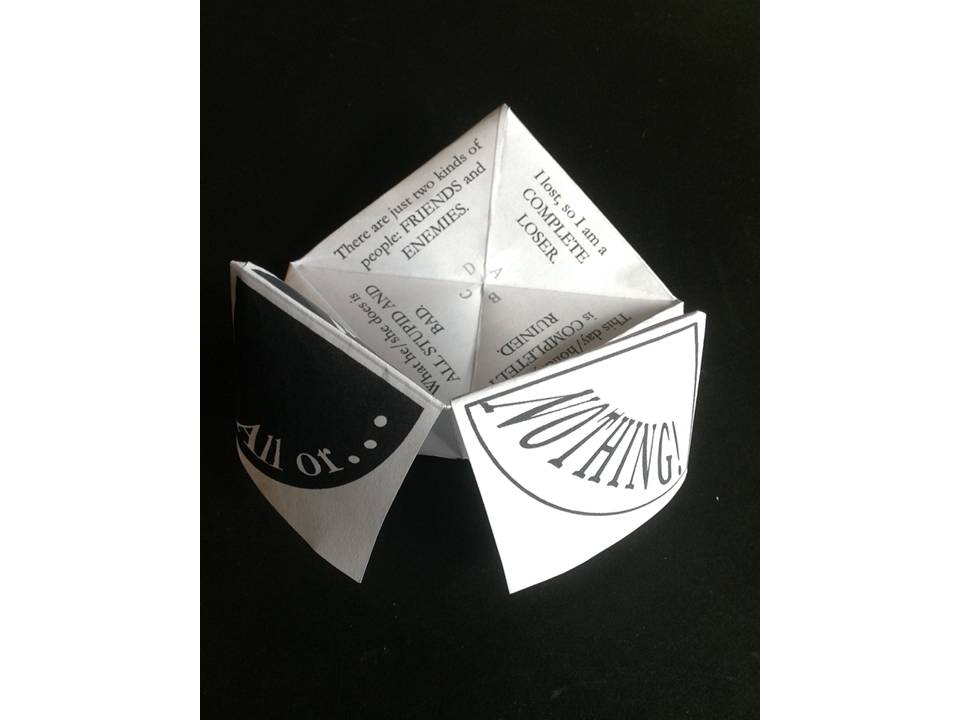
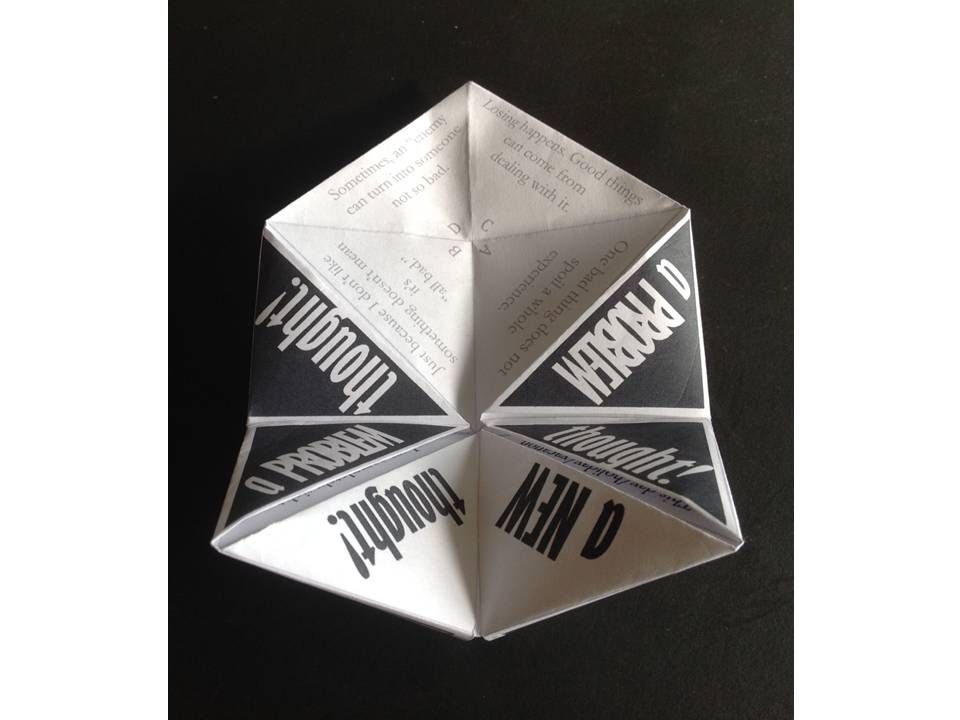
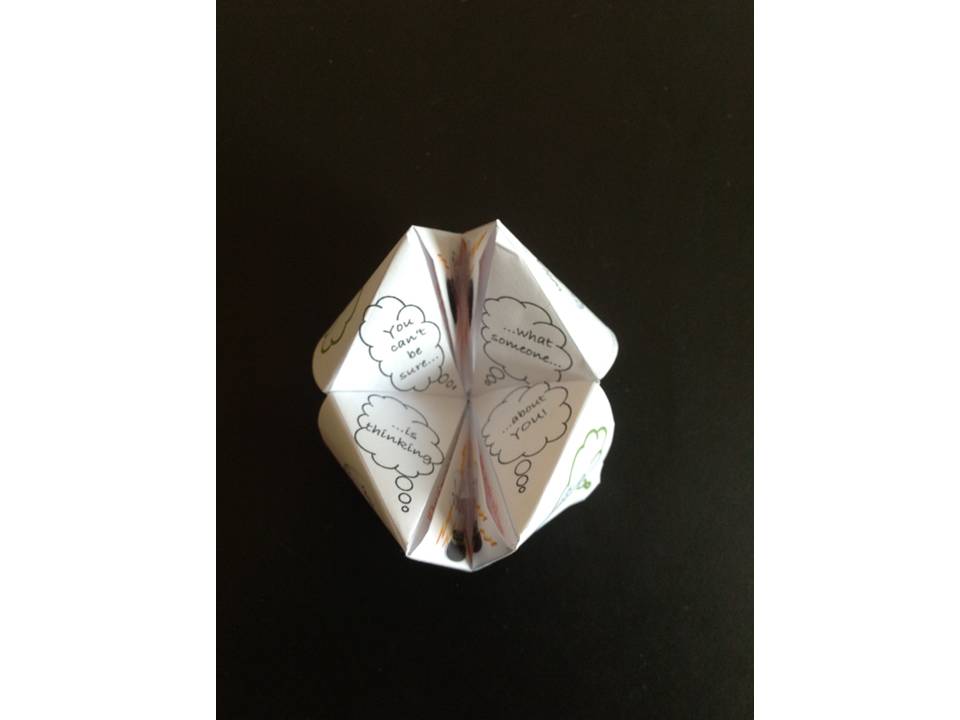
3. Person number two is then shown the two options appearing on the inner triangles. Person one says, “Pick which one you want.” You can see photos of this farther down on this page.
4. Person one opens up the innermost petals, where four options appear. He tells person two, “Pick A, B, C or D.” Person one reads the option selected. If the option read is a negative thought, person two has to tell how to deal with such thoughts. If the option selected is a positive thought, person two must describe a time when he needed to use such a thought to solve a problem.
Here are links to my free CBT worksheets, some explanations on how to use them, and suggestions on how to use the worksheets in combination with other free child therapy resources on the website.
7 cognitive behavioral therapy worksheets with other free CBT resources
CBT was originally designed for educated adults. Before attempting to use any elements of CBT with young people, it is important to simplify it as much as possible and to make it appealing. I really recommend you consider starting out by viewing this six-minute CBT video which was designed for ~ age 7 through late teens.
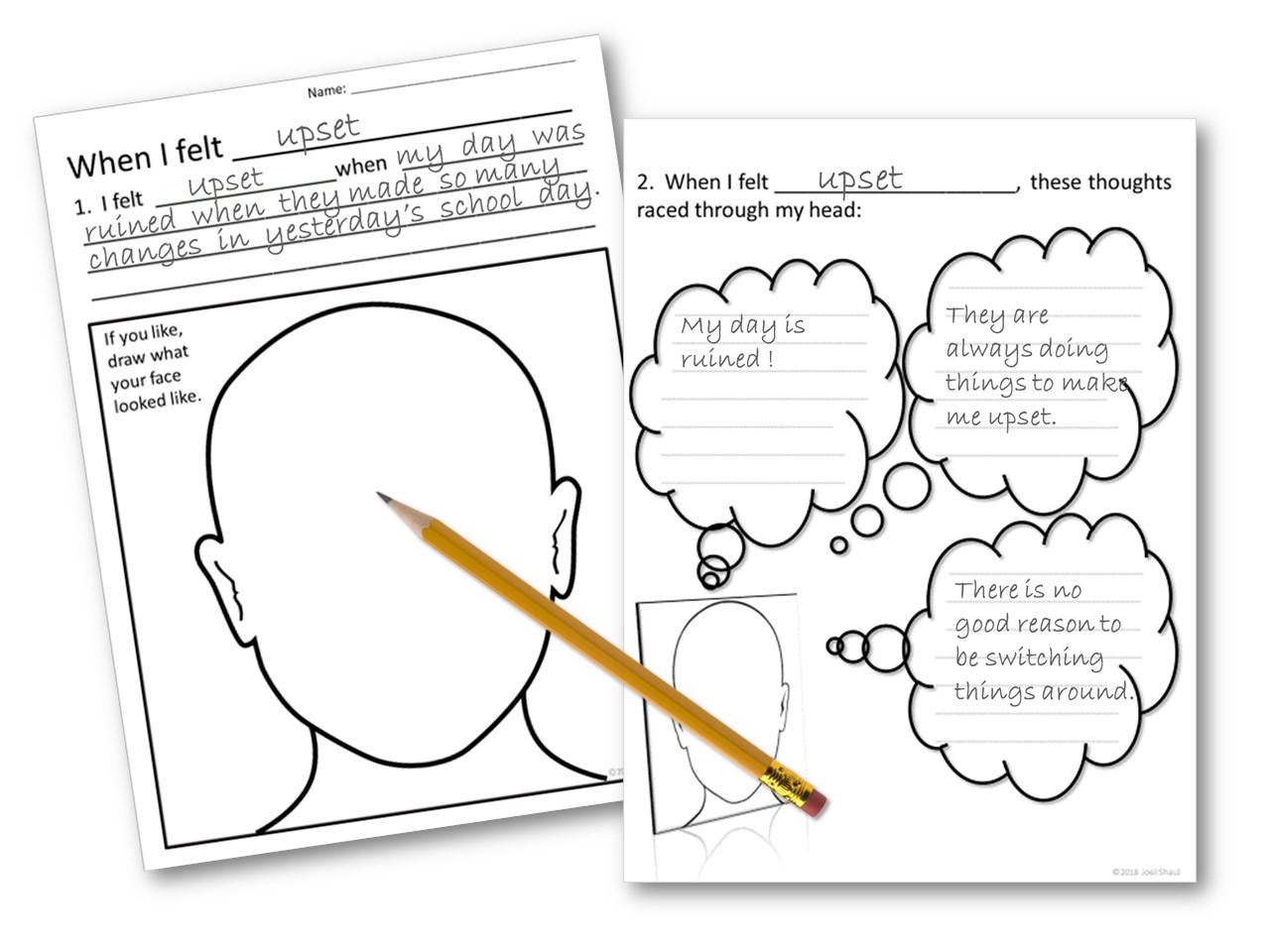
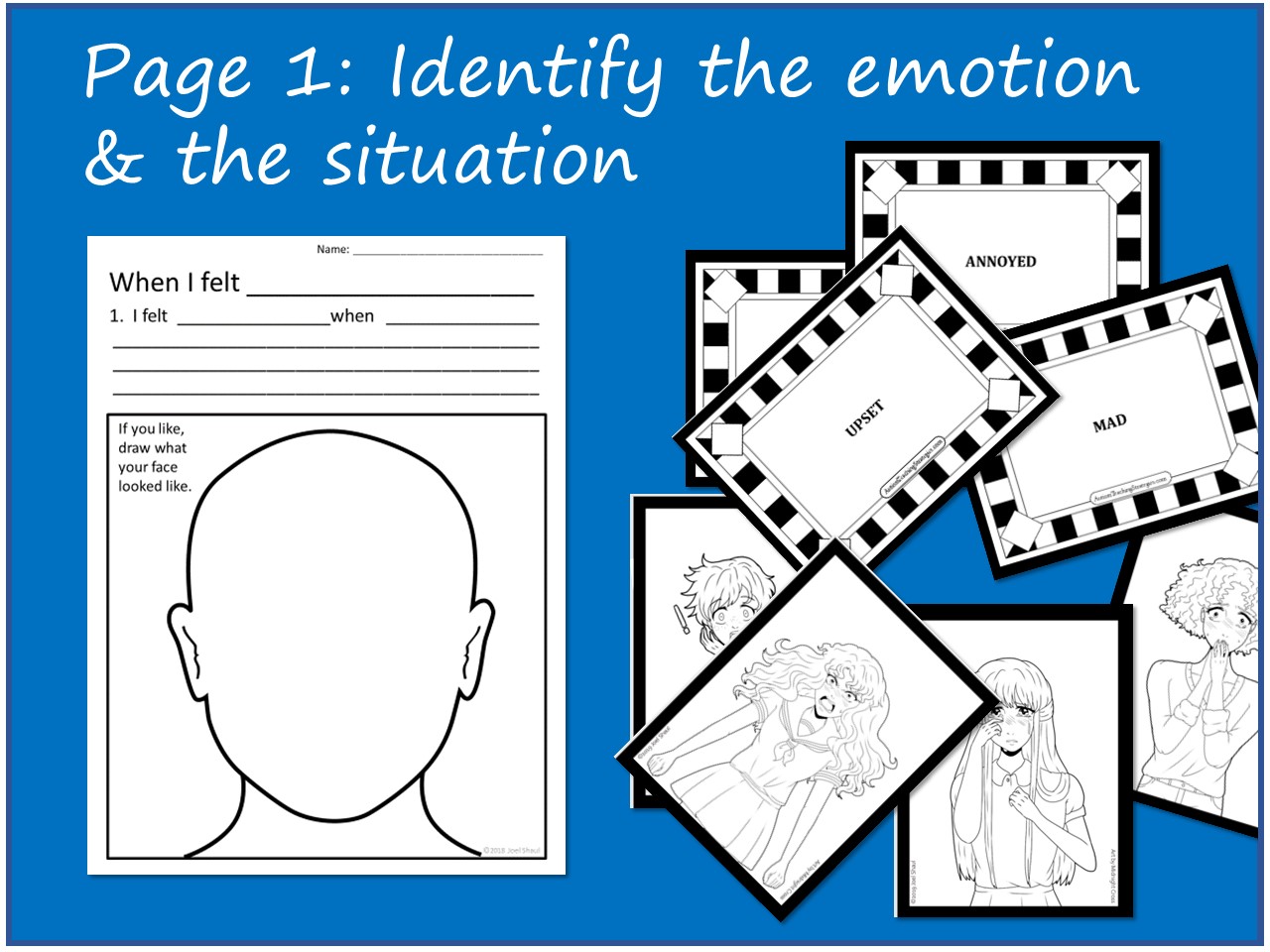
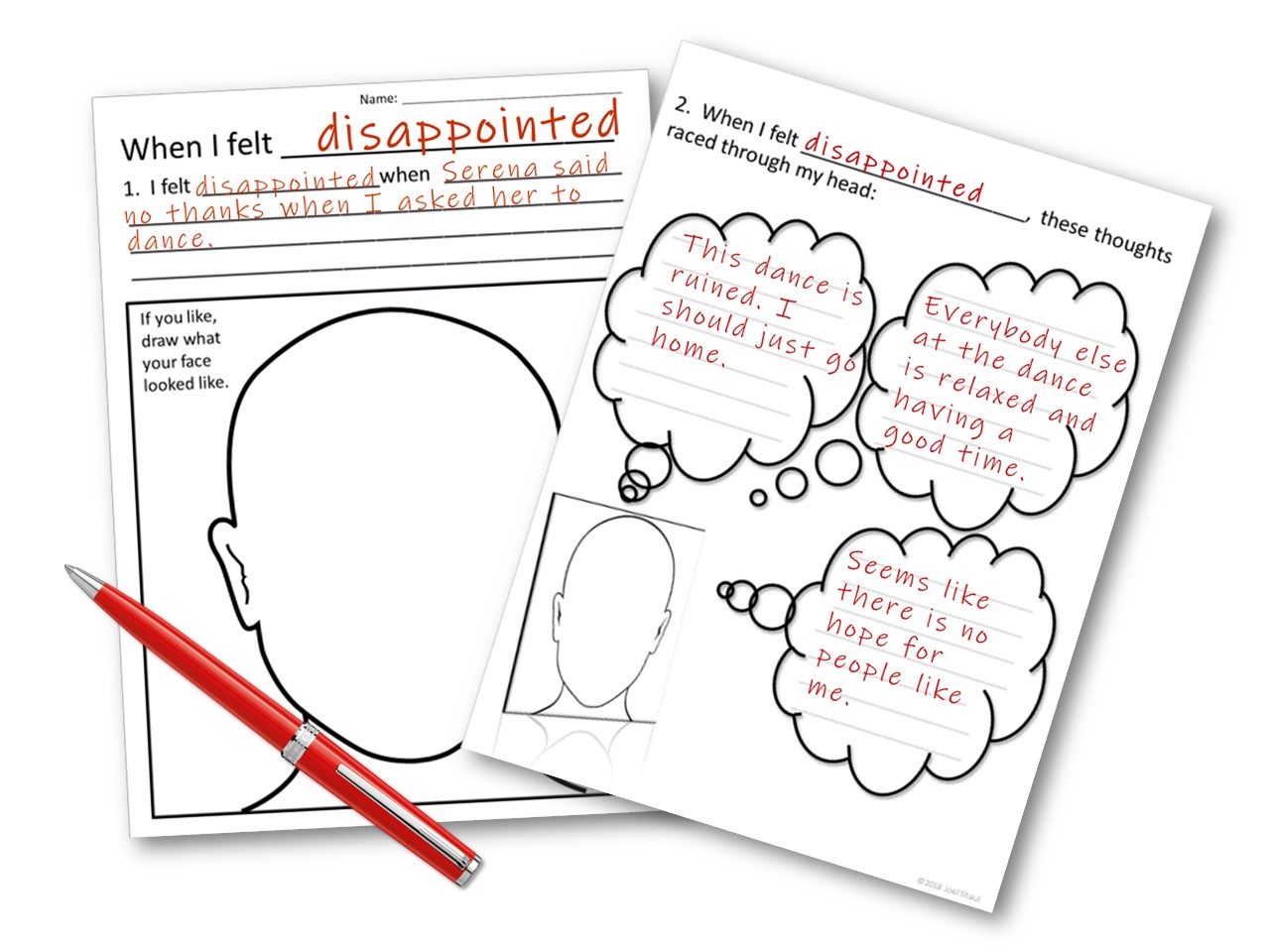
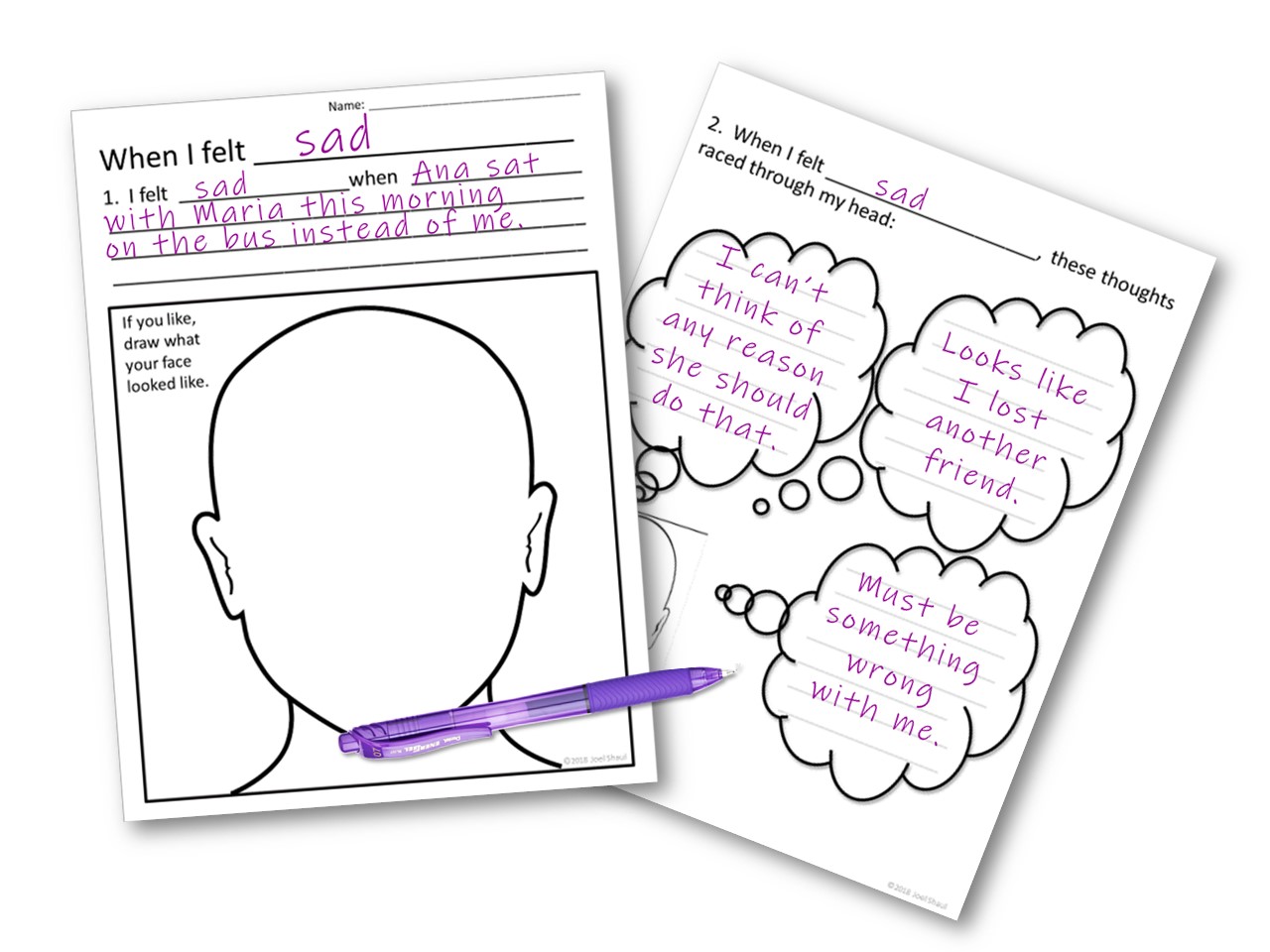
The first page is help identify the problem emotion. It may be necessary to take this step slowly and carefully. I have several free therapy resources that can be helpful, 21 Anime Emotion Cards and Emotion Cards.
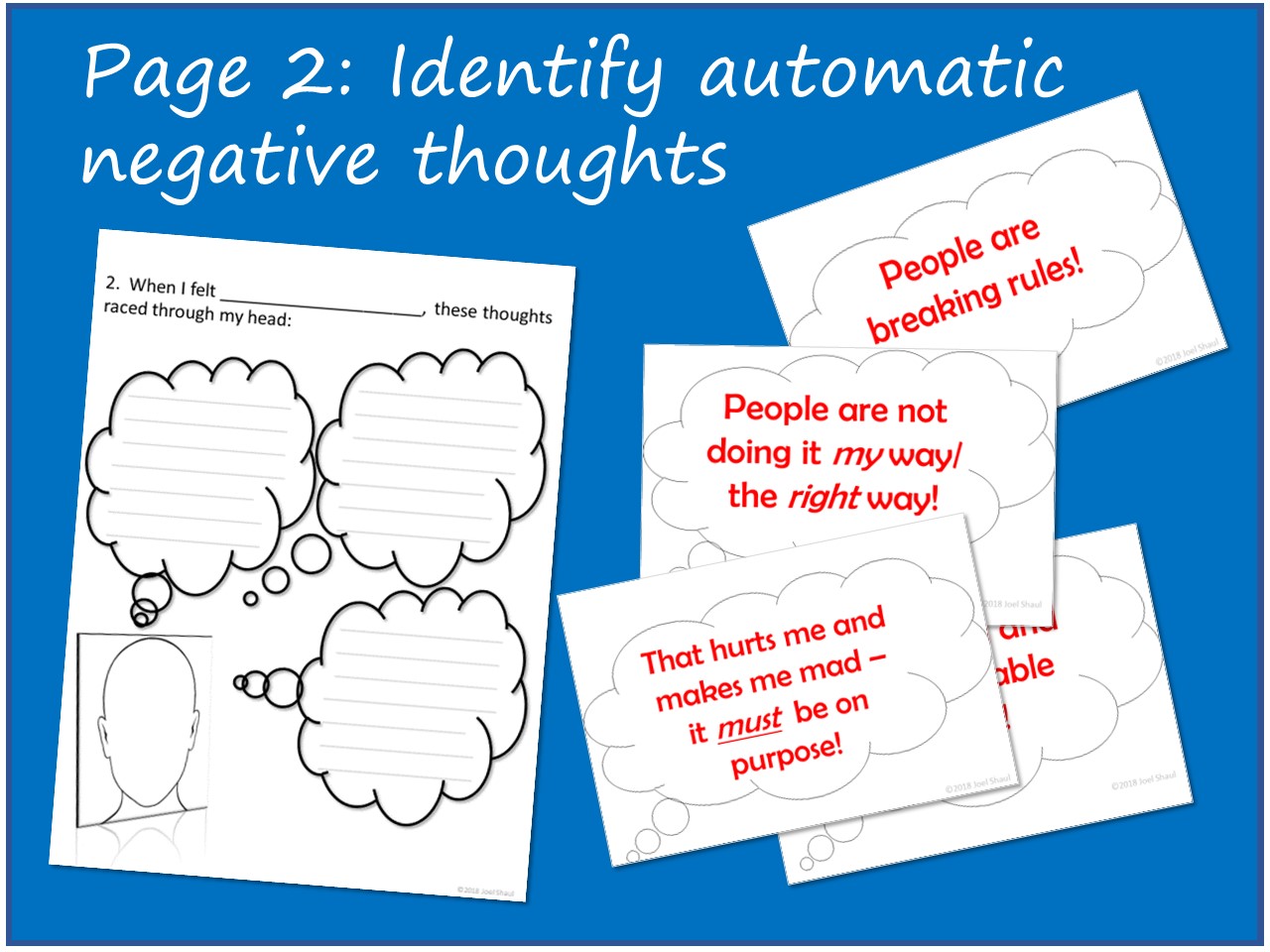
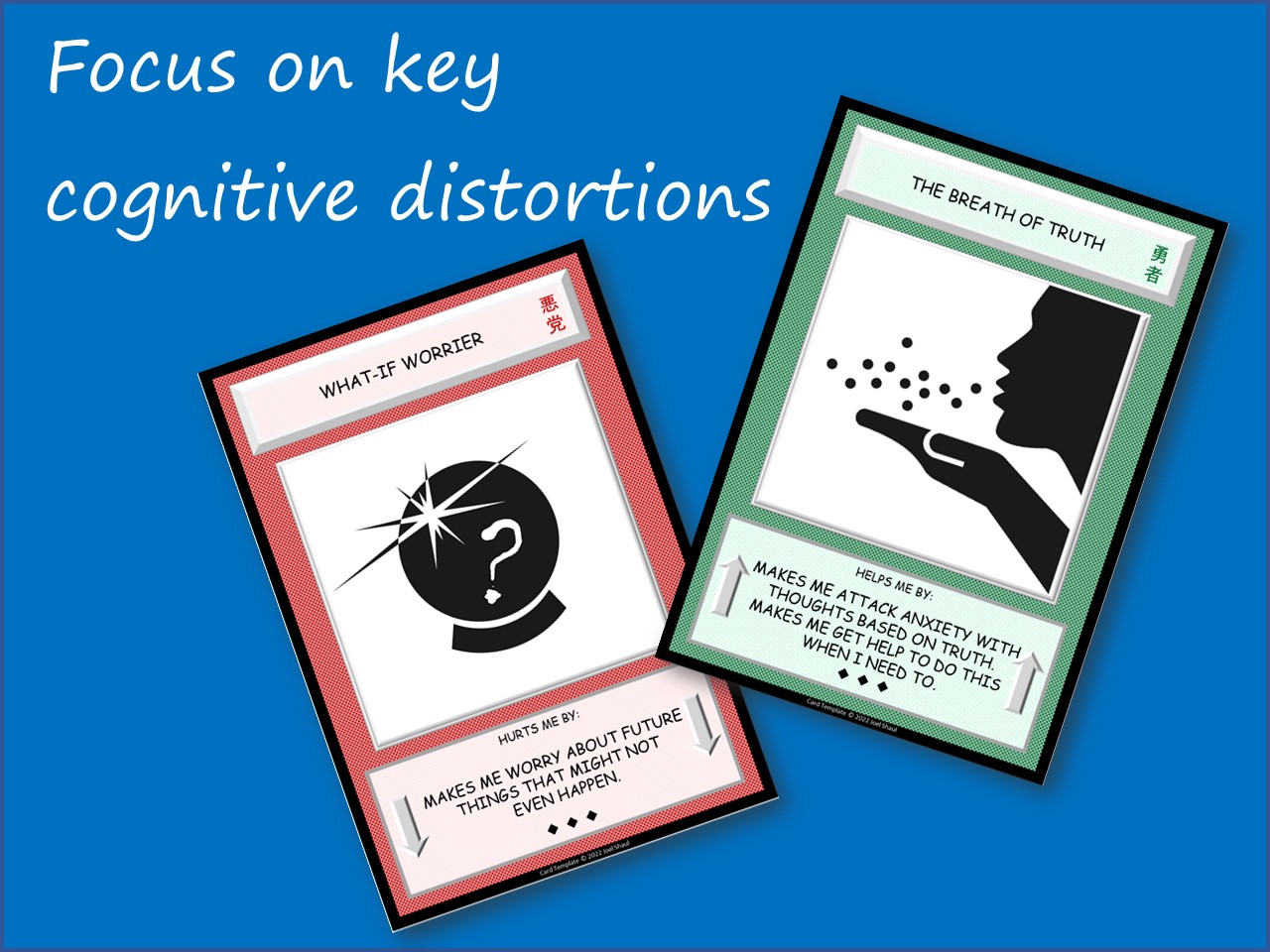
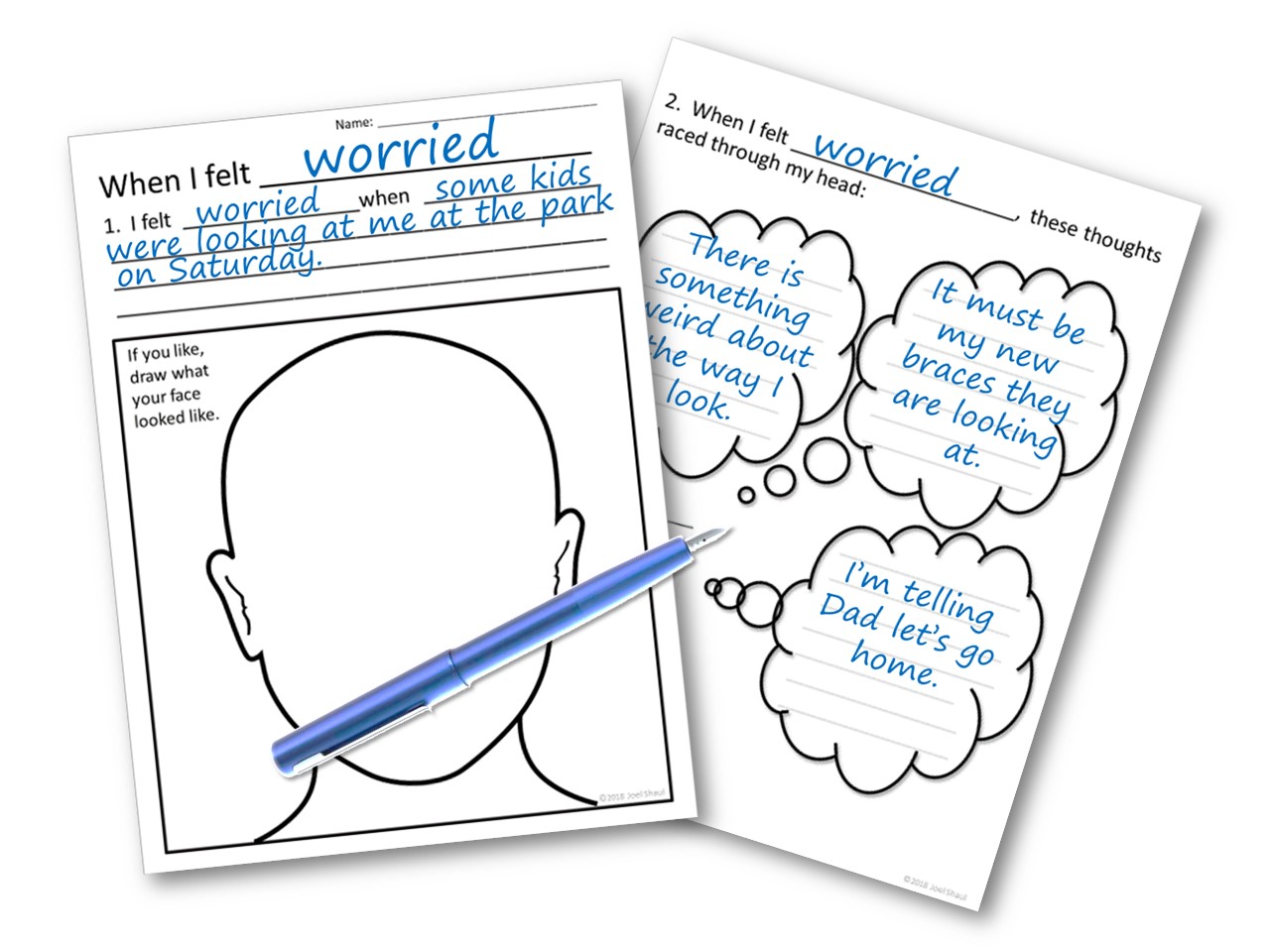
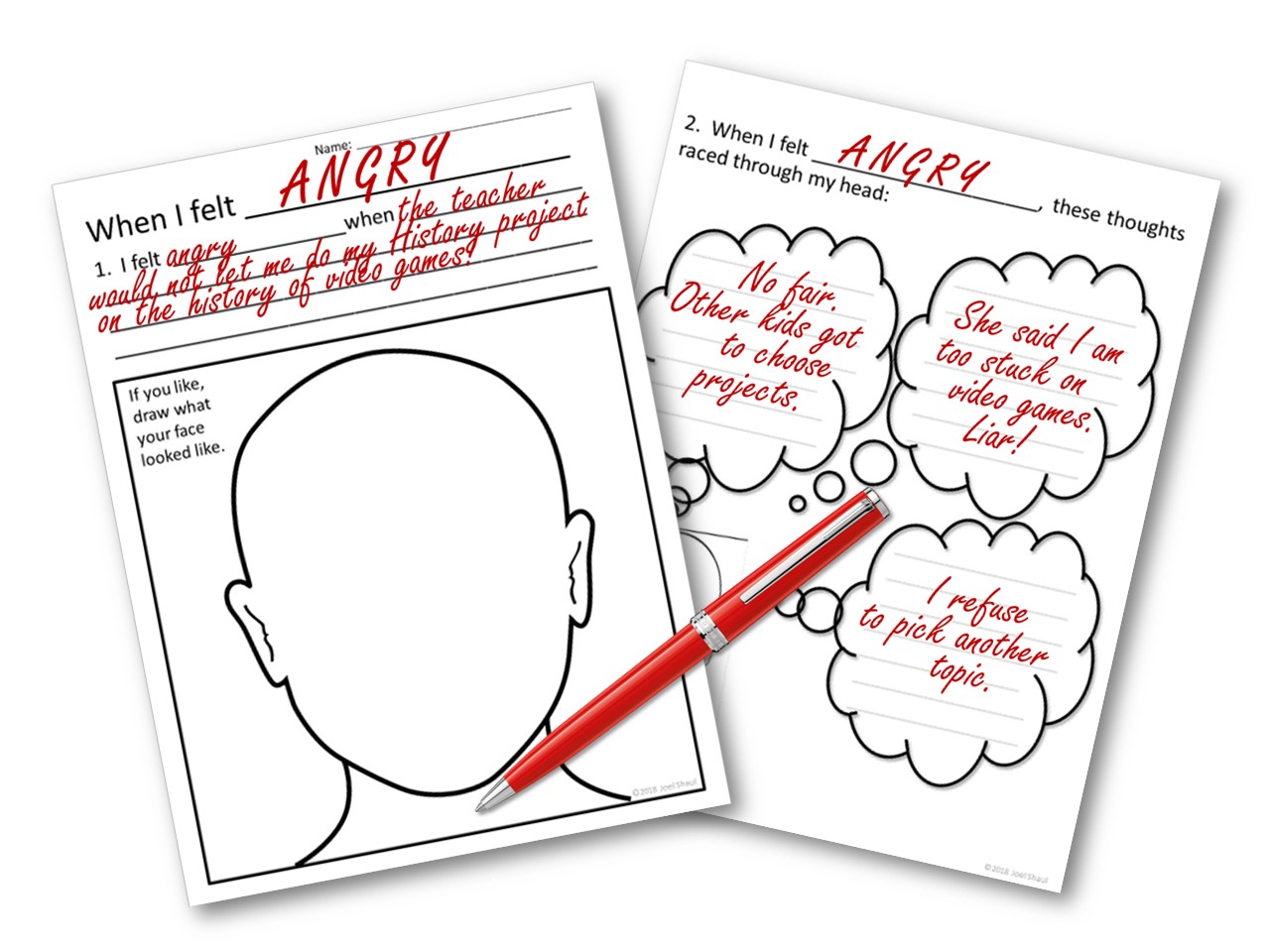
Identifying automatic negative thoughts, which I call “poison thoughts” in my own work, is challenging to learn, even for many adults. But it is surprising how many children can get really good at it. To practice it, I suggest you return to the series of 8 Simple CBT Videos, or access the free download of 48 Cognitive Distortion Thought Bubbles (printable or screen-based version). For additional, game-like incentives to identify “poison thoughts,” you can try these free Poison Thought Cards or using Mr. Yuk stickers.
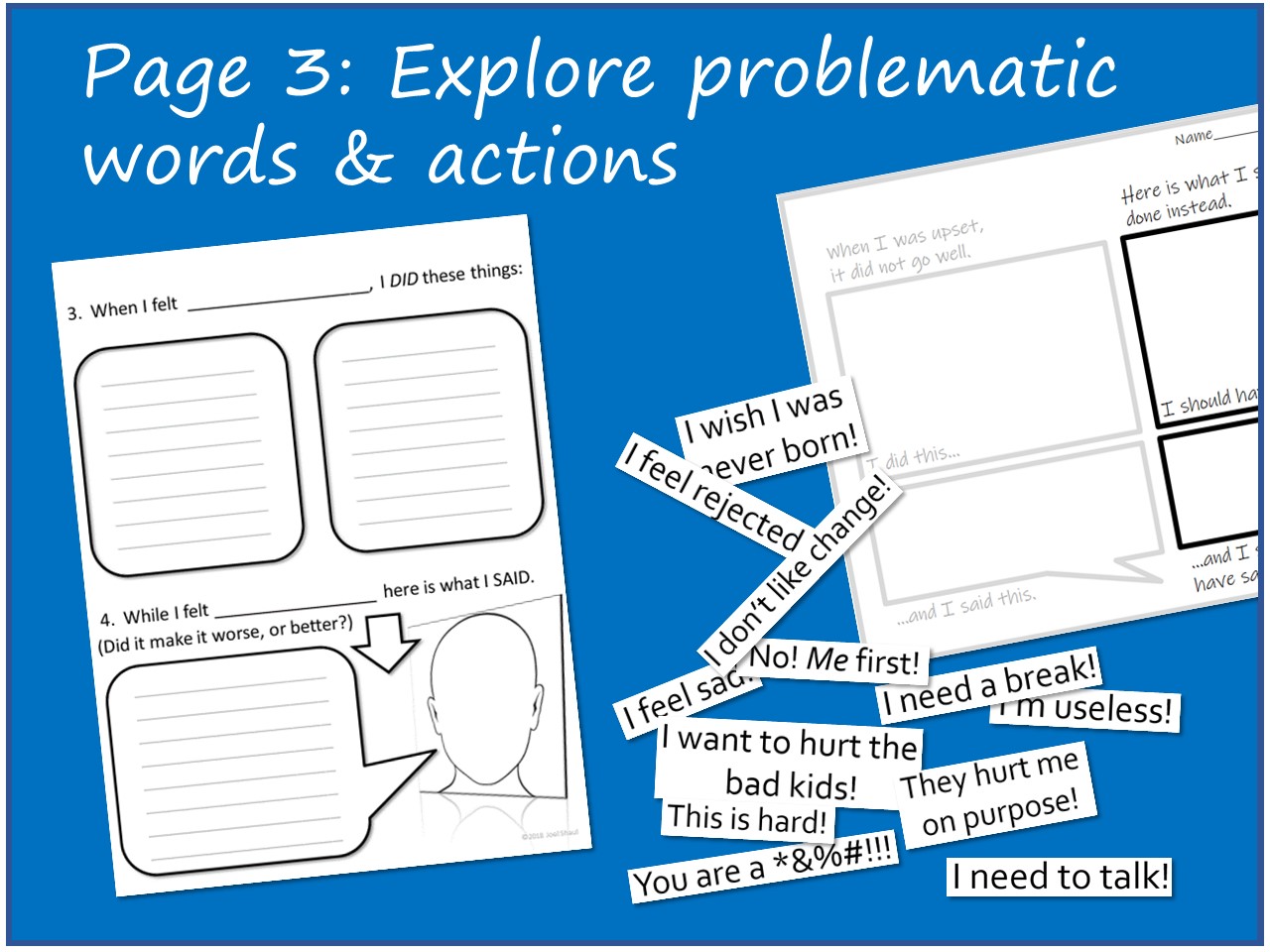
Page 3 is to help the young person to focus carefully on their specific words and actions during their episode of distress. There are two downloadable resources that help with this (both available in both printable and screen-based versions), Filter the Upsetting Thoughts & Words and the What I Should Have Done Different worksheet.
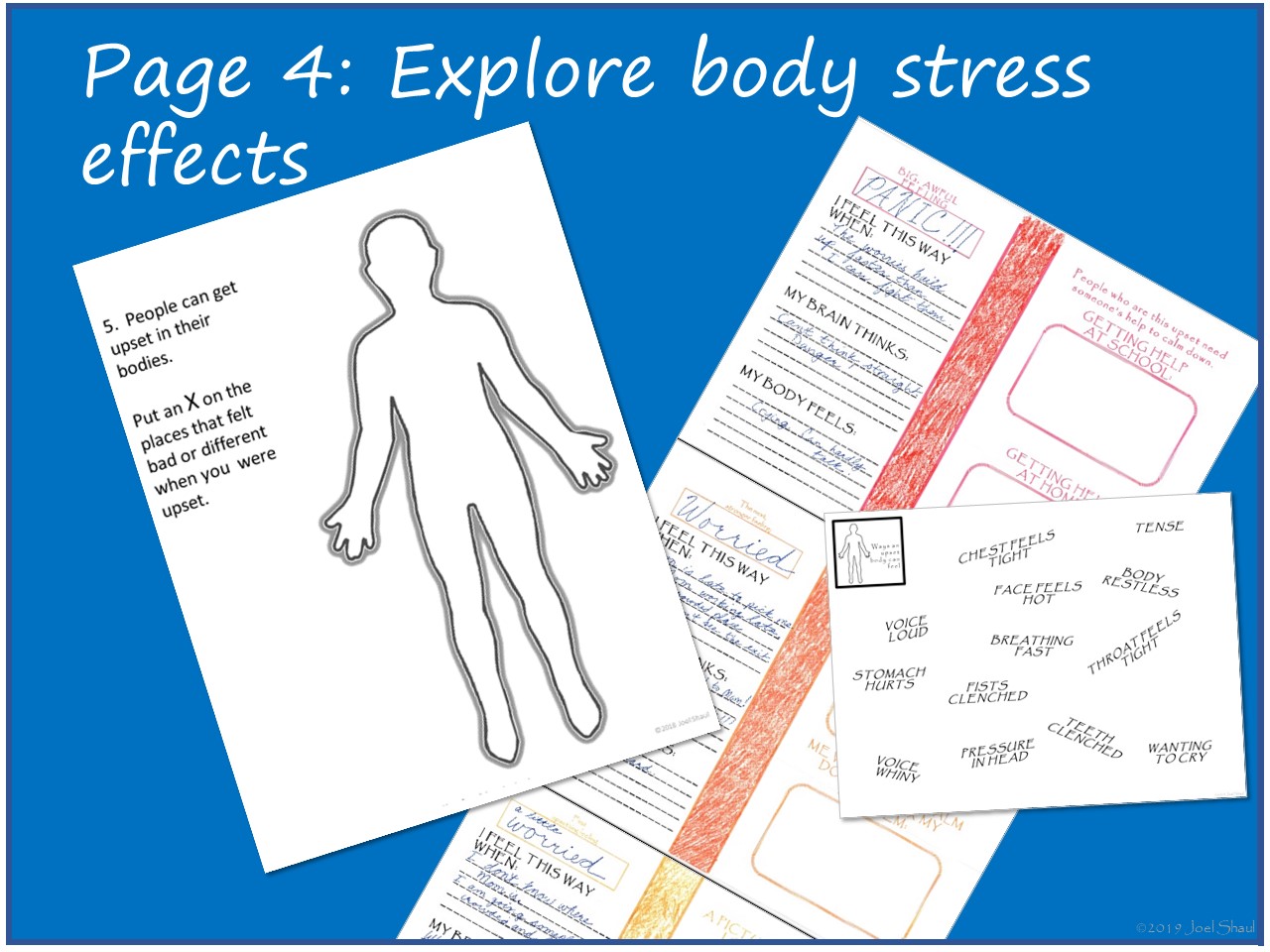
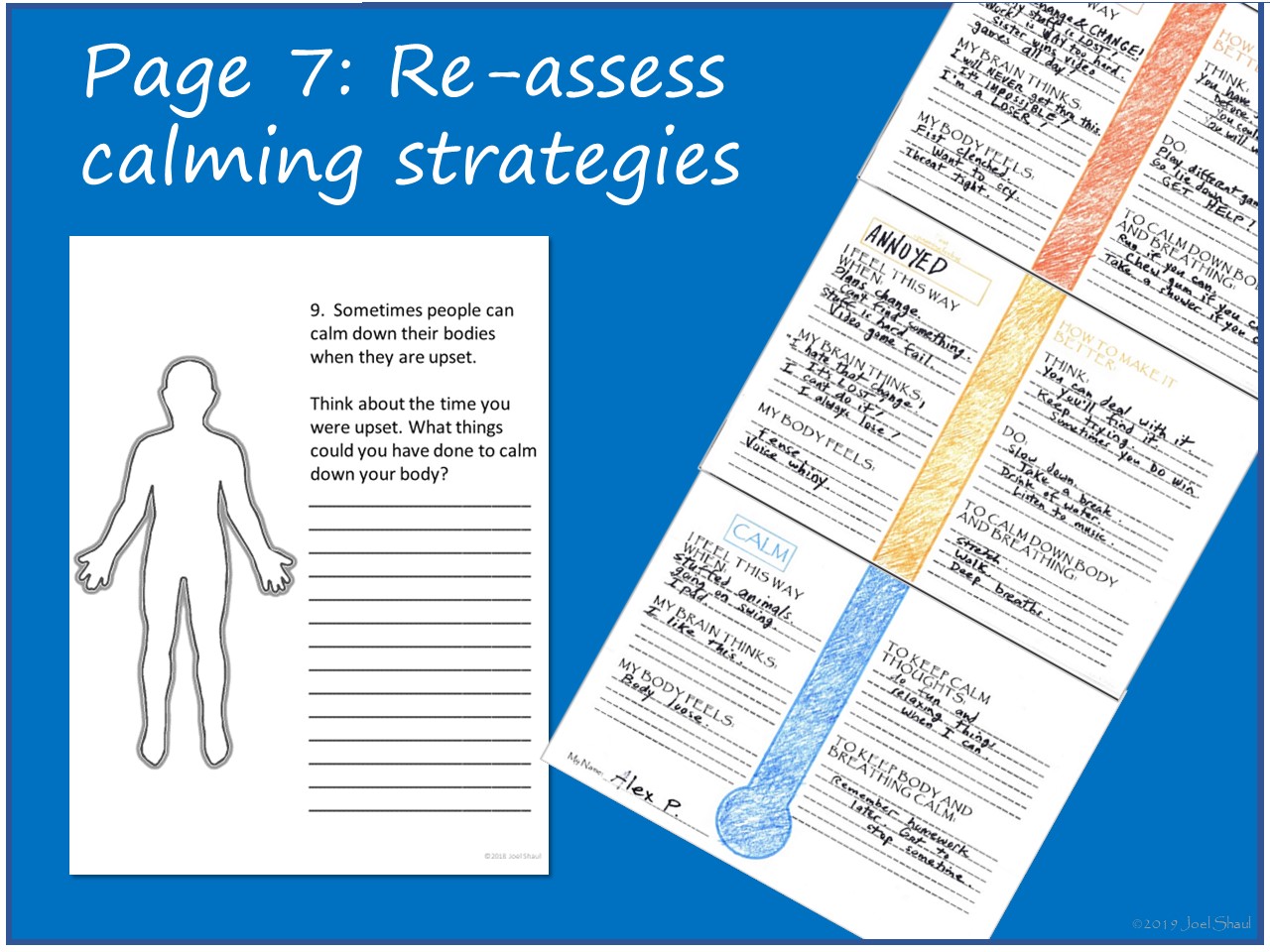
Depending on the child, gaining understanding of bodily manifestations of stress can be significant or the most important part of the work. Shown in the picture are two components of the free download of the Emotion Thermometer.
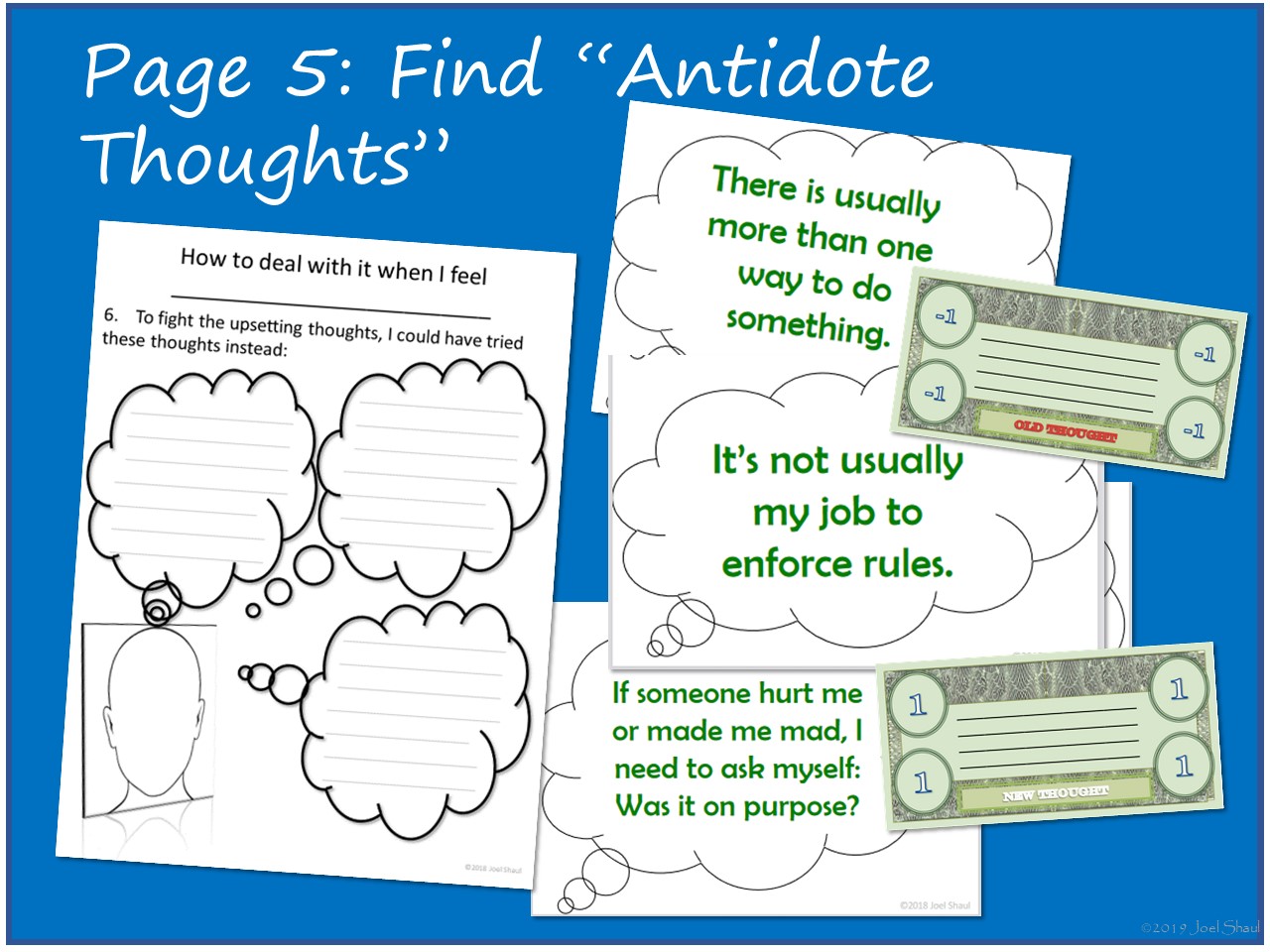
Correcting cognitive distortions, or “creating Antidote Thoughts,” is the work carried out on page 5. Two of my free resources are helpful with this step, 48 Cognitive Distortion Thought Bubbles and the Mint the New Thoughts Kit. Both are available in both printable and screen-based versions.
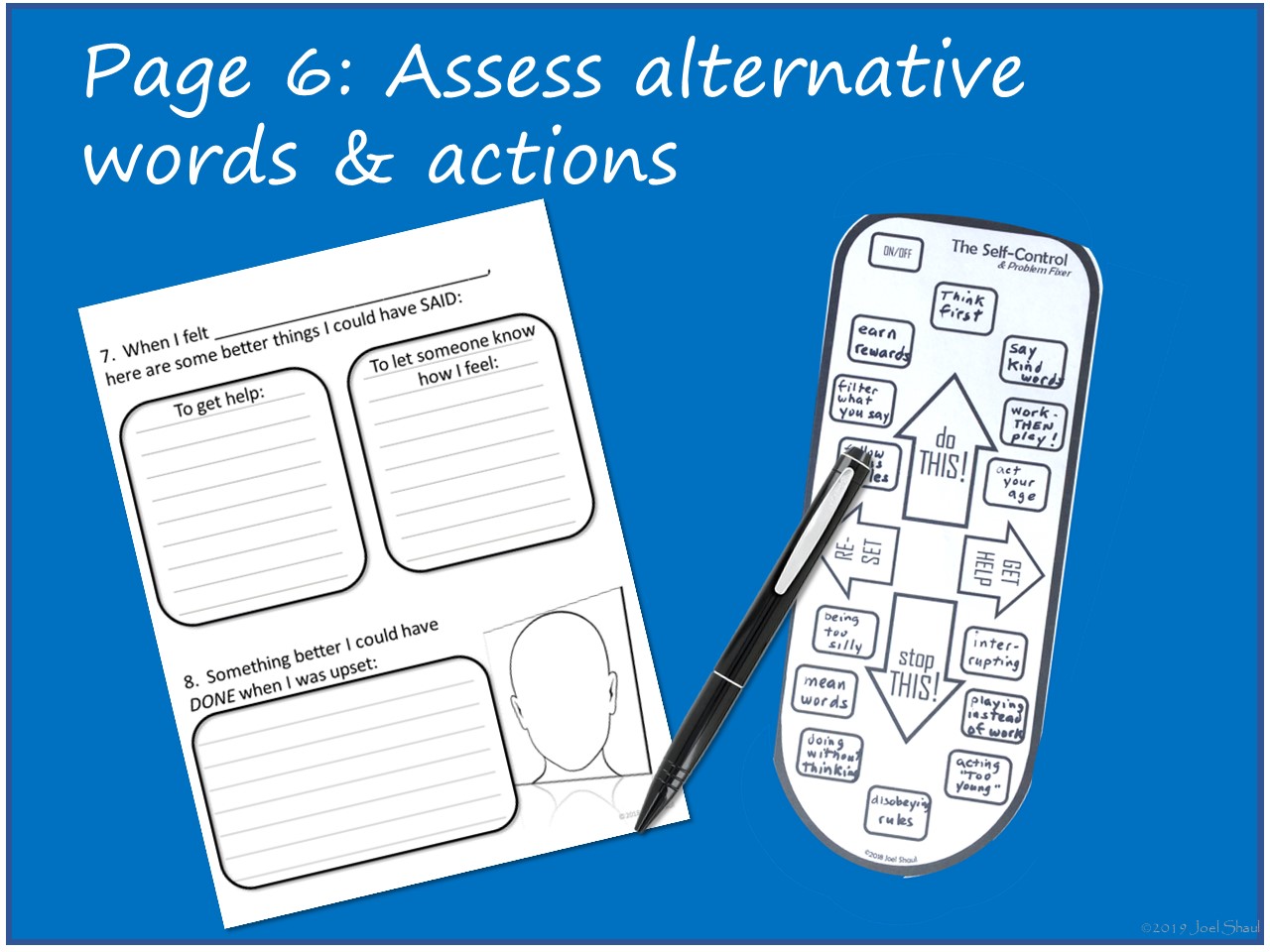
Once the child has explored alternative ways of thinking, we move on to alternative actions and words. A resource to consider for increasing awareness of different ways to behave is Self-Control Problem Fixer.
The final CBT worksheet is a companion to page 4. Displayed here as a suggested related activity is the same Emotion Thermometer shown on page 4.
Additional suggestions for using the CBT worksheets
*It is not a requirement that children draw the face on page 1. Some kids find it helpful, others not.
*Pay close attention to whether the child wants to do their own writing, or if they would prefer that you write as they dictate. There is no downside to the adult actually doing the writing (or the typing in the screen-based versions).
*There is quite often no need to go through each worksheet in the series. I recommend in fact that you don’t put all the worksheets down in front of the child all at once. Get out the worksheets one at a time, and be prepared at any time to switch away from the worksheets into purely spoken exchange, watching a video, or focusing more on one of the other downloads.
*There are many ways to tailor CBT to the needs of children and the learning styles of individual children. Here is an illustrated review of factors to consider when doing CBT with kids.
I wish you success incorporating CBT resources and concepts into your own work with children.
Joel Shaul
The filled-out CBT worksheets shown below I created myself to represent a few typical problems you might encounter doing CBT work.