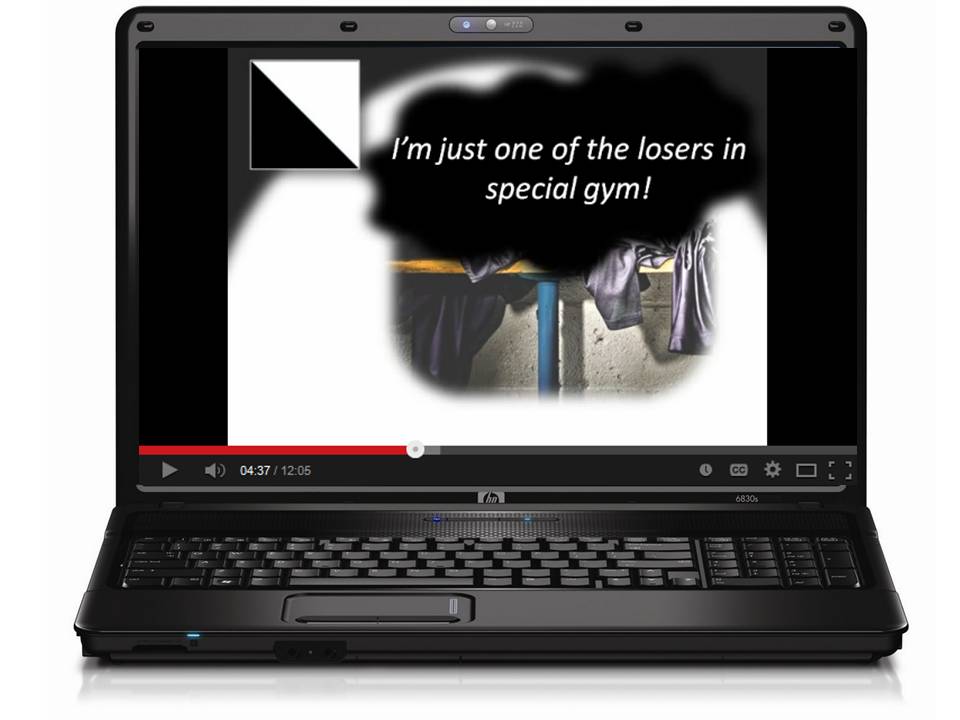

Cognitive-behavioral therapy teaching materials for children with high functioning autism: Many engaging activities with free downloads

Cognitive-behavioral therapy and children with high functioning autism

I have posted an extensive amount of free cognitive behavioral therapy materials on the website.  The following post is to summarize them in one place and provide more convenient links to each of them.

Many are available in screen-based / teletherapy versions. Some are available in translations.

To be connected with each free resource, click on the IMAGE.
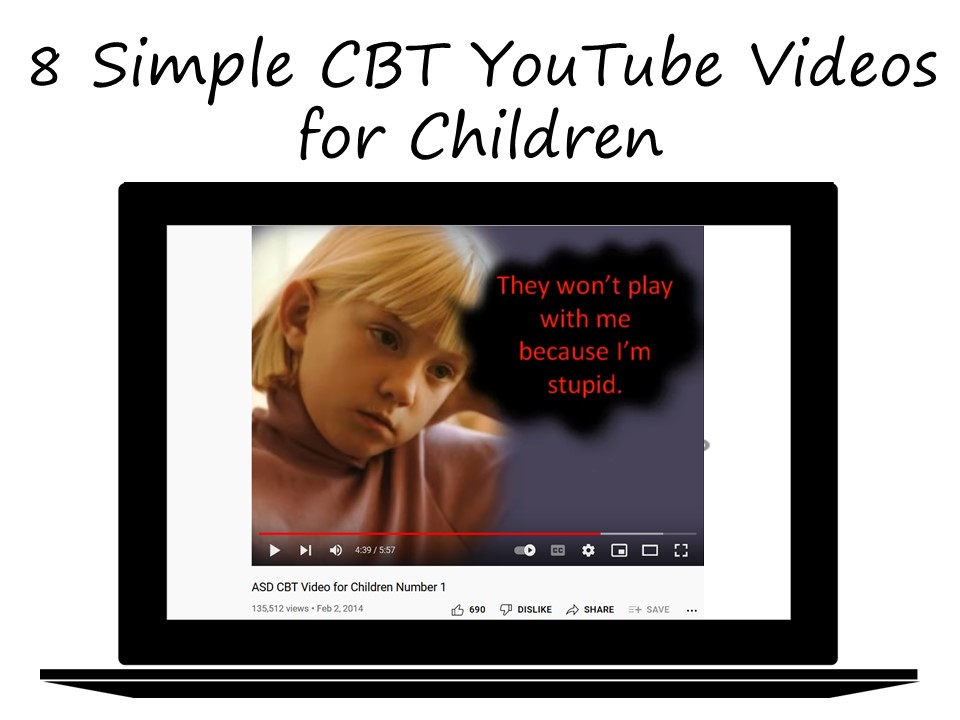
CBT videos for children

If you are just beginning to explain the basics of CBT, I really recommend you watch the first video in this series. It is short, very visual, and clear. The subsequent videos focus on specific categories of automatic negative thoughts, which I refer to as Poison Thoughts.

Here is a concise guide to using the CBT Videos which you should find helpful.
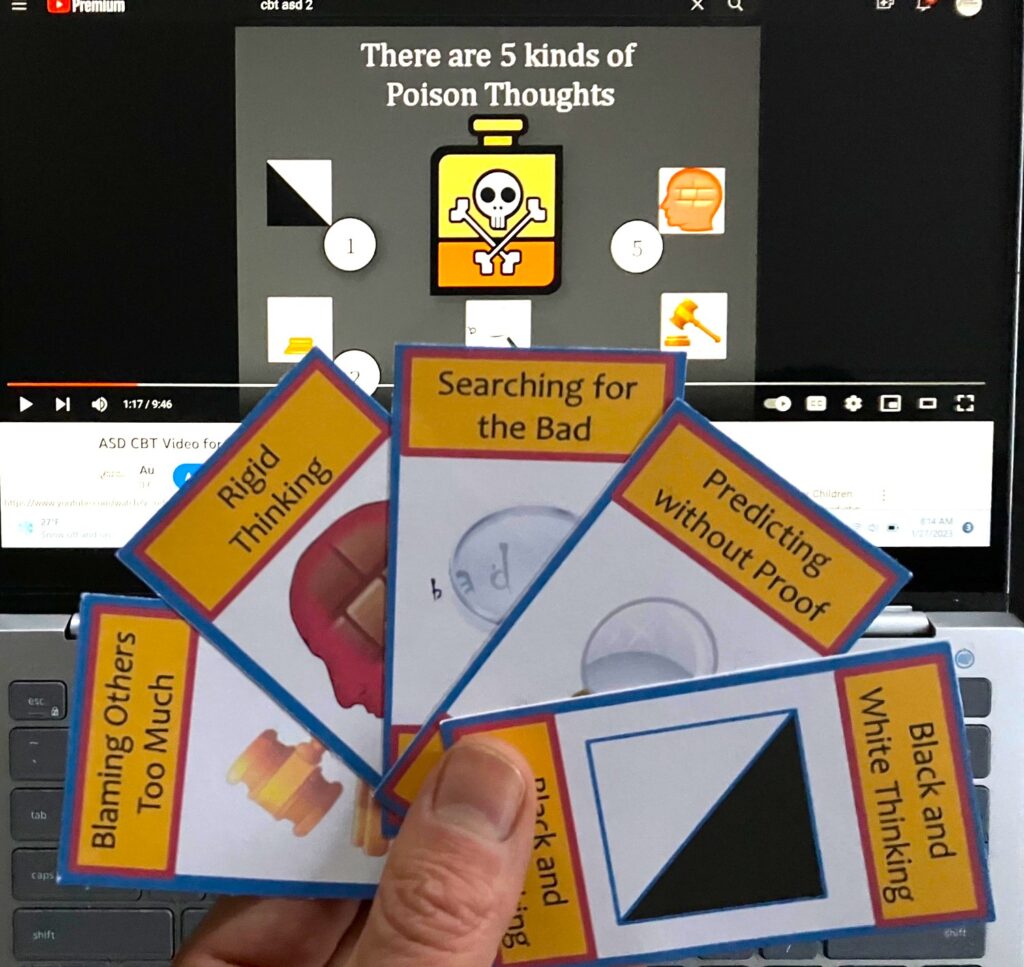
CBT Cards to use with the 8 CBT Videos

Download and cut these out. They are very handy to use while viewing the 8 CBT Videos. The download includes suggestions on different ways to use them.
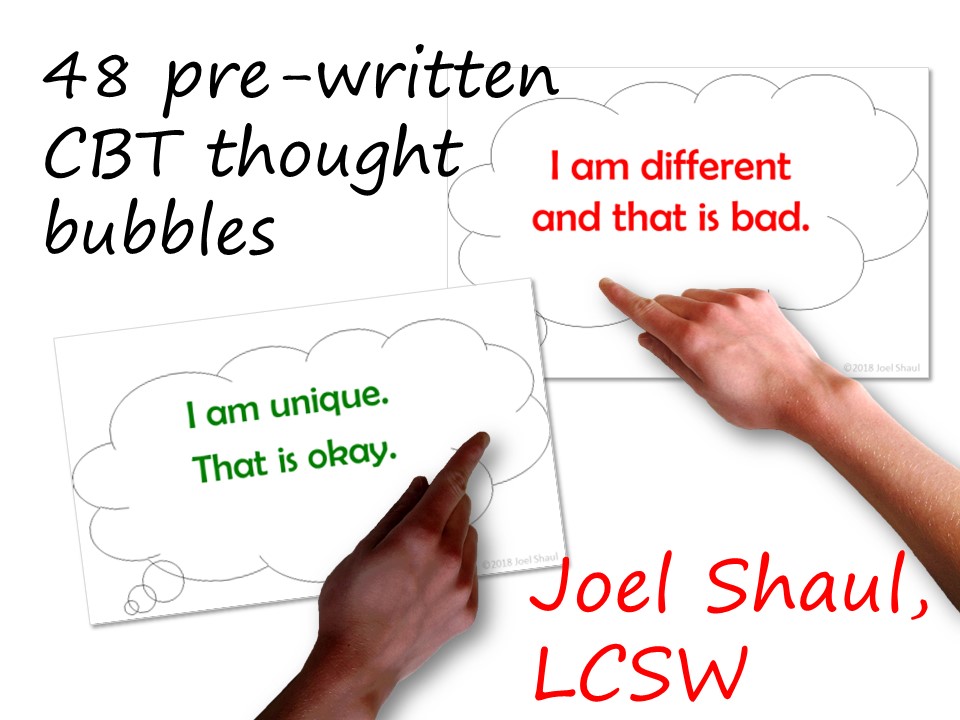
CBT Thought Bubbles, printable and screen-based / teletherapy versions

These have many uses. You can print them and leave them lying around during sessions. You can put them on the wall. The screen-based version is very useful for groups or for teletherapy.
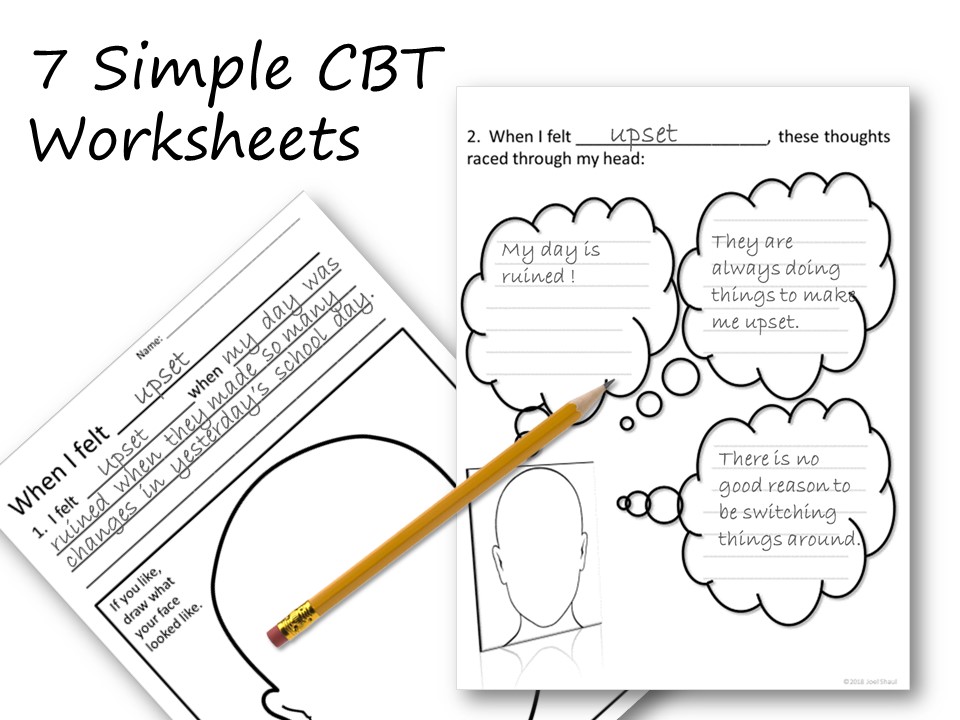
CBT Worksheets for children

I created these years ago because all the CBT worksheets I could find lacked visual elements and required children to write too small. The teletherapy versions of these are very useful, especially the Boom Cards version.

The CBT Worksheets are available in several translations.
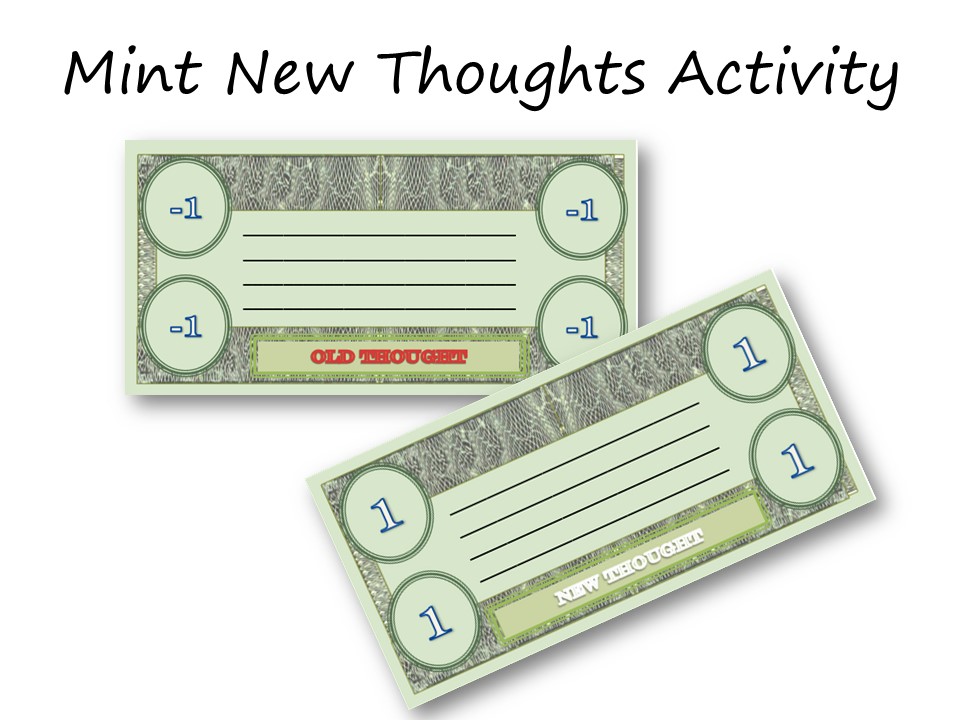
 

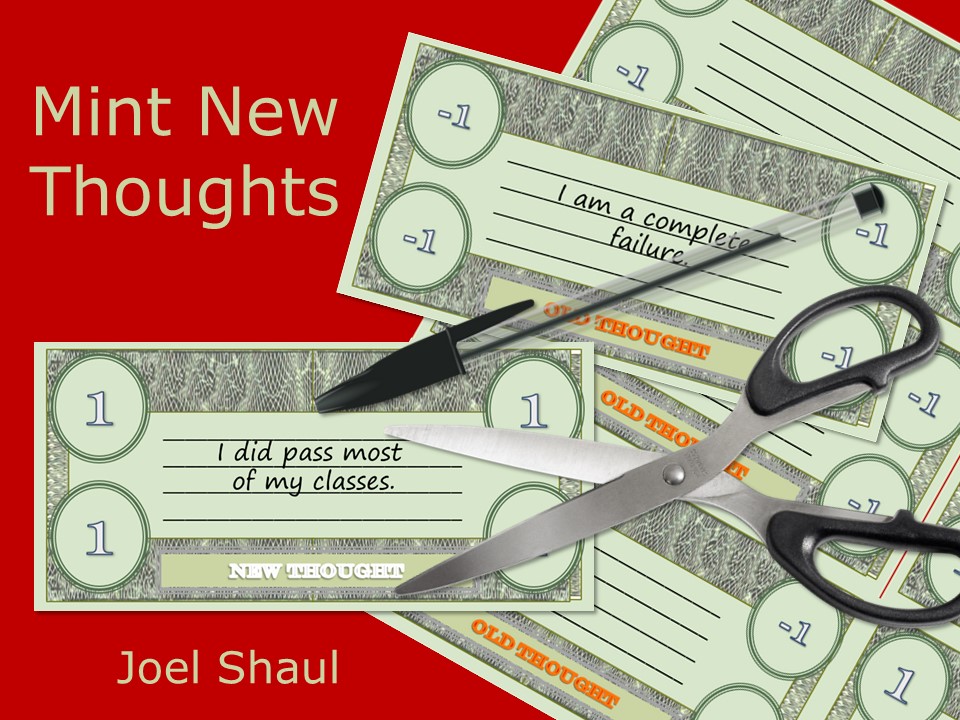
Mint New Thoughts CBT Activity

This is a CBT extension activity. You explain to children how they can create new thoughts to replace flawed ones, just like they do when printing currency. The Boom Cards version of this is particularly good and very useful in teletherapy.
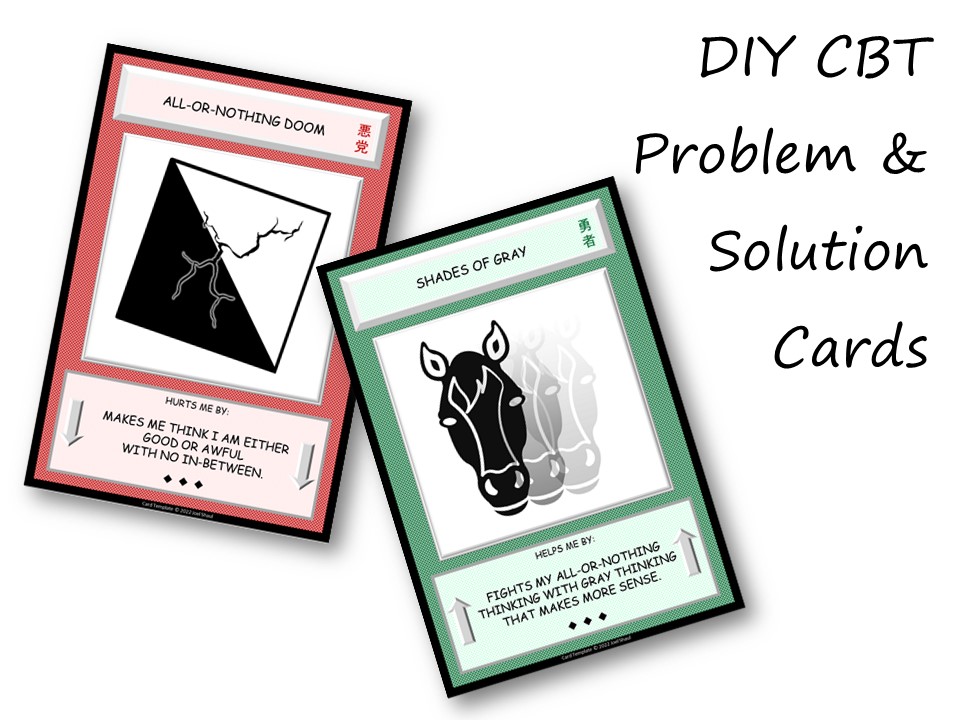
DIY CBT Problem & Solution Cards

In PowerPoint, using my prepared template, text boxes and drag-and-drop images, you quickly create these cards. It’s easy enough to do with the child present and it works well in teletherapy, too.
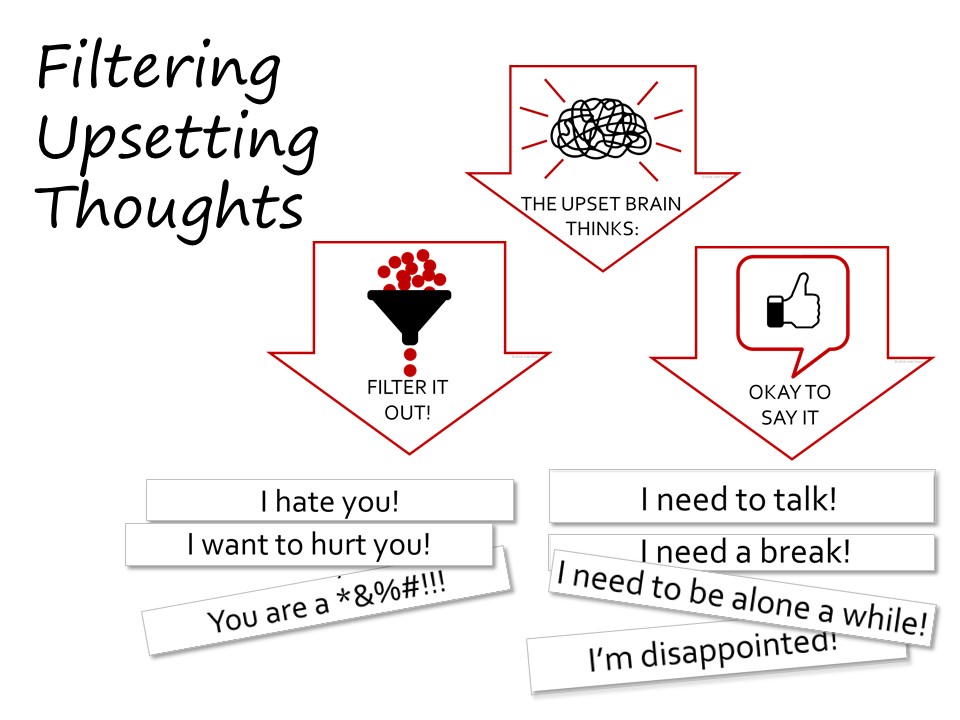
Filter the Upsetting Thoughts Activity

In this hands-on project, you print out dozens of pre-written paper strips showing a wide variety of thoughts that a person might have when they are feeling upset. The child sorts these into categories based on whether they are useful statements or unfiltered thoughts turned into words that may make things worse.

The teletherapy version works the same way, except you drag the statements around a PowerPoint screen to sort them.
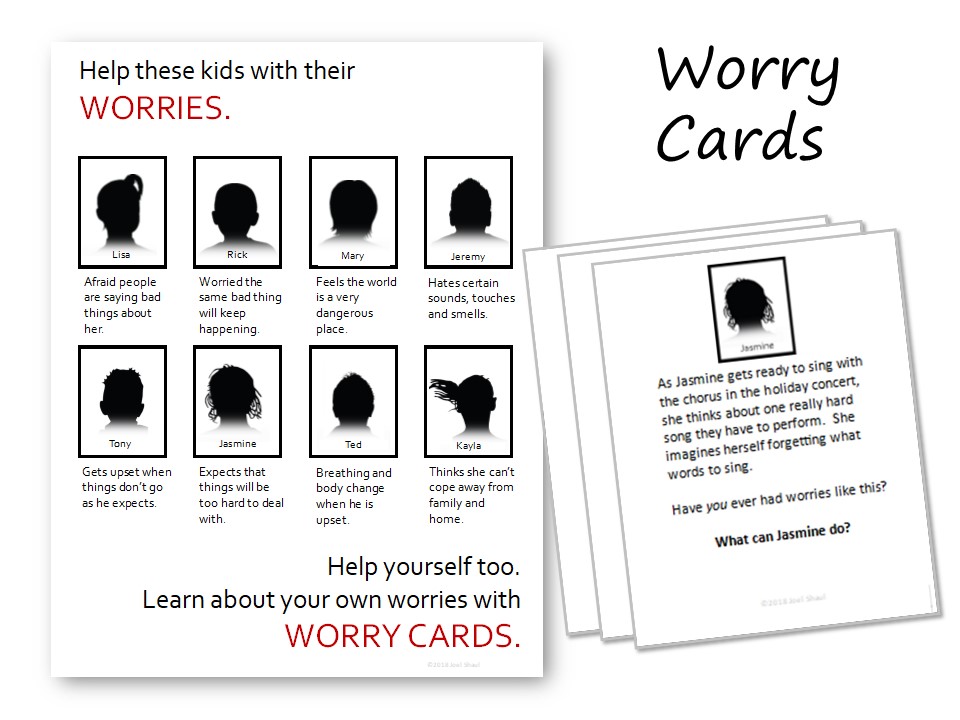


Worry Cards

These problem-solving cards describe ten young people, each experiencing anxiety in a different way.
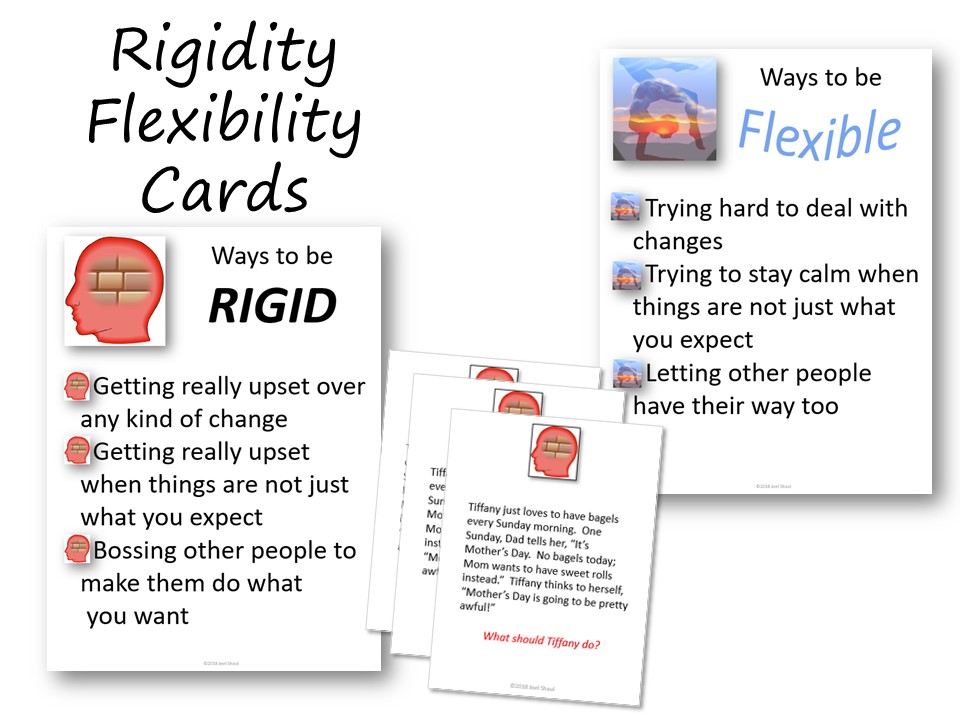
Rigidity Flexibility Cards

These problem exploration cards explore multiple manifestations of rigidity in a number of hypothetical children.
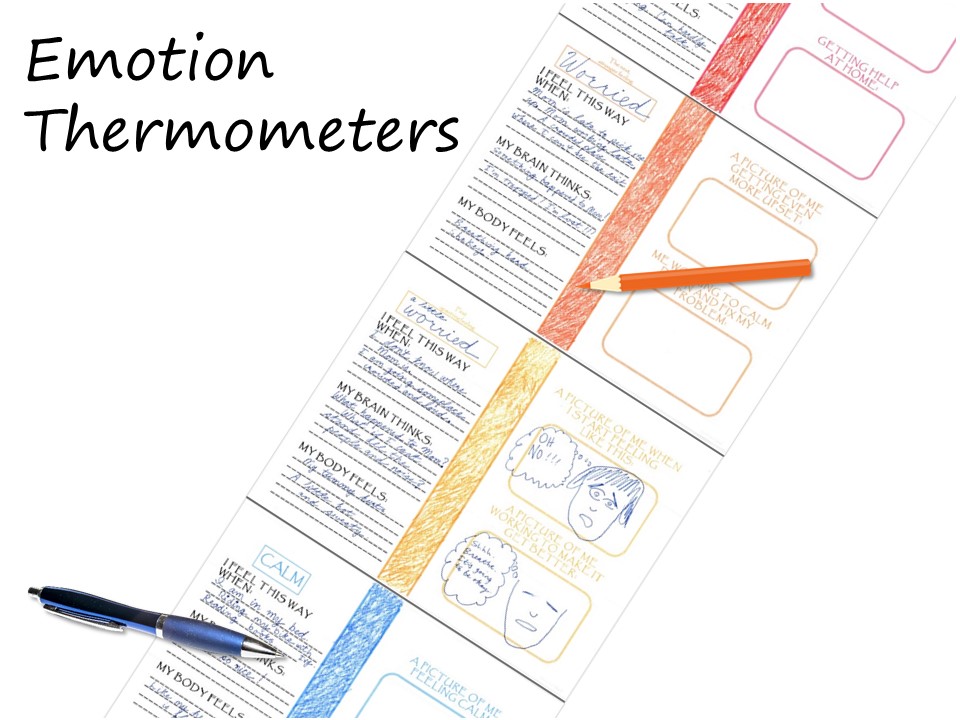
Emotion Thermometers

These large format emotion thermometers include blanks for children to customize them with words and drawings.
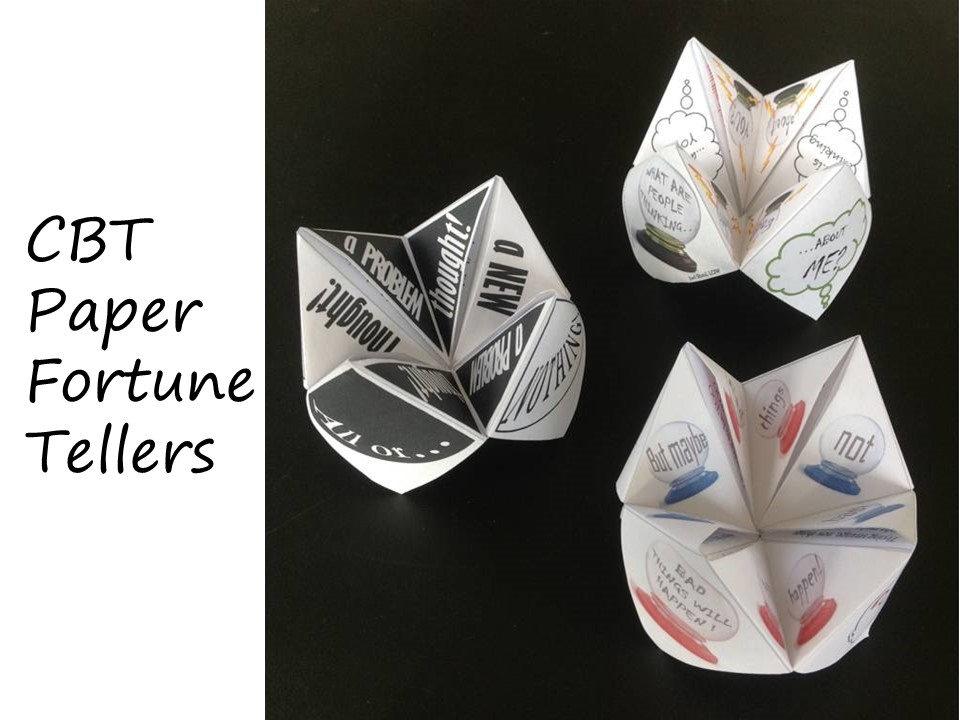
CBT Paper Fortune Tellers

These three paper fortune tellers explore anxiety and black and white thinking.
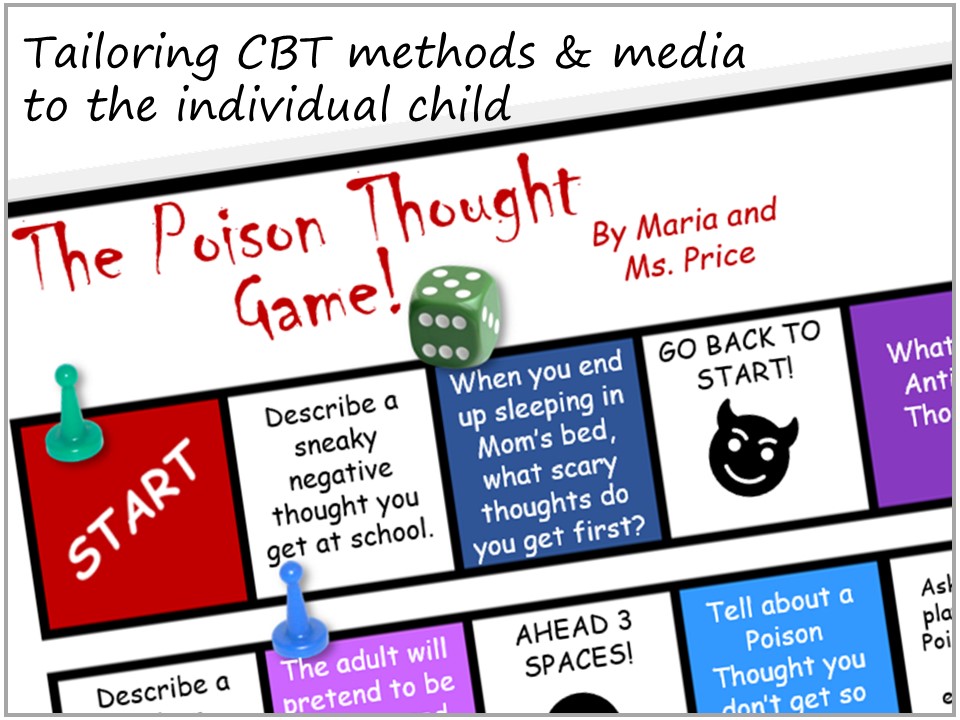
Tailoring CBT to the Individual Child

This illustrated tutorial explores how to take the individual child’s abilities, preferences and temperament into account when planning CBT interventions with children. This includes clickable links to resources, including the one shown in the picture above.

Joel Shaul, LCSW


Green Zone Book Cover Click to Learn More


ASD Feel Better Promo square directing to JKP

Teaching children with autism the social skill of discerning silly from serious

social skills training activity

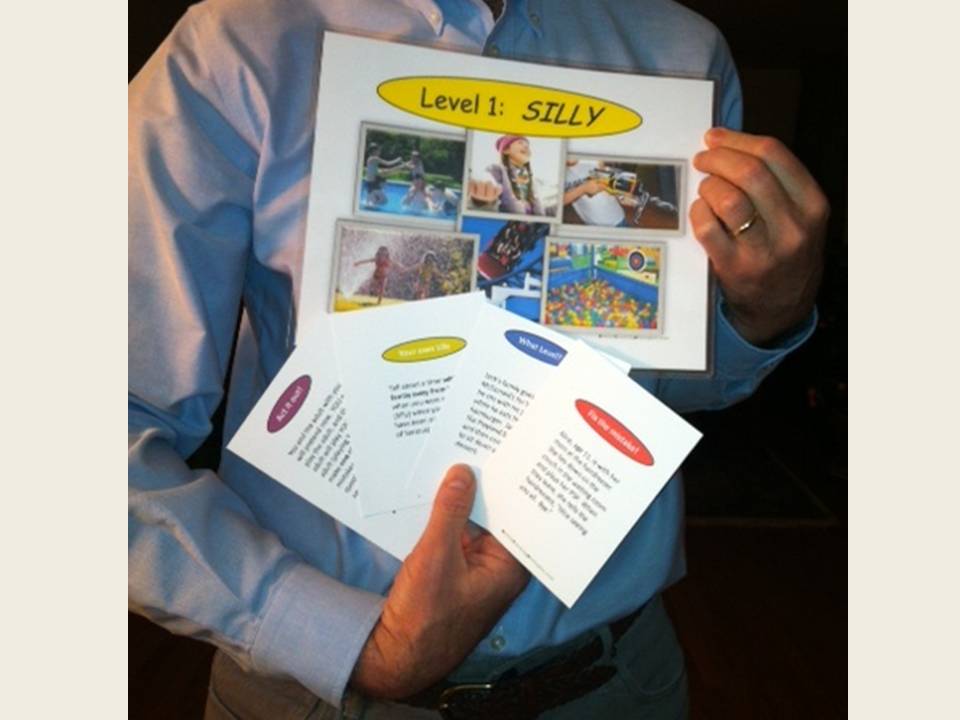
Silly to Serious Set placement featured image 2020A free downloadable kit to help children with ASD to increase awareness of different levels of formality

Silly to Serious Explanation and Panels

Silly to Serious cards only

Silly to Serious Set, PowerPoint Version

This is also available in Polish

Young people with other autism spectrum disorders often struggle to understand what I call “levels of formality” in social situations.  In a milieu where a serious bearing might be indicated for a child, a young person on the autism spectrum might behave and speak in a casual and informal manner.  For some kids with ASD, the opposite can occur also, and they can at times act too proper around peers where more laid back words and actions would be more appropriate.

There are several reasons why children on the autism spectrum find this set of social skills hard to grasp.  First, they tend to not easily understand the subtleties of social hierarchies and how they themselves rank within them.  Second, a child with ASD often tends to  have difficulty making quick shifts in attention, so if such a child is transitioned suddenly from, say,  playing Wii to meeting Mom’s boss who has just stopped by the house, the child might find it extremely difficult to alter his behavior and words quickly enough.  Third, many kids with autism have difficulty regulating extremes of emotion.  Exerting control over feelings of excitement can be hard for them.

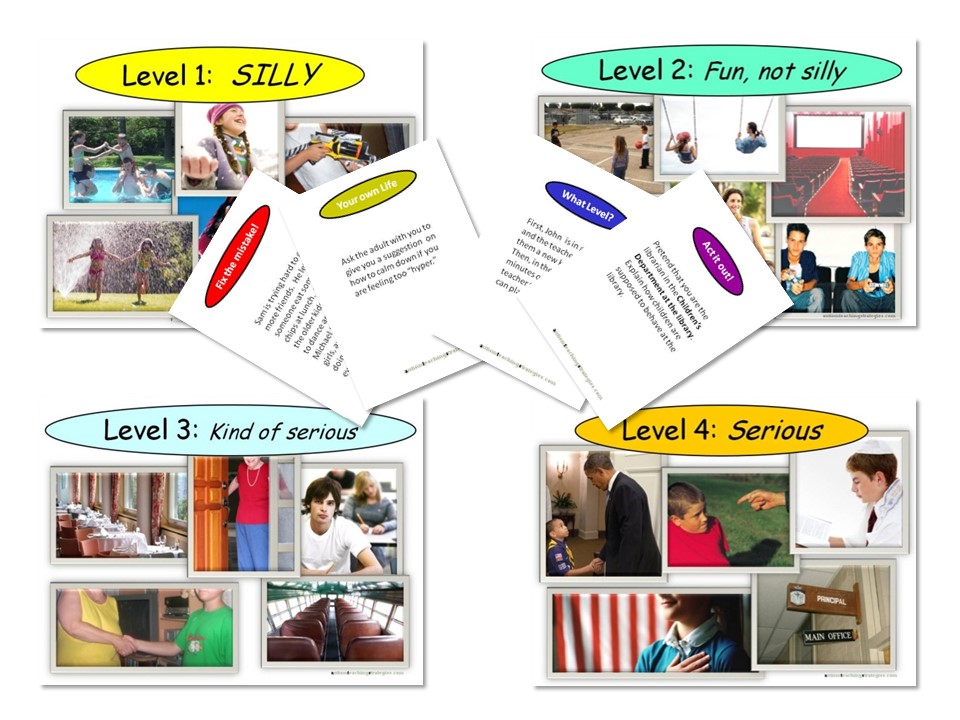
To help children with ASD to learn this social skill, I find it very helpful to divide levels of formality into four different levels.  They are basically defined in the visual above.  Then, you can help the child by saying, “We’re going into Chucky Cheese.  You can be level 1 in there.”  Or, at a big family get-together, you can help the child by saying, “In the backyard pool, that’s a level one. When we go inside to see great-grandpa, who is sick, that is a level 3.”

What is included in the Silly to Serious Card Activity:

1. A set of eight 8 1/2 by 11 illustrated panels

components of this ASD social skills activitiy
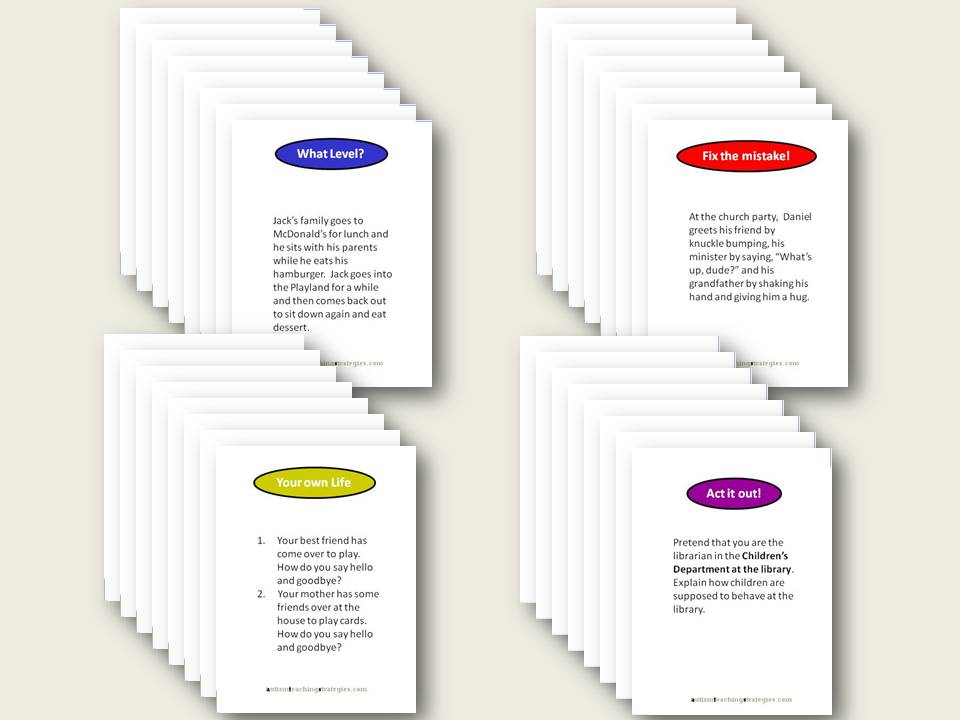
These are the Silly to Serious visual and word prompts for the four levels. You post them on the wall or lay them on the floor. The visuals shown here can be used alone with kids on the spectrum for social skills lessons. Printing out the socials cards below is recommended if you want to make a game out of it.These are the Silly to Serious social skills cards. There are 32. Each card poses a question or sets up a role play.  These are the Silly to Serious social skills cards. There are 32. Each card poses a question or sets up a role play.

 2. A set of 32 question cards you use in a game-like format to increase awareness of levels of formality in diverse social situations.

social skills game cards for kids with Asperger's

How to introduce the activity:

“People can’t be serious all the  time when they are around other people.  People can’t be silly all the time either.  They have to be the right amount of serious or silly, depending on who they are with and what is happening.”

Now, show the Level Cards to the kids and help them to understand the varieties of social situations within each of the levels.  Practice greetings and goodbyes within each of the levels.  As you get into this, you may easily find you have enough to do for one or two classes or sessions without even getting to the card activity.

“We are going to play the Silly to Serious game.  There are four different kinds of cards in this deck, and when you draw a card you have to do what the card says.

If you draw a “What Level” card, you have to figure out which of the four levels the person in the card is going through.

If you draw a “Fix the Mistake” card, you have to find out how the person in the card is either too serious or too silly and then fix their problem.

If you draw a “Your Own Life” card, you have to answer the question about about YOU.

If you draw an “Act it Out” the card, you have to act out what the card tells you to act out.”

I hope this social skills activity is helpful for you.

Joel Shaul, LCSW

Your comments on these resources are most welcome, and often helpful. Click HERE to send an email.

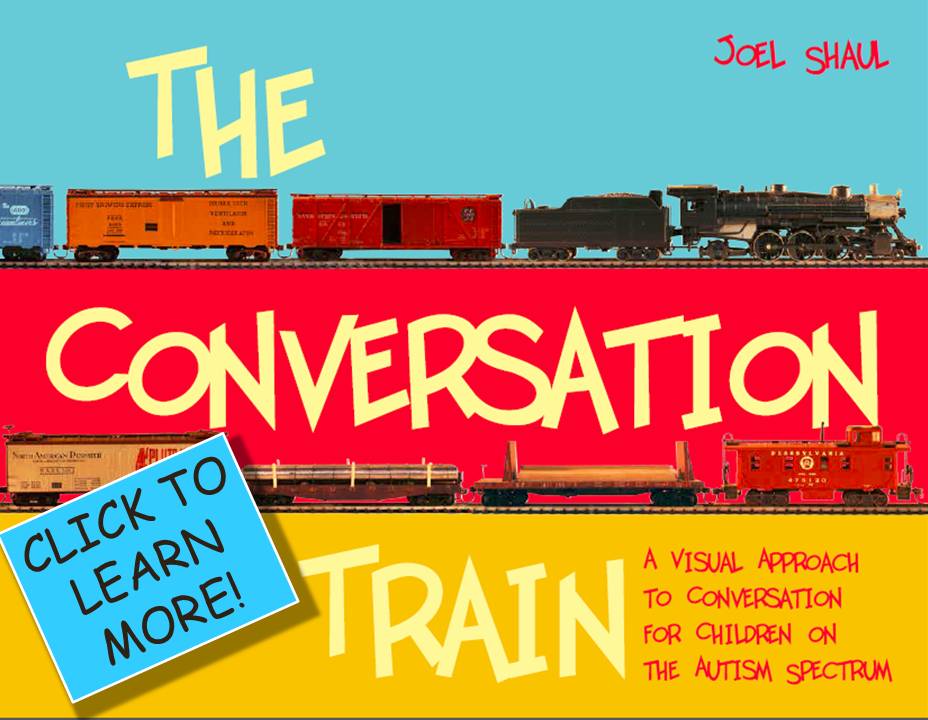
The Conversation Train Book
Green Zone Book Cover Click to Learn More

Missing Objects Game–Social skills therapy for kids with ASD

This is an easy, fun and very useful social skills game to help kids on the autism spectrum to  learn how to encourage others.  Children on the autism spectrum often need help learning to use kind and encouraging words.  This is a “game within a game.”  The object is to remember what item is missing when it is removed when the player is not looking.  The underlying game is to “score” lots of encouraging remarks to the other player when they are playing and it is not your turn.

To download the encouragement word prompt cards for this activity, click HERE.

To download the on-screen / teletherapy version of this activity, click here.

To access the Boom Card version of this activity, click here.

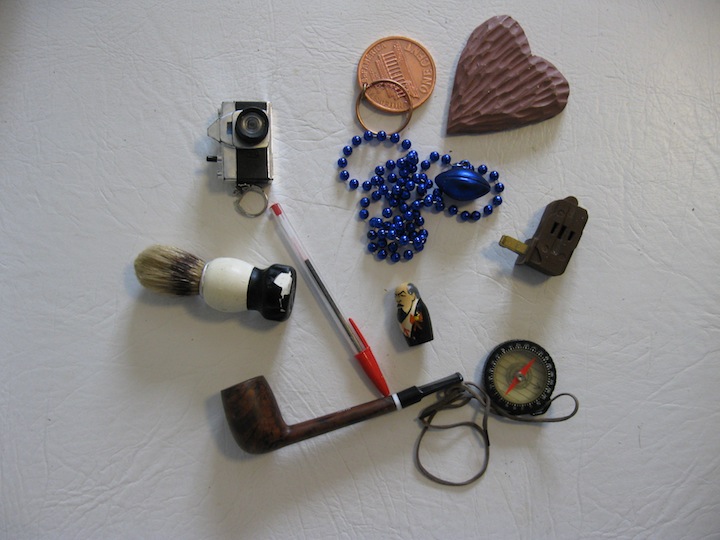
  1. Assemble a collection of eight to twelve very small objects (very small toys, or even just assorted items out
    of a desk drawer).


    Missing Objects Game, a therapeutic game to teach children on the autism spectrum the social skill of encouraging others
    Here is the collection of random objects I keep handy so that I can play The Missing Objects Game with kids on the autism spectrum whenever I feel like it.
  2. Print out the Encouragement Word Prompts and keep them handy to display during the game.
  3. Tell the kids:

“We are going to play the Missing Objects Game.  This is a memory game that works like this.  I will place on the table these small objects.  When it is your turn, you will get one half a minute to look at the objects and try to remember them. Then, we will ask you to step out of the room for a few seconds.  While you are out, we will take away just one of the objects.  Then, you must try to figure out which object is missing!  This can be hard!While you are trying to remember what object is missing, the other kids have an important job.  They have to try their best to say nice things to you, to encourage you and to make you feel okay if you can’t figure out which object is missing.  I will keep track of who is being the nicest, and I will decide then who is first, second and third place at being nice and “encouraging” to the person who is trying to find the missing object.”

4.  Hold up the various encouraging phrase prompts to help the kids know what to say to the child who is trying to remember what is the “missing object.”

 I have found that kids really try hard to be the one who does the best “encouraging”  and that this becomes the main point of the game instead of correctly remembering the missing object.

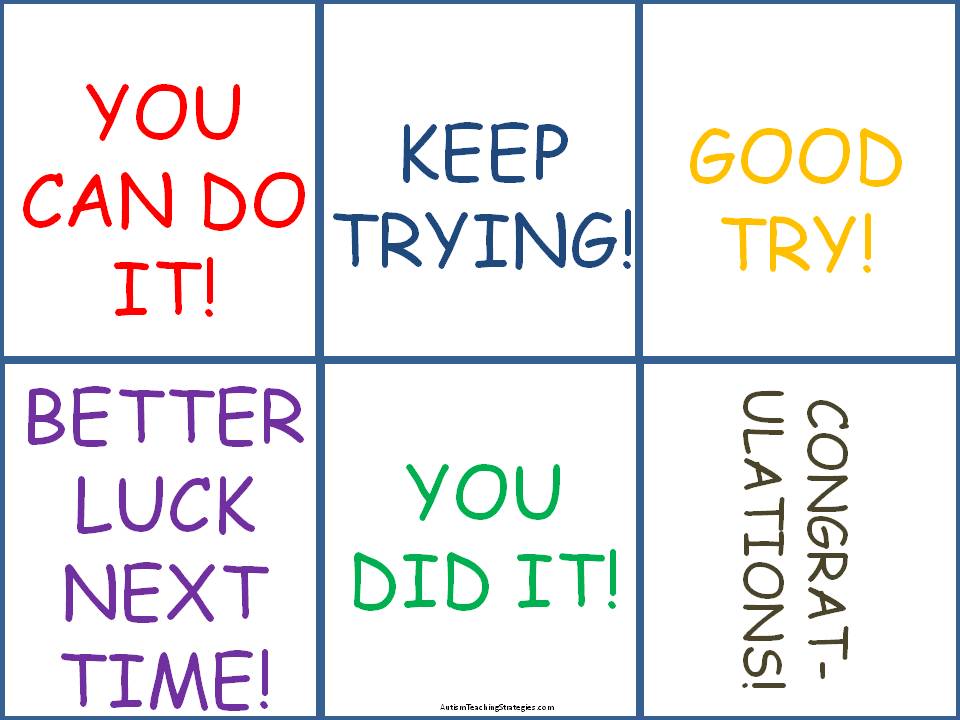
Get out the encouragement prompts to use on other occasions when such skills are called for.

[Reference:  This is derived from a social skills book called Superskills, by Judith Couccouvanis.]

Joel Shaul, LCSW

Your comments on these resources are most welcome, and often helpful. Click HERE to send an email.

The Conversation Train Book

Green Zone Book Cover Click to Learn More


Minting New Thoughts: Engaging CBT Activity for kids with ASD and others

Here is a great activity for individuals or groups of kids to introduce or expand on how to cope with upsetting feelings.  It uses the metaphor of paper money that is first minted, and then shredded if it is defective or worn out. To do the Mint New Thoughts activity you need to print out lots of the special play money (the link for the download play money is found below) and a paper shredder (or you can just tear up the old money).

Print out the OLD THOUGHT money and NEW THOUGHT money in quantities large enough for each participant to have about six to use. To download and print the money, click here:

This kit is available in Polish

Spanish: Acuñar nuevos pensamientos

For free access to an excellent Boom Card version of this resource, click HERE.

To introduce this activity:

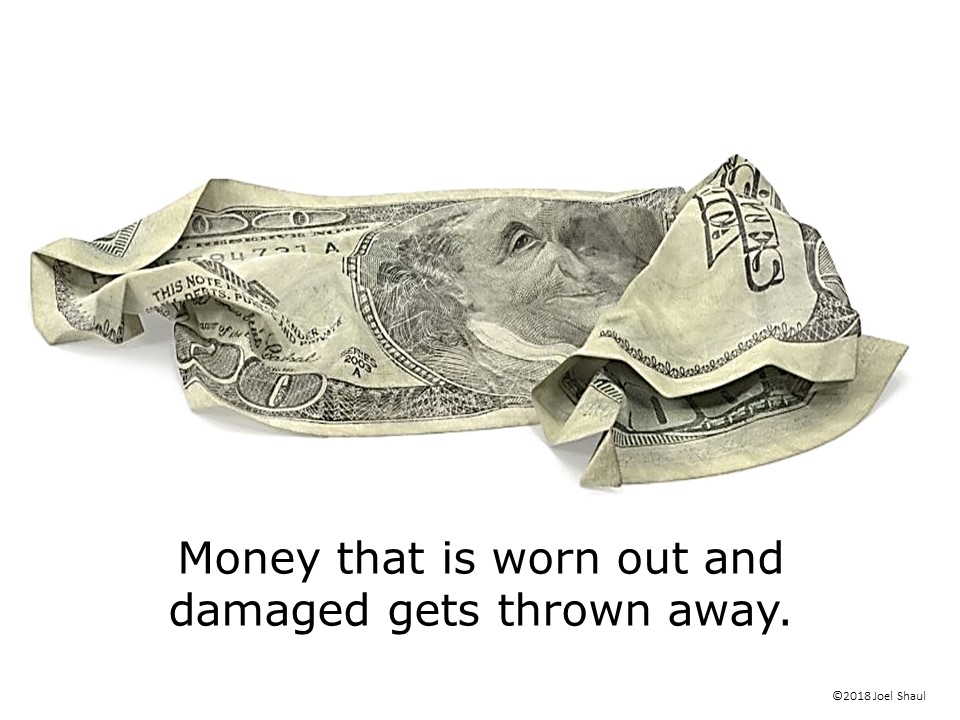
Try using language like this:  “Did you ever wonder where money comes from, and what happens to it when it is no good anymore?  Money comes from a huge printing factory called a “mint.”  All of our money comes from these places called mints.

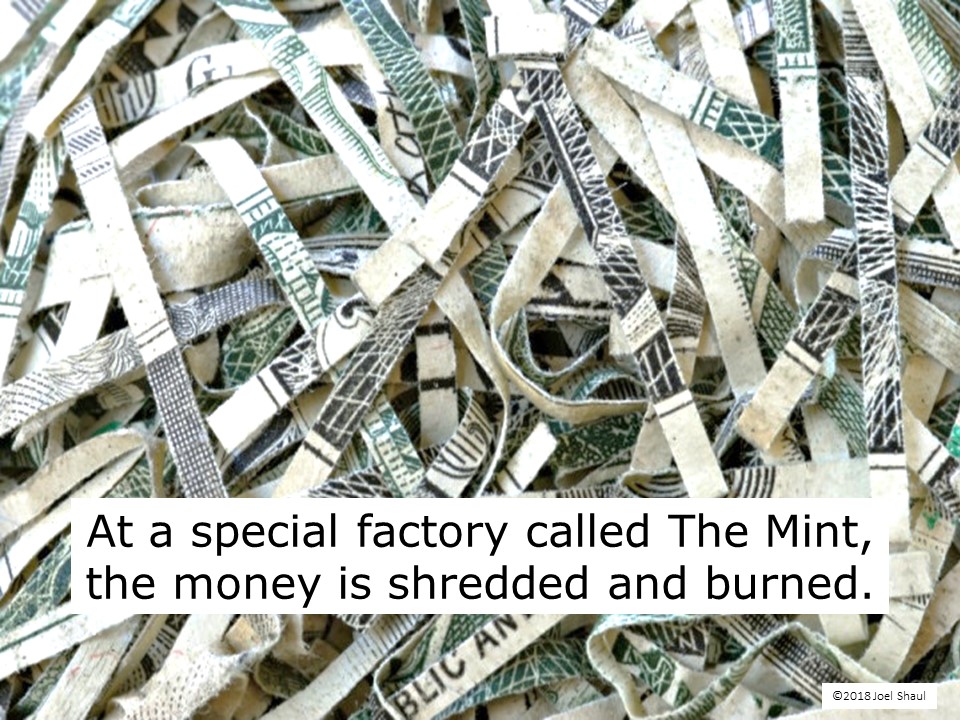
“Often, when the money is not printed right, they have to destroy it.  They use something like the paper shredders you see in an office.  Also, other money gets worn out, and they have to shred that money too.

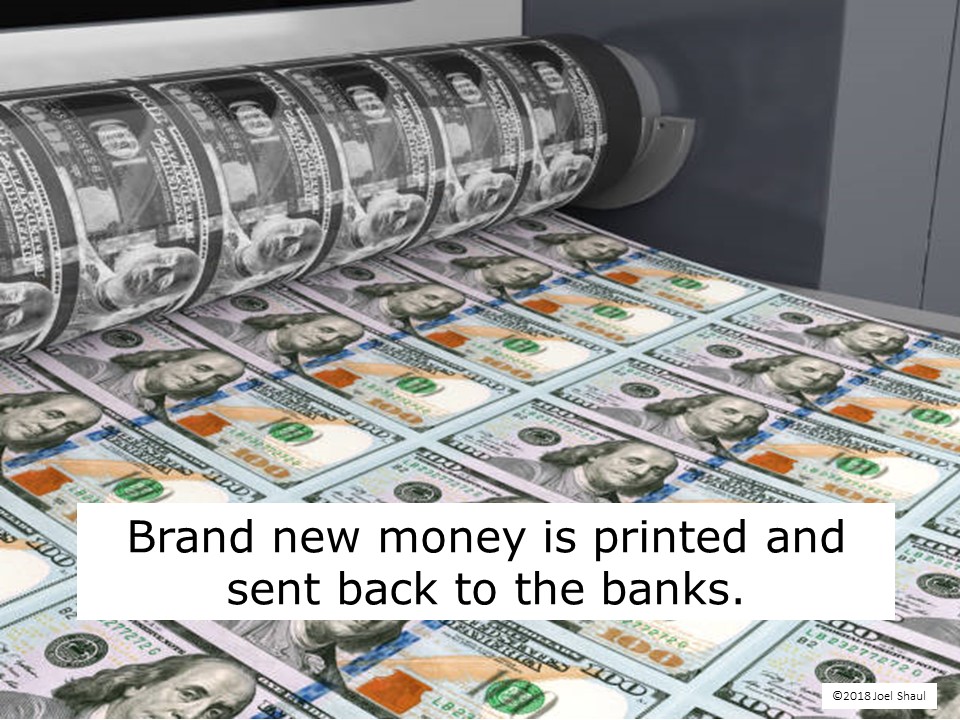
“To replace the destroyed money, the mint prints brand new money.

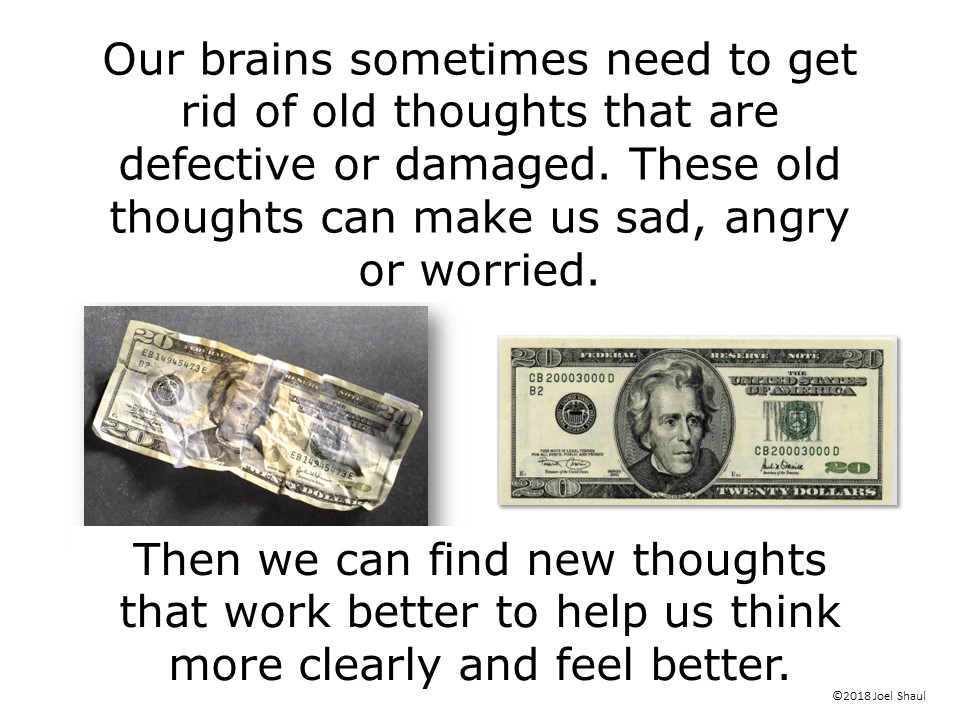
Your mind is something like a mint that makes money, except your mind makes thoughts instead of dollars.  Hundreds of thoughts, thousands of thoughts, every day.  Most of the thoughts are good and helpful to you.  But some kinds of thoughts aren’t good because they just make you upset too much.  When you get these thoughts, they are like bad or worn-out money that needs to be destroyed.  Then, you need new and better thoughts to make you feel good and calm instead of upset.”

  1. Now, show the kids how to fill out the OLD THOUGHT money.  If you have not already introduced the kids to “poison” and “antidote” thoughts, you will want to do this slowly and carefully.  There are lots of other CBT resources available on the website.
  2. Have the kids fill out the NEW THOUGHT money now.  Provide plenty of extra blank money for them to practice.  Tell them that they can use more than one NEW THOUGHT to replace the OLD THOUGHT.
  3. Have the kids run the old money through a paper shredder.  If you have the opportunity to work outside and actually burn them, like on a charcoal grill, this really gets kids’ attention.
  4. If you like, you can laminate the new money now, and with the kids’ permission, display it.


To access a summary of all the CBT materials on this website, click HERE.

Derived from a method described in Cognitive Therapy with Children and Adolescents, ed. By Reinecke, Dattilio and Freeman, 2006, Guilford Press.

Joel Shaul, LCSW

Your comments on these resources are most welcome, and often helpful. Click HERE to send an email.

ASD Feel Better Promo square directing to JKP

The Conversation Train Book

Green Zone Book Cover Click to Learn More