
Children with autism spectrum disorders often suffer quite a lot from being teased and bullied. I have designed some materials to help them to learn some coping skills in this area. This is not intended to serve as an entire curriculum or to function as a classroom’s primary response to the problem of teasing and bullying. Obviously, preventing cruel children from victimizing vulnerable peers on the autism spectrum is the main problem to solve.
The materials I provide here are to help with:
*Increasing repertoire of functional responses to teasing and bullying
*Increasing ability to distinguish “friendly” from “mean” teasing and to distinguish intentional from unintentional harm
*Increasing ability to cope with anger, anxiety, sadness and other emotions associated with being teased and bullied
How to use the six illustrated panels:
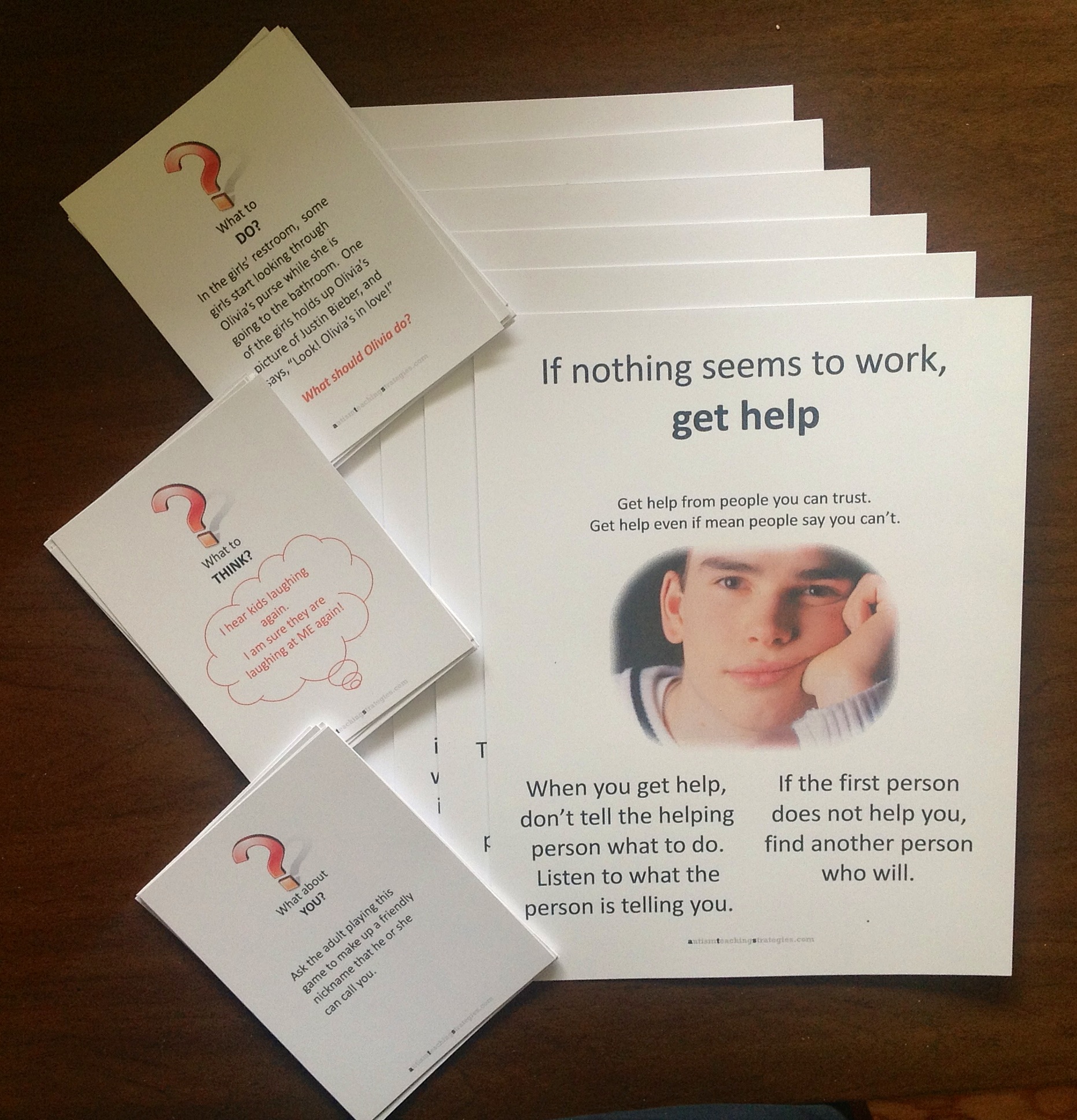
The panels are designed to be used in several different ways. First, they are to be displayed while using the cards to help children know how to respond to the questions and challenges on the cards. Second, you might consider posting them on your wall as a bulletin board if you decide to not use the cards. Finally, you can use them in small groups to hold up one at a time as instructional aids when you are dealing with this topic.
How to use the cards:
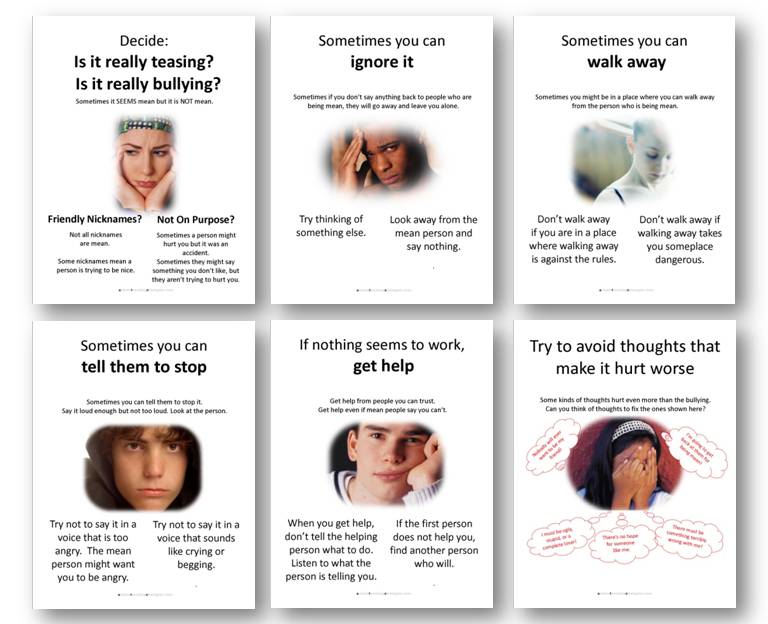
There are three kinds of cards:
1. ” What to do?” cards: These cards describe hypothetical kids in a variety of problem scenarios, and the person drawing the card has to figure out possible solutions. There is often more than one answer.
2. “What about you?” cards: These cards require the person drawing them to carry out a variety of brief learning tasks or to reflect on their own experience with teasing and bullying.
3. “What to think?” cards: Each card contains a thought bubble featuring a particular thought or belief that can increase the harm caused by the unkindness of peers. The task is to try to counter the harmful thought with one or more “antidote thoughts.” (These cognitive behavioral therapy concepts in reference to children with autism are explained in a series of other blog posts with useful downloads.) A good way to use these cards is for you, the adult, to play the role of a child who endorses the thought in the thought bubble. The child(ren) then have to talk you out of this way of thinking.
Options on using the cards:
*You can shuffle up the cards and have kids draw them at random.
*You can keep the cards in three separate piles and have kids draw from one pile or the other based on how they roll a dice.
*You can select and discard cards and distribute the cards within the deck strategically so that the participants will draw cards that help them with their most difficult issues.
*If you don’t wish to use the cards, I invite you nevertheless to borrow the content of the cards in your own therapy/teaching. I tried to cover a lot of issues that affect children with ASD in reference to teasing and bullying.
This social skills topic is going to be really hard work both for your clients with ASD and for you as well. I hope these free social skills materials help. Good luck with it.
Joel Shaul, LCSW
This kit is also available in Polish
If you don’t want to print and cut out all these materials, download the Teasing and Bullying Kit, PowerPoint Version
Your comments on these resources are most welcome, and often helpful. Click HERE to send an email.