Filter the Anger: A hands-on social skills activity to help kids with autism to manage angry verbal outbursts

Filter Blog Images

In social skills training in schools and psychotherapy settings, young people on the autism spectrum often struggle with controlling angry verbal outbursts.  This is a cut-out paper kit that creates a hands-on activity to teach and practice filtering upsetting thoughts and avoiding blurting out things that are frightening or confusing to others.The Filter the Anger Activity is designed to:

* Raise awareness of okay vs. not-okay things to say when you are mad

*Introduce and reinforce the idea that thoughts can be “filtered” before they are turned into words.

To create the materials for this free activity, click on these free download links:

Filter the upsetting thoughts kit

Übung-zum-Filtern-verbaler-Ausbrüche

This kit is also available in Polish.

Filter the upsetting thoughts kit, on-screen version for teletherapy

Sample introduction to this activity:

“When we are upset, we can have many, many upsetting thoughts going through their mind, very quickly.  The thoughts can be so many, and so powerful, that they can “escape” out of your mouth if you are not careful. Your mind has a filter in it, to help us to say the right things, instead of every one of our thoughts to rush out of our mouths.”

(Now describe a filter; depends on knowledge level of participants.  Show them the filter visual)

“There are different kinds of filters.” (have them name some: coffee filter, water filter, oil filter, etc.  If you have a prop to demonstrate a filter now, that is good—try a colander, a coffee filter, etc)

“You can’t see the filter in your brain, but the way it works is kind of the same.  It is especially important to use your brain’s filter when you are upset or angry, so that you say things that are good, and get you help, and so you avoid saying things that frighten, confuse or anger other people.”

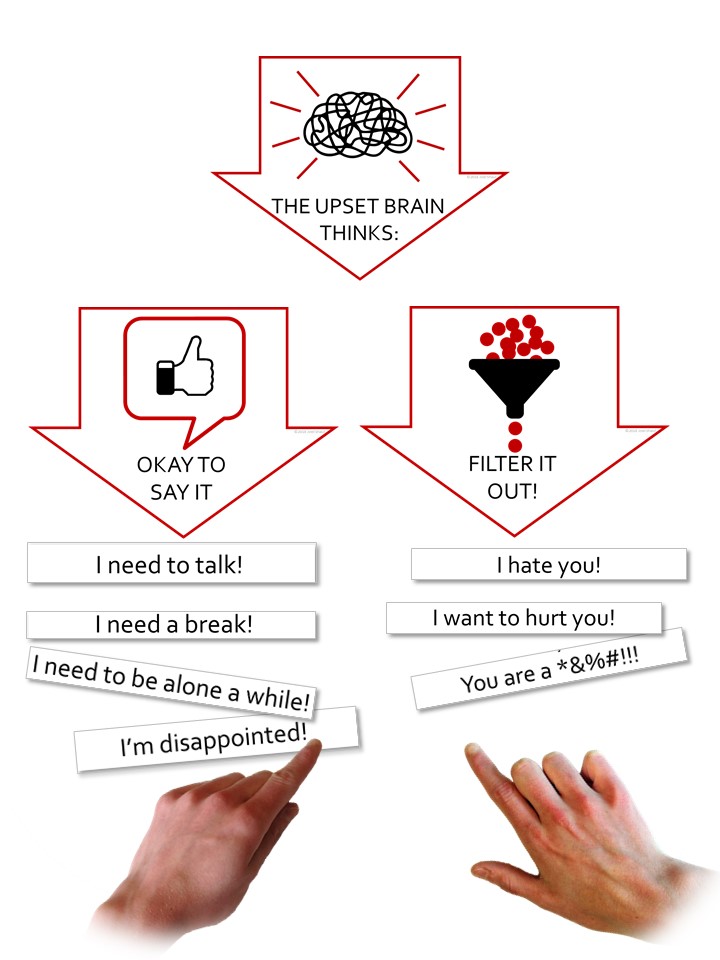
How to use the upset thought strips: On a big table or on the floor, have the participant(s) sort the statements into things that are okay to say, sometimes okay to say, and almost never okay to say.  Use the “Filter These Out” and “You can say these” visuals to help them  with the sorting.

Usually, the child will spontaneously start talking about times they made unfiltered angry statements.  This provides opportunities for learning and adds a visual dimension that is very helpful.

Variations:  You, the adult, can try acting out the role of an upset person who is not succeeding in filtering his words.  Ask the young participants to help you to filter what you say.  Ask them to offer you alternative ways to express your upset feelings.

This is a good teaching/therapy activity for social skills training and anger management for kids autism spectrum disorders.  I hope you find it helpful.

Joel Shaul, LCSW


Here are some related free activities for increasing awareness of social filters, anger management and cause and effect in relationships:

What I should Have Done Different Worksheet

Emotion Thermometers

Customizable Meters for Awareness of Negative Behaviors

Words Hurt/Words Help Worksheets

Pencil / Pen Memories Worksheets

Your comments on these resources are most welcome, and often helpful. Click HERE to send an email.
ASD Feel Better Promo square directing to JKP

 The Conversation Train Book

Green Zone Book Cover Click to Learn More

Game-like elements for teaching social skills to children with Asperger’s and other autism spectrum disorders, Part 1

Teaching social skills to children with autism spectrum disorders can be much more effective when it is engaging and fun.  By the time children with autism ends up in our classrooms  or psychotherapy offices, they are often feeling pretty weary and discouraged with their problems.  If we don’t introduce some elements of levity, we may lose their attention altogether.

Here are some tips for making your social skills training engaging and “game-like.” Much of this is summarized in this Youtube video, check it out: http://bit.ly/x9TvvO

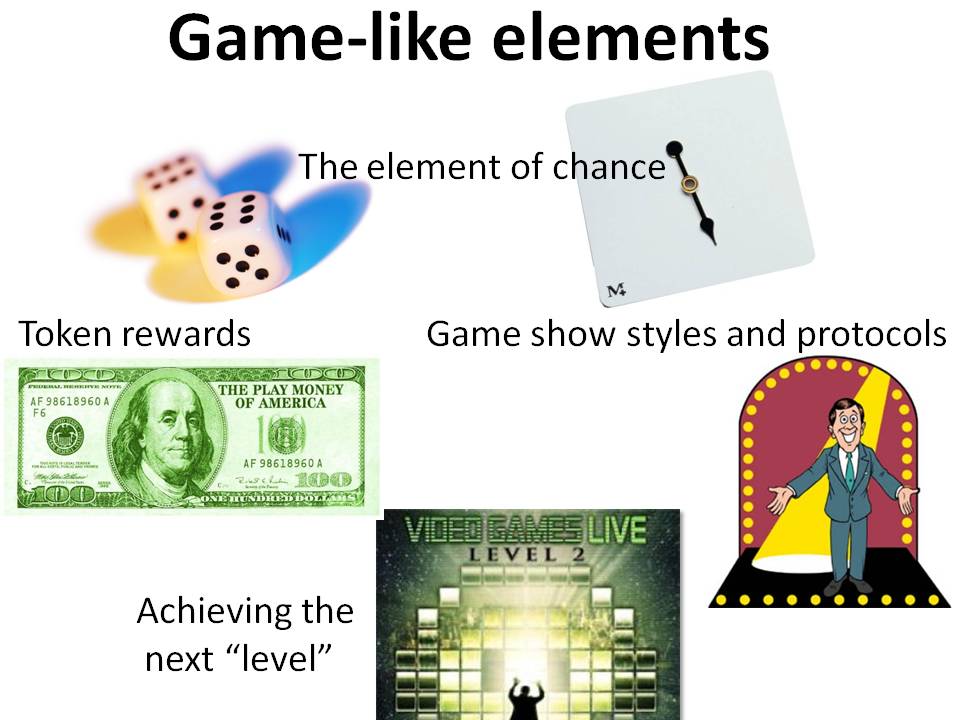
Use the element of chance to make your social skills teaching seem like a social skills game
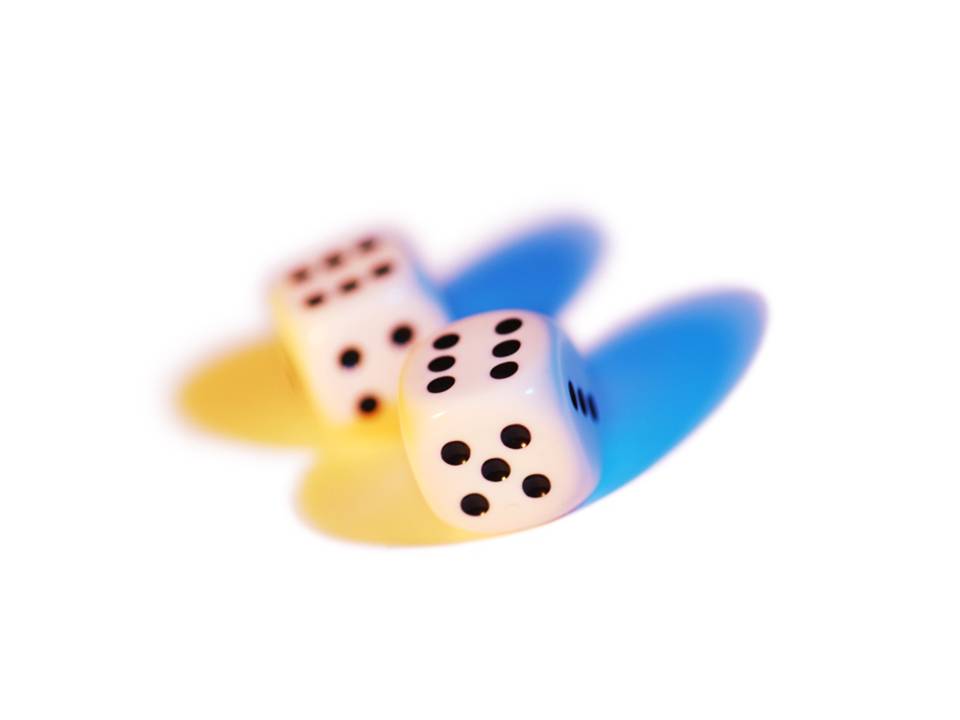
  1. Introduce the element of chance. A simple way to do this is to use some dice, or a blank spinner (available from teacher supply stores).

Here is an example:  “Kids, we are going to play the compliment game today.  A compliment is when you say something nice to someone about  how they look, or about what they do, or about how they are.  When it is your turn, if you roll a one or two with the dice, you have to give someone a compliment here about how they look.  If you roll a three or a four, give a compliment to someone about what they are doing.  If you roll a five or a six, give a compliment to someone about how they are (nice, funny, smart, fast, clever, etc.)”

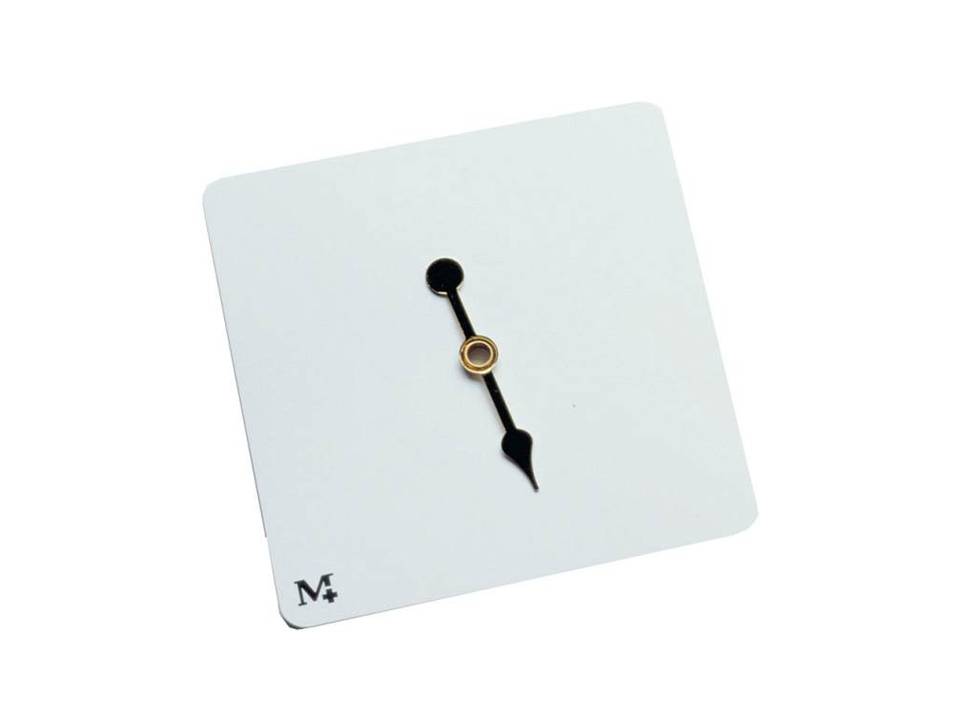
Customize a blank spinner to create social skills games for students/clients on the autism spectrum

social skills learning autism

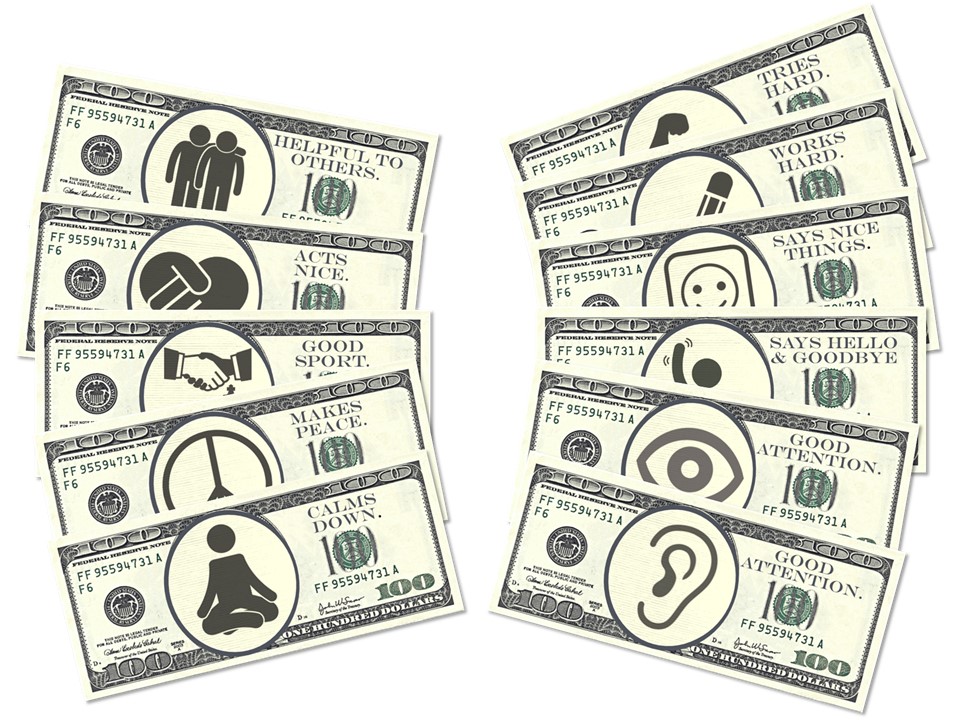
You can download this cool play money that I made! Click here.

2.  Use tokens or scoring systems. These fall into two categories.  The first kind of scoring system is to give out token objects (play money, marbles, etc.).  These you have the kids keep in cups so they are not overly distracted by them.  The second scoring system is to create a score board.  Simply write the names of the children on a dry erase board, and add a hatch mark next to their names each time they score. (This is the preferred system if your kids on the autism spectrum get distracted by wanting to touch and handle the token items.)

Use “levels” to add interest to social skills lessons and social skills training

3.  Use achievement levels. Most kids on the autism spectrum play a lot of video games.  Video games are usually all about “levels” and getting from one level to the next.  Here is an example of how to incorporate this into an activity teaching compliments: “Kids, there are three levels of giving compliments.  We are going to play a compliment game.  Who will get to level three?  Level one is easy.  You say something nice about how someone looks.  Level two is harder.  You have to say something nice about the thing the person is doing.  Level three is the top level.  You have to know the person well enough to know their special inside qualities, like “Generous,” “Smart,” or “Helpful.”

Create a “game show” to turn the social skills lesson into a social skills game

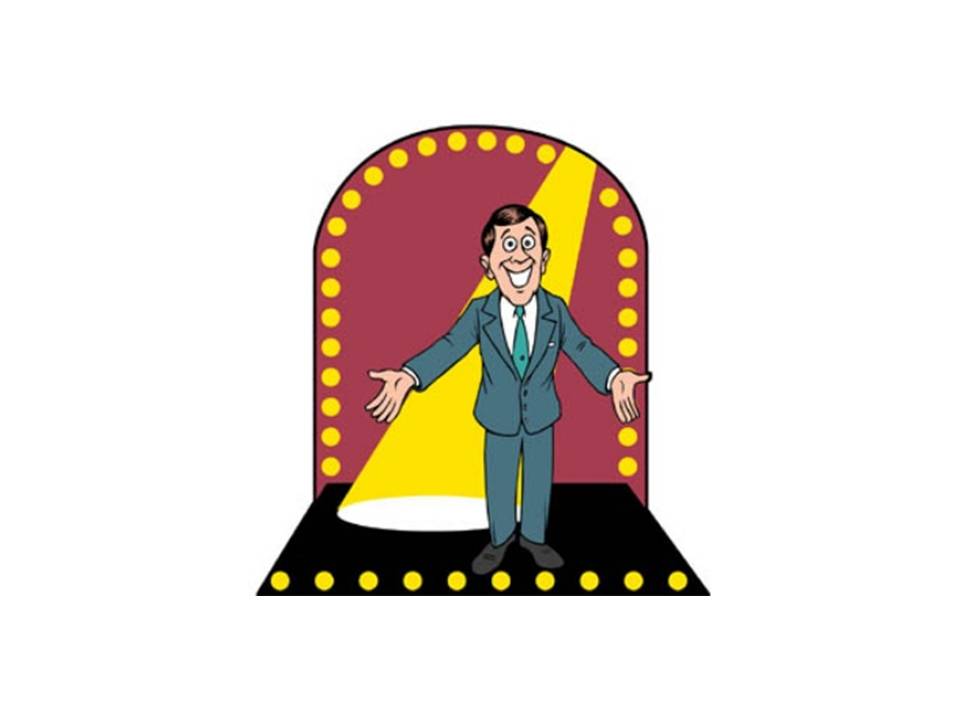
4. Build in Game-show elements. Children with autism spectrum disorders seem to appreciate it when their counselor or teacher is willing to pretend to be a game show host.  Copy and print out the picture of the game show guy shown in the picture above, and stick it on the wall.  If you want to get fancy,  play game show music. Here is a link to Jeopardy music sound clip: http://www.youtube.com/watch?v=vXGhvoekY44 Then,  abandon your professional decorum , and say something like this: “Kids, welcome to the Elmhurst School Game Show.  I am your host, Ms. Apple.  Today, we are going to test people’s ability to give compliments.  Please welcome our first contestant, Tiffany.  Tiffany, come on down!”

I wish you good luck with introducing levity and game-like qualities to your social skills training for kids on the autism spectrum.

Joel Shaul, LCSW

Your comments on these resources are most welcome, and often helpful. Click HERE to send an email.
Welcome to Autism Teaching Strategies

I’m glad you found this website and blog.

I love learning about social skills training for young people with autism, and sharing ideas with other professionals who do similar work.  In this blog, I will be passing on some of what I have learned.

In this blog, I share lots of ideas on how to help young people on the autism spectrum with communication, relationship skills and regulation of emotion.  I offer dozens of resources for that you can download for free.  Some are are also available here in German, Spanish and French and most are available in Polish.

Come back often.  Let’s interact. Take away a few ideas, and leave a few of your own if you like.

Joel Shaul, LCSW

_________________________________

The Conversation Train Book

 Green Zone Book Cover Click to Learn More